Showing posts with label missile test. Show all posts

Friday, 17 September 2021

An upcoming Trident-II D5 SLBM test in the Atlantic

click map to enlarge

A few days ago a Navigational Warning (NAVAREA IV 838/21, also issued as HYDROLANT 2336/21) appeared which points to an upcoming Trident-II D5 SLBM (Submarine-Launched Ballistic Missile) test from a US or Royal Navy SSBN on the Atlantic Eastern Missile Range between 12:30 UT on September 17, and 1:23 UT on Sept 20. The distance between the launch area and MIRV target area is about 9900 km.

This is the text of the Navigational Warning (the map in top of this post shows them mapped, along with a simple ballistic trajectory):

151459Z SEP 21
NAVAREA IV 838/21(11,24,26).
ATLANTIC OCEAN.
FLORIDA.
1. HAZARDOUS OPERATIONS 171230Z THRU 200123Z SEP
   IN AREAS BOUND BY:
   A. 28-56N 079-59W, 29-02N 079-53W,
      29-06N 079-37W, 28-59N 079-10W,
      28-37N 079-10W, 28-36N 079-35W,
      28-45N 079-56W.             
   B. 28-24N 076-44W, 28-42N 076-42W,
      28-21N 074-40W, 28-06N 074-44W.
   C. 27-27N 071-21W, 27-52N 071-15W,
      27-25N 068-46W, 26-54N 068-54W.
   D. 17-22N 044-54W, 18-33N 044-32W,
      16-54N 040-55W, 16-00N 041-23W.
   E. 09-00S 003-51W, 08-22S 003-22W,
      12-35S 002-40E, 13-05S 002-19E,
      11-56S 000-16E, 12-09S 000-16W,
      11-34S 000-20W.
2. CANCEL THIS MSG 200223Z SEP 21.

The launch area (area A) is one of two launch areas used for these kind of tests in the Atlantic (see an earlier post from 2019 analyzing several of these launches). It is the variant closest to the Florida coast, one which I suspect is used when the launch has an 'audience' of officials.

The area is close enough to the Florida coast that Florida east coast residents might see the launch, as has previously happened.

The target area is the regular target area in the southern Atlantic some 1000 km out of the coast of Angola.

Areas B, C and D are where the first, second and third stage splash down.


The location of the hazard areas does not match a simple ballistic trajectory well (such a trajectory is indicated by the line in the map in the top of this post), which might point to some mid-flight manoeuvering of the MIRV-bus.

The test launch is probably a DASO ("Demonstration and Shakedown Operation"), done to recertify the readiness of the submarine and its crew after major overhauls. One candidate submarine for this test launch is the Ohio-class SSBN USS Tennessee (SSBN 734) which reportedly completed a major overhaul at Kings Bay on July 1. [EDIT 18 sept 2021 15:45 UT: it actually was USS Wyoming, which fired two Trident missiles as part of the test]


UPDATE 18 Sep 2021 15:45 UT

The US Navy has announced that as part of DASO-31, the Ohio-class SSBN-742 USS Wyoming has fired two Trident missiles on September 17th.

image: US Navy/David Holmes
image US Navy/David Holmes


Thursday, 8 July 2021

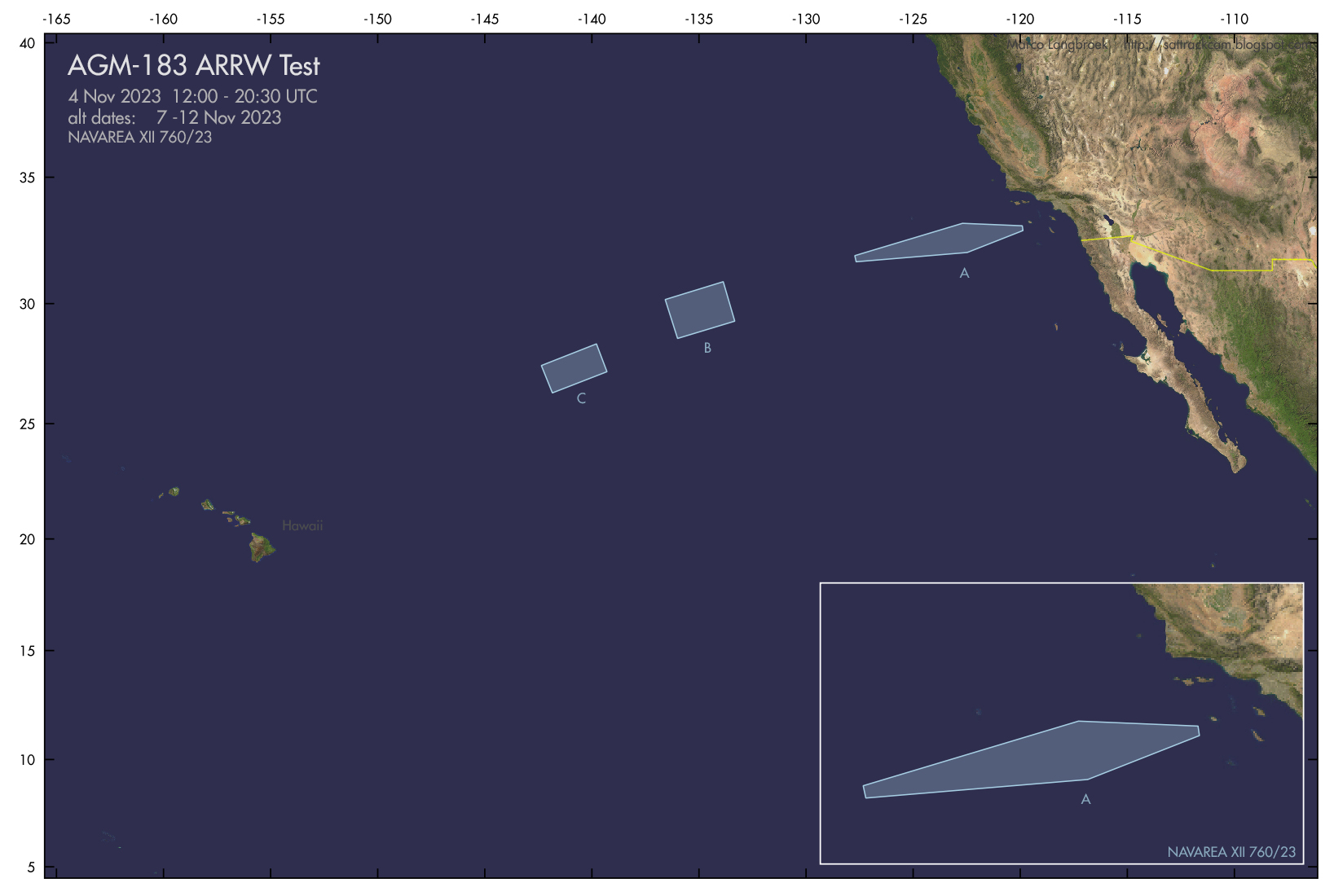
A possible missile test (AGM-183 ARRW, or not?) in the Pacific on July 10


Three related Navigational Warnings have appeared (NAVAREA XII  nr 304, 305 and 306) that together seem to define the trajectory of a missile test in the Pacific on July 10 between 9:00 and 18:00 UT, with a backup date on July 13:

 060344Z JUL 21
 NAVAREA XII 304/21(18).
 EASTERN NORTH PACIFIC.
 CALIFORNIA.
 1. HAZARDOUS OPERATIONS 100900Z TO 101800Z JUL,
    ALTERNATE 130900Z TO 131800Z JUL
    IN AREA BOUND BY
    33-08-45N 121-27-34W, 33-27-41N 121-29-48W,
    33-33-57N 120-11-14W, 33-14-46N 120-09-15W.
 2. THIS MSG 131900Z JUL 21.


 060353Z JUL 21
 NAVAREA XII 305/21(18).
 EASTERN NORTH PACIFIC.
 1. HAZARDOUS OPERATIONS 100900Z TO 101800Z JUL,
    ALTERNATE 130900Z TO 131800Z JUL
    IN AREA BOUND BY
    32-32-16N 129-10-43W, 32-08-05N 131-47-11W,
    31-53-04N 131-45-39W, 32-17-48N 129-09-11W.
 2. CANCEL THIS MSG 131900Z JUL 21.


 060445Z JUL 21
 NAVAREA XII 306/21(19).
 EASTERN NORTH PACIFIC.
 1. HAZARDOUS OPERATIONS 100900Z TOP 101800Z JUL,
    ALTERNATE 130900Z TO 131800Z JUL
    IN AREA BOUND BY
    31-13-21N 136-21-34W, 31-04-36N 137-16-57W,
    30-49-37N 137-15-27W, 31-01-22N 136-20-03W.
 2. CANCEL THIS MSG 131900Z JUL 21.

Below I have plotted the areas from these three Navigational Warnings on a map:

click map to enlarge

The three areas seem to define a ballistic trajectory for a missile fired, either from a ship, submarine or aircraft, in the Point Mugu Sea Range near the Channel Islands of California, in the general direction of (but maybe not as far as) Hawaii. The distance between the easternmost and westernmost area from the Navigational Warnings is about 1600 km. The distance to Hawaii is about 3950 km.

The question is whether the apparent line-up with the Pacific Missile Range Facility at Hawaii (for which there is a perpetual Navigational Warning) is coincidence or not (the map below shows a simple ballistic trajectory from the esternmost area in the Point Mugu Sea Range to Hawaii PMRF: the three areas and PMRF line up well):

click map to enlarge

If the line-up with Hawaii is coincidence, i.e. if we ignore a possible target area near Hawaii, then one option is that this is a flight test of the AGM-183A ARRW (Air-launched Rapid Response Weapon), a hypersonic missile launched from a B-52 aircraft. Little is known about the range of this new missile, and estimates differ: from 925 km to a quoted "almost 1000 miles". 

The latter is somewhat similar to the ~1600 km range between the easternmost area (NAVAREA XII 304) and westernmost area (NAVAREA XII 306) from the current Navigational Warnings. However, the similarity between "925 km" and "almost 1000" also makes me wonder whether kilometer and miles were mixed up in the latter statement. 1600 km equals 994 statute miles, or 863 nautical miles. 

Early June 2021, a test firing of AGM-183A was announced to probably take place this month (July 2021), which is one reason to suspect a connection of these Navigational Warnings to AGM-183.

If these Navigational Warnings indeed do refer the announced July AGM-183 test, then area 304 is where the missile is fired (from an airborne B-52), area 305 where the booster stage splashes down, and area 306 likely the missile target area.

The last (failed) test attempt of AGM-183A was in April, according to sources. It failed because the missile refused to separate from the aircraft.

The areas from the three July 10 Navigational Warnings are 100% identical those those of three earlier Navigational Warnings issued for May 17 (which I at that time, mistakenly probably, thought might be an SLBM test): Navigational Warnings NAVAREA XII nr 210, 211 and 212:


So either there was an aborted/failed test attempt in May as well, or these warnings (both the current and those for May 17) do not refer to AGM-183A.

The AGM-183A ARRW is a hypersonic missile fired from a B-52 aircraft. A rocket stage initially propels it and brings it to high altitude at the edge of space (i.e. not as high as an ICBM which truly enters space), after which it glides down and attains hypersonic speeds up to 6.86 km/s. It is still in its experimental phase with, as far as known, no successful test flight yet.


AGM-183 under the wing of a B-52 during a Captive Carry test. Image: US DoD (Giancarlo Casem)


EDIT: just after I hit the "publish" button Hans Kristensen alerted me to the arrival of an Ohio-class Nuclear Missile submarine in San Diego at July 7th. So, maybe an SLBM test after all (but not a standard Trident-II D5 test then, as the positions of the drop zones do not match with earlier Trident tests).


UPDATE 11 July 2021:

This Navigational Warning cancelling warnings NAVAREA XII 304, 305 and 306 just appeared, the wording of which ("operations completed") suggests that something did take place:

101832Z JUL 21
NAVAREA XII 314/21(18).
EASTERN NORTH PACIFIC.
CALIFORNIA.
CANCEL NAVAREA XII 304/21, 305/21, 306/21
AND THIS MSG, OPERATIONS COMPLETED.

Thursday, 17 June 2021

An intriguing apparent Missile Defense (?) test from Kodiak and Kwajalein [UPDATED: hypersonic, not Missile Defense]


click map to enlarge

Update 22 Oct 2021: this turns out to have been Navigational Warnings for a test with a Hypersonic glider weapon, not Missile Defense. See update at bottom of the post.


A Navigational Warning issued on June 16 seems to point to a possible Missile Defense test on June 21, with missile launches from Kodiak Island in Alaska (the Pacific Space Port Complex) and the Kwajalein Test Range in the Marshall islands.

Below is the text of the Navigational Warning in question, NAVAREA XII 271/21, defining four areas A to D. I have mapped the areas in the map in top of this post, with one of several possible interpretations (in this interpretation, an interceptor is launched from Kwajalein to intercept an ICBM launched from Kodiak. The flight distance involved for the interceptor in this scenario does not sit well with me though).

160922Z JUN 21
NAVAREA XII 271/21(16,19,81).
GULF OF ALASKA. 
NORTH PACIFIC.
ALASKA. 
1. HAZARDOUS OPERATIONS, ROCKET LAUNCHING 
   210830Z TO 211430Z JUN, ALTERNATE 
   0830Z TO 1430Z DAILY 22 THRU 25 JUN 
   IN AREAS BOUND BY:
   A. 57-29N 152-20W, 57-20N 152-11W, 
      56-39N 153-28W, 56-41N 153-33W,
      57-11N 152-47W, 57-16N 152-43W,
      57-19N 152-38W, 57-21N 152-38W,
   B. 51-08N 160-22W, 50-58N 159-50W,
      51-01N 159-26W, 51-17N 158-58W,
      51-42N 158-35W, 52-29N 158-16W,
      52-32N 158-24W, 51-51N 159-35W,
      51-23N 160-14W.
   C. 33-50N 171-41W, 33-44N 171-27W,
      36-52N 169-25W, 38-40N 168-15W,
      39-58N 167-47W, 40-02N 167-59W,
      39-15N 168-39W, 38-27N 169-18W,
      37-05N 170-02W.
   D. 12-45N 172-48E, 08-11N 166-38E, 
      08-56N 166-01E, 13-34N 172-11E.
2. CANCEL THIS MSG 251530Z JUN 21.

There is an additional Navigational Warning, NAVAREA XII 270/21, defining several areas west of Hawaii for several dates around the possible test, in the general area where the launch trajectories from Kodiak and Kwajalein seem to meet. One of the dates issued (nr 2, highlighted in red) has a time window that, while not similar, does overlap with the time window of warning NAVAREA XII 271/21:

150910Z JUN 21
NAVAREA XII 270/21(19).
NORTH PACIFIC. 
1. HAZARDOUS OPERATIONS 192100Z TO 201000Z JUN 
   IN AREA BOUND BY 
   22-42.0N 172-13.0W, 22-28.2N 171-01.3W, 
   21-08.4N 171-20.8W, 21-22.0N 172-35.0W.
2. HAZARDOUS OPERATIONS 202100Z TO 211000Z JUN 
   IN AREAS BOUND BY:
   A. 30-37.0N 169-02.0W, 30-13.0N 167-20.0W, 
      29-07.0N 167-41.0W, 29-24.0N 169-04.0W.
   B. 24-05.0N 171-50.0W, 23-50.7N 170-36.7W, 
      22-28.2N 171-01.3W, 22-42.1N 172-13.0W.
   C. 23-06.0N 178-55.0W, 23-06.0N 175-15.0W, 
      21-40.0N 175-15.0W, 21-40.0N 178-55.0W.
   D. 22-00.0N 167-58.0W, 22-00.0N 166-36.0W, 
      20-19.0N 166-36.0W, 20-19.0N 167-58.0W.
3. HAZARDOUS OPERATIONS 212100Z TO 221000Z JUN 
   IN AREAS BOUND BY: 
   A. 29-10.0N 169-54.0W, 28-25.0N 167-54.0W, 
      27-28.0N 168-11.0W, 28-06.0N 170-23.0W.
   B. 23-50.7N 170-36.7W, 23-37.0N 169-28.0W, 
      22-14.8N 169-48.4W, 22-28.2N 171-01.3W.
   C. 23-06.0N 178-55.0W, 23-06.0N 175-15.0W, 
      21-40.0N 175-15.0W, 21-40.0N 178-55.0W.
   D. 22-00.0N 167-58.0W, 22-00.0N 166-36.0W, 
      20-19.0N 166-36.0W, 20-19.0N 167-58.0W.
4. HAZARDOUS OPERATIONS 222100Z TO 231000Z JUN 
   IN AREAS BOUND BY: 
   A. 28-06.0N 170-12.0W, 27-28.0N 168-11.0W, 
      26-30.0N 168-27.0W, 27-00.0N 170-30.0W.
   B. 22-28.2N 171-01.3W, 22-14.8N 169-48.4W, 
      20-55.0N 170-08.0W, 21-08.4N 171-20.8W.
   C. 20-19.0N 170-20.0W, 20-29.0N 168-01.0W, 
      18-01.0N 168-01.0W, 18-01.0N 170-20.0W.
5. HAZARDOUS OPERATIONS 232100Z TO 241000Z JUN 
   IN AREA BOUND BY 
   20-19.0N 170-20.0W, 20-29.0N 168-01.0W, 
   18-01.0N 168-01.0W, 18-01.0N 170-20.0W.
6. CANCEL THIS MSG 241100Z JUN 21.


It is not clear whether these Navigational Warnings really are related to the Navigational Warnings from NAVAREA XII 271/21. They might be, or might not be. If they are, this might be one of several possible interpretations, pointing to a multiple target intercept where both a missile fired from Kodiak and a missile fired from Kwajalein are to be intercepted:

click map to enlarge

When I presented the evidence for a possible 21 June Missile Defense test on twitter, there were some suggestions that this might be the planned test FTT-21

However, what is known of that planned FTT-21 test suggests the target(s) for that test should be SRBM, i.e. a missile with a range of no more than 1000 km. Which is at odds with what seems to be indicated by the Navigational Warnings, with the missile fired from Kodiak  apparently flying at least 6000 km (assuming areas A to C, blue in the map, define the trajectory of one and the same missile) and the Kwajalein missile at least 1800 km if it is to intercept the Kodiak missile or if it is to be intercepted from area B of the second Navigational Warning (the red area A in the map above). That would be ICBM and IRBM targets, not SRBM targets.

In other words: it is not clear what is going on here, which makes this an interesting issue. 


UPDATE 22 Oct 2021: Not Missile Defense, but Hypersonic glider test 

A very similar set of Navigational Warnings (NAVAREA XII 598/21 and HYDROPAC 2936/21) appeared for October 19-29 2021 (see map below), which I initially too interpreted as a possible Missile Defense test, noting it was 100% similar to the June Navigational Warnings discussed earlier in this blogpost.

However, as Joseph Trevithick reports in The Drive, the test (which happened on October 21) was in reality a test with a long distance hypersonic glider weapon: that failed, reportedly because the booster stack launching the hypersonic glider failed.

So a good thing I used a question mark in the title of this post, and included caveats about the interpretations.

The interesting 'dogleg' in the trajectory is in fact representing a change of course of the glider, and there is no missile launched from Kwajalein: that is the target area of the glider instead.

Here is the map with the Navigational Warnings for October, which is as you can see 100% similar to that for June:

click map to enlarge

It is not clear whether the test for which the June Navigational Warnings were issued happened (and if so whether it was successful or not), or was postponed.

Sunday, 25 April 2021

An upcoming French ICBM/SLBM test [UPDATED TWICE]

click map to enlarge

UPDATE (see end of post for more info): the test happened and it was an M51 SLBM

Navigational Warnings HYDROLANT 1140/21 and NAVAREA IV 337/21 which appeared today suggest that France will be test-firing some sort of ICBM or SLBM over the northern Atlantic between April 28 and May 21. 

As indicated by the position of area A, the launch will be from from DGA Essais de Missiles, a missile base of the French Military on the coast of the Gulf of Biscaye, some 70 km southwest of Bordeaux. The target area appears to be north of  Bermuda, some 5500 km from the launch site.

250005Z APR 21
HYDROLANT 1140/21(and NAVAREA IV 337/21)
NORTH ATLANTIC.
BAY OF BISCAY.
FRANCE. 
1. MISSILE OPERATIONS 0001Z TO 1000Z DAILY
   28 APR THRU 21 MAY IN AREAS BOUND BY:
   A. 45-30.00N 006-39.00W, 44-35.00N 001-28.00W,
      44-26.00N 001-16.00W, 44-18.00N 001-17.00W,
      44-14.00N 001-36.00W, 45-08.00N 006-45.00W.
   B. 47-33.00N 019-01.00W, 47-21.00N 015-35.00W,
      45-29.00N 015-33.00W, 45-41.00N 019-12.00W.
   C. 35-50.00N 070-08.00W, 35-50.00N 063-38.00W,
      34-15.00N 063-38.00W, 34-15.00N 070-08.00W.
   D. 46-38.12N 039-31.05W, 45-37.02N 039-15.53W,
      45-53.52N 036-47.10W, 46-54.92N 036-59.92W.
2. CANCEL HYDROLANT 1124/21.
3. CANCEL THIS MSG 211100Z MAY 21.

I have mapped  the four hazard areas from the Navigational Warning in the map in top of this post. Areas A, B and D are along a simple ballistic trajectory. Area C, the target area north of Bermuda, is not (as can be clearly seen), so either the post-boost vehicle or the dummy MIRV's fired from it will take a different course at some point. 

Note that the dog-leg which I have drawn in the map is very hypothetical and not very realistic: its purpose just is to show that the target area deviates from the initial missile trajectory. [added note: it is much more likely that the trajectory changed is effected much earlier in the  sequence]

Depending on the time of, and weather conditions during, this test launch, it might generate some UFO reports from the southwest French and northern Spanish coast.

As far as I am aware of, the French only have SLBM's in operational service at this moment. Their landbased ICBM's were mothballed in 1996. 

So the launch might be a (land-based) launch of an M51 SLBM. The ground range and size of the areas A,B and D with respect to to the launch site are similar to those of another recent French SLBM test, fired from a submarine in front of the Breton coast on June 12, 2020 (I wrote about that test here).

Click to enlarge

UDATE 1: 

I spoke with Joseph Trevithick for this article in The Drive which also has insights from several other experts.

What I did not know, but learned from the article, is that the DGA Essais de Missiles has a pool with a submerged launch platform, so they can simulate SLBM launches from a submarine. So if it is another M51 test, this makes the choice of the launch site less odd.

Here is some footage from an earlier SLBM test from this submerged platform at DGA Essais de Missiles:


UPDATE 2
(28 April 2021)

The French Ministry of Defense has announced that a successful test with an M51 SLBM was indeed conducted from DGA Essais de Missiles in the morning of 28 April. Bulletin (in French) here.

In the hours around the test, French and US military monitoring planes were in the air near the target area north of Bermuda:


The twitter account of the French Direction générale de l'armement published this video of the launch:


The image below, which is from the bulletin put out by the French Ministry of Defense, may or may not show the actual missile fired:


Monday, 8 February 2021

A possible (now CONFIRMED) Trident-II SLBM test launch between February 9 and 14, 2021 [UPDATED]

click map to enlarge

A Navigational Warning, NAVAREA IV 117/21, appeared yesterday, and is suggestive of an upcoming Trident-II SLBM test in the Atlantic. I have posted on such test launches before.

This is the text of the Navigational Warning:

 071431Z FEB 21
 NAVAREA IV 117/21(GEN).
 ATLANTIC OCEAN.

 1. HAZARDOUS OPERATIONS, ROCKET LAUNCHING
    091340Z TO 140226Z FEB IN AREAS BOUND BY:
    A. 28-56N 76-17W, 28-56N 75-34W,
       28-36N 75-34W, 28-43N 76-17W.
    B. 28-02N 73-18W, 28-17N 73-13W,
       27-47N 71-11W, 27-34N 71-17W,
       27-44N 72-10W.
    C. 26-25N 67-23W, 26-47N 67-10W,
       25-44N 63-47W, 25-06N 63-57W,
       25-32N 65-52W.
    D. 17-10N 45-30W, 17-37N 45-11W,
       16-53N 43-06W, 15-23N 41-22W,
       14-46N 41-42W, 16-11N 44-26W.
    E. 06-00S 09-39W, 05-13S 09-08W,
       06-37S 06-56W, 07-17S 07-22W,
       06-55S 07-57W, 07-00S 08-05W.
 2. CANCEL THIS MSG 140326Z FEB 21.


The map in top of this post shows the hazard areas A to E from this Navigational Warning plotted, and a fitted ballistic trajectory. Together they define what strongly looks like a Trident-II Submarine Launched Ballistic Missile (SLBM) trajectory

Area 'A' is the launch area where the submarine is located; areas 'B', 'C' and 'D' is where respectively the first, second and third stages of the missile splash down; area 'E' is the target area of the warhead(s).

The indicated range, from the distance between area's A and E, is about 8400 km. That is somewhat shorter than most earlier Trident-II tests in the Atlantic.

Earlier tests in the Atlantic typically had a range near  9800 km, in one case even 10 600 km (see my overview here). So this test falls short from a  typical test by about 1500 km. 

An earlier clearly shorter range was however indicated for the infamous June 2016 Royal British Navy Trident-II test, which would have had a 8900 km range with a target area west of Ascension Island if it had not failed. The range of the upcoming February 2021 test is 500 km shorter than that of this June 2016 test, with a target area slightly more north and the launch area further out of the Florida coast. 

The launch area is nevertheless a familiar one: one of two areas regularly used for Atlantic Trident test launches

It is the same as that for the 10 Sep 2013, March 2016 and June 2018 Trident tests. It is the area labelled 'launch area B' in the map below, which plots the launch areas of several previous Trident tests. The figure comes from this previous post and is discussed there (including a suggestion for why there might be two distinct launch areas).

click map to enlarge
 

The target area near Ascension Island and shorter range might perhaps indicate that this will be a British Royal Navy test with the SLBM launched from a Vanguard-class submarine rather than a US Navy test, but this is by no means certain. It could also mean a US Navy test with new hardware, e.g. a more heavy dummy warhead or a new stage engine.

US Navy tests are usually acknowledged after the test, so it will be interesting to see whether such an acknowledgement will appear from either the US or British Navy.


UPDATE  10 Feb 2021 10:50 UT

Overnight, images and footage have appeared from Florida and Bahama residents that show an exhaust plume, indicating that the test indeed took place, near 23:30 UT on Feb 9. These are a few of them:


The imagery shows the sun-illuminated exhaust plume of the missile. The missile itself is in space by that time, ascending towards its ~1200-1800 km apogee.

I did a quick calculation: for a launch at 23:30 UT on 9 February 2021, the missile (and its expanding exhaust plume) should break into sunlight about a minute after launch once above ~147 km altitude. I have indicated the sunlit part of the trajectory in the map below in yellow. This means that the exhaust plume on the imagery is from either the second or third stage of the missile.

click map to enlarge

UPDATE 16 Feb 2021:

The Drive reports that the US Navy has now confirmed that this was a Trident test. The name of the submarine from which the missile was launched has not been released.

Sunday, 15 November 2020

SM-3 Block IIA Missile Defense test FTM-44 against an ICBM-class target imminent, 17-19 November 2020 [UPDATED]

Click to enlarge. Image: MDA

Three days ago, on 12 November 2020, a Navigational Warning appeared that denoted three hazard zones in the northern Pacific for the period 17 to 19 November, connected to what clearly is some kind of missile test:


121041Z NOV 20
NAVAREA XII 509/20(GEN).
EASTERN NORTH PACIFIC.
NORTH PACIFIC.  
1. HAZARDOUS OPERATIONS 170400Z TO 171000Z NOV, 
   ALTERNATE 0400Z TO 1000Z DAILY 18 AND 19 NOV 
   IN AREAS BOUND BY:
   A. 09-12N 167-43E, 09-01N 167-40E, 
      08-58N 167-43E, 08-58N 167-48W, 
      09-00N 167-59W, 09-30N 168-18E, 
      09-43N 168-04E. 
   B. 11-22N 170-00E, 11-08N 170-10E, 
      11-44N 173-34E, 13-13N 176-53E, 
      15-39N 178-17E, 18-07N 179-23E, 
      18-48N 177-48E, 17-13N 174-19E,
      16-18N 173-08E, 13-08N 171-00E. 
   C. 44-06N 133-00W, 35-00N 131-00W, 
      28-30N 143-30W, 44-06N 140-30W. 
2. CANCEL THIS MSG 191100Z NOV 20.


I have plotted the three area's  in the map below. Note that there appears to be a clerical error in the Navigational Warning for two of the positions defining area A: those reading "W" should probably read "E", which results in a hazard area which makes much more sense (in the map below, the original, probably erroneous, shape for area A is depicted in red: what was likely meant in white).

(note added 17 Nov: an update to this Navigational Warning issued as HYDROPAC 3337/20 confirms the clerical error)

click map to enlarge

The location of the areas lead me to believe it points to a Missile Defense test: an attempt to intercept a dummy Ballistic Missile launched from Kwajalein towards the US main land. Area A denotes the immediate launch hazard zone for the dummy ICBM at Kwajalein; area B where the first second stage of the dummy ICBM will come down; area C the intercept area where the SM-3 interceptor will be fired and the intercept occurs.

Based on the location and shape direction of area C, I initially (and erroneously) thought it might be a Ground-Based Midcourse Defense test from one of the GBMD sites in Alaska. However, after some discussion with the Twitter missile community and some digging around, I am now quite confident that this is not a GMBD test, but an AEGIS SM-3 test, with the SM-3 intercept missile fired from a US Navy Destroyer located in the Pacific in the north of area C. Basically, the situation below:

Click to enlarge

(those of you who remember the infamous Operation Burnt Frost will know the Standard Missile 3 (SM-3): it was used to destroy the malfunctioned USA 193 satellite on 20 February 2008)

Indeed, a Missile Defense test with an SM-3 Block IIA missile, designated as test FTM-44, is known to have been originally scheduled in the Pacific for the third quarter of 2020.  It next was postponed due to the impact of the Corona pandemic, to late 2020

The Navigational Warning NAVAREA XII 509/20 that appeared three days ago now suggests that the FTM-44 test is imminent, and will take place between 17 and 19 November with the daily window running from 04:00 to 10:00 UT. The locations and shapes of the hazard zones designated in the Navigational Warning NAVAREA XII 590/20 fit well with what we know about the FTM-44 test (see below).

A US Naval Institute news release from August 2020 includes the following schematic graphic for FTM-44: compare this to the graphics above and note the clear similarity (note that my figure above is a view from the north,while the MDA figure below is a view from the south):


Click to enlarge. Image: MDA

Test FTM-44 will be the first attempt at intercepting an ICBM-class  missile rather than a MRBM, extending the system to include ICBM targets. AEGIS previously only included short- and medium range ballistic targets. From the position of area C, the intercept will take place at a range of about 6500 km from the Kwajalein launch site.

As can be seen from the MDA diagram above,  the test includes the use of Space-Based assets (satellites): the Space-Based Infra-Red System (SBIRS) for the initial detection of the launch of the dummy ICBM from GEO and HEO, and the Space Tracking and Surveillance System (STSS) for additional tracking of the ICBM missile through midcourse.

Satellites from the STSS system make passes with view of the test area around the following times during the 3-day test window:

Nov 17  ~04:15 UT
Nov 17  ~05:15 UT
Nov 17  ~06:15 UT
Nov 17  ~07:15 UT
Nov 17  ~08:15 UT
Nov 17  ~09:15 UT
Nov 17  ~10:00 UT

Nov 18  ~04:40 UT
Nov 18  ~05:40 UT
Nov 18  ~06:40 UT
Nov 18  ~07:40 UT
Nov 18  ~08:40 UT
Nov 18  ~09:40 UT
Nov 18  ~10:00 UT

Nov 19  ~04:05 UT
Nov 19  ~05:05 UT
Nov 19  ~06:05 UT
Nov 19  ~07:05 UT
Nov 19  ~08:05 UT
Nov 19  ~09:05 UT
Nov 19  ~10:00 UT


The US Naval Institute news release from August 2020 suggests that the FTM-44 SM-3 interceptor will be fired from the USS John Finn. This Arleigh-Burke class Destroyer will probably be located in the northern part of area C from the Navigational Warning.


USS John Finn. Image: US Navy (through Wikimedia)


UPDATE  (17 Nov 11:25 UT):

A news release from the Missile Defense Agency (MDA) has confirmed that FTM-44 has taken place this morning, and was successful. It states that the target was launched from the Ronald Reagan Ballistic Missile Defense Test Site at Kwajalein at 7:50 pm Hawaii Standard Time (=17 Nov 5:50 UT). With an approximately 21 minutes flight time, this should place the intercept near 6:11 UT (17 Nov 2020). [edit: but this assumes a typical ICBM speed, zo there is leeway in this time of intercept]

Between the time of launch and intercept, the STSS DEMO 2 satellite (2009-052B) was well positioned to track the target-ICBM mid-course (note: the position of the Destroyer that fired the SM-3 interceptor missile in the image below, has been assumed):

click image to enlarge

SECOND UPDATE:

Footage from the test has been released and can be seen here on the MDA website.

Graphic simulation of the test on the MDA website.

The MDA footage of the target launch and the MDA simulation linked above, confirm that the target ICBM was launched from 9.0065 N, 167.7270 E.


click to enlarge. Image: Google Earth

Acknowledgement: this blog post benefitted from discussions with Simon Petersen, Scott Lafoy and Ankit Panda.

Saturday, 13 June 2020

A French M51 SLBM test with a 6000 km range on June 12

click image to enlarge

On the morning of June 12, 2020, the French Navy test launched an unarmed M51 SLBM from the Triomphant-class submarine Le Téméraire.

The launch was from a spot near the French coast just south of Audierne Bay in Bretagne, not far from the French Naval port of Brest, according to a French Government bulletin. Navigational Warnings place it around 47o.65 N, 4o.15 W. The launch direction was towards the Caribean, with impact in the Atlantic Ocean near 24o.4 N, 66o.1 W according to the same Navigational Warnings.

The locations of the hazard areas from these Navigational Warnings point to a 6000 km flight trajectory (see figures above and below):


HYDROLANT 1882/20

EASTERN NORTH ATLANTIC.
CELTIC SEA.
BAY OF BISCAY.
FRANCE.
DNC 08.
1. MISSILE OPERATIONS 0200Z TO 1100Z DAILY
11 JUN THRU 11 JUL IN AREAS BOUND BY:
A. 47-12N 010-25W, 47-49N 004-31W,
47-39N 004-01W, 47-24N 004-11W,
46-44N 010-17W.
B. 46-17N 019-54W, 46-50N 017-09W,
45-07N 016-29W, 44-35N 019-01W.
2. CANCEL THIS MSG 111200Z JUL 20.//

Authority: NAVAREA II 167/20 042002Z JUN 20.

Date: 060713Z JUN 20
Cancel: 11120000 Jul 20


NAVAREA IV 485/20

NORTH ATLANTIC.
1. MISSILE OPERATIONS 0200Z TO 1100Z DAILY
11 JUN THRU 11 JUL:
A. IN AREA BOUND BY
39-37N 040-14W, 40-40N 037-48W,
39-41N 037-07W, 38-39N 039-31W.
B. IN AREA WITHIN 92 MILES OF 24-24N 066-06W.
2. CANCEL THIS MSG 111200Z JUL 20.//

Authority: AVURNAV BREST 070808Z JUN 20.

Date: 070851Z JUN 20
Cancel: 11120000 Jul 20


I have plotted the Navigational Warnings on the map below. The line shown is a simple STK-modelled ballistic trajectory, which fits these area's well. Assuming a 1200 km apogee, the flight-time should have been around 23 minutes.

Click map to enlarge

The M51 is  the newest French SLBM. It is in service since mid-2010. It has three stages and can carry up to 10 RV's. It's maximum range is said to be near 11 000 km, i.e. comparable to the Trident-II SLBM of the US Navy and Royal British Navy. This is the 5th succesful test of an M51 SLBM (a 6th test attempt in May 2013 ended in failure).

A nice summary of what is known from public sources about this test is provided in this article by Tyler Rogoway on The Drive.


Note added
For those interested in these issues: last year, I did an in-depth analysis of several Trident-II SLBM test launches, including one that was serendipitously photographed by an astrophotographer from the Canary Island. The latter observation allowed to estimate the apogee altitude of that test.

Tuesday, 22 October 2019

A reanalysis of the Trident SLBM test of 10 September 2013 and other tests

9 May 2019 Trident-II D5 test launch from USS Rhode Island in front of Florida
Photo: John Kowalski/US Navy


NOTE: This post reanalyses a case from September 2013 that turned out to be a Trident SLBM test launch. New information on the launch trajectory allows to glean information on the missile's apogee. The 10 September 2013 test launch trajectory is compared to those of several other Atlantic Trident test launches in subsequent years

Elements of this re-analysis were already published in May of this year in two Twitter threads here and here. As Twitter is highly ephemeral in nature, this blog post serves to preserve and consolidate the two analysis.

*********


On 9 May 2019, I noted a Maritime Broadcast Warning issued for the period of May 9 to 12, that clearly defined the trajectory of  a Trident-II SLBM test in the Atlantic (this was was later confirmed to be a Trident test launch from the submarine USS Rhode Island):

NAVAREA IV 394/2019 

(Cancelled by NAVAREA IV 403/2019)

WESTERN NORTH ATLANTIC.
FLORIDA.
1. HAZARDOUS OPERATIONS, ROCKET LAUNCHING
   091340Z TO 120026Z MAY IN AREAS BOUND BY:
   A. 28-53N 080-01W, 29-00N 079-35W, 28-55N 078-58W,
      28-38N 079-00W, 28-40N 079-37W, 28-50N 080-01W.
   B. 28-34N 076-26W, 28-24N 075-24W, 28-10N 075-27W,
      28-21N 076-29W.
   C. 27-45N 070-22W, 27-14N 068-45W, 26-48N 068-56W,
      27-18N 070-32W.
   D. 17-46N 045-38W, 16-22N 042-18W, 15-44N 042-36W,
      17-09N 045-55W.
   E. 15-47S 004-32E, 17-17S 007-04E, 17-10S 007-08E,
      17-29S 007-49E, 17-20S 007-52E, 17-19S 008-07E,
      17-28S 008-12E, 17-41S 008-04E, 17-45S 008-14E,
      18-27S 007-50E, 17-51S 006-44E, 17-43S 006-50E,
      16-11S 004-16E.
2. CANCEL THIS MSG 120126Z MAY 19.

071718Z MAY 2019 EASTERN RANGE 071600Z MAY 19.

The five hazard areas defined in the Broadcast Warning correspond to: the launch area in front of the coast of Florida; the splash-down zones of the three booster stages;  and the MIRV target area in front of the Namibian coast. This is what it looks like when the coordinates are mapped - the dashed line in the map below is a modelled simple ballistic trajectory between the lauch area and target area:

click map to enlarge

The case brought me back six years, to September 2013, when I was asked to look at photographs made by German astrophotographer Jan Hattenbach that showed something mysterious. I suggested it was a missile test, a suggestion which was later confirmed.

In this blog post, I revisit the 2013 analysis in the light of new information about this test, and compare it to other tests for which I could find trajectory information.

In the evening of 10 September 2013, Jan Hattenbach was making a time-lapse of the night sky near the GranTeCa dome at the Roque de los Muchachos observatory on La Palma in the Canary Islands, at 2300 meter altitude.

Suddenly, a strange fuzzy objects producing cloudy "puffs" moved through the sky. I wrote about it in two blog posts in 2013 (here, and follow-up here), identifying the phenomena as a Trident-II SLBM test launch conducted from a US Navy Ohio-class submarine.

This is Hattenbach's time lapse of the phenomena: the fuzzy cloud moving from bottom center to upper left is the missile (the other moving object briefly visible above the dome is a Russian satellite, Kosmos 1410). The distinct "puffs" are likely the missile's Post-Boost Control System (PBCS) reorienting while deploying RV's during the post-boost phase:


Here is a stack of the frames from the time-lapse, and a detail of one of the frames:

click to enlarge

click to enlarge

At that time, Ted Molczan had managed to dig up a Broadcast Warning that appeared to be for the MIRV target area:

( 090508Z SEP 2013 )
HYDROLANT 2203/2013 (57) 
(Cancelled by HYDROLANT 2203/2013)

SOUTH ATLANTIC.
ROCKETS.
1. HAZARDOUS OPERATIONS 091400Z TO 140130Z SEP
   IN AREA BOUND BY
   09-18S 000-26W, 09-50S 000-32E,
   12-03S 002-39E, 13-40S 004-09E,
   14-09S 003-49E, 13-06S 001-56E,
   11-05S 000-58W, 10-55S 001-05W,
   09-56S 000-50W.
2. CANCEL THIS MSG 140230Z SEP 13.


The case of May this year made me realize there should be Broadcast Warnings for the launch area and stage splashdown zones as well. Searching the database for such Navigational Warnings, I indeed managed to find them, as a separate Broadcast Warning:

( 082155Z SEP 2013 )
NAVAREA IV 546/2013 (24,25,26) 
(Cancelled by NAVAREA IV 546/2013)

WESTERN NORTH ATLANTIC.
ROCKETS.
1. HAZARDOUS OPERATIONS 091400Z TO 140130Z SEP
   IN AREAS BOUND BY:
   A. 28-57N 076-17W, 28-56N 075-54W,
      28-44N 075-11W, 28-29N 075-13W,
      28-43N 076-17W.
   B. 27-53N 073-02W, 28-14N 072-56W,
      27-58N 071-52W, 27-46N 071-08W,
      27-38N 071-11W, 27-39N 071-43W,
      27-39N 071-48W, 27-41N 072-04W.
   C. 26-42N 066-58W, 26-16N 065-36W,
      25-37N 063-38W, 25-18N 063-35W,
      25-06N 063-42W, 25-02N 063-52W,
      25-39N 065-51W, 26-07N 067-12W.
   D. 15-59N 043-47W, 16-51N 043-14W,
      15-54N 040-54W, 14-19N 038-09W,
      13-48N 038-28W, 13-30N 039-26W.
2. CANCEL THIS MSG 140230Z SEP 13.


When the coordinates of these two Broadcast Warnings are mapped, they define a clear trajectory for this test (map below). It is somewhat different from the hypothetical trajectory we reconstructed in 2013 (the launch site is at a different location, much closer to Florida) and it is very similar to that of the recent May 2019 test. The dashed line is, again, a modelled simple Ballistic trajectory between the launch area and MIRV impact area, this time fitting the hazard areas extremely well:


click map to enlarge

The trajectory depicted is for an apogee height of 1800 km. This altitude was found by modelling ballistic trajectories for various apogee altitudes, and next looking which one of them matches the actual sky positions seen in Hattenbach's photographs from La Palma best.

In order to do so, I astrometrically measured Jan Hattenbach's images in AstroRecord, measuring RA and declination of the missile in each image using the stars on the images as a reference. The starmap below shows these measured sky positions, as red crosses.

When compared to various modelled apogee altitudes (black lines in the starmap), the measured positions best match an apogee altitude of ~1800 km:


click starmap to enlarge

So, we have learned something new about the Trident-II D5 apogee from Hattenbach's La Palma observations. At 1800 km the apogee is a bit higher than initially expected (ICBM/SLBM apogees normally are in the 1200-1400 km range).

This is how it approximately looks like in 3D (green lines depict the approximate trajectories of the missile stages). The ground range of this test was about 9800 km:


click to enlarge


Out of curiosity, and now knowing what to look for in terms of locations, I next searched the Broadcast Warning database for more Broadcast Warnings connected to potential Trident-II tests. I found six of them between 2013 and 2019, including the 10 September 2013 and 9 May 2019 test launches. It concerns additional test launches in June 2014, March 2016, June 2016, and June 2018. Putting them on a map reveals some interesting patterns, similarities and dissimilarities:


click map to enlarge

The set of Broadcast warnings points to at least two different launch areas, and three different MIRV target areas.

The two launch areas are in front of the Florida coast, out of Port Canaveral. One (labelled A in the map) is located some 60 km out of the coast, the other (labelled B in the map) is further away, some 400 km out of the coast.

I suspect that the area closest to Florida is used for test launches special enough to gather an audience of high ranking military officials. The recent test of 9 May 2019 belongs into this category, as well as a test in June 2014, and also the infamous British Royal Navy test of June 2016 (I will tell you why this test has become infamous a bit later in this blog post).

As to why area A is tapered and area B isn't, I am not sure, except that the launch location for these tests could perhaps be more defined, restrained by the audience that needs a good, predefined and safe spot to view it.

Click map to enlarge

Not only are there two different launch locations near Florida, but likewise there are at least three different MIRV target areas near Africa.

Four tests, including the 10 September 2013 test imaged by Hattenbach, target the same general area, some 1000 km out of the coast of Angola (indicated as 'impact area 1' in the map below). Two of the tests however target a slightly different location.


click map to enlarge

One of these two deviating tests is the earlier mentioned infamous Trident-II test by the British Royal Navy from June 2016.

This test has become notorious because the Trident missile, fired from the submarine HMS Vengeance, never made it to the target area. Instead it took a wrong course after launch, towards Florida (!)  and had to be destroyed. That test had a planned target area (dark green in the map above) somewat shortrange from the other tests, closer to Ascension island. This is the shortest ground range test of all the tests discussed here, approximately 8900 km, some 1000 km short of most other tests. Incidently, the choice of launch area indicates this failed test had a launch audience, so I reckon some top brass was not amused that day.

The other is the recent 9 May 2019 test. This US Navy test had a target area (red in the map above) some 400 km out of the African coast, further downrange from previous tests. This is the longest range test of all the tests discussed here, with a ground range of approximately 10 700 km, about 700 km longer than the other tests. From the choice of launch area, this test too might have had a launch audience.

The other tests had a range of 9600 to 9900 km. The different ranges could point to different payload masses (e.g. number or type of RV's), different missile configurations, or different test constraints.

There have certainly been many more Trident-II tests than the six I could identify in Broadcast Warnings (e.g. see the list here). Why these didn't have Broadcast Warnings issued, or why I was not able to identify those if they were issued, I do not know.

The Trident-II is a 3-staged Submarine-Launched Ballistic Missile with nuclear warheads. The missile is an important part of US and British nuclear deterrance strategies. The missiles are caried by both US and British Ballistic Missile submarines.

click to enlarge

Edit 23 Oct 2019:
Considering the Trident-II D5 range, the US Navy clearly needs to update it's own 'fact file' here (which at the time of writing lists a maximum range of 7360 km, well short of the distances found in this analysis)

Saturday, 17 August 2019

The Chinese ICBM test of August 7 [UPDATED]


Just after local midnight of August 7-8, 2019, the South Korean amateur astronomer Mr Lee Won-Gyu was taking images of the night sky at Mount Jiri in Korea when he observed and photographed a cloud-like illuminating phenomena in Corona Borealis that to the expert eye is clearly the exhaust cloud from a rocket engine burn.

Mr Lee Won-Gyu's images of the cloud are featured in this article in the Korea Times, where they were presented as a 'UFO'. The images were taken between 00:14 and 00:24 Korean time (corresponding to August 7, 15:14-15:24 UT). Mount Jiri, the location of the sighting, is at approx. 35.34 N, 127.73 E. In this blogpost, I will identify this 'UFO' as a Chinese ICBM test.

Initial speculation on the internet was that this was perhaps related to the AEHF 5 geosynchronous satellite launch from Florida on August 8, 10:13 UT. The observation was however done 19 hours before this launch (there was some initial confusion due to the date difference in local time and UT), and the cloud was seen in a wrong part of the sky for a launch to geosynchronous altitude. So I suggested it could be a Russian or Chinese ICBM test launch.

As it turns out, additional evidence suggests this indeed was an ICBM test, by China. As the result of a private request by me, Twitter user @Cosmic_Penguin managed to dig up NOTAM's for the date and time of the event posted on a Chinese forum by a forum member nicknamed 'kktt'. These NOTAM's with temporary airspace closures from "ground to unlimited" in two parts of China corroborate an ICBM test launch:


A4092/19 NOTAMN
Q) ZBPE/QRTCA/IV/BO/W/000/999/3909N10940E019
A) ZBPE B) 1908071449 C) 1908071511
E) A TEMPORARY RESTRICTED AREA ESTABLISHED BOUNDED BY:
N392016E1092107-N391413E1100213-N385819E1095815-N390419E1091716
BACK TO START.VERTICAL LIMITS:GND-UNL. ALL ACFT SHALL BE FORBIDDEN
TO FLY INTO THE RESTRICTED AREA.
F) GND G) UNL


A4094/19 NOTAMN
Q) ZWUQ/QRTCA/IV/BO/W/000/999/3712N08311E108
A) ZWUQ B) 1908071451 C) 1908071548
E) A TEMPORARY RESTRICTED AREA ESTABLISHED CENTERED AT
N371133E0831033 WITH RADIUS OF 200KM. ALL ACFT ARE FORBIDDEN TO
FLY INTO THE TEMPORARY RESTRICTED AREA. VERTICAL LIMITS:GND-UNL.
F) GND G) UNL


The NOTAM's have a time window between 14:49 UT and 15:48 UT on 7 August 2019, which fits the phenomena observed from Korea (7 August 15:14-15:24 UT). They also fit the direction of the sky phenomena as seen from Korea: the exhaust cloud was seen at 30 degrees elevation in the sky at azimuth 290-291 degrees (west-northwest). This sightline points directly to the area designated in NOTAM A4092/19.

The map below plots the two areas designated in the NOTAM's. The smaller rectangular area from NOTAM A4092/19 represents the launch area near Hongjian Nur in Shaanxi province. The larger circular area from NOTAM A4094/19 at the southern edge of the Taklamakan desert represents the RV target area. The two areas are some 2300-2400 km distant from each other:

click map to enlarge

I have depicted the sightline from Mr Lee Won-Gyu's photographs from Mt. Jiri in Korea on the map as well (white): it points towards the launch area and it lines up with the direction of that rectangular area. Both time and direction therefore fit the Korean sighting. So does the character of the photographed cloud, which is similar to missile exhaust clouds observed during other ICBM launches.

This was an interesting ICBM launch in that it appears to have been highly lofted, with an apogee at approximately 3000 km altitude. This is based on both the estimated flightime (about 37 minutes) deduced from the NOTAM time window durations; and from an assessment of the exhaust cloud sightings from Korea, the direction and elevation of which point to a burn at 3000 km, close to apogee of the orbit, when combined with a ballistic trajectory between the two areas of the two NOTAM's. The launch happened near 15:00 UT (August 7), the missile engine burn seen from Korea happened some 15 minutes later close to mid-course and was probably meant to change the direction of the missile.

The situation is spatially depicted in the diagram below. The sightline from Korea crosses a 3000 km apogee trajectory twice, at about 2300 km altitude when the missile is ascending, and near apogee at 3000 km altitude. The latter altitude is the most likely location of the engine burn. At these altitudes, exhaust clouds are well above the earth shadow and hence brightly sun-illuminated.

click image to enlarge

When launched on a less lofted trajectory, this missile would have had a ground range of at least 6300 km. The reason to launch it into a lofted trajectory, rather than a more typical trajectory with apogee at 1200 km, is that in this way the test could be done completely within the borders of China. We have seen such lofted trajectories earlier with some early North Korean ICBM tests.

The ICBM appears to have done a dog-leg manoeuvre near apogee, changing the course just before mid-course. One piece of evidence for this is that the orientation of the launch hazard area from NOTAM A4092/19 does not match with a simple ballistic trajectory towards the target area. Neither does the sightline direction from Korea. They would result in a target area more to the north than the area from NOTAM A4094/19.

This can be well seen in the map, where I depicted both a direct ballistic trajectory (solid black line) between the two areas from the NOTAM's, as well as a 'dog-legged' trajectory (dashed black line), with the dogleg at the near-apogee burn imaged from Korea and initial launch direction according to the orientation of the NOTAM A4092/19 area:


click map to enlarge
The direct trajectory clearly does not fit the launch area direction and Korean sighting well, whereas a launch into the direction of the NOTAM A4092/19 area and a dogleg near apogee does, with the latter also clearly fitting the Korean sighting.

A reason for such a dog-leg manoeuvre might be to confuse and evade mid-course anti-Ballistic missile intercepts. So I am wondering if this perhaps was an anti-ballistic missile test as well.

This missile test must in theory (and ignoring cloud cover) have been widely visible over Eastern Asia. The Korean Times article presents one other observation, also from Korea, but I have not seen other observations so far.

UPDATE: Twitter user @LaunchStuff sent me this link to a Weibo page, which includes several photographs of the event from various parts of China and a very cool video shot from Inner Mongolia, showing the spiralling behaviour seen during other ICBM tests as well.


Acknowledgement: I thank Ravi Jagtiani for bringing the Korea Times article to my attention; @Cosmic_Penguin for digging up the NOTAM's; and Jim Oberg and Jonathan McDowell for discussions.

Thursday, 1 March 2018

On PBS Newshour, about Open Source investigation of the North Korean missile program


In December of 2017, I was interviewed by Miles O'Brien for PBS Newshour, about Open Source investigation into the North Korean missile program.

The item aired on 28 February 2018. It is 9 minutes in duration and alternatingly features Jeffrey Lewis of the Middlebury Institute and me showing what we can learn from analysing DPRK propaganda photographs and video imagery.

(the video above starts at the start of the item).