Showing posts with label FIA Radar 1. Show all posts

Monday, 5 May 2014

KH-11 USA 129 is missing, USA 186 has still not manoeuvered

USA 129 (96-072A), the oldest of the KH-11 Keyhole/CRYSTAL/KENNAN optical reconnaisance satellites, has gone missing. The last observers to see it were me on April 22 and Russel Eberst on April 24. The photo below shows one of my images from April 22, with USA 129 passing near Castor and Pollux:


click image to enlarge

Somewhere between that date and May 1, when various observers noted it missing, it disappeared.

There is a possibility that it has been de-orbitted, as it is over 17.5 years old now and appears to be 'redundant' after the launch of USA 245 and plane move of USA 186 (see various earlier posts on this blog). On the other hand, we should be cautious and not too hasty: in the recent past (Feb 2014) we erroneously wrote USA 129's eulogy before, and it turned out it had just manoeuvered. Maybe it did this time as well. A dedicated plane watch I did in the evening of 3 May between 20:41 -21:05 UT yielded nothing.

Meanwhile, we had expected USA 186 (2005-042A) to manoeuvre early May. But up to yesterday May 4th it hasn't. Maybe it will do in the coming days. On May 1st the difference in RAAN with the main West plane KH, USA 245, was 19.8 degrees. At a drift rate of 0.11 degrees/day, it reached 20 degrees the past weekend. If it hasn't manoeuvered by the end of the coming week, it will become interesting. Unfortunately, it is disappearing in evening twilight for my location these days.

The image below shows USA 186 crossing Canis minor in deep evening twilight of May 2nd:

click image to enlarge

I imaged USA 245 (2013-043A), the current main West plane KH-11, last Saturday evening. In evening twilight, it was visible in the same camera field with FIA Radar 1 (2010-046A):


click image to enlarge

Wednesday, 28 March 2012

(video) A last view of ESA's ATV-3, with ISS, FIA Radar 1 and an old Russian Soyuz upper stage


click image to enlarge


This morning near 3:39 UTC (5:39 am local time), Europeans could witness the last visible pass of ESA's Space Freighter ATV-3 'Edoardo Amaldi' on its way to the International Space Station (ISS), less than a day away from docking to the ISS in the night of March 28/29.

I watched, photographed and filmed the pass from Leiden: footage shot with the WATEC 902H + 1.4/12mm lens, and a photograph made with the Canon EOS 450D + EF 2.0/35mm lens, can be seen above.

I got a very fine view with more than just the ISS and ATV visible. Just before the ISS became visible around 3:56 UTC a bit of  bright (mag +1) space-debris, an old Russian Soyuz Zenit upper stage crossed the sky (see first seconds of the video above, left in the FOV): 99-039B, the upper stage from the OKEAN-O launch in 1999 [edit 30/03/2012: it is a Zenit rather than a Soyuz r/b - with thanks to Ralf Vandeberg]. Next, the ISS emerged out of earth shadow eclipse near Arcturus, quickly attaining a brightness of -3 to -4. As it moved through Bootes, Corona Borealis, Hercules and into Lyra, the American military satellite FIA Radar 1 (10-046A) came into view, going the opposite direction of the ISS (nicely demonstrating that it is in a rare retrograde orbit, i.e. moves from east to west rather than west to east). As FIA Radar 1 started to descend to the west through Corona Borealis, ESA's ATV-3 came into view, again as a nice and bright naked eye object attaining about mag. 0 to +1. It followed the ISS by almost exactly 3 minutes, just a little bit too much separation alas to image the ATV and it's destination the ISS together. The photograph above (and the video) shows it together with the FIA Radar 1: ATV-3 is moving up, the FIA Radar 1 down! (note: for easthetic reasons, I photoshopped an annoying trail from the aircraft that can be seen in the video, out of the photograph).

The video ends with ATV-3 descending in the east and disappearing behind the roof of our appartement building.

I wish to thank Laurent Arzel (ESA) for providing me with predicted orbital elements with manoeuvres of ATV-3 taken into account. Some web-based satellite prediction services (and surprisingly, the German DLR in a tweet) used "old" elements from the 27th, that lead to erroneous pass times (off by over 5 minutes: these suggested the ATV was leading the ISS by 2.5 minutes, while in reality it was following by 2.5 to 3 minutes!). Thanks to Laurent's elements, I could plan for the correct situation and point some fellow amateur observers to the correct pass times.

With docking less than half a day away as I write this, our Dutch astronaut André Kuipers onboard ISS can look forward to fresh supplies of Dutch cheese soon!

Sunday, 29 January 2012

FIA Radar 1 through the Pleiades, and Geostationary satellites in Orion

 click image to enlarge

The picture above (10s exposure taken with a Canon 450D and SamYang 1.4/85 mm lens) shows the classified military Radar reconnaissance satellite FIA Radar 1 (10-046A) sailing smack through the Pleiades last Friday.

Friday evening started clear, and I took the opportunity do so some observing. Using the SamYang 1.4/85 mm and the Carl Zeiss Jena Sonnar MC 2.8/180mm, I not only obtained the picture of FIA Radar 1 above, but I also targetted some geostationary satellites, imaging several of them in Orion.

Among the targets were the classified military communication satellite Milstar 5 (02-001A), the SDS data relay satellite USA 227 (11-011A) and the SIGINT satellite Mentor 2 (98-029A). Two other classified objects were captured as by-catch of these objects: the SIGINT satellite Vortex 6 (89-035A) and the object "Unknown 110623" (11-674A), an amateur-discovered object in GTO that is probably a spent rocket booster of a military launch. Note how it created a tiny trail in the image below as it was moving northwards through Orion.

The images below show these objects. Milstar 5, Vortex 6, UNK 110623 plus the two non-classified commercial communication satellites Eutelsat W2 (98-056A) and Intelsat New Dawn (11-016A) are all in the same 10-degree wide 85mm image. The stars of Orion's belt are visible in the top of the image, and Milstar 5 is close to the Orion Nebula. Orion's belt stars are visible at left in the Mentor 2 image as well.

click images to enlarge


In one of the other images taken last Friday evening, another commercial geostationary communication satellite, Intelsat 4 (95-040A) was captured while it briefly flared brightly at about 18:58:30 UTC (27 Jan).

The FIA radar and a number of geostationary objects (Mentor 2, Mentor 4) and the NOSS 3-3 r/b were imaged by me two weeks earlier as well, observations on January 14 and 15 which I had not reported here earlier. I also tried to relocate PAN, which recently has been relocated again but so far has not been recovered, although both Greg in South Africa and I in the Netherlands have tried.

Wednesday, 31 August 2011

Rush hour on the Sagitta-Vulpecula border

Yesterday, while preparing the series of images on comet 2009 P1 Garrad (see previous post), I captured below 10 second exposure using the Samyang 1.4/85 mm lens. The telescope mount was not yet adequately following that time.

It shows satellite rush hour on the Sagitta-Vulpecula border: as much as four objects in this single image measuring less than 10 degrees!

11-037B is related to the SPEKTR R (Radioastron) launch. Kosmos 530 (72-087C) is clearly slowly flashing.

click image to enlarge


Later that evening, I captured the FIA Radar 1 (10-046A) passing through Cygnus amidst whisps of clouds, making for this eerie picture (made using the Canon EF 2.5/50mm Macro):

click image to enlarge

Sunday, 21 August 2011

Satellites far and near

Both Friday and Saturday evening were very clear, and the moon not yet a nuisance untill midnight.

On Friday I targetted both a few LEO and HEO objects. The KH-12 Keyhole USA 129 (96-072A), the SAR Lacrosse 3 (97-064A) and the FIA Radar 1 (10-046A) were observed, although a misalignment of the camera in the case of FIA R1 resulted in only one point on the latter. As I was waiting for FIA R1 to pass, the International Space Station (ISS) made a majestic, very bright zenith pass.

Next I changed the EF 2.5/50mm lens for the Carl Zeiss Jena Sonnar MC 2.8/180mm, and targetted two faint and distant HEO objects, The Trumpet ELINT and SBIRS platform USA 200 (08-010A) and the SDS 3-4 data communications satellite USA 179 (04-034A). Two images of both are shown below.
Link
click images to enlarge


While sleeping, the G68 Sierra Stars Observatory Telescope in California made images for me that resulted in a position on the enigmatic Prowler (90-097E).

Saturday evening was clear as well. This time, I only targetted LEO objects: the Japanese malfunctioned satellite IGS 1B (03-009B), and both the KH-12 USA 129 and the FIA Radar 1 again.

As I was observing, a group of people attending a birthday party of one of the neighbours came onto the courtyard for a smoke. Curious, they asked me what I was doing, and after a short explanation from my part, the group of six watched in an excited state when IGS 1B made a very bright pass. It was easily visible naked eye, and they all saw it.

Below is one of the images from this evening: the FIA Radar 1 (10-046A) passing through Lyra (brightest star is Vega).

click image to enlarge

Wednesday, 10 August 2011

Perseid

Yesterday evening saw very dynamic weather conditions, with the sky going from overcast to cklear to overcast in a matter of minutes. I managed to photograph the FIA Radar 1 (10-046A) and IGS 1B (03-009B).

Then I set up my camera with an Aputure automatic timer and let it take 20 second pictures all night. I did this earlier, to construct a time-lapse showing sky rotation. This time, it was also meant to capture some early Perseid meteors.

I captured one (below), low in the west.

click image to enlarge

Sunday, 13 February 2011

FIA Radar 1 and a flaring Topex near the Andromeda Galaxy

In the evening of Februari 8 I observed the KH-12 Keyhole USA 129 (96-072A) which is becoming visible for my location again, and the FIA Radar 1 (10-046A).

The latter moved close to M31, the Andromeda Galaxy. In the same image is another satellite, Topex (92-052A), which is flaring (it is present in a second image too). All together, this yielded this nice image:

(click image to enlarge)


Topex was part of a joint US/French oceanographic experiment. Launched in 1992, it functioned up to 2005. With the loss of attitude control since it ceased functioning, it has started to tumble, producing flashes.

I also observed the FIA Radar 1 on February 3rd, together with the USA 144 decoy (99-028C)

Yesterday, on Februari 12th after a day full of drizzle, it unexpectedly cleared around midnight, allowing me to photograph the geostationary SIGINT satellite Mentor 2 (98-029A) which at that time was just south of Procyon:

(click image to enlarge)

Sunday, 30 January 2011

Satellites near the Pleiades

Yesterday evening (Saturday 29 January) some satellites seemed to be in love with the Pleiades. In a somewhat hazy sky, I observed Lacrosse 3 (97-064A) cruising near the Pleiades and Hyades in twilight, and half an hour later watched the NOSS 3-4 duo (07-027 A & C) cruise right through the Pleiades.

Below are the resulting images. The top image of the NOSS duo cruising through the Pleiades (movement is from top to bottom, with 07-027A leading) was made using the Canon EF 100/2.8 Macro USM lens: the images of Lacrosse 3 were made using the EF 50/2.5 Macro lens.

click images to enlarge


The FIA Radar 1 (10-046A) was imaged as well. Unlike a few nights ago, it did not flare.

The previous night had a better quality sky, so I targetted a few geostationary satellites low above the horizon. Classified geostationary targets imaged were PAN (09-047A), Mentor 2 (98-029A), Mentor 4/USA 202 (09-001A) and the Milstar 5 r/b (02-001B). A number of commercial geostationary satellites were captured as well.

Below image, taken with the Carl Zeiss Jena Sonnar MC 2.8/180mm, shows PAN with the nearby commercial geostationary Yamal 202 (03-053A).

click image to enlarge


The image below, taken with the EF 2.5/50mm Macro, shows Mentor 2, with the stars of Orion's belt and Orion's nebula M42 at left:

click image to enlarge


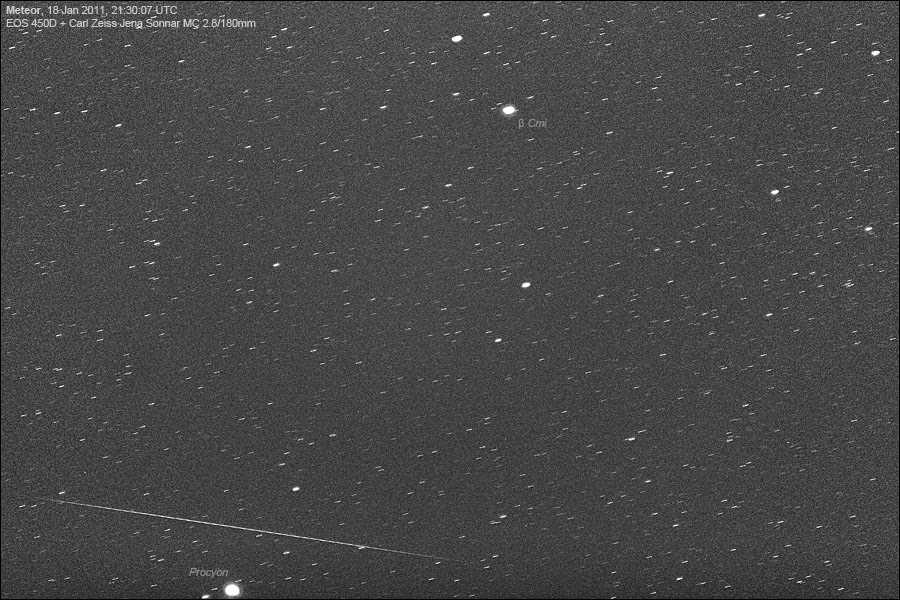
I also accidentally captured a mag. +2.5 sporadic meteor in one of the images taken with the Carl Zeiss 180 mm (FOV only 5 x 7 degrees!):

click image to enlarge

Wednesday, 26 January 2011

FIA Radar 1 flaring!

Yesterday evening I had a short clear window of opportunity before clouds rolled in. I tried in vain to spot Nanosail-D in deep twilight, and next targetted the FIA Radar 1 (10-046A) again.

Much to my surprise (as I had not see it do that before), it flared twice. At about 17:54:11 UTC (25 Jan) the first brief but bright flare, to mag. -1 occurred. Unfortunately, I was re-aiming the camera at that moment. The satellite flared again however, to mag. +0.5, at 17:54:37.0 UTC, and this time the camera was photographing. Below is the resulting image, and the brightness curve derived from it. It are actually two flares, as a slightly fainter flare at 17:54:35.7 preceeds the main flare.

click image to enlarge


click diagram to enlarge


Later that evening, during a second brief period of clear sky, I imaged Mentor 2 (98-029A) in Orion.

I also observed on the 20th (The FIA Radar 1 again, and Milstar 5r (02 001B)) and the 22nd (USA 200, 08-010A), during short clear spells.

Monday, 17 January 2011

The FIA Radar, USA 179 (SDS 3-3) and more

On the 5th, 9th, 10th and on the 16th of January, the skies shortly cleared in the evening and I observed the FIA 1 Radar (10-046A) making some nice passes through the winter sky. On the 16th it was a particularly close race with clouds coming in (the last image in the series has clouds in the image frame).

Below are two images: one from the 10th showing the FIA 1 Radar passing close to the Pleiades; the other showing it passing through the alpha Persei association on Jan 16th.

click images to enlarge


I also observed the Molniya orbit satellite USA 179 (SDS 3-3) on the 16th, which was close to the alpha Persei association too. As it was too faint for the 50mm lens, I used the Carl Zeiss Jena 180mm lens for it (brightest star in image is alpha Persei):

click image to enlarge


Other objects observed include PAN (09-047A) on the 9th of January. It is still in the fixed position at 49.0 E where it is since December 24 (see earlier post here). That same evening, Mentor 4 (USA 202), Mentor 2 and the Milstar 5 r/b were observed as well. A flashing H2A rocket, 06-059A, was captured as a stray. On the 5th of January, the IGS R2 r/b was captured in twilight, being very fast and very bright.

Thursday, 23 December 2010

A second NROL-41 (FIA Radar 1) patch

Grey overcast skies and snow do not allow observations currently. South-African observations by Ian Roberts show that PAN was still drifting as off 21 December. Will be interesting to see where the drifting stops (if it continues this way, it will soon drift out of my reach).

In a week or so from now, I will be preparing my overview of 2010 observations. For now, I want to fill the weather-induced lul in observations by showing a recent addition to the patch collection.

A patch for NROL-41, the FIA Radar 1 launch (2010-046A), was shown earlier on this blog here. Recently I however acquired a second patch, which is of much better design:

click image to enlarge


Patch designs of the black space program have become a bit generic and bland lately, perhaps as the result of this NRO Director's memo, but the NROL-41 patch above is beautiful. And, with hindsight, offering some clues (to what we now already know from our own observations).

The clue is in the heroine archer. She is aiming for the setting sun (i.e., westwards). I feel this could very well be an allusion to the unusual retrograde (westward) orbit of the FIA 1 Radar.

The purple 'vermicelli' pattern in the nighttime earth actually includes a few character combinations, i.e. acronyms, of units and organizations connected to the launch. Recognizable are amongst others 'NRO', and what appears to be '4 SLS' and 'LRS' or 'LRSW'.

It would be interesting to know what the three white stars in the patch rim signify.

Sunday, 17 October 2010

Again the FIA Radar 1 (NROL-41)

Last night was frosty and very, very clear. In the evening, I took pictures of the KH-12 USA 129 (96-072A), the HEO SDS 3-4 USA 179 (04-034A) and the geostationary ELINT USA 202/Mentor 4 (09-001A), low over the southeastern horizon. At the time of observation, it was some 4 degrees south of Jupiter.

click images to enlarge


I took a quick shot at Jupiter too with the Carl Zeiss Sonnar MC 2.8/180, to capture the moons of Jupiter. Here is the image, at 100% pixel resolution:

click image to enlarge


In the early morning, at 5:18 am local time, I watched and photographed a very fine pass of the FIA Radar 1 (10-046A) again. It attained a maximum brightness of +3.5 while crossing through Cassiopeia. Below is an image, showing the 'W' of Cassiopeia and the FIA Radar 1 trail (movement is from top to bottom).

click image to enlarge

Wednesday, 13 October 2010

At last the FIA Radar 1 (NROL-41), and the first images with the new Carl Zeiss Jena Sonnar MC 2.8/180

Last weekend saw my first observation, at last, of the payload of the NROL-41 launch: the FIA Radar 1 (2010-046A). At 4:25 am local time it made a pass in the northern sky over Polaris, and became visible to the naked eye at a brightness of mag +3.5. Below is one of the two pictures, plus a picture of the launch patch of NROL-41.

click images to enlarge


The orbit of the satellite is unusual, as it is retrograde, and in fact resembles a retrograde version of the Lacrosse orbits. There is some speculation as to the why of this.

The object currently is actively manoeuvring: when I captured it, it was 34 seconds late with regard to just one day old elements after one such manoeuvre. The apparent intention is to create a frozen orbit.


A new lens added to the equipment

This weekend saw the first active use of a new piece of optics added to the repertoire: an old, DDR-made, Carl Zeiss Jena Sonnar MC 2.8/180mm lens. The lens itself is renowned, for its sharpness. Originally made for 6x7 cameras, it provides very good sharpness from edge to edge on a DSLR image. Fitted with a P6 to EOS adapter, it works perfectly on my Canon EOS 450D. It yields almost twice the aperture of my EF 100/2.8, and hence will be used to capture faint distant objects such as Molniya orbit objects. The lens is of very heavy build: solid metal and glass with no plastics. It weights 1.5 kg!

Below is an image of the optics I am now using in my observations: a Canon EF 2.5/50 mm Macro used for LEO and some GEO objects; a Canon EF 2.8/100 mm Macro USM used fro MEO and HEO objects; and the Carl Zeiss Jena Sonnar MC 2.8/180 mm for HEO and GEO objects.

click image to enlarge


The advantage of the lens is that it goes deeper in magnitude of the objects it captures. A disadvantage is that it has a smaller FOV (6.8 x 5.0 degrees) which, with the software I use for astrometry (AstroRecord), means I have to carefully select the part of the sky to aim for (it should have enough stars brighter than +8 and at last 3 stars with a Flamsteed number, as the AstroRecord sequence starts with identifying 3 of those after which it starts to auto-identify stars). Especially the requirement of the 3 Flamsteed numbers in such a small FOV is limiting.
Anoher drwaback of this lens is that with 1.5 kg it is heavy! It is at the edge of what my lightweight camera tripod can carry, and hence vulnerable to vibrations.

On October 9 and 10 I used the lens to capture two Molniya-orbit (HEO) objects: USA 184 (06-027A), and USA 198 (07-060A, SDS 3F5). As a stray, it also captured another Molniya, the Russian US-KS Oko IR missile detection platform Kosmos 2393 (02-059A), and an old Russian rocket body in LEO (Kosmos 411 r, 71-041J). The image sequence shows that Kosmos 2393 was flaring at that time (20:14:02 - 20:14:12 UTC, 9 Oct 2010)

Below are two parts (at full pixel resolution) of one image that contained both USA 184 and Kosmos 2393 (the latter close to the edge of the image); and one of the images of USA 198.

click images to enlarge