Showing posts with label PAN. Show all posts

Thursday, 11 November 2021

PAN/NEMESIS 1 is still drifting


click image to enlarge

In a blog post in September, I wrote that after almost eight years of being steady at longitude 47.7 E, the classified  SIGINT satellite PAN/NEMESIS 1 (2009-047A) had started to slowly drift eastwards, with the drift starting in February 2021.

Observations on the evening of November 8 show that it is still drifting. Currently it is near longitude 54.8 E, close to Yamal 402 and the grouplet GSAT 8, GSAT16 and GSAT 29, as is visible in the image above.

As it is drifting eastwards, it is getting lower in my sky: currently it is at 14.7 degrees elevation above my northeastern horizon.

The history of PAN's relocations so far (for backgrouds on PAN, its probable role and its frequent relocations during the first five years of its life, see my 2016 article in The Space Review):

click diagram to enlarge

Tuesday, 14 September 2021

PAN (NEMESIS 1) is on the move again

Pan on August 8/9, 2021, imaged from Leiden. Click image to enlarge

Five years ago, in 2016, I wrote a long article in The Space Review titled "A NEMESIS in the sky: PAN, Mentor 4 and close encounters of the SIGINT kind". The primary subjects of that article were two SIGINT satellites: PAN (Nemesis 1) and Mentor 4.

In the article, I discussed what we had observed and deduced about PAN as amateur trackers, to what had been recently revealed about PAN by leaked documents from the Snowden files.

In the article I documented the frequent movements of PAN (2009-047A): for four years between its launch in September 2009 and mid 2013, PAN, very unusual for a geosynchronous satellite, was roving from location to location, each time being put close to a satellite for commercial satellite telephony.
For information on the "why" of that, and the larger context of it (a new kind of SIGINT information gathering), I refer to the earlier mentioned Space Review paper which goes into details.

Mid-2013, four years after launch, the frequent relocations stopped. For 8 years, the position of PAN remained stable in longitude near 47o.7 E. It's roving days, snooping around and sniffing other satellites, were over. Until this year.  

Somewhere between 6 February and 7 May 2021, PAN started to move again, eastwards in longitude. Observed longitudes over the period May-August 2021 suggest a drift eastwards at about 0.025 deg/day

Assuming a stable drift, the move appears to have been initiated within a few days of 11 February, 2021.The last observation still showing PAN at 47.7 E was on 6 February 2021 (as it happens, our network did not observe it again untill early May 2021 when it had already moved eastwards by two degrees).

The diagram below (an updated version of one that appeared in my 2016 Space Review article) shows the positions in longitude that PAN has been taking up since its launch in 2006. Note the frequent relocations over the period 2009-2013, then the long stabilization at 47.7E, and the start of a new drift episode in 2021:

click diagram to enlarge


The question now is, what this drift since February means:

(1) Has it deliberately been brought into a drift state to move it to an eventual new position? 

(2) Has it reached end-of-life and been manoeuvered into a graveyard orbit?

A 'graveyard orbit' is usually an orbit that is located at least 235 km higher than a geosynchronous orbit. That does not appear to be the case here: if anything, the orbit seems to be a few km lower than it previously was. So it appears to be option (1).

It will be interesting to see whether PAN will stabilize its longitude at some point or not, and where that will be. Unfortunately, as it is drifting eastwards it is getting lower in my sky (currently, it is some 16 degrees above my local horizon), and there do not appear to be many other amateurs covering it currently.

It would be interesting to see whether radio observers can detect radio signals from PAN, which shortly after launch was emitting at frequencies similar to that of the "UFO" (UHF Follow On) constellation.


PAN on 2/3 June, 2021, imaged from Schiermonnikoog Island. Click to enlarge

Tuesday, 6 April 2021

LUCH (Olymp-K), an eavesdropping SIGINT snooping around commercial comsats


click image to enlarge

Back in 2016, I published an article in The Space Review (A NEMESIS in the sky: PAN, Mentor 4 and Close Encounters of the SIGINT kind) about the mysterious US classified satellite PAN, and Mentor 4, another classified US satellite.

Both are SIGINT satellites launched in 2009, that are positioned close to commercial telephony communications satellites in GEO in order to eavesdrop on their communications. While Mentor 4 (an ADVANCED ORION) dedicatedly covers Thuraya 2, PAN (NEMESIS 1) moved from satellite to satellite in a 'roving' role every few months during the first 5 years of its operational existence. Its sister ship CLIO (NEMESIS 2) launched in 2014 has done pretty much the same.

But (of course) the USA is not the only country playing this game. In the same year that CLIO (NEMESIS 2) was launched, the Russian Federation launched LUCH (2014-048A), aka OLYMP-K or OLIMP-K. In 2015, in an essay in The Space Review, Brian Weeden pointed out that LUCH was roving from satellite to satellite too, possibly eavesdropping on their communications. This created headlines at the time. By all means, LUCH/OLYMP-K is the Russian equivalent of PAN and CLIO.

The diagram below shows the frequent repositionings of LUCH/OLYMP-K over the years ( a table with major repositionings is at the end of this post):


click diagram to enlarge

LUCH has recently (in the second week of February, 2021) been relocating from longitude 3 W to 8 W and is now positioned near EUTELSAT 8 WEST B (2015-039B). Before the relocation, it had been close to ABS-3A (2015-010A) for several weeks. 

I shot this image below on March 29th, when LUCH and EUTELSAT 8 WEST B were about 90 km apart:


click image to enlarge


The image was made with a CANON EOS 80D and Samyang 2.0/135 mm lens (10 seconds at 1000 ISO) and was a by-product of targetting MEV-2 and several classified objects in this stretch of sky.

The table below gives longitudinal positions for LUCH/OLYMP-K. The table focusses on major relocations.

Dates refer to he moments the longitude appears to get stabilized, and have generally been preceeded by a period of drift. Also indicated is what satellite was closest to LUCH/OLYMP-K at the start of each stable period. Note that in several cases, multiple satellites were close by and possibly targetted as well.


TABLE: positions of LUCH/OLYMP-K since late 2014 

DATE          LON      NEAR

17-02-2021    08.1 W   EUTELSAT 8 West B       2015-039B
06-11-2020    03.1 W   ABS-3A                  2015-010A
28-09-2020    04.9 W   Eutelsat 5W B           2019-067A
11-05-2020    01.1 W   Intelsat 10-02          2014-058A
28-03-2020    21.5 E   EUTELSAT 21B            2012-062B
28-11-2019    70.6 E   EUTELSAT 70B            2012-069A
22-10-2019    68.4 E   Intelsat 20             2012-043A
25-08-2019    65.9 E   Intelsat 17             2010-065B
01-07-2019    64.0 E   Intelsat 906            2002-041A
21-02-2019    60.0 E   Intelsat 33E            2016-053B
28-10-2018    57.0 E   NSS 12                  2009-058A
03-07-2018    49.9 E   Turksat 4B              2015-060A
07-06-2018    48.0 E   Eutelsat 28B            2008-065B
27-04-2018    47.5 E   Yahsat 1B               2012-016A
17-01-2018    41.9 E   Turksat 4A              2014-007A
25-10-2017    38.1 E   Paksat 1R               2011-042A
18-08-2017    32.7 E   Intelsat New Dawn       2011-016A
14-09-2016    09.9 E   Eutelsat 10A            2009-016A
11-01-2016    01.1 W   Intelsat 10-02          2004-022A
05-10-2015    24.3 W   Intelsat 905            2002-027A
26-06-2015    18.1 W   Intelsat 901            2001-024A
22-02-2015    96.4 E   Express AM-33           2008-003A


Monday, 20 January 2020

Testing a new lens for GEO and HEO (SamYang 2.0/135 mm)


The past week brought some clear skies. It also brougt me a new lens, a SamYang 2.0/135 mm ED UMC.

This lens had been on my wish-list for a while, as a potential replacement for the 1979-vintage Zeiss Jena Sonnar MC 2.8/180 mm I hitherto used for imaging faint Geosynchronous (GEO) and Highly Elliptical Orbit (HEO) objects, objects which are typically in the magnitude +10 to +14 range.

The 2.0/135 mm SamYang lens has gotten raving reviews on photography websites, several of these reviews noting that the optical quality of this lens is superior to that of a Canon 2.0/135L lens. And this while it retails at only half the price of an L-lens (it retails for about 460 to 500 Euro).

While I have the version with the Canon EF fitting, the SamYang lens is also available with fittings for various other camera brands.

Focussing is very smooth and easy with this lens. Unlike a Canon-L lens, the SamYang lens is fully manual (both focus and F-stop), but for astrophotography, manually focussing is mandatory anyway. The general build of the lens is solid. It is made of a combination of metal and plastic.

While not particularly lightweight, the lens is lighter in weight than my 1979-vintage Zeiss (which is all-metal and built like a tank, in true DDR fashion). The SamYang has a somewhat larger aperture (6.75 cm) than the Zeiss (6.42 cm), meaning it can image fainter objects. It also has a notably wider field of view (9 x 7 degrees, while the Zeiss has 7 x 5 degrees).

So for me, this seemed to be the ideal lens for GEO and HEO.

And after two test nights I can confirm: this SamYang lens indeed is spectacularly sharp. The first test images, made on January 15 and 16, have truely impressed me. Even at full F2.0 aperture, it is sharp from the center all the way to the edges and corners of the image.

Here is a comparison of the image center and the upper right corner of an image, at true pixel level. There is hardly any difference in sharpness:

click to enlarge

The images below, taken with the SamYang on a Canon EOS 80D, are crops of larger images, all but one at true pixel level.

The first image is a test image from January 15, a nice clear evening. It shows two objects in HEO: a Russian piece of space debris (a Breeze-M tank), and the classified American SIGINT satellite TRUMPET 1 (1994-026A). Note how sharp the trails are (this is a crop at true pixel level):

Click image to enlarge

The next night, January 16, I imaged several geostationary objects (which at my 51 degree north latitude are low in the sky, generally (well) below 30 degrees elevation). While the sky was reasonably clear, there were lingering aircraft contrails in the sky, locally producing some haze. Geostationary objects showed up well however, better than they generally did in the Zeiss images in the past.

The image below, which is a crop of a larger image, is not true pixel size, but slightly reduced in size to fit several objects in one image. It shows the Orion Nebula, several unclassified commercial GEO-sats, the Russian military comsat KOSMOS 2538 (BLAGOVEST 14L), and the classified Italian military communications satellite SICRAL 1B (2009-020A):


Click image to enlarge


The images below are all crops at true pixel level. The first one shows the US classified SIGINT satellite PAN/NEMESIS I (2009-047A), shadowing the commercial satellite telephony satellite YAHSAT 1B. It also shows a number of other unclassified commercial GEO-sats.

PAN/NEMESIS 1 is an NSA operated satellite that eavesdrops on commercial satellite telephony (see my 2016 article in The Space Review).

Note that this image - just like the next images- was taken at very low elevation, and from a light-polluted town center.

click image to enlarge

The image below shows another US classified SIGINT satellite, Mentor 4 (2009-001A), an ADVANCED ORION satellite. It shadows the commercial satellite telephony satellite THURAYA 2 (more backgrounds on this in my 2016 article in The Space Review). At magnitude +8, it is one of the brightest geosynchronous objects in the sky (note how it is much brighter than THURAYA 2):

click to enlarge

The last image below again is a classified US military SIGINT satellite, MERCURY 2 (1996-026A). While 24 years old it is, together with its even slightly older sibling MERCURY 1 (which I also imaged but is not in this image), probably still operational:

Click image to enlarge

After these two test nights, I am very enthusiastic about the SamYang lens. It is incredibly sharp, also in the corners, easy to focus, goes deep (in terms of faint objects), and overall performs excellent. I also like the wide field of view (compared to the 180 mm Zeiss which I previously used to target GEO). Together with the equally well performing SamYang 1.4/85 mm, it might be the ideal lens for imaging GEO and HEO.

Astrometric data on the targetted satellites from these test images are here and here. The astrometric solutions on the star backgrounds in the images had a standard deviation of about 2".

Added 20 Jan 2020:

This last image (reduced in resolution to fit) was taken this evening (20 January) and shows Trumpet 1 (1994-026A) passing the Pleiades:

Click image to enlarge


Friday, 2 December 2016

SIGINT Galore!


USA 136 (Trumpet 3), a TRUMPET in HEO. 28 Nov 2016
click to enlarge

The evening of 28 November was very clear - no moon and an extremely transparent sky, with temperatures around zero.

I used it to target several objects in GEO and HEO. Due to the favourable sky I could use exposure times twice as long as usual.

All the classified objects imaged were Signals Intelligence (SIGINT) satellites, i.e. eavesdropping satellites. The image above shows you one of the TRUMPET satellites, USA 136 (1997-068A), crossing through Andromeda. This is an object in a 63 degree inclined HEO orbit. The satellite was coming down from apogee at that moment and at an altitude of ~31 500 km.

Below is another object in HEO, USA 184 (2006-027A). This too is a SIGINT satellite, part of the TRUMPET-Follow On program (aka Advanced TRUMPET. It also serves as a SBIRS platform.

USA 184, a TRUMPET-FO in HEO, 28 Nov 2016
click to enlarge

This object was near apogee at this moment, at an altitude of 39 000 km over the Faroër Islands, which is why it looks stellar in this 20-second exposure. The star field is in Cassiopeia.

Both these objects hadn't been observed by our network for a while, hence they were somewhat off their predictions (1.5 degrees in position in the case of USA 136; and 1 degree off position in the case of USA 184).

I also briefly imaged a part of the geosynchronous belt, much lower in the sky. The targetted GEO objects were SIGINT satellites too: both Mercury 1 and Mercury 2 (1994-054A and 1996-026A), The Advanced ORION satellites Mentor 4 and Mentor 6 (2009-001A and 2012-034A) and the NEMESIS satellite PAN (2009-047A).

PAN and Mentor 4 (both shown below) have a story attached to them and were the subject of my recent article in The Space Review, which you can read here.

PAN (USA 207), a NEMESIS in GEO, 28 Nov 2016
click to enlarge

Mentor 4 (USA 202), an Advanced ORION in GEO, 28 Nov 2016
click to enlarge

Tuesday, 24 May 2016

Geostationary bonanza

click to enlarge

The images above and below are two small parts of one single image shot on May 2nd 2016, using a SamYang 1.4/85mm lens on a Canon EOS 60D with 30 seconds exposure (ISO 1000) under a very dark sky. These two image excerpts overlap in the corner: the upper right corner of the image excerpt above overlaps with the lower left corner of the image excerpt below.

Although both sub-images are only a few degrees wide, they show a bonanza of objects, including 3 classified objects.

In the image above, 11 objects including the classified SIGINT satellite PAN (2009-047A) are visible. PAN is parked next to the commercial communications satellite Yahsat 1B.

In the image below, 10 objects including two classified objects are visible: the two classified objects are the SIGINT satellite Mercury 1 (1994-054A), and the SIGINT satellite Mentor 4 (2009-001A), the latter parked next to the commercial communications satellite Thuraya 2.

The full 10 x 14 degree image, of which the images featured here are small excerpt parts, shows over 30 objects.


click to enlarge

Friday, 11 March 2016

Imaging a "UFO" (Ultra High Frequency Follow-On)

UFO F2 on 3 March 2016
(click image to enlarge)

The image above is my first image of a UFO...

(* cue X-Files tune *)

No need to call in Mulder, however. The object in the image is a geosynchronous satellite, UFO F2 (1993-056A).

The truth is out there

The acronym 'UFO' in this case does not stand for the classic Unidentified Flying Object. It stands for Ultra High Frequency (UHF) Follow-On, the name of a class of US Navy communication satellites.

The UFO satellite constellation consists of 11 satellites (not all of them operational) in geosynchronous orbit, launched between 1993 and 2003. It serves fleet-wide communication needs for the US Navy (including its submarines, but also Marine units on land). The system is currently being replaced by the newer MUOS constellation (see a previous post) and will gradually be phased out.

UFO satellite constellation on 9 March 2016
(click image to enlarge)

The first launch in the series, the launch of UFO F1 on 25 March 1993 with an Atlas 1 from Cape Canaveral, resulted in a partial failure to reach the intended geosynchronous orbit due to the failure of one of the rocket engines. The second UFO launch, UFO F2, the one imaged above, was the first truely successful launch of this satellite class.


USA 236 on 28 February 2016
(click image to enlarge)

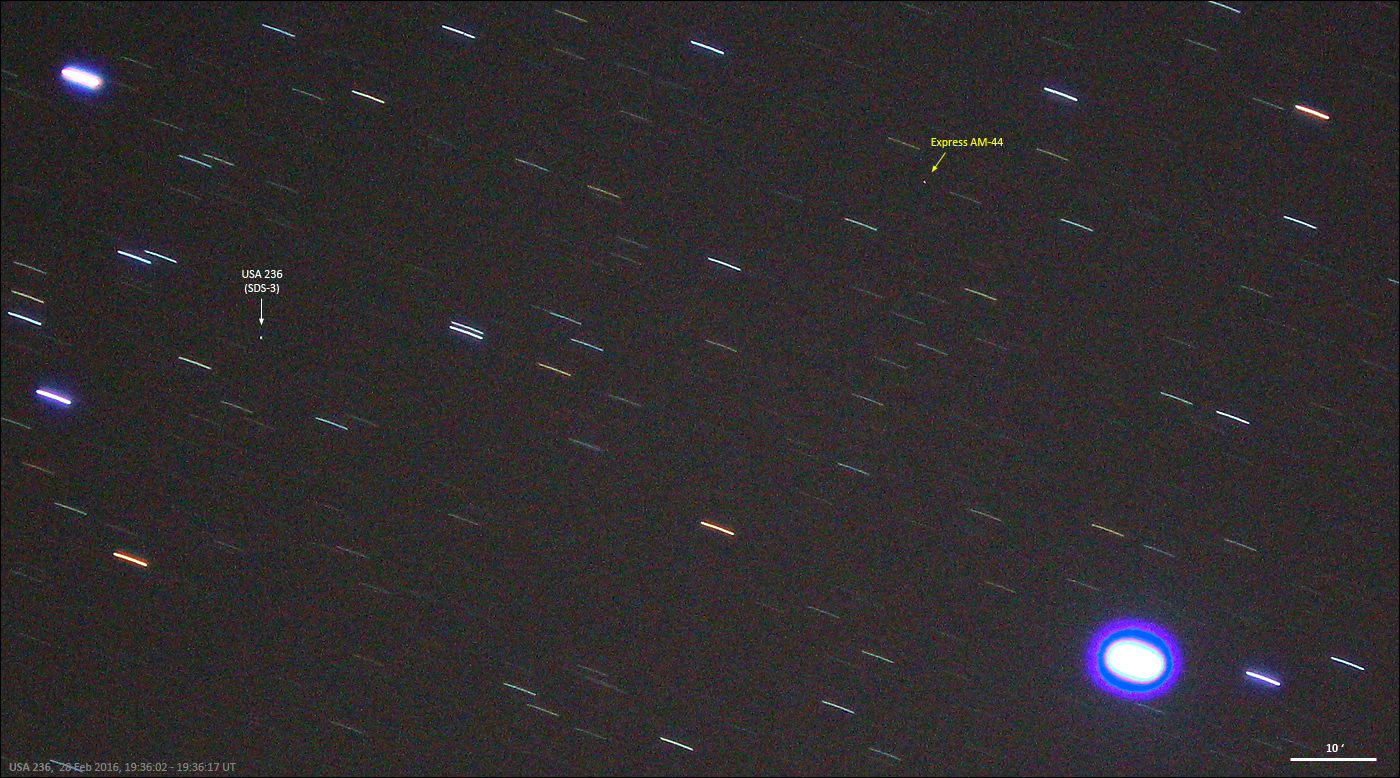
I imaged more geosynchronous objects the past week, taking advantage of clear moonless evenings. The image above shows a star field in Orion in the evening of 28 February 2016, with USA 236 (SDS 3 F7, 2012-033A), an SDS data communications satellite in geosynchronous orbit. These satellites relay data from other US military satellites, optical and radar reconnaissance satellites in Low Earth Orbits such as the KH-11 'Keyhole'/CRYSTAL, Lacrosse (ONYX) and FIA (TOPAZ), to the US.

PAN on 28 February 2016
(click image to enlarge)

I also did my periodic revisit of the enigmatic SIGINT satellite PAN (2009-047A) as well (see image above). PAN is still stable at 47.7 E (see my long-term analysis here), near Yahsat 1B. The image above shows it near that satellite and a number of other commercial communications satellites in an image taken on 28 February 2016.

Mercury 1 r on 3 March 2016
(click image to enlarge)

On Feb 28 and March 3, I recovered Mercury 1 r (1994-054B), the upper stage from the launch of the Mercury 1 SIGINT satellite. We had lost this object for a while, it had not been seen for 153 days when I recovered it. The image above shows it in Hydra on 3 March 2016.

USA 186 on 5 March 2016
(click image to enlarge)

As spring is approaching, the visibility of satellites in Low Earth Orbit is gradually coming back for northern hemisphere observers.  This means we can take over from our lone southern hemisphere observer, Greg. The image above shows the KH-11 'Keyhole'/CRYSTAL optical reconnaissance satellite USA 186 (2005-042A) imaged on 5 March 2016.

Monday, 14 December 2015

Imaging Geostationary satellites, and PAN's past relocations

Last week saw some clear evenings, and I used one of them to image some geostationary satellites. It concerned "the usual suspects": MENTOR's, MERCURY's and the enigmatic, probably SIGINT satellite PAN (2009-047A). The latter satellite has not been moved for quite a while now: since the end of 2013 it is at longitude 47.7 E, parked close to a number of commercial comsats. In the past it was frequently relocated, taking positions next to various commercial COMSATS. In four years time between 2009-2013, it moved at least 9 times (which is a lot) to various longitudes between 33 E and 52.5 E.

PAN amidst several commercial COMSATS on 9 December 2015 (click to enlarge)

The diagram below charts these frequent movements of PAN. Relocations typically took place about once every 6 months. Late 2013, they stopped. PAN however must still be operational, as active station-keeping is necessary for it to stay at 47.7 E.

relocations of PAN over time, 2009-2015 (click to enlarge)

Four other SIGINT satellites and a military comsat were imaged as well: Mentor 4 (2009-001A) and Mentor 6 (2012-034A), Mercury 1 (1994-054A) and Mercury 2 (1996-026A), and the military comsat Milstar 5 (2002-001A).


Mentor 4, next to commercial comsat Thuraya 2 on 9 Dec 2015 (click to enlarge)

Mentor 6 and a number of commercial satellites, close to the Orion nebula, on 9 Dec 2015

Using the remote telescope at Warrumbungle (MPC Q65) in Australia, I recently (4 December 2015) also checked-up on the recently launched US Navy COMSAT MUOS 4 (2015-044A). It is still at its check-out location over the Pacific at longitude 172 W, but some recent press statements suggest check-out has been successfully completed, and it will be moved to its operational position at longitude 75 E near India in the spring of 2016.

Thursday, 14 May 2015

CLIO

On 16 September 2014, the US military launched an enigmatic satellite (2014-055A) from Cape Canaveral into a geostationary orbit. It was not disclosed for which agency the object was launched (this is information that usually is disclosed). Nor what its function would be (this is information sometimes but not always disclosed). All we know is the rather uninformative name, CLIO, that it was built by Lockheed Martin and based on their commercial A-2100 bus.

CLIO imaged on May 13, 2015 (click image to enlarge)

CLIO is currently located at longitude 108.0 E, over Indonesia, where I imaged it yesterday using the 0.51-m telescope of Warrumbungle (MPC Q65) in Australia. The image can be seen above: CLIO is positioned just north of Telkom 1 (1999 042A), an Indonesian satellite for satellite telephony. (since Telkom 1 is also built on a Lockheed A2100 bus, the brightness difference in the image above is interesting, and probably due to different attitudes (orientations) of the satellites, although it potentially could also indicate custom components on CLIO, e.g. something like a large dish antenna).


click to enlarge

In many ways CLIO appears similar to another enigmatic satellite,  PAN (USA 207, 2009-047A), launched in September 2009 and infamous among our amateur tracking network for its frequent repositioning.

PAN was also built by Lockheed Martin and like CLIO based on the A-2100 bus. As with CLIO, the government agency behind it was not disclosed, and no indications of its role provided. What was known, is that PAN was developed and built rapidly (in less than 3 years time) using off-the-shelf commercial parts, apparently in response to an urgent need of some undisclosed government agency (which I suspect is either the CIA or NSA). Much speculation has occurred about the role of the spacecraft. The frequent relocations (which stopped at the end of 2013) make clear it is not a simple communications or early warning platform. PAN is currently located at longitude 47.9 E over east Africa.

Because of the similarities, several analysts believe that CLIO, five years after PAN, is a follow-on to the PAN program. The two satellites are currently 60 degrees separated in longitude.


Thursday, 2 January 2014

An unknown object in (near) Geostationary orbit: Express AM-5?

The evening of December 29 2013 started clear, so I did a small survey of a part of the geostationary belt. Main focus of the session was PAN, as well as Mentor 4 and 6.

Inspecting the images I found an unidentified object in near-Geostationary orbit some 4 degrees east of PAN, between Mentor 6 and NSS 5, on several images (positions here). The image below shows it near M42, the Orion nebula, near 19:17 UT:

click image to enlarge

In addition to the UNID you can also see a classified satellite at left, Mentor 6 (2012-034A), a SIGINT satellite also known under the code name Advanced Orion. At right are two commercial geostationary satellites, NSS 5 (1997-053A) and Galaxy 26 (1999-005A).

Cees Bassa in the Netherlands and Greg Roberts in South Africa also observed what is likely the same UNID object later that night. While it is not easy to fit a reliable orbit to such a relatively short span of observations, the suggestion is an object with an inclination near 0 and a Mean Motion of about 0.92 revolutions per day, i.e. an object near Geostationary altitudes.

The Mean Motion could suggest an old object being moved to a Graveyard Orbit. If this is the case, we haven't been able to identify which 'old' object it is yet.

Another option is that this is a new object. The only likely candidate in that case is the Russian satellite Express AM-5 which was launched on December 26th. This object seems to have been temporarily "lost" by JSpOC: as I write this (Jan 2),  Space-Track does not list orbital elements later than December 26th (when it was still in  a temporary transfer orbit).

For the moment, Mike McCants has given it the name UNK 131229 (with the acronym UNK meaning "Unknown").

This observing session also served to check on PAN (2009-047A). PAN is a highly mobile satellite and often moves position in May and December (I have written on the mystery of this satellite before). Not this time, it seems: it is still at the position it has been in for several months, forming a trio with the commercial satellites Yahsat 1B and Intelsat 10:


click image to enlarge

Other classified objects imaged this night were the old SIGINT Mercury 1 (USA 105, "Advanced Vortex", 1994-054A), and the SIGINT Mentor 4 (USA 202, 2009-001A). Mercury 1 was placed at 48 E and recovered by me about a year ago.


click images to enlarge

During this observing session, I captured a bright irregular orange light moving across the sky: a 'Thai Lantern' ( a miniature hot-air balloon). They are the cause of many false fireball and re-entry reports. Here it is, moving through Orion while carried by the wind:


Two days earlier, on December 27, I also did my periodic check on Prowler (90-097E), using the 61-cm Cassegrain of Sierra Stars Observatory in Markleeville, California (MPC G68).

I concluded the evening of the 29th by making some shots of M31, the Andromeda Galaxy. Unfortunately, some thin haze came in after a while. The image below is a stack of 16 haze-free images of 30 seconds exposure each, with a CLS filter (against light pollution - the images were taken from Leiden town center)) and Zeiss 2.8/180mm lens piggyback on the mount of my C6:

click image to enlarge

Monday, 6 May 2013

PAN has moved again [UPDATED]

On April 23 I wrote the following about PAN (2009-047A) and its frequent relocations in my post here:

"No doubt it will move again in the future, perhaps in May as December and May are frequently the months the satellite is moved"

I was very right with the "perhaps in May": PAN is on the move again!

Greg Roberts observing from South-Africa noted it missing at its old position on April 29. He recovered it on May 4th near the commercial geostationary Comsat Yamal 404. It is not (yet) clear whether that is its final position, or whether it is still drifting. Greg next initially thought he recovered it near the commercial comsat Yamal 404 on imagery from May 4th, but that turned out to be a mistake: as Mike McCants pointed out, the object in question was in reality the commercial geosat GSAT 8.

Ian Roberts, another South African observer, then located what likely indeed is PAN near Intelsat 12 on May 6th. Greg Roberts then managed to find it in his earlier images of May 4th as well, confirming Ian's observations.

Just goes to show that even the most secret of all satellites cannot escape the inquisitive eyes of a dedicated amateur.

Tuesday, 23 April 2013

PAN and Mentor 4 in March

Finally, an update on my observing activities in March. With apologies that it took so long.

In this post, early March observations of the classified geostationary satellites PAN and Mentor 4 will feature. In a second post following this one, I will report on some non-satellite observations: comet PANSTARRS and a fabulous display of Aurora borealis which I observed from Finland.


PAN and Mentor 4

As I noted on the blog before, weather has been extremely bad here since mid November 2012. Many nights were clouded, we had unusual amounts of snow, and spring set in very late (in fact, only last week).

click image to enlarge


The few clear nights we had, usually coincided with a bright moon in the sky. As wintertime is a bad time for LEO objects at latitude 52N  (the visibility window is very short, restricted to twilight) the focus is on objects in GEO during this season: but that necessitates clear moonless nights....

On the evening of March 4 I did an attempt, which was cut short when clouds and haze moved in. The pictures came out bad, but I did manage to image PAN (2009-047A) and Mentor 4 (2009-001A), as can be seen in the picture above. Mentor 4 is a SIGINT: PAN probably is too.

PAN was moved again in December-January, this time taking up position at 42.5 E close to the commercial telecom sat Nigcomsat 1R.

Since its launch in 2009, this enigmatic satellite has frequently moved, and this is unusual. PAN was stationed at 33.0 E from late 2009 to May 2010 and then was moved to 38.0 E. It was moved again to 49.0 E in December 2010, followed by a move to 44.9 E in the spring of 2011. Then it was relocated to 39.1 E in the summer of 2011 and next moved to 52.5 E somewhere between late October 2011 and January 2012. In May 2012 it was moved back to 38.0 E. In December 2012, it moved to 42.5 E. No doubt it will move again in the future, perhaps in May as December and May are frequently the months the satellite is moved.

Note: the listed positions for PAN are based on privately archived TLE's for the satellite. The TLE source is Mike McCants and the TLE's are based on amateur observations of the satellite, notably by Greg Roberts (S-Africa), Peter Wakelin (UK), Ian Roberts (s-Africa) and me (Netherlands).

Wednesday, 21 November 2012

PAN, other Geostationary satellites, and another UNID (this time Greg's)

As reported earlier I had a prolific observing session on Geostationary satellites in the evening of November 18th, discovering amongst others an unidentified geostationary object now temporarily designated Unknown 121118 (see here and follow-up here with imagery by Greg from S-Africa: an more on it near the end of the current post).

Below is some more imagery showing various classified and unclassified objects. All images were made using a Canon EOS 60D with a SamYang 1.4/85mm lens at ISO 1000.


Unknown 20121117 (Greg's UNID)

The November 18th imagery includes imagery of a second unidentified object, Unknown 121117 discovered by Greg Roberts (CoSaTrak) from South Africa a day earlier on the 17th (a third initially reported  'unid 'by Greg turned out to be identifiable as a known object, a Chinese CZ-3C r/b). So Greg recovered my Nov 18th UNID on the 19th, and I recovered Greg's Nov 17 UNID on the 18th: nice teamwork!

The image below shows it together with a number of nearby commercial geosats (the veil-like lighter streaks in the image are cirrus clouds, who had begone to invade an initially clear sky):

click image to enlarge

Below is one of Greg's images of the object from 17 November taken from S-Africa: in my image above taken a day later the object has drifted quite a distance more to the West.

(image courtesy Greg Roberts, CoSatTrak S-Africa)

Unknown 121117 is a truely uncatalogued object. There is nevertheless some idea about the identity of this satellite, but I am currently not allowed to provide more information.


PAN

PAN (09-047A) and the nearby commercial geosat Paksat 1R visible in Greg's Nov 17th image are visible on my Nov 18th imagery as well. The image below basically fits to the upper image above (see the Eutelsat pair visible in both images), giving you a sense how Greg's Unknown 2012117 has moved in a day time:

click image to enlarge


I have written about PAN on this blog several times before: it is an enigmatic classified satellite that frequently relocates.


Mentor 4, Thuraya 2 and the Mentor 1r

Among the other objects imaged were the SIGINT Mentor 4 (and the nearby commercial satellite Thuraya 2), and a r/b from the Mentor 1 launch, Mentor 1r.

Mentors (the biggest geostationary satellites in existence and the biggest man-made objects in space with exception of the ISS) are relatively bright objects (typically mag. +8):

click image to enlarge


I already posted imagery of another Mentor, Mentor 5, as well as the SIGINT Vortex 6 in an earlier post.


More on my UNID, Unknown 121118

This object in an 8.5 degree inclined geosynchronous orbit (see here and here for earlier coverage) remains 'unidentified' (i.e., is not present in public orbital catalogues such as USSTRATCOM's): we are however starting to believe it could be a classified object that has recently been moved to this location from somewhere else. It is currently positioned over 48.3 E and appears stable in longitude:

click map to enlarge