Showing posts with label USA 236. Show all posts

Friday, 11 March 2016

Imaging a "UFO" (Ultra High Frequency Follow-On)

UFO F2 on 3 March 2016
(click image to enlarge)

The image above is my first image of a UFO...

(* cue X-Files tune *)

No need to call in Mulder, however. The object in the image is a geosynchronous satellite, UFO F2 (1993-056A).

The truth is out there

The acronym 'UFO' in this case does not stand for the classic Unidentified Flying Object. It stands for Ultra High Frequency (UHF) Follow-On, the name of a class of US Navy communication satellites.

The UFO satellite constellation consists of 11 satellites (not all of them operational) in geosynchronous orbit, launched between 1993 and 2003. It serves fleet-wide communication needs for the US Navy (including its submarines, but also Marine units on land). The system is currently being replaced by the newer MUOS constellation (see a previous post) and will gradually be phased out.

UFO satellite constellation on 9 March 2016
(click image to enlarge)

The first launch in the series, the launch of UFO F1 on 25 March 1993 with an Atlas 1 from Cape Canaveral, resulted in a partial failure to reach the intended geosynchronous orbit due to the failure of one of the rocket engines. The second UFO launch, UFO F2, the one imaged above, was the first truely successful launch of this satellite class.
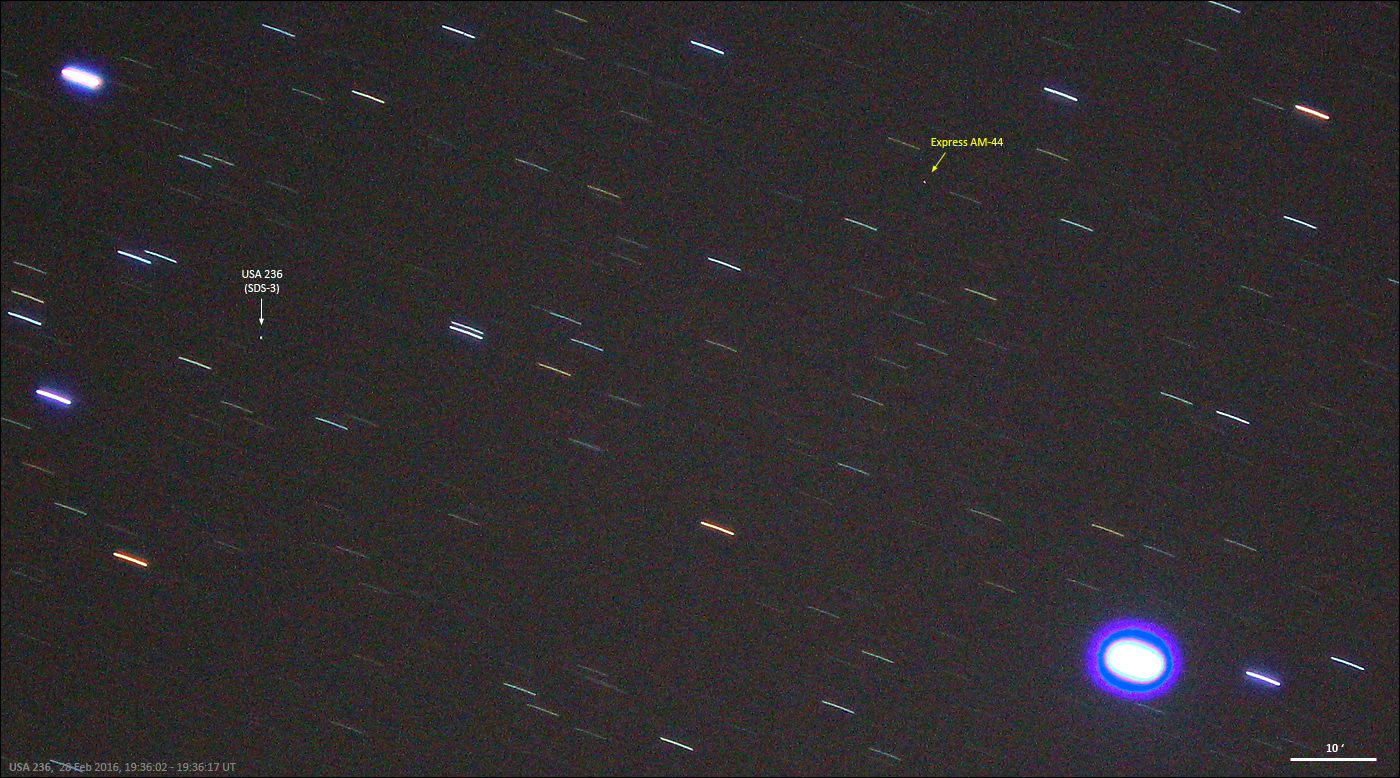

USA 236 on 28 February 2016
(click image to enlarge)

I imaged more geosynchronous objects the past week, taking advantage of clear moonless evenings. The image above shows a star field in Orion in the evening of 28 February 2016, with USA 236 (SDS 3 F7, 2012-033A), an SDS data communications satellite in geosynchronous orbit. These satellites relay data from other US military satellites, optical and radar reconnaissance satellites in Low Earth Orbits such as the KH-11 'Keyhole'/CRYSTAL, Lacrosse (ONYX) and FIA (TOPAZ), to the US.

PAN on 28 February 2016
(click image to enlarge)

I also did my periodic revisit of the enigmatic SIGINT satellite PAN (2009-047A) as well (see image above). PAN is still stable at 47.7 E (see my long-term analysis here), near Yahsat 1B. The image above shows it near that satellite and a number of other commercial communications satellites in an image taken on 28 February 2016.

Mercury 1 r on 3 March 2016
(click image to enlarge)

On Feb 28 and March 3, I recovered Mercury 1 r (1994-054B), the upper stage from the launch of the Mercury 1 SIGINT satellite. We had lost this object for a while, it had not been seen for 153 days when I recovered it. The image above shows it in Hydra on 3 March 2016.

USA 186 on 5 March 2016
(click image to enlarge)

As spring is approaching, the visibility of satellites in Low Earth Orbit is gradually coming back for northern hemisphere observers.  This means we can take over from our lone southern hemisphere observer, Greg. The image above shows the KH-11 'Keyhole'/CRYSTAL optical reconnaissance satellite USA 186 (2005-042A) imaged on 5 March 2016.

Wednesday, 9 July 2014

A bounty of GEO satellites on June 21


The night of June 21-22 was clear, and as I had trouble sleeping, I decided to take the short bicycle trip to my secondary site, Cospar 4355. This site is located in the polder only just outside of town, but the sky is better there than at my regular site 4353, which is in the town center (the secondary site is about 2 km south of my regular site). As a result, I can use twice as long exposures, which means I can image fainter GEO satellites than from my regular site. The site, being in a polder, also has less horizon obstruction. Below is a panorama of the site, split up in two parts, each slightly larger than 180 degrees. Azimuth directions are indicated.


Panoramic view at Cospar 4355

I took some 54 picture (20 second exposures with a Canon EOS 60D + SamYang 1.4/85mm at 800 ISO) over the course of an hour. My main focus was on approximately 20-30 degree (1-2 camera fields) wide equatorial areas near azimuth 120-130 deg, 160 deg and 200 deg.

I captured a nice batch of objects: 17 classified objects, two Unknowns (initially four but two got ID-ed as classifieds) and A LOT of unclassified objects. The image in the top of this post shows an only 2.7 degree wide stretch of one image, and look how many objects are already in it.
One of the objects in the image, the defunct Russian military comsat Raduga 1-M1/Kosmos 2434 (2007-058A) was flaring repeatedly in subsequent images (compare also the two images in the top of this post).

The images below show two other swaths of sky only a few degrees wide. Various commercial GEO sats are visible, as well as two old Ariane r/b, of which several were captured this night:

click image to enlarge

It also shows  the British military communications satellite Skynet 5B (2007-0056B).

One of the classified objects captured this night was AEHF 2 (USA 235, 2012-019A), part the new military communications satellite constellation that is gradually replacing the Milsat system. Another object imaged was the SBIRS GEO 2 (2013-011A) satellite, part of the new infra-red Early Warning constellation that is replacing the DSP constellation.


click images to enlarge


The lower of the two images above (it is slightly blurry because it is the edge of the image) also shows one of the initial UNID's of that night, "UNID 2", one that Cees and Ted later identified as the classified Italian military communications satellite Sicral 1 (2001-005A), which has recently been moved to 22 E.

Cees also managed to identify another UNID I imaged that night, "UNID 3":

click image to enlarge

It is the object we amateur trackers designate as Unknown 130929 (2013-772A), an object in a Molniya orbit which was last seen 132 days before my observations (i.e. we temporarily "lost" it). It was over West Africa at an altitude of 1270 km at the time of observation, moving away from perigee:


Two other UNID's of this night remain to be identified. One of these ("UNID 1") appears to be in GTO: the other one ("UNID 4") appears to be in LEO and was very faint.

The image below shows two classified objects (plus several commercial geosats), both US Military communications satellites: USA 236 (2012-033A) and WGS 3 (2009-068A). WGS 3 is the third satellite in the Wideband Global Satcom constellation. USA 236 is a geostationary SDS data relay satellite. It is believed that they notably relay imagery of IMINT satellites in LEO, for example optical imageryby  KH-11 Keyhole/CRYSTAL and radar imagery by Lacrosse and FIA.

click image to enlarge

Mentor 4 and Thuraya 2 change of configuration

A change is occurring in the configuration of Mentor 4 (USA 202, 2009-001A), a huge Mentor /ORION SIGINT satellite, and the commercial communications satellite Thuraya 2. For over 3 years, Mentor 4 was stationed (as seen from my observing location) slightly south of Thuraya 2. On my June 21 imagery, it has moved to slightly North of Thuraya 2. Compare the top image from last June 21 with some images shot in previous years:

21 June 2014:

8 December 2010:

18 November 2012:

29 December 2013:
click images to enlarge


(The first image also shows the still unidentified UNID 1, likely in GTO, and  a classified r/b from another Mentor/ORION launch, Mentor 3 r/b (2003-041B)).