Showing posts with label Mentor 2. Show all posts
Showing posts with label Mentor 2. Show all posts
Tuesday, 1 November 2016
A NEMESIS in the sky: PAN, Mentor 4 and close encounters of the SIGINT kind
I have published an article with the above title in The Space Review. Click here to read it.


Friday, 16 March 2012
MiTEx 1, AEHF 1 and Prowler
Weather conditions have not been too well lately. In the evening of March 14, I could do some imaging from Leiden, albeit under hazy skies. The relatively bright geostationary SIGINT Mentor 2 (98-029A) was the target.
In addition, I used a "remote" telescope, the 37-cm F14 Rigel Cassegrain of Winer Observatory (MPC 587) to image a few geostationary objects over US longitudes. Targets were (below images from top to bottom) the communication satellite AEHF 1 (10-039A), and the enigmatic objects MiTEx 1 (06-024A) and Prowler (90-097A).


AEHF 1 (aka USA 214) is the first of the Advanced Extremely High Frequency communication satellites that should replace the Milstar system. Because one of its onboard rocket boosters failed, the satellite had to be brought from GTO to its geostationary destination using smaller thrusters designed for station keeping, a procedure which took over a year.
This was the first time I imaged AEHF 1.
Prowler and MiTEx 1 are both enigmatic objects. Prowler's unique story has been discussed here before. MiTEx 1 (USA 187) is an enigmatic object that has some connection to the Prowler legacy. Like Prowler presumably was, it was designed to inspect other satellites. Two MiTEx satellites were launched (in the same launch in 2006), MiTEx 1 and 2. They were used to inspect, amongst others, the failed DSP satellite DSP-23 in 2009. I imaged MiTEx 2 before, this was the first time I also imaged MiTEx 1.
In addition, I used a "remote" telescope, the 37-cm F14 Rigel Cassegrain of Winer Observatory (MPC 587) to image a few geostationary objects over US longitudes. Targets were (below images from top to bottom) the communication satellite AEHF 1 (10-039A), and the enigmatic objects MiTEx 1 (06-024A) and Prowler (90-097A).
click image to enlarge


AEHF 1 (aka USA 214) is the first of the Advanced Extremely High Frequency communication satellites that should replace the Milstar system. Because one of its onboard rocket boosters failed, the satellite had to be brought from GTO to its geostationary destination using smaller thrusters designed for station keeping, a procedure which took over a year.
This was the first time I imaged AEHF 1.
Prowler and MiTEx 1 are both enigmatic objects. Prowler's unique story has been discussed here before. MiTEx 1 (USA 187) is an enigmatic object that has some connection to the Prowler legacy. Like Prowler presumably was, it was designed to inspect other satellites. Two MiTEx satellites were launched (in the same launch in 2006), MiTEx 1 and 2. They were used to inspect, amongst others, the failed DSP satellite DSP-23 in 2009. I imaged MiTEx 2 before, this was the first time I also imaged MiTEx 1.
Sunday, 29 January 2012
FIA Radar 1 through the Pleiades, and Geostationary satellites in Orion

click image to enlarge
The picture above (10s exposure taken with a Canon 450D and SamYang 1.4/85 mm lens) shows the classified military Radar reconnaissance satellite FIA Radar 1 (10-046A) sailing smack through the Pleiades last Friday.
Friday evening started clear, and I took the opportunity do so some observing. Using the SamYang 1.4/85 mm and the Carl Zeiss Jena Sonnar MC 2.8/180mm, I not only obtained the picture of FIA Radar 1 above, but I also targetted some geostationary satellites, imaging several of them in Orion.
Among the targets were the classified military communication satellite Milstar 5 (02-001A), the SDS data relay satellite USA 227 (11-011A) and the SIGINT satellite Mentor 2 (98-029A). Two other classified objects were captured as by-catch of these objects: the SIGINT satellite Vortex 6 (89-035A) and the object "Unknown 110623" (11-674A), an amateur-discovered object in GTO that is probably a spent rocket booster of a military launch. Note how it created a tiny trail in the image below as it was moving northwards through Orion.
The images below show these objects. Milstar 5, Vortex 6, UNK 110623 plus the two non-classified commercial communication satellites Eutelsat W2 (98-056A) and Intelsat New Dawn (11-016A) are all in the same 10-degree wide 85mm image. The stars of Orion's belt are visible in the top of the image, and Milstar 5 is close to the Orion Nebula. Orion's belt stars are visible at left in the Mentor 2 image as well.
click images to enlarge


In one of the other images taken last Friday evening, another commercial geostationary communication satellite, Intelsat 4 (95-040A) was captured while it briefly flared brightly at about 18:58:30 UTC (27 Jan).
The FIA radar and a number of geostationary objects (Mentor 2, Mentor 4) and the NOSS 3-3 r/b were imaged by me two weeks earlier as well, observations on January 14 and 15 which I had not reported here earlier. I also tried to relocate PAN, which recently has been relocated again but so far has not been recovered, although both Greg in South Africa and I in the Netherlands have tried.
Sunday, 13 February 2011
FIA Radar 1 and a flaring Topex near the Andromeda Galaxy
In the evening of Februari 8 I observed the KH-12 Keyhole USA 129 (96-072A) which is becoming visible for my location again, and the FIA Radar 1 (10-046A).
The latter moved close to M31, the Andromeda Galaxy. In the same image is another satellite, Topex (92-052A), which is flaring (it is present in a second image too). All together, this yielded this nice image:

Topex was part of a joint US/French oceanographic experiment. Launched in 1992, it functioned up to 2005. With the loss of attitude control since it ceased functioning, it has started to tumble, producing flashes.
I also observed the FIA Radar 1 on February 3rd, together with the USA 144 decoy (99-028C)
Yesterday, on Februari 12th after a day full of drizzle, it unexpectedly cleared around midnight, allowing me to photograph the geostationary SIGINT satellite Mentor 2 (98-029A) which at that time was just south of Procyon:

The latter moved close to M31, the Andromeda Galaxy. In the same image is another satellite, Topex (92-052A), which is flaring (it is present in a second image too). All together, this yielded this nice image:
(click image to enlarge)

Topex was part of a joint US/French oceanographic experiment. Launched in 1992, it functioned up to 2005. With the loss of attitude control since it ceased functioning, it has started to tumble, producing flashes.
I also observed the FIA Radar 1 on February 3rd, together with the USA 144 decoy (99-028C)
Yesterday, on Februari 12th after a day full of drizzle, it unexpectedly cleared around midnight, allowing me to photograph the geostationary SIGINT satellite Mentor 2 (98-029A) which at that time was just south of Procyon:
(click image to enlarge)

Sunday, 30 January 2011
Satellites near the Pleiades
Yesterday evening (Saturday 29 January) some satellites seemed to be in love with the Pleiades. In a somewhat hazy sky, I observed Lacrosse 3 (97-064A) cruising near the Pleiades and Hyades in twilight, and half an hour later watched the NOSS 3-4 duo (07-027 A & C) cruise right through the Pleiades.
Below are the resulting images. The top image of the NOSS duo cruising through the Pleiades (movement is from top to bottom, with 07-027A leading) was made using the Canon EF 100/2.8 Macro USM lens: the images of Lacrosse 3 were made using the EF 50/2.5 Macro lens.


The FIA Radar 1 (10-046A) was imaged as well. Unlike a few nights ago, it did not flare.
The previous night had a better quality sky, so I targetted a few geostationary satellites low above the horizon. Classified geostationary targets imaged were PAN (09-047A), Mentor 2 (98-029A), Mentor 4/USA 202 (09-001A) and the Milstar 5 r/b (02-001B). A number of commercial geostationary satellites were captured as well.
Below image, taken with the Carl Zeiss Jena Sonnar MC 2.8/180mm, shows PAN with the nearby commercial geostationary Yamal 202 (03-053A).

The image below, taken with the EF 2.5/50mm Macro, shows Mentor 2, with the stars of Orion's belt and Orion's nebula M42 at left:

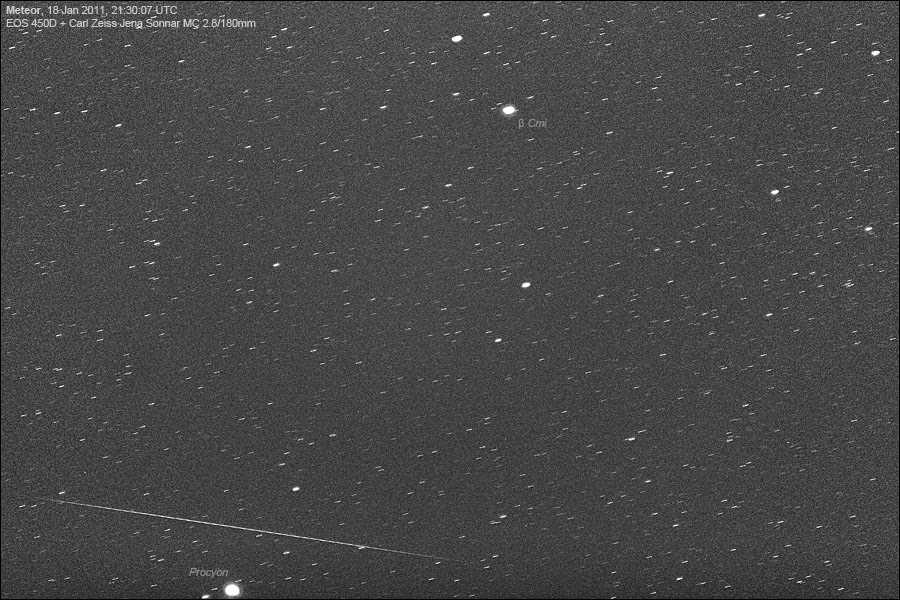
I also accidentally captured a mag. +2.5 sporadic meteor in one of the images taken with the Carl Zeiss 180 mm (FOV only 5 x 7 degrees!):

Below are the resulting images. The top image of the NOSS duo cruising through the Pleiades (movement is from top to bottom, with 07-027A leading) was made using the Canon EF 100/2.8 Macro USM lens: the images of Lacrosse 3 were made using the EF 50/2.5 Macro lens.
click images to enlarge


The FIA Radar 1 (10-046A) was imaged as well. Unlike a few nights ago, it did not flare.
The previous night had a better quality sky, so I targetted a few geostationary satellites low above the horizon. Classified geostationary targets imaged were PAN (09-047A), Mentor 2 (98-029A), Mentor 4/USA 202 (09-001A) and the Milstar 5 r/b (02-001B). A number of commercial geostationary satellites were captured as well.
Below image, taken with the Carl Zeiss Jena Sonnar MC 2.8/180mm, shows PAN with the nearby commercial geostationary Yamal 202 (03-053A).
click image to enlarge

The image below, taken with the EF 2.5/50mm Macro, shows Mentor 2, with the stars of Orion's belt and Orion's nebula M42 at left:
click image to enlarge

I also accidentally captured a mag. +2.5 sporadic meteor in one of the images taken with the Carl Zeiss 180 mm (FOV only 5 x 7 degrees!):
click image to enlarge
Wednesday, 26 January 2011
FIA Radar 1 flaring!
Yesterday evening I had a short clear window of opportunity before clouds rolled in. I tried in vain to spot Nanosail-D in deep twilight, and next targetted the FIA Radar 1 (10-046A) again.
Much to my surprise (as I had not see it do that before), it flared twice. At about 17:54:11 UTC (25 Jan) the first brief but bright flare, to mag. -1 occurred. Unfortunately, I was re-aiming the camera at that moment. The satellite flared again however, to mag. +0.5, at 17:54:37.0 UTC, and this time the camera was photographing. Below is the resulting image, and the brightness curve derived from it. It are actually two flares, as a slightly fainter flare at 17:54:35.7 preceeds the main flare.


Later that evening, during a second brief period of clear sky, I imaged Mentor 2 (98-029A) in Orion.
I also observed on the 20th (The FIA Radar 1 again, and Milstar 5r (02 001B)) and the 22nd (USA 200, 08-010A), during short clear spells.
Much to my surprise (as I had not see it do that before), it flared twice. At about 17:54:11 UTC (25 Jan) the first brief but bright flare, to mag. -1 occurred. Unfortunately, I was re-aiming the camera at that moment. The satellite flared again however, to mag. +0.5, at 17:54:37.0 UTC, and this time the camera was photographing. Below is the resulting image, and the brightness curve derived from it. It are actually two flares, as a slightly fainter flare at 17:54:35.7 preceeds the main flare.
click image to enlarge

click diagram to enlarge

Later that evening, during a second brief period of clear sky, I imaged Mentor 2 (98-029A) in Orion.
I also observed on the 20th (The FIA Radar 1 again, and Milstar 5r (02 001B)) and the 22nd (USA 200, 08-010A), during short clear spells.
Monday, 17 January 2011
The FIA Radar, USA 179 (SDS 3-3) and more
On the 5th, 9th, 10th and on the 16th of January, the skies shortly cleared in the evening and I observed the FIA 1 Radar (10-046A) making some nice passes through the winter sky. On the 16th it was a particularly close race with clouds coming in (the last image in the series has clouds in the image frame).
Below are two images: one from the 10th showing the FIA 1 Radar passing close to the Pleiades; the other showing it passing through the alpha Persei association on Jan 16th.


I also observed the Molniya orbit satellite USA 179 (SDS 3-3) on the 16th, which was close to the alpha Persei association too. As it was too faint for the 50mm lens, I used the Carl Zeiss Jena 180mm lens for it (brightest star in image is alpha Persei):

Other objects observed include PAN (09-047A) on the 9th of January. It is still in the fixed position at 49.0 E where it is since December 24 (see earlier post here). That same evening, Mentor 4 (USA 202), Mentor 2 and the Milstar 5 r/b were observed as well. A flashing H2A rocket, 06-059A, was captured as a stray. On the 5th of January, the IGS R2 r/b was captured in twilight, being very fast and very bright.
Below are two images: one from the 10th showing the FIA 1 Radar passing close to the Pleiades; the other showing it passing through the alpha Persei association on Jan 16th.
click images to enlarge


I also observed the Molniya orbit satellite USA 179 (SDS 3-3) on the 16th, which was close to the alpha Persei association too. As it was too faint for the 50mm lens, I used the Carl Zeiss Jena 180mm lens for it (brightest star in image is alpha Persei):
click image to enlarge

Other objects observed include PAN (09-047A) on the 9th of January. It is still in the fixed position at 49.0 E where it is since December 24 (see earlier post here). That same evening, Mentor 4 (USA 202), Mentor 2 and the Milstar 5 r/b were observed as well. A flashing H2A rocket, 06-059A, was captured as a stray. On the 5th of January, the IGS R2 r/b was captured in twilight, being very fast and very bright.
Thursday, 9 December 2010
Again Terra SAR-X and TanDEM-X, and a rich batch of
Yesterday evening was a very dynamic evening, where conditions changed from clear to clouded to clear in matters of minutes.
Besides the unexpected recovery of a lost classified geostationary, I also observed a number of other geostationary satellites, and another fine flare of the close duo TerraSAR-X and TanDEM-X (for an earlier observation, see here). They flared to mag. -1 at about 17:18:20 UTC, yielding the image below:

Movement is from left to right, with TerraSAR-X leading. The distance between the two objects was 3' (arcminutes).
Among the geostationary satellites imaged, were the classified objects PAN (2009-097A) and the Mentor's USA 202 (Mentor 4, 2009-001A) and Mentor 2 (98-029A). In addition, the commercial geosats Express AM-1 (2004-043A), Hellas-sat 2 (2003-020A), Paksat-1 (96-006A, close to PAN) and Thuraya 2 (2003-026A, close to USA 202). This in addition to the recovery of DSCS 3-11 (2000-001A) and the closeby commercial geosats Turksat 2A (2001_002A) and Turksat 3A (2008-030B) .
Below two images show the couple Mentor 4 (USA 202) and Thuraya 2 imaged with the Carl Zeiss Jena Sonnar MC 2.8/180mm; and Mentor 2 imaged with the Canon EF 2.5/50 Macro.


Besides the unexpected recovery of a lost classified geostationary, I also observed a number of other geostationary satellites, and another fine flare of the close duo TerraSAR-X and TanDEM-X (for an earlier observation, see here). They flared to mag. -1 at about 17:18:20 UTC, yielding the image below:
click image to enlarge

Movement is from left to right, with TerraSAR-X leading. The distance between the two objects was 3' (arcminutes).
Among the geostationary satellites imaged, were the classified objects PAN (2009-097A) and the Mentor's USA 202 (Mentor 4, 2009-001A) and Mentor 2 (98-029A). In addition, the commercial geosats Express AM-1 (2004-043A), Hellas-sat 2 (2003-020A), Paksat-1 (96-006A, close to PAN) and Thuraya 2 (2003-026A, close to USA 202). This in addition to the recovery of DSCS 3-11 (2000-001A) and the closeby commercial geosats Turksat 2A (2001_002A) and Turksat 3A (2008-030B) .
Below two images show the couple Mentor 4 (USA 202) and Thuraya 2 imaged with the Carl Zeiss Jena Sonnar MC 2.8/180mm; and Mentor 2 imaged with the Canon EF 2.5/50 Macro.
click images to enlarge


Thursday, 1 July 2010
Progress-M 04M, MSX, and Mentor 2
A long spell of very warm, sunny weather is resulting in several clear nights. Since my last observations reported here (those of June 2nd), I have been able to observe on June 3, 13, 14, 16, 17, 22, 24, 26 and 29. Objects include Progress-M 04M, Mentor 2, Mentor 4 (USA 202), USA 161, USA 32, USA 184, MSX, Milstar 5, the NOSS 3-1 duo, and the STSS Demo-1. This does not include a number of non-classified strays also captured.
USA 161 (01-044A) slowly flared to -1 at 23:58:59 UTC (24 Jun).
Below are a few pictures. First: UARS captured as a stray, flaring, on June 16th:

Progress-M 04M on 26 and 29 June:


Geostationary USA 202 (Mentor 4), in the trees low in the sky (altitude about 17.5 degrees):

Mentor 2 (geostationary), MSX and a stray (HJ-1A, a Chinese Earth Observation Satellite)

USA 161 (01-044A) slowly flared to -1 at 23:58:59 UTC (24 Jun).
Below are a few pictures. First: UARS captured as a stray, flaring, on June 16th:
click image to enlarge

Progress-M 04M on 26 and 29 June:
click images to enlarge


Geostationary USA 202 (Mentor 4), in the trees low in the sky (altitude about 17.5 degrees):
click image to enlarge

Mentor 2 (geostationary), MSX and a stray (HJ-1A, a Chinese Earth Observation Satellite)
click image to enlarge

Subscribe to:
Posts (Atom)