Showing posts with label NOSS. Show all posts

Tuesday, 4 September 2018

Capturing a flaring NOSS duo (NOSS 3-6)

click to enlarge

On 30 August 2018 near 20:59 UT I was imaging the NOSS 3-6 duo (2012-048A & 2012-048P) during a near-zenith pass, when they briefly flared. They were at a sky elevation of 77.5 degrees at that time.

The image above is a stack of the video frames showing the flaring spacecraft: the flare of the leading P component was captured just before it peaked (I was adjusting the camera FOV during the seconds before it), the flare of the A component was captured in its entirety. Below is the video itself from which these frames were extracted (video shot with a WATEC 902H + Canon FD 1.8/50 mm lens):


I next used LiMovie to analyse the video and extract brightness curves from the video frames, with the following results. The data points shown are 3-point averages of the raw data. small discontinuities visible in the curves are where the satellite passed a star:

click diagram to enlarge

click diagram to enlarge

The leading P component seems to exibit only one flare peak. The traling A component shows an interesting  double or tripple peak. The centroids of the peaks of the P and A component were some 6.5 seconds apart.

In the diagram below, I have transposed both curves on each other by shifting the curve for the A component along both axes untill it matches that of the P component:

click diagram to enlarge

What can be seen is that the curve for the A component pre- and post-peak follows the pattern of that of the P component, but unlike the P component it shows a pronounced valley at the peak, with a small secondary peak in the valley bottom. The shape of the valley is the inverse of the peak shape of the P component. Intriguing!

The rather sudden change in steepness some seconds before and after the peaks as shown by both components is interesting too. The main peak shape is slightly asymmetric.

One option for the difference in the shape of the curve for the A component (i.e. for the "valley"at the top) might be the presence of a rotating component interfering with the flare pattern caused by the satellite body, perhaps.

NOSS (Naval Ocean Surveillance System) satellites are SIGINT satellites operated by the US Navy to locate shipping, based on geolocation of the ship's radio emissions. They are also known by the code name INTRUDER. They always operate in close pairs, such as can be seen on the video.

The P component peaked at 20:59:11.85 UT (Aug 30, 2018), at position RA 313.222 DEC +45.628. The A component has a first major peak at 20:59:17.33 UT at RA  313.331 DEC +45.077; the small secondary peak at 20:59:18.37 UT at RA 313.765 DEC +45.307; and a third major peak at 20:59:19.33 UT at RA 314.170  DEC +45.518. The two major peaks are 2.0 seconds apart.

Thursday, 23 March 2017

NOSS 3-8 (NROL-79) components now close to operational separation

In a recent blog post I documented the intricate manoeuvering of the two NROL-79 payloads (NOSS 3-8) over the past three weeks. They were manoeuvering to circularize and synchronize their orbits and manoeuvre to a desired mutual distance.

click image to enlarge


Much of this manoeuvering is now done, and the two spacecraft are now flying in formation at a mutual distance of ~50.5 km. They now look like a typical NOSS pair, as can be seen in the image above shot in the evening of March 21 (the bright star is Procyon).

Below is an updated diagram, showing the evolution of the separation between the two spacraft over time:

click diagram to enlarge

After an initial rapid post-launch separation with a drift of ~31-32 km/day, reaching a maximum separation of ~202 km on day 6 after launch, the separation distance started to decrease post day 6, and is now, by day 20-21 after launch, clearly flattening out to a stable separation distance of about 50 km.

The Mean Motion/orbital period of the two spacecraft are now very similar too, as is their orbital inclination: all signs that they are now close to the desired configuration. The two orbital planes are currently about 0.2 degree separated in RAAN.

click diagram to enlarge

While they are now at their operational distance (which looks to be ~50 km in this case) and close to operational configuration, this does not mean that NOSS 3-8 is now fully operational. Over the coming weeks, they will probably undergo extensive check-out tests. I also expect them to continue to make small manoeuvres for a while (but while maintaining a more or less stable mutual distance at ~50 km).

Several amateur satellite trackers contributed data to this analysis, including Leo Barhorst, Cees Bassa, Russell Eberst, Alain Figer, Paul Camilleri, Dave Waterman, Alberto Rango, Brad Young and me.

Sunday, 19 March 2017

NOSS 3-8 (NROL-79): Dancing in the Dark

click image to enlarge

The image above shows the new NOSS 3-8 duo (2017-011 A & B, launched as NROL-79 on March 1, see my earlier blog post here), aka USA 274, imaged on March 12 through very thin cirrus.

Over the past 2.5 weeks a number of us (Leo Barhorst, Cees Bassa and me in the Netherlands; Russell Eberst in Scotland; Alain Figer in France; and Paul Camilleri in Australia) have been chasing this duo and monitored their manoeuvering, consisting of small adjustments in apogee and perigee and orbital period.

Click diagram to enlarge

I expect their manoeuvering to be complete by 21 days (3 weeks) after launch, i.e. near March 23. They will then have attained their finalized separation distance. I expect this initial operational distance to be about 45 km. I do not exclude further small manoeuvres after March 23 though, but these will be more as a pair, and not with respect to each other.

NROL-79 consists of a NOSS (Naval Ocean Surveillance System) duo: two payloads orbiting as a close pair (typically 30-55 km). The second object is  catalogued as "debris" by JSpOC (they did this with all second payloads of NOSS launches), but isn't: after all, real debris shouldn't manoeuvre, and shouldn't stationkeep with respect to the other payload.

click diagram to enlarge

After insertion in a 1010 x 1204 km, 63.45 degree inclined orbit, the two payloads started an intricate dance in space, step by step positioning themselves with respect to each other.

In the initial week after launch the two payloads separated at a rate of ~31-32 kilometer per day, to a maximum separation of just over 200 km on Day 7. Then their drift reversed, with the two payloads gradually moving closer again (see diagram above, which also gives similar data for a previous NOSS launch, NROL-55 (NOSS 3-7) from 2015). Extrapolating the drift, and looking at the previous NOSS launch, I expect that by the end of the 3rd week after lauch (~March 23, 2017) the two payloads will reach their intended separation of ~45 km, and stabilize with respect to each other.

It is interesting to note the difference with the previous NOSS launch, NOSS 3-7, also depicted in the diagram. The latter initially drifted further apart, and for a longer time: the separation increased until 14 days after launch (double as long as for the current case), to as much as ~570 km (almost three times as large as the current case), before the two objects started to move closer again.

In the image below, taken three days apart on March 10 and March 13, the decrease in distance over time after the first week can clearly be noted (in the images, movement is from top to bottom and the B-object is leading). The images show the payloads in roughly the same part of the sky (bright stars are 1, 10 and 13 Cyg):

click image to enlarge


A first major manoeuvre occurred on day 6, when both payloads lowered their orbital period:

click diagram to enlarge

Around that same date, the visual brightness of the two objects changed. The latter probably signifies the deployment of something on the payloads: either antennae, or perhaps panels used to make minor orbital adjustments by decreasing or increasing drag (it has long been rumoured that this is one of the ways the NOSS payloads maintain their bond).

The pattern between the current launch and the previous launch is similar (although I have a suspicion that for the previous NROL-55 launch in 2015, analysts switched the identitities of the two objects around day 6): a major orbital period adjustment on day 6, after which one of the payloads gradually increases its orbital period again while the other very slowly decreases its orbital period. But what can be seen is that for the current case, the values for both payloads stay much more similar than was the case with the previous launch, just as with the evolution of the spatial separation of the two. One of the things this could point to is that, perhaps, the initial orbit insertion of NROL-79 went better than for NROL-55, but this is speculation.

Note: orbital calculations for NROL-79 used were done by myself using observational data from the persons mentioned in the main text. The NROL-55 orbit calculations from 2015 were by Mike McCants and  Ted Molczan. I am indebted to Leo Barhorst and Bram Dorreman for their help in filling gaps in my archive of orbits for the latter object.

Friday, 3 March 2017

Tracking NROL-79, a new NOSS duo

Launch of NROL-79 from Vandenberg on March 1, 17:49 UT (photo ULA)

On March 1, 2017, at 17:50 UT,  an Atlas V rocket was launched from Vandenberg with a classified (double) payload for the National Reconnaissance Office (NRO) onboard. It was the 70th Atlas V mission, and the 14th NRO launch using this launch vehicle.

The two payloads were launched towards a southern direction into a 63.46 degree inclined, 1010 x 1204 km orbit. The payloads are almost certainly a new set of NOSS (Naval Ocean Surveillance System) satellites, NOSS 3-8 (NOSS satellites are also known under the code name INTRUDER). These are SIGINT/ELINT satellites operating in close, formation flying pairs. The purpose of these satellites is to geolocate radio signals, notably signals originating from ships. In order to keep their mutual distance  stable, they operate in 63.4 degree orbits, a critical inclination which keeps perigee in a stable position.

This is the 8th launch in the third generation of these spacecraft.

Based on estimated search elements, both payloads were quickly picked up by amateur trackers. Russell Eberst in Scotland and Alain Figer in France first spotted them about 10 hours after the launch, on March 2.  Paul Camilleri in Australia soon followed. I was clouded out that night, but the next night (March 3) was clear in Leiden, and I managed to image the payloads on two consecutive passes, albeit under a somewhat hazy sky. It was also imaged by Leo Barhorst that same night.

Below are two of my images of the two payloads chasing each other, from consecutive passes, obtained from Leiden under a hazy sky (click them to enlarge):


NROL-79 payloads, image 3 March 2017, 1:43 UT (click to enlarge)

In the image above taken during the first pass near 1:43 UT, the objects are moving from top to bottom through a field in Cygnus. In the image below, from the second pass, they are moving from left to right. Note the difference in brightness between the two objects, noticable during this second pass:

NROL-79 payloads, image 3 March 2017, 3:31 UT (click to enlarge)

The NOSS components are usually designated A and B (sometimes A & C). For the moment, we have named the fainter leading object B. The objects are currently still quite faint, indicating that they have not yet deployed their solar arrays and other gear.

The B object is usually catalogued as "debris" by JSpOC, but this is a ruse: in reality it is a functional payload (as it manoeuvres and carefully stationkeeps with the A component during its operational years).

Our current tracking data established that they are in a 63.46 degree inclined, 1010 x 1204 km orbit. The two payloads are about 45 km apart in space.


Over the coming days, they will likely make manoeuvres to finalize their orbits and respective positions.

The respective distances of current still operational NOSS pairs (NOSS 3-3 to 3-7) varies between 39.5 and 55 km.

Monday, 12 October 2015

Chasing the new NOSS 3-7 pair (the NROL-55 payloads)

NOSS 3-7 (NROL-55) payloads on 2015 October 10, two days after launch
Click image to enlarge

On October 8th 2015, an Atlas V rocket launched the National Reconnaissance Office's NROL-55 mission from Vandenberg AFB. The mission consisted of two NRO payloads and a number of cubesats hitching a ride. The two NRO payloads (of which only one is acknowledged, the other being catalogued as 'debris', which it isn't) are a new NOSS pair, NOSS 3-7, which replaces the 10-year-old NOSS 3-3 duo (2005-004A and C).

NOSS (Naval Ocean Surveillance System) satellites operate in pairs, flying in close formation. They geolocate ships by radio interferometry observations of the ship's radio and radar signals.

Based on the launch direction and rocket used, as well as the few details published, we knew it would be a new NOSS duo, and from previous launches had an idea in what orbit they would be launched and what manoeuvering sequence would be used.

The first observations of the newly launched objects were made within a few hours after the launch, by several observers. About 1.5 hours after the launch, observers in Iran and Tibet witnessed a spectacular fuel vent by the Centaur rocket from the launch. Next a number of satellite trackers in our network observed the payloads and the Centaur rocket (e.g. here, here, and here).

I was clouded out on Oct 8. I could join in the chase and got my first look at the payloads only on the next evening on the 9th, but under poor conditions (very hazy) with the objects only marginally showing up on my imagery made with a 2.5/50 mm lens.

NOSS 3-7 (NROL-55) Centaur near Altair on 2015 October 10
Click image to enlarge

The next night, on the 10th, the sky was very clear, and I employed the 1.4/85mm lens rather than the 2.5/50mm lens. First, I imaged a pass of the Centaur rocket near 19:47 UT (image above). As is usual for the Centaur boosters from these launches, it was clearly variable in brightness due to tumbling. This can be clearly seen in the image below, a stack of five images:

NOSS 3-7 (NROL-55) Centaur, stack of 5 images showing brightness variation
Click image to enlarge

Next I observed the two payloads closely chasing each other near 19:55 UT. Like the previous evening, the leading object was clearly fainter than the following object (movement is from top to bottom in the image below, showing the two payloads crossing a part of Cassiopeia).

NOSS 3-7 (NROL-55) payloads on 2015 October 10, two days after launch
Click image to enlarge

NOSS pairs operate for about 10 years, each pair maintaining a close spatial proximity configuration of parallel orbits with one satellite just leading the other. After 10 years their mission is over and the pair loses their close spatial proximity. From previous patterns, Ted Molczan expects that the NOSS pair that is being replaced by this new launch (NOSS 3-3, 2005-004 A and C, launched in 2005) will end its mission and lose their close spatial proximity about 7-8 months from now, i.e. around April-May 2016.

click image to enlarge

The newly launched NOSS 3-7 duo is not yet at its operational orbit in its operational configuration. Based on past missions, they will continue to manoeuver the next few weeks until they reach their operational orbits (after which a check-out period will follow). This manoeuvering makes them interesting targets to follow the coming few weeks.

The image at the top of this post shows the pair of payloads (moving top to bottom through Cassiopeia in the image), with the leading object being slightly fainter than the trailing object. This is a pattern also seen with previous launches: once operational, both payloads will however be of similar brightness.

Monday, 17 March 2014

Open Question: Could US Military SIGINT satellites help to narrow down flight MH370's last location?

Please note: this post contains discussions of a highly speculative nature

Over the past days, it has become clear that the lost Malaysian Airlines flight MH370 has flown on for some 7 hours after contact was lost at 17:20 UT (March 7 UT, local March 8). This information comes from radio "ping-backs" of the aircraft's ACARS system received by the Inmarsat 3-F1 satellite, a geostationary communications satellite that is located at longitude 64 E over the Indian Ocean. These ping-backs were received hours after the last radio contact with the pilots and hours after the transponder was shut off, and indicate that the aircraft was still powered and 'alive' hours after it disappeared. A well written story at the CNN website gives backgrounds on the receptions and the system.

Position and footprint of Inmarsat 3-F1
click image to enlarge

In this post, I will briefly summarize how Inmarsat 3-F1 detected the aircraft and determined a wide arc where the aircraft could have been at that time. I will then explore whether additional signal receipts by classified US Military Signals Intelligence (SIGINT) satellites might perhaps have been possible. If such additional receptions exist (an open question!) they would enable to further narrow down the location of the last ping-back.

That will largely be a theoretical exercise, as so far there has been no word that the US SIGINT satellite constellation did detect these ping-backs. This post therefore entails a clear element of speculation, and the central question remains an explicit open question.


Backgrounds: 'Marco Polo' between an aircraft and a satellite

Someone in the aircraft shut off the radar transponder beacon and the active ACARS messaging system near 17:20 UT. Yet this did not fully disable the ACARS system. The system kept answering periodic "pings" by the Inmarsat 3-F1 (1996-020A) satellite. These "pings", basically a kind of "Marco?" message,  are periodically sent out by the satellite and when received by the aircraft ACARS antenna, the aircraft pings back a brief "handshake" basically saying "Polo!". While such a handshake does not contain clear information about where the aircraft is when the active ACARS is disabled, it does contain the aircraft ID.

According to press reports, the last ping-back from flight MH370 was received 7 hours after the flight disappeared, near 00:11 UT on March 8. Apparently, only Inmarsat 3-F1 received these ping-backs.

From the time it took the radio-ping to travel from Inmarsat 3-F1 to the aircraft and then back again, the distance (but not direction) of the aircraft to the satellite can be determined. For example, at a radiowave speed of 300 000 km/s, a time difference of say 0.2 seconds between Inmarsat sending the ping and receiving the answer back, indicates the aircraft is at a distance of 30 000 km from the satellite.

Once you know the distance, you can draw a globe with that radius around the location of the Inmarsat satellite. Where that globe cuts the earth surface, it creates a circle, centred on the sub-satellite point. The aircraft must have been somewhere on that circle. This is basically how the wide arc that has been published was constructed, an arc which runs from Thailand to Kazakhstan in the north, and Indonesia to Australia and the Indian Ocean in the south. The aircraft could have been anywhere on that big arc, an area stretching thousands of kilometers.


To pinpoint the aircraft more accurately to a particular spot in the arc, one needs a detection by a second and preferably a third satellite.


Could US SIGINT satellites provide additional receptions for these pings?

One source of such additional ping-back signal receptions, in theory could be one of several Signals Intelligence (SIGINT) satellites employed by the US military. Please note that I say IN THEORY as the US government hasn't provided any statements that they did (which might indicate that they didn't). In other words: I am speculating on an open question here.

It depends on a lot of factors, not the least of which are questions whether these satellites were listening at the time, and whether they were monitoring the particular VHF/UHF radiofrequencies in question. Those are questions I do not have the answers to. What I will do, is discuss which US military satellites could potentially have received these ping-backs because they had coverage of the area.

1. The Mentor and Trumpet SIGINT satellites

Two US SIGINT systems in high orbits cover(ed) the relevant area: (1) several of the very large Mentor/Advanced Orion SIGINT satellites in geostationary orbit: and (2) one of the SBIRS/TRUMPET combined SIGINT and SBIRS satellites which moves in a Highly Elliptical Orbit and hovered high above the northern hemisphere at the time.

These SIGINT satellites serve to eavesdrop on radio communications including satellite- and mobile telephony, missile telemetry and signals from groundbased and airborne radar systems.

USA 184 TRUMPET imaged on 25 Aug 2009 by the author

 Mentor 4 imaged on 18 Nov 2012 by the author


The TRUMPET satellite in HEO which had coverage of (a part of) the area at that time is  USA 184 (2006-027A). The geostationary Mentor satellites covering the area are Mentor 1, 3, 4, 5 and 6 (1995-022A, 2003-041A, 2009-001A, 2010-063A and 2012-034A).

Position of various Mentor satellites and TRUMPET USA 184
Mentor satellite footprints


USA 184 area coverage and footprint detail
click image to enlarge

2. NOSS (Naval Ocean Surveillance System) SIGINT satellites

Apart from the Mentor and Trumpet SIGINT satellites in high orbits, the US also operates a series of SIGINT satellites with accurate geolocalization capabilities in a Low Earth Orbit. It concerns the US Navy Naval Ocean Surveillance System (NOSS) satellites, of which there are several. They operate in close pairs, orbiting at an altitude of about 1000 x 1200 km in 63 degree inclined orbits. Their main purpose is to locate and track shipping through the radio communications of the latter.

A NOSS duo (NOSS 3-4) imaged by the author on 29 Jan 2011


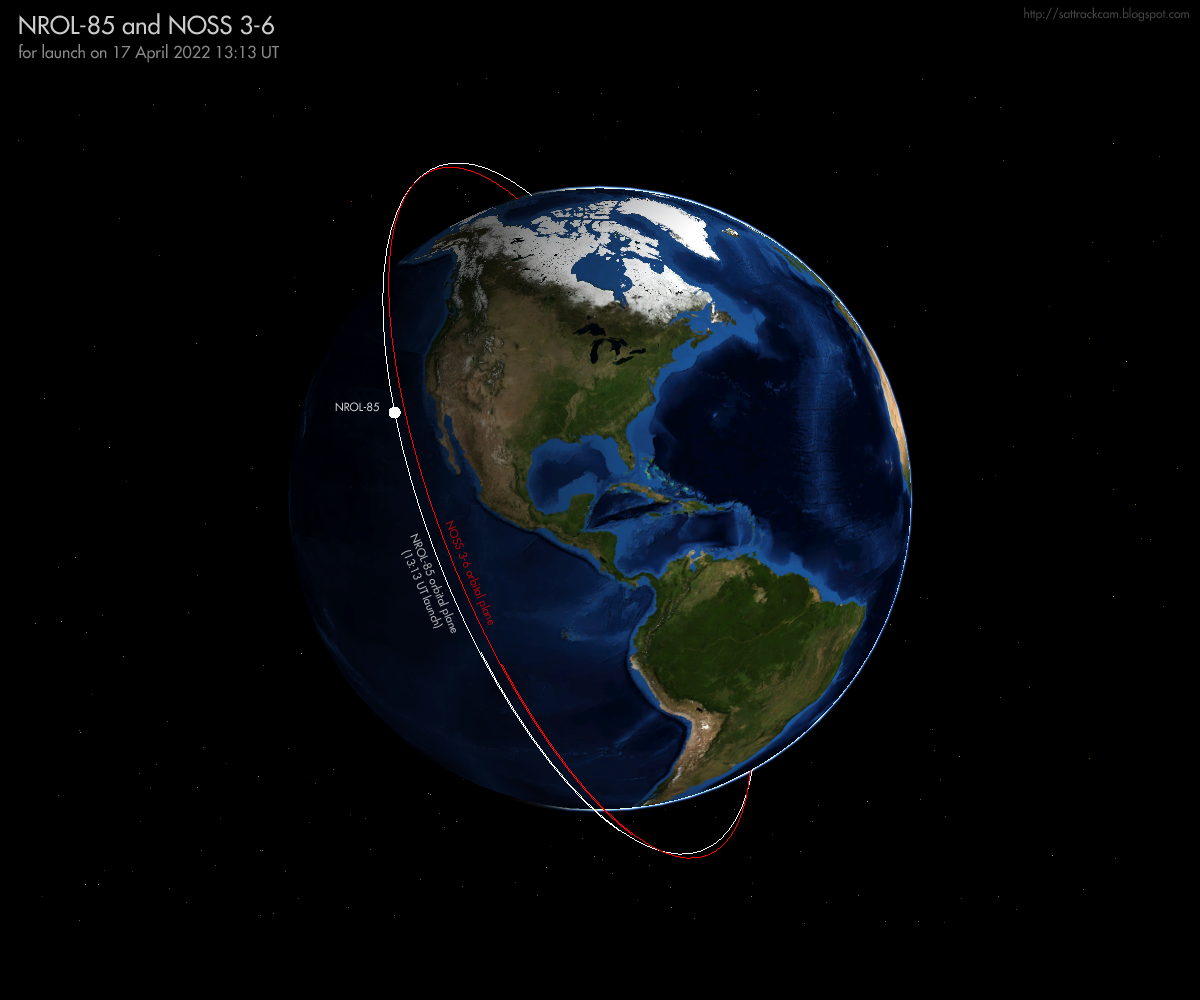
Two duo's of NOSS satellites were covering the northern half of the area at the time of the last ping-back received by Inmarsat 3-F1: the NOSS 3-5 and NOSS 3-6 duo's (2011-014A and B and 2012-048A and P).

The NOSS 3-6 duo had the best coverage, which includes the full northern arc from Thailand to Kazakhstan determined by the Inmarsat reception:

click images to enlarge
position of the NOSS 3-5 and NOSS 3-6 duo at the time of the last pingback

in 3D: yellow arc is where the aircraft could be according to the Inmarsat 3-F1 reception

Chinese SIGINT

China operates a satellite system similar to the US NOSS, consisting of three satellite trio's in the Yaogan series (Yaogan 9A, B, C; 16A, B, C; 17A, B, C). None of these however had coverage of the relevant areas in the Indian Ocean, central Asia or southern Eurasia at that time.

Coverage summary

From the brief satellite coverage analysis summed up above, it seems that the northern overland arc from Thailand to Kazakhstan was potentially well covered by various US military SIGINT satellites: five Mentor satellites, a TRUMPET and a NOSS duo. The southern Indian Ocean arc is slightly less well covered (no TRUMPET or NOSS coverage) but was nevertheless in view of several geostationary Mentor SIGINT satellites.

The question now is: could one or more of these SIGINT satellites have captured the same ACARS ping-backs received by Inmarsat 3-F1? If so, the combination of their data with the Inmarsat data could potentially narrow down the last known position of the aircraft considerably.

It all depends on whether the satellites in question were actively listening at that time, and moreover, whether their monitoring includes the radio frequencies in which the ACARS ping-backs of flight MH370 operated. It perhaps also includes questions like whether any signals received are all kept on file, or if some selection is made and much deemed of no interest is directly discarded.

Those are some big serious "ifs", that I simply do not know the answers to: this stuff is, after all, classified. So far, the US government has not indicated that one of their SIGINT systems did capture the ping-backs. Which might mean that they didn't, as I can't imagine that they did not check for it.

Classified SIGINT satellite positions in this post (and previous posts) are based on orbits calculated by Mike McCants, based on amateur observations communicated on the SeeSat-L mailing list.


Addendum 18 March 2014:
In my initial analysis posted 17/03/2014, I forgot to include two other and older geostationary US SIGINT satellites: the two Mercury/ADVANCED VORTEX satellites that are located over East Africa.


 click images to enlarge

It concerns Mercury 1  (1994-054A) and Mercury 2 (1996-026A). Both satellites were recently moved to a new orbital position over East Africa and are station-keeping there, indicating they are operational. Their footprint includes the area of interest, although the southern Indian Ocean arc is close to the edge of their coverage.

Mercury 1 imaged by the author on 29 Dec 2013

Saturday, 24 March 2012

Brightness variability of the NOSS 3-3 Centaur Upper Stage (with video)

NOSS 3-3 is a pair of US Navy NOSS surveillance satellites launched early 2005. The Centaur upper stage of this NOSS 3-3 launch, NOSS 3-3r (2005-004B) is still orbiting earth as well. And as it does so, it is tumbling.

This tumbling is visible to an observer as a regular variation in brightness. Currently, the rocket stage brightens up every 11.4 seconds.

Below video shows the regular variation in brightness: watch it go from faint to bright to faint etcetera with an 11.4 second period. It is footage from a pass over Leiden which I filmed in the evening of March 22, using the WATEC 902H and a Canon EF 2.0/35 mm lens:


click images to enlarge


Using LiMovie, I extracted the brightness variation from the movie on a frame by frame basis, resulting in the depicted brightness profile above. Note that the tops of the curve are sharp, not rounded. It is a nice saw-tooth pattern. The integrated video frame picture shows the brightness variability nicely too.

Documenting this kind of tumbling behaviour (and notably how it changes over the years) can actually provide some valuable scientific data. A number of amateur observers specialize in these "flash observations", notably my fellow members of the Belgian Working Group Satellites (BWGS).

Sunday, 20 November 2011

NOSS 3-1 A & C no longer a pair, and Lacrosse 3 is missing

On November 14th and 15th, Alan Figer from France first noted that one of the objects of the NOSS 3-1 pair (2001-040 A & C) was missing. Following up on his message, I could confirm this the next evening, using photography and video. Only one object instead of the usual close pair of two was visible:


Above is the video footage that was shot by me. What turns out to be the A-component can be seen crossing Lyra (bright star is Vega. The glow in the lower left corner is from a nearby lamp), but no C component is to be seen in this video segment (nor was it for one minute before and 3 minutes after this segment). Next, Derek Breit missed it as well in a window of 8 minutes centered on the A object pass, and so did Brad Young.

Over the past few days, two possible obervations have been made of the missing C-object, now well away from the A object, by Brad Young and Bill Arnold.

The break-up of the NOSS 3-1 pair probably means it had reached end of mission. It is interesting to see that some of the older NOSS pairs (and one trio) do still  maintain their pair bonding though..

Lacrosse 3 has gone missing - perhaps deorbitted

Another satellite, the 14 year old SAR satellite Lacrosse 3 (1997-064A) has gone missing in a more serious way. It has not been seen since early October. Several observers including me and Pierre Neirinck have done plane searches but so far, it hasn't been recovered. So it has either manoeuvered into a completely different orbit, or has been de-orbitted. If the latter is true, this possible de-orbit comes half a year after the de-orbit of Lacrosse 2 late March 2011. It leaves two remaining Lacrosses  in orbit (Lacrosse 4 and 5).

Tuesday, 30 August 2011

NOSS 2-1 (C) very bright

In the evening of August 28, during a short clearing, I was testing a new lens, the very fine Samyang F1.4/85 mm Aspherical IF.

The EOS 450D with the lens was mounted piggyback on my Meade ETX-70, with the ETX following the movement of the stars.

While making a series of images of the Deneb area, situated near the zenith, a bright naked eye satellite of mag. +1.5 passed through Cygnus and the camera field.

On the image, it turned out to be accompanied by two other satellites, much fainter. It actually was the NOSS 2-1 trio, and the bright one was the (C) component (1990-050C). Below is the image:

click image to enlarge


NOSS-es usually do not get this bright in the zenith and I have never seen 1990-050C this bright before. Scott Tilley from the USA has recently observed the same unusual brightness of NOSS 2-1(C), and so did Brad Young.

The lens I was testing, the Samyang F1.4/85 mm Aspherical IF which gets raving reviews on the internet, turns out to be an extremely fine F1.4 lens. The optical quality is astounding, and this at a cost of only €269,- !

Wednesday, 6 July 2011

PAN, and the NOSS 3-5 duo

Monday evening was a nice clear evening with a very transparent sky.

I observed the NOSS 3-5 duo (11-014 A & B), which was captured in a very fine image with a stray nearby, the rocket from the Kosmos 1697 launch (85-097B). De double parallel trail above is the NOSS duo, the single trail under an angle is the Russian rocket (bright star near trails is Deneb):

click image to enlarge


I also took opportunity of the transparent sky to target some geostationary objects low in the southeast. Targets were PAN (09-047A) and Mentor 4 (09-001A):

click image to enlarge


Tuesday, 19 April 2011

NROL-34 recovered!

NROL-34 code-named ODIN is a classified payload launched by the NRO on 15 April 2011 (last Friday), 04:24:10 UTC. The launch itself was called FRIGGA, see the launch and mission patches here.

Initially suspected to be a Trumpet destined for a Molniya orbit by independant analysts, a change of mind was promoted short before the launch by new information that suggested it to be a new NOSS pair. NOSS stands for Naval Ocean Surveillance System, and the newer NOSS typically consist of two satellites forming a close tandem.

After the launch of NROL-34 on April 15, the hunt was on to recover it: and hence for me it was very frustrating to see that a period of cloudy skies ensued at Cospar 4353!

Initial attempts by several observers to locate it according to orbit estimates published by Ted failed (see here and here). Then Mike reported an observation of what could be the NOSS duo from Texas on April 17, prompting a new orbit estimate. However, several other observers plus Mike himself next failed to recover it according to this orbit estimate (see here, here, here and here). So, the situation was very unclear: where was NROL-34, and what did Mike see?

Independant of each other, BWGS president Bram Dorreman in Belgium and me in Leiden, the Netherlands, turned back to Ted's initial orbit estimate, for a prolonged orbit plane search, yesterday evening: Bram visually, and I used the camera. This was the first clear evening allowing this. Conditions were poor, as the only potentially visible pass was very low in the west (20 degrees altitude), with a very poor phase angle and hence expected low brightness. I therefore decided to use the EF 2.8/100 mm Macro lens, as this picks up fainter objects - the trade-off is however a smaller FOV. I started the photographic survey at 20:05:20 UTC, making a continuous series of 10s exposures separated by 10 seconds each, and ended at 20:13:00 UTC.

On the 4th exposure (20:06:22.30 - 20:06:32.35 UTC), a very faint trail showed up. The trail is extremely marginal in quality, barely visible above the background noise: but it turned out to be one of the two NOSS objects (the leading one, probably) of the elusive NROL-34!

Below is (a part of) the image, with the very faint, barely visible trail marked by arrows at the start and end (you might have to adjust your monitor settings to see it, and definitely need to click the image below to full size):

click image to enlarge


After measuring the image, and finding no match to a known object, I privately mailed to Ted and Mike (and inadvertently switched the trail ends in that proces, initially reporting the trail end as the first position and the trail start as the second, instead of the correct other way around: a revised, correct report can be found here). The object passed about 4 minutes earlier than the nominal predicted pass time from Ted's initial NROL-34 elset estimate.

Meanwhile, it turned out, Bram in Belgium had visually (binoculars) picked up the same object, as well as a second object trailing it by 16 seconds. The latter probably was too faint to be photographed, as it was not visible on my images.

Based on a quick revised search orbit from Bram and my observations, Ted next picked it up a few hours later from Toronto in Canada, and Kevin Fetter observed it from the USA as well, as did Tim Luton.

So, three days after launch NROL-34 finally has been recovered. The game can now begin to further refine the orbit, and monitor any subsequent manoeuvres. The new NOSS has been given the provisional designation NOSS 3-5 by our group of amateur observers.

Later that evening, I observed IGS 1B (03-009B: see my post on the expected re-entry of this object a year from now here) and the KH-12 USA 186 (05-042A), as well as (as strays) a duo of Globalstars, Globalstar 4 (98-008D) and Globalstar 37 (99-012D), trying to impersonate a NOSS (as if the evening wasn't already confusing enough!).

Sunday, 30 January 2011

Satellites near the Pleiades

Yesterday evening (Saturday 29 January) some satellites seemed to be in love with the Pleiades. In a somewhat hazy sky, I observed Lacrosse 3 (97-064A) cruising near the Pleiades and Hyades in twilight, and half an hour later watched the NOSS 3-4 duo (07-027 A & C) cruise right through the Pleiades.

Below are the resulting images. The top image of the NOSS duo cruising through the Pleiades (movement is from top to bottom, with 07-027A leading) was made using the Canon EF 100/2.8 Macro USM lens: the images of Lacrosse 3 were made using the EF 50/2.5 Macro lens.

click images to enlarge


The FIA Radar 1 (10-046A) was imaged as well. Unlike a few nights ago, it did not flare.

The previous night had a better quality sky, so I targetted a few geostationary satellites low above the horizon. Classified geostationary targets imaged were PAN (09-047A), Mentor 2 (98-029A), Mentor 4/USA 202 (09-001A) and the Milstar 5 r/b (02-001B). A number of commercial geostationary satellites were captured as well.

Below image, taken with the Carl Zeiss Jena Sonnar MC 2.8/180mm, shows PAN with the nearby commercial geostationary Yamal 202 (03-053A).

click image to enlarge


The image below, taken with the EF 2.5/50mm Macro, shows Mentor 2, with the stars of Orion's belt and Orion's nebula M42 at left:

click image to enlarge


I also accidentally captured a mag. +2.5 sporadic meteor in one of the images taken with the Carl Zeiss 180 mm (FOV only 5 x 7 degrees!):

click image to enlarge