Showing posts with label NOSS 3-6. Show all posts

Tuesday, 4 September 2018

Capturing a flaring NOSS duo (NOSS 3-6)

click to enlarge

On 30 August 2018 near 20:59 UT I was imaging the NOSS 3-6 duo (2012-048A & 2012-048P) during a near-zenith pass, when they briefly flared. They were at a sky elevation of 77.5 degrees at that time.

The image above is a stack of the video frames showing the flaring spacecraft: the flare of the leading P component was captured just before it peaked (I was adjusting the camera FOV during the seconds before it), the flare of the A component was captured in its entirety. Below is the video itself from which these frames were extracted (video shot with a WATEC 902H + Canon FD 1.8/50 mm lens):


I next used LiMovie to analyse the video and extract brightness curves from the video frames, with the following results. The data points shown are 3-point averages of the raw data. small discontinuities visible in the curves are where the satellite passed a star:

click diagram to enlarge

click diagram to enlarge

The leading P component seems to exibit only one flare peak. The traling A component shows an interesting  double or tripple peak. The centroids of the peaks of the P and A component were some 6.5 seconds apart.

In the diagram below, I have transposed both curves on each other by shifting the curve for the A component along both axes untill it matches that of the P component:

click diagram to enlarge

What can be seen is that the curve for the A component pre- and post-peak follows the pattern of that of the P component, but unlike the P component it shows a pronounced valley at the peak, with a small secondary peak in the valley bottom. The shape of the valley is the inverse of the peak shape of the P component. Intriguing!

The rather sudden change in steepness some seconds before and after the peaks as shown by both components is interesting too. The main peak shape is slightly asymmetric.

One option for the difference in the shape of the curve for the A component (i.e. for the "valley"at the top) might be the presence of a rotating component interfering with the flare pattern caused by the satellite body, perhaps.

NOSS (Naval Ocean Surveillance System) satellites are SIGINT satellites operated by the US Navy to locate shipping, based on geolocation of the ship's radio emissions. They are also known by the code name INTRUDER. They always operate in close pairs, such as can be seen on the video.

The P component peaked at 20:59:11.85 UT (Aug 30, 2018), at position RA 313.222 DEC +45.628. The A component has a first major peak at 20:59:17.33 UT at RA  313.331 DEC +45.077; the small secondary peak at 20:59:18.37 UT at RA 313.765 DEC +45.307; and a third major peak at 20:59:19.33 UT at RA 314.170  DEC +45.518. The two major peaks are 2.0 seconds apart.

Monday, 17 March 2014

Open Question: Could US Military SIGINT satellites help to narrow down flight MH370's last location?

Please note: this post contains discussions of a highly speculative nature

Over the past days, it has become clear that the lost Malaysian Airlines flight MH370 has flown on for some 7 hours after contact was lost at 17:20 UT (March 7 UT, local March 8). This information comes from radio "ping-backs" of the aircraft's ACARS system received by the Inmarsat 3-F1 satellite, a geostationary communications satellite that is located at longitude 64 E over the Indian Ocean. These ping-backs were received hours after the last radio contact with the pilots and hours after the transponder was shut off, and indicate that the aircraft was still powered and 'alive' hours after it disappeared. A well written story at the CNN website gives backgrounds on the receptions and the system.

Position and footprint of Inmarsat 3-F1
click image to enlarge

In this post, I will briefly summarize how Inmarsat 3-F1 detected the aircraft and determined a wide arc where the aircraft could have been at that time. I will then explore whether additional signal receipts by classified US Military Signals Intelligence (SIGINT) satellites might perhaps have been possible. If such additional receptions exist (an open question!) they would enable to further narrow down the location of the last ping-back.

That will largely be a theoretical exercise, as so far there has been no word that the US SIGINT satellite constellation did detect these ping-backs. This post therefore entails a clear element of speculation, and the central question remains an explicit open question.


Backgrounds: 'Marco Polo' between an aircraft and a satellite

Someone in the aircraft shut off the radar transponder beacon and the active ACARS messaging system near 17:20 UT. Yet this did not fully disable the ACARS system. The system kept answering periodic "pings" by the Inmarsat 3-F1 (1996-020A) satellite. These "pings", basically a kind of "Marco?" message,  are periodically sent out by the satellite and when received by the aircraft ACARS antenna, the aircraft pings back a brief "handshake" basically saying "Polo!". While such a handshake does not contain clear information about where the aircraft is when the active ACARS is disabled, it does contain the aircraft ID.

According to press reports, the last ping-back from flight MH370 was received 7 hours after the flight disappeared, near 00:11 UT on March 8. Apparently, only Inmarsat 3-F1 received these ping-backs.

From the time it took the radio-ping to travel from Inmarsat 3-F1 to the aircraft and then back again, the distance (but not direction) of the aircraft to the satellite can be determined. For example, at a radiowave speed of 300 000 km/s, a time difference of say 0.2 seconds between Inmarsat sending the ping and receiving the answer back, indicates the aircraft is at a distance of 30 000 km from the satellite.

Once you know the distance, you can draw a globe with that radius around the location of the Inmarsat satellite. Where that globe cuts the earth surface, it creates a circle, centred on the sub-satellite point. The aircraft must have been somewhere on that circle. This is basically how the wide arc that has been published was constructed, an arc which runs from Thailand to Kazakhstan in the north, and Indonesia to Australia and the Indian Ocean in the south. The aircraft could have been anywhere on that big arc, an area stretching thousands of kilometers.


To pinpoint the aircraft more accurately to a particular spot in the arc, one needs a detection by a second and preferably a third satellite.


Could US SIGINT satellites provide additional receptions for these pings?

One source of such additional ping-back signal receptions, in theory could be one of several Signals Intelligence (SIGINT) satellites employed by the US military. Please note that I say IN THEORY as the US government hasn't provided any statements that they did (which might indicate that they didn't). In other words: I am speculating on an open question here.

It depends on a lot of factors, not the least of which are questions whether these satellites were listening at the time, and whether they were monitoring the particular VHF/UHF radiofrequencies in question. Those are questions I do not have the answers to. What I will do, is discuss which US military satellites could potentially have received these ping-backs because they had coverage of the area.

1. The Mentor and Trumpet SIGINT satellites

Two US SIGINT systems in high orbits cover(ed) the relevant area: (1) several of the very large Mentor/Advanced Orion SIGINT satellites in geostationary orbit: and (2) one of the SBIRS/TRUMPET combined SIGINT and SBIRS satellites which moves in a Highly Elliptical Orbit and hovered high above the northern hemisphere at the time.

These SIGINT satellites serve to eavesdrop on radio communications including satellite- and mobile telephony, missile telemetry and signals from groundbased and airborne radar systems.

USA 184 TRUMPET imaged on 25 Aug 2009 by the author

 Mentor 4 imaged on 18 Nov 2012 by the author


The TRUMPET satellite in HEO which had coverage of (a part of) the area at that time is  USA 184 (2006-027A). The geostationary Mentor satellites covering the area are Mentor 1, 3, 4, 5 and 6 (1995-022A, 2003-041A, 2009-001A, 2010-063A and 2012-034A).

Position of various Mentor satellites and TRUMPET USA 184
Mentor satellite footprints


USA 184 area coverage and footprint detail
click image to enlarge

2. NOSS (Naval Ocean Surveillance System) SIGINT satellites

Apart from the Mentor and Trumpet SIGINT satellites in high orbits, the US also operates a series of SIGINT satellites with accurate geolocalization capabilities in a Low Earth Orbit. It concerns the US Navy Naval Ocean Surveillance System (NOSS) satellites, of which there are several. They operate in close pairs, orbiting at an altitude of about 1000 x 1200 km in 63 degree inclined orbits. Their main purpose is to locate and track shipping through the radio communications of the latter.

A NOSS duo (NOSS 3-4) imaged by the author on 29 Jan 2011


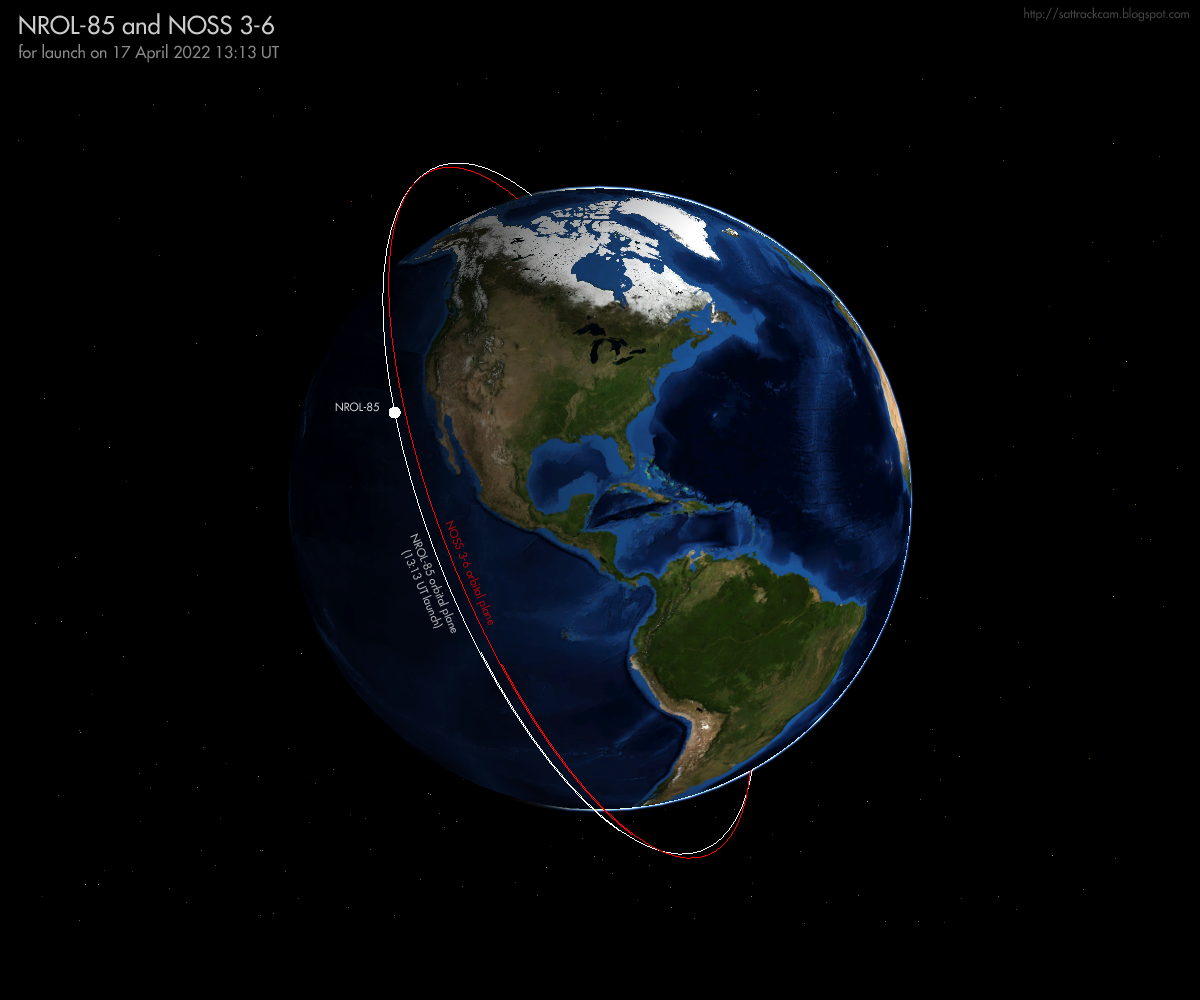
Two duo's of NOSS satellites were covering the northern half of the area at the time of the last ping-back received by Inmarsat 3-F1: the NOSS 3-5 and NOSS 3-6 duo's (2011-014A and B and 2012-048A and P).

The NOSS 3-6 duo had the best coverage, which includes the full northern arc from Thailand to Kazakhstan determined by the Inmarsat reception:

click images to enlarge
position of the NOSS 3-5 and NOSS 3-6 duo at the time of the last pingback

in 3D: yellow arc is where the aircraft could be according to the Inmarsat 3-F1 reception

Chinese SIGINT

China operates a satellite system similar to the US NOSS, consisting of three satellite trio's in the Yaogan series (Yaogan 9A, B, C; 16A, B, C; 17A, B, C). None of these however had coverage of the relevant areas in the Indian Ocean, central Asia or southern Eurasia at that time.

Coverage summary

From the brief satellite coverage analysis summed up above, it seems that the northern overland arc from Thailand to Kazakhstan was potentially well covered by various US military SIGINT satellites: five Mentor satellites, a TRUMPET and a NOSS duo. The southern Indian Ocean arc is slightly less well covered (no TRUMPET or NOSS coverage) but was nevertheless in view of several geostationary Mentor SIGINT satellites.

The question now is: could one or more of these SIGINT satellites have captured the same ACARS ping-backs received by Inmarsat 3-F1? If so, the combination of their data with the Inmarsat data could potentially narrow down the last known position of the aircraft considerably.

It all depends on whether the satellites in question were actively listening at that time, and moreover, whether their monitoring includes the radio frequencies in which the ACARS ping-backs of flight MH370 operated. It perhaps also includes questions like whether any signals received are all kept on file, or if some selection is made and much deemed of no interest is directly discarded.

Those are some big serious "ifs", that I simply do not know the answers to: this stuff is, after all, classified. So far, the US government has not indicated that one of their SIGINT systems did capture the ping-backs. Which might mean that they didn't, as I can't imagine that they did not check for it.

Classified SIGINT satellite positions in this post (and previous posts) are based on orbits calculated by Mike McCants, based on amateur observations communicated on the SeeSat-L mailing list.


Addendum 18 March 2014:
In my initial analysis posted 17/03/2014, I forgot to include two other and older geostationary US SIGINT satellites: the two Mercury/ADVANCED VORTEX satellites that are located over East Africa.


 click images to enlarge

It concerns Mercury 1  (1994-054A) and Mercury 2 (1996-026A). Both satellites were recently moved to a new orbital position over East Africa and are station-keeping there, indicating they are operational. Their footprint includes the area of interest, although the southern Indian Ocean arc is close to the edge of their coverage.

Mercury 1 imaged by the author on 29 Dec 2013

Monday, 24 September 2012

Imaging a near-zenith pass of the new NOSS 3-6 pair (NROL-36)

As I wrote earlier, the NRO launched a new pair of NOSS satellites, NOSS 3-6,  on September 13th, as NROL-36. Two days after the launch, I got my first look at these objects, albeit under very poor conditions (see my post here).

Sunday morning, 10 days after the launch, the cloud cover broke and I finally got a renewed and much better view of the two NOSS objects and the Centaur r/b from the launch, during a near-zenith pass. Some very thin cirrus clouds (dispersed aircraft contrails in part) were in the sky. These eerie pictures, taken shortly after 5 am local time on the 23rd, are the result (click them to appreciate them in full glory):

(click images to enlarge)
the NOSS 3-6 duo

the NOSS 3-6 Centaur r/b

The top image shows the payloads, 2012-048A and 2012-048P, traversing Perseus (alpha Persei star association in top). The P-object is leading over the A-object: movement is from lower right to upper left. I could see both payloads naked-eye, at about mag. +4.

Currently, the two satellites are still notably further apart than operational NOSS-es are, as they are still in the process of active manoeuvering. Ted Molczan believes that eventually, the A-object will probably overtake the P-object and become the leading object once the final operational configuration is reached.

The second image shows the Centaur r/b (2012-048N) traversing the Cassiopeia-Perseus border (h and chi Persei in top, stars of Cassiopeia near the bottom). It was very bright, initially +1 just after shadow exit, then +2. I could see no clear periodic brightness variation: the slow tumbling that was apparent in the days right after lauch and which might have been due to remnant fuel outgassing according to Ted Molczan, apparently has subdued.


The USA 237 r/b

On the 16th, I imaged the geostationary satellite USA 237, which is perhaps a 6th Mentor (see the bottom part of my previous post here).

On the 19th, I used the 37-cm Rigel Cassegrain of Winer Observatory (MPC 857) in Arizona to image the USA 237 r/b of this launch (2012-034B) :

(click image to enlarge)


In addition to the USA 237 r/b, I also did one of my periodic observations on Prowler (90-097E) that same night using the same telescope.

Monday, 17 September 2012

Tracking the new NOSS 3-6 (NROL-36) launched September 13th, and imaging USA 237 (NROL-15) and SDS 2-2

NROL-36 (NOSS 3-6)

At 21:39 UTC on September 13th, 2012, the NRO launched NROL-36 from Vandenberg AFB. The launch vehicle was an Atlas V containing a classified NRO payload in addition to a number of cubesats. Several analysts already suspected the classified payload of this launch to concern a new duo of US Navy NOSS satellites.

That suspicion appears to be born out by the first observations of the launched objects, which show two satellites in close formation, typical of a NOSS formation.

The Centaur last stage was the first object from this launch to be observed, by Björn Gimle in Sweden, who observed it 5 hours after launch, and then by BWGS chair Bram Dorreman in Belgium 1.5 hours later, who remarked it was variable in brightness. Alas I was clouded out in Leiden at that moment. Eleven hours after launch, Kevin Fetter in Canada observed it next. Over the following day Russell Eberst in Scotland and Scott Tilley in Canada added more observations.

The payloads were first observed by Kevin Fetter in Canada near 9:43 UTC (Sep 14), 12 hours after launch. Scott Tilley, also in Canada, next observed them on the 15th near 12:34 UT.

On the morning of the 16th, 2 days and 5 hours after the launch, it was clear in Leiden allowing me to join the chase. I (photographically) observed the Centaur r/b pass at 2:49 UTC (see image below) and then the payloads at 2:55 UTC (Sep 16).

The NROL-36 Centaur booster
(click image to enlarge)

The observations were done under difficult conditions: it was somewhat hazy, the passes were at very low altitude due east (only 14 degrees elevation for the Centaur and 21 degrees elevation for the payloads), and the phase angles for the objects were unfavourable, resulting in dim magnitudes (around +7 for the payloads). The resulting images (one of them below) are therefore not quite pretty: even with use of the 1.4/85mm SamYang lens the trails were so faint that they were marginally visible at best. As reported earlier by Scott Tilley, the leading object indeed seemed to be somewhat variable (on some images it wasn't visible at all).

The NROL-36 payloads (NOSS 3-6)
(click image to enlarge)

Over the next days, I'll hopefully be able to obtain much better imagery during more favourable passes (this morning I was alas clouded out again, however....)


USA 237 (Mentor 6?)

That same morning, following the NROL-36 related observations, I took a few images of the area near the bright geostationary Mentor 4 (USA 202, 2009-001A). These images not only recorded this 3-year-old Mentor, but also the geostationary satellite USA 237 (2012-034A), a classified NRO payload launched from Cape Canaveral as NROL-15 on 29 June 2012, employing an Atlas IV-Heavy as launch vehicle.

These were my first observations of this object: tracking of this object over the summer was done mostly by Greg Roberts in South Africa (who was the first to discover the object) and Peter Wakelin in Britain. Over the summer it had slowly been drifting westwards: as of mid-September 2012 it appears to have stabilized at 47.8 E. For me in Leiden it is currently located at 20 degrees elevation in azimuth 129 degrees (low SE), about 6 degrees separated from Mentor 4 in the sky.

USA 237 (NROL-15)
(click image to enlarge

The identity of this object is still provisional. There have been some thoughts that NROL-15 launched a stealth Misty satellite in LEO/MEO and then progressed to put a decoy (the object designated as USA 237) in geostationary orbit. USA 237 is very bright however (about mag. +8), ranking it among the brightest geostationary objects in the sky, the Mentor SIGINTs. As Ted Molczan showed, they seem very similar in terms of absolute brightness. The likeliness can be well seen in the photographic comparison below, which shows Mentor 4 and USA 237 (the crops come from one and the same image):

(click image to enlarge)

This gives reason to think that NROL-15/USA 237 is perhaps a sixth Mentor SIGINT (i.e., it is Mentor 6).


SDS 2-2

As by-catch of the NROL-36 payload and Centaur observations, I also obtained my first observations of the geostationary SDS satellite SDS 2-2 (USA 67, 1990-097B). It is located at an elevation of only 16.5 degrees, very low in the east for me. To my surprise, it was rather bright and easily visible in the 5-second exposures, of which the one below is one:

 (click image to enlarge)