Showing posts with label flare. Show all posts

Tuesday, 4 September 2018

Capturing a flaring NOSS duo (NOSS 3-6)

click to enlarge

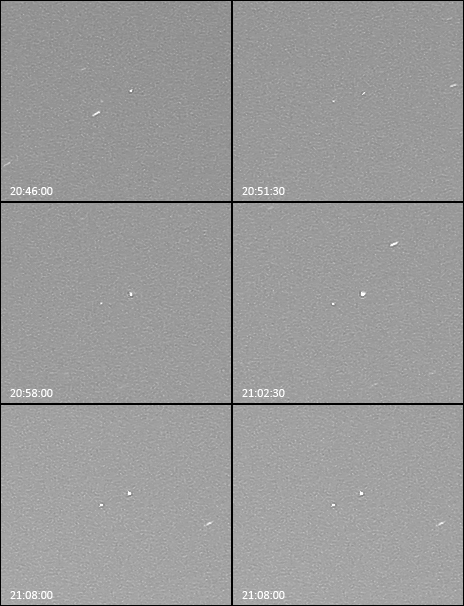
On 30 August 2018 near 20:59 UT I was imaging the NOSS 3-6 duo (2012-048A & 2012-048P) during a near-zenith pass, when they briefly flared. They were at a sky elevation of 77.5 degrees at that time.

The image above is a stack of the video frames showing the flaring spacecraft: the flare of the leading P component was captured just before it peaked (I was adjusting the camera FOV during the seconds before it), the flare of the A component was captured in its entirety. Below is the video itself from which these frames were extracted (video shot with a WATEC 902H + Canon FD 1.8/50 mm lens):


I next used LiMovie to analyse the video and extract brightness curves from the video frames, with the following results. The data points shown are 3-point averages of the raw data. small discontinuities visible in the curves are where the satellite passed a star:

click diagram to enlarge

click diagram to enlarge

The leading P component seems to exibit only one flare peak. The traling A component shows an interesting  double or tripple peak. The centroids of the peaks of the P and A component were some 6.5 seconds apart.

In the diagram below, I have transposed both curves on each other by shifting the curve for the A component along both axes untill it matches that of the P component:

click diagram to enlarge

What can be seen is that the curve for the A component pre- and post-peak follows the pattern of that of the P component, but unlike the P component it shows a pronounced valley at the peak, with a small secondary peak in the valley bottom. The shape of the valley is the inverse of the peak shape of the P component. Intriguing!

The rather sudden change in steepness some seconds before and after the peaks as shown by both components is interesting too. The main peak shape is slightly asymmetric.

One option for the difference in the shape of the curve for the A component (i.e. for the "valley"at the top) might be the presence of a rotating component interfering with the flare pattern caused by the satellite body, perhaps.

NOSS (Naval Ocean Surveillance System) satellites are SIGINT satellites operated by the US Navy to locate shipping, based on geolocation of the ship's radio emissions. They are also known by the code name INTRUDER. They always operate in close pairs, such as can be seen on the video.

The P component peaked at 20:59:11.85 UT (Aug 30, 2018), at position RA 313.222 DEC +45.628. The A component has a first major peak at 20:59:17.33 UT at RA  313.331 DEC +45.077; the small secondary peak at 20:59:18.37 UT at RA 313.765 DEC +45.307; and a third major peak at 20:59:19.33 UT at RA 314.170  DEC +45.518. The two major peaks are 2.0 seconds apart.

Saturday, 14 March 2015

Prowler captured flaring again

On June 10 of last year (2014) I captured a brief bright flare of Prowler (1990-097E) when imaging it 'remote' with the 0.61-m Schmidt-Cassegrain of MPC G68 Sierra Stars Observatory in California, USA.

Last week on March 7, Prowler again briefly flared while I was imaging it with the same telescope, Note the brightening of the trail near the left end of it:


It is a flare of the same short specular type as that of last year. It was captured in one of three brief 30-second exposure  images taken near 03:45UT: the flare is close to the end of the trail in the second image, i.e. occuring at about 03:45:10 UT (March 7, 2015). Here is a stack of all three images:


These brief specular flares are superimposed on what seems to be another, very slow periodicity in brightness.

Prowler itself is a very interesting, enigmatic object. It was a clandestine launch from Space Shuttle STS-38 in 1990 and long existed in the realm of rumours only. It was a top secret experimental  satellite with stealth characteristics, meant to make close inspections of third party satellites in GEO orbit. I have written an extensive in-depth post on the story of Prowler before which you can read here.

Friday, 28 March 2014

A flare show by USA 245

Wednesday evening saw a dynamic atmosphere, where clear skies intermittently were broken by fields of fast moving scattered clouds.

I targeted all three West plane KH-11 Keyhole/CRYSTAL satellites that evening: USA 129 (1996-072A), USA 186 (2005-042A) and USA 245 (2013-043A).

USA 245 had a pass during a period where patches of clouds occupied the southern sky up to the zenith. The image below shows it rising through Leo, over the roof of my house, amidst scattered clouds:

click image to enlarge

USA 245 twice flared brightly during this pass. Such flares are caused when a reflective surface on the satellite (solar panels, an antenna panel, a dish or some other part of the structure) acting like a mirror reflects sunlight directly towards the observer. I love it when they do that, it is always spectacular.

The first flare was a slow bright one up to magnitude -2 peaking near 20:27:28 UTC (26 March) just above the back of Leo:

click image to enlarge

One-and-a-half minutes later at 20:29:03.64 UTC, while passing through Uma, it flared again, a more brief glint/flare to magnitude -1:

 click images to enlarge

USA 129 was also observed, low in the west while emerging from earth shadow. It only faintly registered on one image, allowing one position determination. USA 186 was not seen, but this was likely due to unfavourable circumstances (it was too faint for the lens used) as Cees Bassa did observe it, on-time, the next day.

Monday, 13 August 2012

CBERS 2B flash pattern

click image to enlarge

Last night I set up the camera with a Tamron 2.8/17-50mm lens set at f3.2/17mm to run automatically (using an Aputure timer), in order to catch some Perseids.

AS part of the image series, I captured a satellite showing a regular flash pattern. The top image above is a stack of 7 images of 20s each, showing the repeated flashing (including a brighter flare).

It turned out to be CBERS 2B (07-042A) which was launched from China on 19 September 2007 as the third Chinese-Brazilian Earth Resources Satellite. It ceased operations in June 2010.

By measuring the positions of the flashes and relating these to a recent TLE, I was able to determine the flash pattern. It is a combination of two series: one with flashes each 23.7s (series a), and another one (which includes the bright flare) with flashes each 47.4s (series b). The latter is the double of the series a period. The sequence of flashes is a-a-b-a-a-b-a-a-b but the b-flashes are not nicely in the middle of the a-series flashes.

click diagram to enlarge

The two series probably relate to different reflective surfaces. The flashes from series a are conspicuously orange, while those from series b are bluish-white.

click image to enlarge

As can be seen on the CBERS website, the satellite body itself is wrapped in orange insulation foil, suggesting the orange flashes could be reflections from the satellite body. The bluish-white flashes could be from the solar panels. The satellite would then rotate once each 94.8 seconds during which 2 solar panel flares and 4 body flares (4 sides of the cubus) can be seen.

CBERS 2B was not the only satellite captured flaring this night: I'll report on the other later. Amongst others, Envisat was seen flaring again.

Perseids

I indeed captured some meteors as well: 7 Perseids and one sporadic meteor. Here is a nice Perseid:

click image to enlarge

Thursday, 9 August 2012

ENVISAT and other satellites flaring over the Italian Dolomites

During the second half of July, I travelled through northern Italy, including an 8-day mountain hike from mountain hut to mountain hut through the high Alpine parts (up to 2770 m) of the Rosengarten Dolomites. The latter mountains are truely marvelous, and perhaps the most beautiful mountains I have ever seen.

During two clear evenings I did some limited astrophotography: limited, as because of weight considerations I had only two lenses with me  (a Canon EF 100mm Macro and a Tamron 17-50mm zoom) . After all, we already had to carry 16 kg on our backs every day while scaling the mountain.

click image to enlarge


The image above was shot at 2238m altitude from Rifugio Vajolet on July 23rd. It shows ENVISAT (02-009A) flaring. Since contact with this legendary Europe remote sensing satellite was lost on 8 April 2012, it appears to have started to tumble. Two brightness maxima (one brighter and one fainter preceding it) are visible on the original of the above 30 second exposure, and other (faint) maxima are visible on an earlier and on subsequent images.

click image to enlarge


A 45 image series (30s exposure each) from the same location was used to create the above image of startrails circling the celestial pole. The mountain at right is the 3004m high Kesselkügel.

click image to enlarge


A few days earlier (16 July), while at lower altitude (1188m) in Aldein (Aldino) where we visited the nearby Bletterbachschlucht, I shot this image of a double Iridium flare. The brighter of the two is Iridium 63, the other one is Iridium 14. The classified Japanese satellite IGS 7A (11-075A) can be seen as well as a fainter steady trail near the center of the image (the original image has 3 more very faint satellite trails as well). The bright star top right is Arcturus.

All images were made with a Canon EOS 60D at 2000 ISO (and part of image series driven by a programmable timer) using a Tamron 2.8/17-50mm set at 17mm.

Friday, 23 March 2012

Video of Metop-A (06-044A) flaring brilliantly


click images to enlarge


Metop-A (06-044A) is the first operational satellite in a planned series of European meteorological (weather) satellites. It was launched on 19 October 2006. Among satellite observers, it is known for frequently producing very bright flares. These flares occur when the solar panels reflect sunlight to the observer on Earth.

I captured such a flare with my video system yesterday evening: see the video above. The brilliant flare reached mag. -2 at 20:11:11.2 UTC (22 March 2012) and had a FWHM of 6.0 seconds.

Below the video is an integration of all the video frames, and a diagram of the brightness profile (made using LiMovie, wonderful software by Kazuhisa Miyashita). Camera was a WATEC 902H with Canon EF 2.0/35mm lens.

My GPS time-inserter unfortunately lost signal about a minute before the flare - hence why the display says "Bad GPS" in the video. Fortunately, in the preceding minutes I had recorded enough of time-signal in the video to extrapolate the time using the video frame rate. Hence, I am quite confident about the accuracy of the brightness profile.

Wednesday, 21 September 2011

Eternal circling of the sky - and a METOP-A flare

As I pointed out in my previous post, the evening of 19 September was reasonably clear (the odd streak of clouds every now and then).

After I observed USA 129 (and incidentally Topex flashing nicely, see previous post), I set up the camera with the automated wire release for a long series of images on the celestial pole, using the EF 2.8/24mm wide angle lens.

click image to enlarge

 Result is above "classic" star trail image, showing the eternal circling of the sky around the celestial pole. It was constructed by stacking 165 images of 15 seconds each, shot over a time interval of 44 minutes. Note that the Polestar makes a small circle segment too - it is not exactly at the celestial pole.

The long crossing lines are aircraft (I am close to a major airport). The near-vertical trail in the upper left corner is a satellite flare however: the European weather satellite METOP-A (06-044A).

Below is a detail from the single image that showed the METOP-A flare (at about 20:37:55 UTC, 19 September). Very faintly, the double trail of a NOSS duo, NOSS 3-2 (03-054 A & C) can be seen as well. As this part of the image is close to the image edge, it suffers a bit from coma with this wide angle lens.

click image to enlarge

In the old days of analogue photography, a 44 minute star trail image like this would not have been possible from my urban locality: the image would have fogged too much. Modern digital and especially image stacking techniques, make it possible.

Friday, 2 September 2011

SPECTACULAR flare by IGS 1B!


Click images to enlarge! Do!

This picture speaks for itself. When this happened, I was jumping up and down in excitement, shouting "WOHOOOOO!!!!".

The picture shows the malfunctioned Japanese spy satellite IGS 1B flaring to at least magnitude -8 in Hercules (M13 can be seen as a fuzzy "star" in the picture) at 20:58:40 UTC (2 Sept 2011). It rivalled the best of Iridium flares.

Image shot with the Canon EOS 450D + EF 2.5/50mm Macro, 800 ISO. It was somewhat hazy with a few contrails in the sky, one of them lighting up around the flare for added drama.

Needless to say, I was extremely happy that this happened while the camera was open...

Tuesday, 23 August 2011

Progress M-11M, and a spectacular flare by IGS 1B

At 9:35 UTC on 23rd August 2011, the Progress M-11M spacecraft (2011-027A) which had been attached to the International Space Station (ISS) since June was decoupled from the latter. It will orbit earth on its own for 9 days and will do various measurements, before being de-orbited to burn up over the Pacific.

On the evening of the 23rd near 20:29 UTC (22:29 local time) I watched them both during a fine near-zenith pass. The Progress spacecraft was about 1 minute ahead of the ISS in time, and attained a maximum brightness of mag. +0.5. Below two images show the Progress (top image) and the ISS a minute later(bottom image), both in Lyra:

click images to enlarge


Next I observed the IGS 5 rocket (09-066B), and IGS 1B (a malfunctioned Japanese spy satellite that is up for an uncontrolled re-entry in 2012-2013, see here). Both objects flared.

The IGS 5 rocket stage flared to mag. -0.5 at about 20:35:55 UTC. But IGS 1B (03-009B) flared much more spectacularly, to at least mag. -3 at 20:43:01 UTC, while passing through the zenith! An image of this splendid flare (captured close to the edge of the image) is the top image below, while the bottom image shows it while ascending in the south, just west of Altair:

click images to enlarge


Wednesday, 1 June 2011

More flashing NanoSail-D, and flaring KH-12 USA 224

A week after my May 24 observations, I observed NanoSail-D (2010-062L) again, the experimental NASA solar sail.

NanoSail-D (image: NASA/MSFC)

As a week ago, it became very bright after culmination, while descending in the south, and was rapidly flashing again. It was easily seen by the naked eye, reaching mag. +1 or possibly +0.5.

In fact it is so bright, that the pixel brightness of the trail reached saturation on two of the three images. The first image (below) did yield brightness information: the resulting curve is shown beneath it. The flash period is irregular, but periods of 0.5s and 1.0s pop up frequently in the diagram (for actual determined flash times, see here. Astrometry on the satellite itself can be found here).

click images to enlarge


As can be seen on the images, the satellite was in a race with an untimely field of clouds (the orangish streaks in the images), staying just ahead of it. Visually, the brightness fluctuation was much more apparent than it is on these images (due to the saturation of the latter): it was very clearly flashing.

Nanosail-D was not the only object flashing. USA 224 (11-002A), the new KH-12 Keyhole launched on January 20 this year, flared too, while passing through the zenith, with flares at 23:48:27.3 and 23:48:31.8 UTC (May 31). The "saddle" and elevated brightness between the two flares is interesting (the trail is notably fainter before the first flash, and subsequent images show it is fainter again after the second flash):

click images to enlarge


This was the second time I imaged USA 224 (The first time was May 24). In addition to USA 224 and NanoSail, I also imaged another KH-12 Keyhole, USA 161 (01-044A), and a Lacrosse SAR, Lacrosse 3 (97-064A).

Friday, 22 April 2011

KH-12 USA 129 flaring: and IGS 1B again

A period of sunny weather commenced the past week, albeit with a trend towards increasing hazyness. I observed on the 19th, 20th and 21st of April, targets being the evening KH-12's USA 129 (96-072A) and USA 186 (05-042A), as well as IGS 1B (03-009B). An attempt to locate the geostationary satellite Mentor 2 (98-029A) on the 20th failed, probably because of the poor observing conditions.

Yesterday evening (21st April) the sky was quite hazy with, during twilight, abundant whisps of thin clouds. USA 129 (96-072A) slowly flared to mag. 0 at about 19:56:15 UTC, and the resulting picture of the flare amidst thin clouds in a still bluish twilight sky, looks very eerie:

click image to enlarge


Some what later, I made this shot of IGS 1B (03-009B) gracefully sailing through Bootes:

click image to enlarge


My story about the re-entry of the above pictured malfunctioned IGS 1B satellite in about a year from now, has been picked up, notably after Jim Oberg reposted it on the NASA Spaceflight Forum here. Two journalists contacted me with questions, and my post itself attracted some US Government attention (when the Executive Office of the President visits your weblog, you know it is being taken serious). So I guess some people have woken up now, and hopefully we will soon see a serious risk assessment and more pertinent information by the Japanese as to the tank content of the satellite.

Friday, 15 April 2011

IGS 5r flaring, and more USA 129 KH-12 in perigee

Over the past week I was able to observe on April 8, 9 and 12. I already reported on my April 9 observations of the new USA 227 (NROL-27) geostationary SDS here.

On April 12, I observed the Japanese optical reconnaissance satellite IGS 5A (09-066A) and the rocket that launched it, the IGS 5 rocket (IGS 5r, 09-066B), as well as the old American experimental satellite MSX (96-024A).

To my surprise, the IGS 5 rocket treated me on a bright slow mag 0 flare at about 20:43:27 UTC while it was making a pass in the east, near the tail of the Big Dipper. Below image shows the slow flare, with as an inset a second image made 20s later, showing it at its more usual brightness:

click image to enlarge


MSX
displayed a brief modest flare as well (mag. +1) at about 21:28:43 UTC.

IGS 1B (03-009B), another, older (and now defunct) Japanese IGS, was captured as well ( I will post more on IGS 1B shortly, probably at the end of next weekend, as it is coming down within a year from now):

click image to enlarge


The KH-12 optical reconnaissance satellite USA 129 (96-072A) was still making near-perigee passes over the SatTrackCam observatory, resulting in fast passes and long trails. I had to revert to the 24 mm wide-angle lens to avoid the object running out of the FOV.

Below are two images showing it ascend over the rooftop of the SatTrackCam observatory. The first image shows it in the front body of Leo: the second image shows the head and front body of Leo at left, Castor and Pollux in Gemini at right, the head of Hydra in the bottom, and the trail of USA 129 close to the M44 (Praesepe) cluster in Cancer:

click images to enlarge


Sunday, 20 March 2011

Flaring Keyholes in a moonlit sky, and a BWGS meeting

The "Supermoon" of yesterday was not my only observational target. The sky was very transparent, and hence even with this full "supermoon" low in the southeast, conditions were fine for satellite observations.

I imaged two Lacrosses and two KH-12 Keyholes: Lacrosse 3 (97-064A), Lacrosse 5 (05-016A), USA 129 (96-072A) and USA 186 (05-042A). In one of the images, Rubin 4/SL-8 (03-042B) was captured as a faint stray.

Both of the Keyholes and one of the Lacrosses (Lacrosse 3) flared: KH-12 USA 129 did so while the camera was open, yielding the picture below (note the Hyades at the bottom):

click image to enlarge


Flare times:

USA 129: 20:29:08 UTC
USA 186: 20:14:40 UTC
Lacrosse 3: 19:52:40 UTC

Below images show Lacrosse 3 ascending and brightnening over the chimney (with Canis minor in the upper right corner: this was just before it flared), and Lacrosse 5 descending through the tail of the Big Dipper (the fuzzy arc is a reflection from a nearby lightsource):

click images to enlarge


These observations were all done just after returning from a trip to Belgium, where we had a meeting of the BWGS (Belgian Working Group Satellites). It was a small but nice gathering (six attendants, including this author). Below some pictures showing me (left) and Leo Barhorst (right): and BWGS president Bram Dorreman (all pictures taken by Koen Geukens):

click images to enlarge


On the agenda were amongst others the future of flash observations; the observations of flaring geostationary satellites earlier this month; while I did a very short photo-presentation on the recent PAN relocation story (see also here). Our host that day was Koen Geukens.

Saturday, 5 March 2011

It's geosat flare season! (1)

Around this time of the year, just before spring equinox, the sun is moving through the orbital plane of the geostationary belt. As a result, two things happen:

(1) directly opposite the sun, geostationary satellites "disappear"in the earth shadow for a while;

(2) just before that, they can flare brightly (sometimes to naked eye magnitudes).

Last two evenings I spent some time photographing the relevant part of the geostationary belt, using the EF 2.5/50mm (24 x 18 degrees FOV).

Normally, this lens has too small an aperture to capture geosats (with the exception of the very bright Mentor's). But in the geosat flare season, scores of brightening geosats turn up on the images!

Below animated GIF shows Eutelsat W4 (left) and W7 (right). Both are flaring (normally I need the Zeiss 180mm lens to capture them!), and especially W7 becomes very bright near 21:04 UTC (March 4, 2011). The animation has been made using a series of 12 images taken at approximately 2 min intervals (Canon EOS 450D + EF 2.5/50mm Macro @ F2.8, 800 ISO, 10s):


The "wobble" of W7 is not real, but an effect of small changes in the camera tilt over the series (sorry, tripod was on a bumpy field of grass).

Below image is a crop from a single photograph (one of the series that also contained both Eutelsats above) taken around 4 March 20:46 UTC showing Turksat 2A and 3A both flaring, with Turksat 3A being extremely bright (it was visible by the naked eye). Twenty minutes later, both had become invisible due to entry in the earth's shadow:

click image to enlarge

Wednesday, 26 January 2011

FIA Radar 1 flaring!

Yesterday evening I had a short clear window of opportunity before clouds rolled in. I tried in vain to spot Nanosail-D in deep twilight, and next targetted the FIA Radar 1 (10-046A) again.

Much to my surprise (as I had not see it do that before), it flared twice. At about 17:54:11 UTC (25 Jan) the first brief but bright flare, to mag. -1 occurred. Unfortunately, I was re-aiming the camera at that moment. The satellite flared again however, to mag. +0.5, at 17:54:37.0 UTC, and this time the camera was photographing. Below is the resulting image, and the brightness curve derived from it. It are actually two flares, as a slightly fainter flare at 17:54:35.7 preceeds the main flare.

click image to enlarge


click diagram to enlarge


Later that evening, during a second brief period of clear sky, I imaged Mentor 2 (98-029A) in Orion.

I also observed on the 20th (The FIA Radar 1 again, and Milstar 5r (02 001B)) and the 22nd (USA 200, 08-010A), during short clear spells.

Monday, 29 November 2010

Terra SAR X and Tandem X flying in formation (and flaring!)

Over the past months, the two German remote sensing research satellites Tandem X and Terra SAR X (2010-030A and 2007-026A) operated by the German agency DLR have been manoeuvred to form a very tight formation, cruising up together with a distance of no more than a few hundred meters.

This provides a very nice sight for observers, especially since both satellites also produce slow, naked eye flares when the sun-satellite-observer angle is favourable.

Yesterday evening near the end of twilight, I had a favourable pass, with the duo cruising through the zenith at an altitude of around 515 km. They flared while they did this, to mag. +1, at about 17:01:15 UTC (28 Nov), give or take a few seconds. My camera opened just a few seconds after the flare peak, and captured the pair while slowly fading in this 10 second image:

click image to enlarge


Movement is from bottom right to upper left. I measure a distance of 70 arcseconds (or just over 1 arcminute) between the two objects on this image, corresponding at face value to about 175 meter distance. But because there is a small altitude difference between the two objects as well, the true separation between the two is a bit more than this value. Terra SAR X (2007-026A) is the slightly leading and slightly brighter object in the formation.

Wednesday, 13 October 2010

At last the FIA Radar 1 (NROL-41), and the first images with the new Carl Zeiss Jena Sonnar MC 2.8/180

Last weekend saw my first observation, at last, of the payload of the NROL-41 launch: the FIA Radar 1 (2010-046A). At 4:25 am local time it made a pass in the northern sky over Polaris, and became visible to the naked eye at a brightness of mag +3.5. Below is one of the two pictures, plus a picture of the launch patch of NROL-41.

click images to enlarge


The orbit of the satellite is unusual, as it is retrograde, and in fact resembles a retrograde version of the Lacrosse orbits. There is some speculation as to the why of this.

The object currently is actively manoeuvring: when I captured it, it was 34 seconds late with regard to just one day old elements after one such manoeuvre. The apparent intention is to create a frozen orbit.


A new lens added to the equipment

This weekend saw the first active use of a new piece of optics added to the repertoire: an old, DDR-made, Carl Zeiss Jena Sonnar MC 2.8/180mm lens. The lens itself is renowned, for its sharpness. Originally made for 6x7 cameras, it provides very good sharpness from edge to edge on a DSLR image. Fitted with a P6 to EOS adapter, it works perfectly on my Canon EOS 450D. It yields almost twice the aperture of my EF 100/2.8, and hence will be used to capture faint distant objects such as Molniya orbit objects. The lens is of very heavy build: solid metal and glass with no plastics. It weights 1.5 kg!

Below is an image of the optics I am now using in my observations: a Canon EF 2.5/50 mm Macro used for LEO and some GEO objects; a Canon EF 2.8/100 mm Macro USM used fro MEO and HEO objects; and the Carl Zeiss Jena Sonnar MC 2.8/180 mm for HEO and GEO objects.

click image to enlarge


The advantage of the lens is that it goes deeper in magnitude of the objects it captures. A disadvantage is that it has a smaller FOV (6.8 x 5.0 degrees) which, with the software I use for astrometry (AstroRecord), means I have to carefully select the part of the sky to aim for (it should have enough stars brighter than +8 and at last 3 stars with a Flamsteed number, as the AstroRecord sequence starts with identifying 3 of those after which it starts to auto-identify stars). Especially the requirement of the 3 Flamsteed numbers in such a small FOV is limiting.
Anoher drwaback of this lens is that with 1.5 kg it is heavy! It is at the edge of what my lightweight camera tripod can carry, and hence vulnerable to vibrations.

On October 9 and 10 I used the lens to capture two Molniya-orbit (HEO) objects: USA 184 (06-027A), and USA 198 (07-060A, SDS 3F5). As a stray, it also captured another Molniya, the Russian US-KS Oko IR missile detection platform Kosmos 2393 (02-059A), and an old Russian rocket body in LEO (Kosmos 411 r, 71-041J). The image sequence shows that Kosmos 2393 was flaring at that time (20:14:02 - 20:14:12 UTC, 9 Oct 2010)

Below are two parts (at full pixel resolution) of one image that contained both USA 184 and Kosmos 2393 (the latter close to the edge of the image); and one of the images of USA 198.

click images to enlarge