Showing posts with label video. Show all posts

Wednesday, 5 April 2017

VIDEO: the ISS Fabric Shield (again), and North Korea's Kwangmyongsong-4


Yesterday I posted April 3 photographic imagery of the ISS Fabric Shield (1998-067 LF), a 1.5 x 0.6 meter anti-micrometeoroid shield astronauts inadvertently let fly into space during an EVA on March 30 (see my previous post for more details).

Yesterday evening April 4, in late twilight, I managed to film the object, which was now 1m 45s ahead of the ISS. The video, shot with a WATEC 902H low-light-level camera and a Samyang 1.4/85 mm lens, is above.

Later in the evening I also targetted  North Korea's Kwangmyongsong-4 (KMS-4, 2016-009A) which I had filmed, but as a very faint object, a week before as well. This time, KMS-4 was much brighter due to a more favourable illumination angle, and is easy to see as it cruises past Alcor and Mizar:


Both the ISS Fabric Shield and KMS-4 do not show a clear periodic brightness variation in the video imagery. The only variation that is there are slow trends (altitude and illumination angle related) and fluctuations within the fluctuation expected from atmospheric scintillationand oscillations in the video signal (estimated by looking at variations in the apparent brightness of a comparison star) :


click diagram to enlarge

Saturday, 16 February 2013

On national television about 2012 DA14 and the Russian super meteor

Yesterday was a crazy day, that started as soon as I woke up, opened my e-mail and saw the messages about the Russian super meteor event. Next, my telephone was red-hot from phone calls, and my e-mail and twitter flowed over from private messages by persons and news media seeking information.

I got two TV crews visiting me, plus a radio reporter, and I turned down a couple of other media requests.

At 22:00 (10 pm) Dutch time I was Live in the broadcast of 'Nieuwsuur', a prominent news program on Dutch national television channel Nederland 2. Through a satellite connection, I was interviewed by the news anchors in the studio, while I was standing next to my telescope in my courtyard. The topics were both the Russian event and the 2012 DA14 asteroid fly-by.

 TV van in the street


screenshots from the live Nieuwsuur broadcast

The video (in Dutch) can be seen here. It starts directly with my item.

I was also interviewed by a regional TV and radio station, TV West. The video of that TV appearance (again in Dutch of course) can be viewed here [link fixed: it initially erroneously linked to the Nieuwsuur item]: my item starts at 3:40 in the video.


TV West filming my explanation


Screenshots from the TV West broadcast

Radio reporter interviewing me

Thursday, 29 November 2012

Video of my lecture (in Dutch) on Hunting for Asteroids and the Van der Bilt Prize ceremony, 10 November 2012

As related earlier on this blog, I was much honoured to receive the Dr J. Van der Bilt Prize of the Royal Dutch Astronomy and Meteorology Association (KNVWS) on November 10, 2012.

The post linked above already provides a narrative of that day and a couple of photographs. This current post is to point the interested reader to video of the ceremony (in Dutch), shot by my GF:


As is customary, I did a 1-hour lecture on (part of) the activities which earned me this prestigious prize. In my case, the lecture focussed on my asteroid search activities.

Video of that is below, in three parts of approximately 20 minutes each. The lecture is in Dutch. Ignore the camera repositioning near the start of part I, it becomes stable after a few minutes (when also my lecture gathers more steam):

Part I (20 minutes):

Part II (20 minutes):

Part III (15 minutes):

Wednesday, 28 March 2012

(video) A last view of ESA's ATV-3, with ISS, FIA Radar 1 and an old Russian Soyuz upper stage


click image to enlarge


This morning near 3:39 UTC (5:39 am local time), Europeans could witness the last visible pass of ESA's Space Freighter ATV-3 'Edoardo Amaldi' on its way to the International Space Station (ISS), less than a day away from docking to the ISS in the night of March 28/29.

I watched, photographed and filmed the pass from Leiden: footage shot with the WATEC 902H + 1.4/12mm lens, and a photograph made with the Canon EOS 450D + EF 2.0/35mm lens, can be seen above.

I got a very fine view with more than just the ISS and ATV visible. Just before the ISS became visible around 3:56 UTC a bit of  bright (mag +1) space-debris, an old Russian Soyuz Zenit upper stage crossed the sky (see first seconds of the video above, left in the FOV): 99-039B, the upper stage from the OKEAN-O launch in 1999 [edit 30/03/2012: it is a Zenit rather than a Soyuz r/b - with thanks to Ralf Vandeberg]. Next, the ISS emerged out of earth shadow eclipse near Arcturus, quickly attaining a brightness of -3 to -4. As it moved through Bootes, Corona Borealis, Hercules and into Lyra, the American military satellite FIA Radar 1 (10-046A) came into view, going the opposite direction of the ISS (nicely demonstrating that it is in a rare retrograde orbit, i.e. moves from east to west rather than west to east). As FIA Radar 1 started to descend to the west through Corona Borealis, ESA's ATV-3 came into view, again as a nice and bright naked eye object attaining about mag. 0 to +1. It followed the ISS by almost exactly 3 minutes, just a little bit too much separation alas to image the ATV and it's destination the ISS together. The photograph above (and the video) shows it together with the FIA Radar 1: ATV-3 is moving up, the FIA Radar 1 down! (note: for easthetic reasons, I photoshopped an annoying trail from the aircraft that can be seen in the video, out of the photograph).

The video ends with ATV-3 descending in the east and disappearing behind the roof of our appartement building.

I wish to thank Laurent Arzel (ESA) for providing me with predicted orbital elements with manoeuvres of ATV-3 taken into account. Some web-based satellite prediction services (and surprisingly, the German DLR in a tweet) used "old" elements from the 27th, that lead to erroneous pass times (off by over 5 minutes: these suggested the ATV was leading the ISS by 2.5 minutes, while in reality it was following by 2.5 to 3 minutes!). Thanks to Laurent's elements, I could plan for the correct situation and point some fellow amateur observers to the correct pass times.

With docking less than half a day away as I write this, our Dutch astronaut André Kuipers onboard ISS can look forward to fresh supplies of Dutch cheese soon!

Tuesday, 27 March 2012

Video: ATV 3 'Edouardo Amaldi', a meteor, and the ISS this morning


This morning I was up early to capture the 3:29 UTC (5:29 am CEST) pass of ESA's space freighter ATV-3 "Edouardo Amaldi". This was just before the start of twilight, so the sky was still dark and several stars can be seen on the video. The video was shot from the center of Leiden town, from the east-facing window of my girlfriend's  appartment. Camera: WATEC 902H + 1.4/12mm lens.

The ATV emerged from Earth shadow at about 38 degrees elevation in the E-SE. Initially mag. +1, it was easily visible by the naked eye, then faded as it descended towards the horizon.

The movie also features footage of a nice 3-second meteor that appeared only a few minutes before the ATV pass: as well as footage of the ISS passing the same sky area about 30 minutes before the ATV.

 Brightest star in the FOV is Altair (alpha Aquila), with the stars of the Arrow just upper left of the center, and stars of the Dolphin near the GPS clock.

Below is also a photographic image, a 6-second exposure with the Canon EOS 450D + EF 2.5/50 mm Macro lens, showing the ATV on the border of Aquila and Sagitta.

click image to enlarge

Note: with a special "thank you!" to Laurent Arzel at ESA ATV CC-flight dynamics for providing timely orbit forecasts!

Saturday, 24 March 2012

Brightness variability of the NOSS 3-3 Centaur Upper Stage (with video)

NOSS 3-3 is a pair of US Navy NOSS surveillance satellites launched early 2005. The Centaur upper stage of this NOSS 3-3 launch, NOSS 3-3r (2005-004B) is still orbiting earth as well. And as it does so, it is tumbling.

This tumbling is visible to an observer as a regular variation in brightness. Currently, the rocket stage brightens up every 11.4 seconds.

Below video shows the regular variation in brightness: watch it go from faint to bright to faint etcetera with an 11.4 second period. It is footage from a pass over Leiden which I filmed in the evening of March 22, using the WATEC 902H and a Canon EF 2.0/35 mm lens:


click images to enlarge


Using LiMovie, I extracted the brightness variation from the movie on a frame by frame basis, resulting in the depicted brightness profile above. Note that the tops of the curve are sharp, not rounded. It is a nice saw-tooth pattern. The integrated video frame picture shows the brightness variability nicely too.

Documenting this kind of tumbling behaviour (and notably how it changes over the years) can actually provide some valuable scientific data. A number of amateur observers specialize in these "flash observations", notably my fellow members of the Belgian Working Group Satellites (BWGS).

Footage of ATV 3 passing in morning twilight of March 24


The footage above shows the European cargoship ATV 3 'Edouardo Amaldi' as it passed over Leiden this morning near 4:54 UTC (5:54 am local time), deep in morning twilight (sun at less than -7 degrees elevation only). In the opening shot, Arcturus can be seen top right, and the ATV will appear from behind the chimney-pipe of the roof below.

ATV 3 was bright (magnitude 0 to -1.5) and easily visible by the naked eye. It was somewhat orangish in colour. Once past culmination, I lost it in the twilight glare to the east.

The footage was recorded with a WATEC 902H camera and a 1.4/12mm lens.

I also made some photographic pictures this morning, including this one:

click image to enlarge


ATV 3 was launched by ESA yesterday from Kourou in French Guyana, and is on its way to the International Space Station (ISS) with supplies. I observed it yesterday morning as well, only 22 minutes after launch (see post and pictures here).

Friday, 23 March 2012

Video of Metop-A (06-044A) flaring brilliantly


click images to enlarge


Metop-A (06-044A) is the first operational satellite in a planned series of European meteorological (weather) satellites. It was launched on 19 October 2006. Among satellite observers, it is known for frequently producing very bright flares. These flares occur when the solar panels reflect sunlight to the observer on Earth.

I captured such a flare with my video system yesterday evening: see the video above. The brilliant flare reached mag. -2 at 20:11:11.2 UTC (22 March 2012) and had a FWHM of 6.0 seconds.

Below the video is an integration of all the video frames, and a diagram of the brightness profile (made using LiMovie, wonderful software by Kazuhisa Miyashita). Camera was a WATEC 902H with Canon EF 2.0/35mm lens.

My GPS time-inserter unfortunately lost signal about a minute before the flare - hence why the display says "Bad GPS" in the video. Fortunately, in the preceding minutes I had recorded enough of time-signal in the video to extrapolate the time using the video frame rate. Hence, I am quite confident about the accuracy of the brightness profile.

Thursday, 22 March 2012

SAR Lupe 4 and USA 129 (pass footage)

Like a few days ago, I used the WATEC 902H video camera  yesterday evening to film a pass of  USA 129.

Near 19:41:30 UTC (21 March), the same 10-degree wide FOV first saw the German military Radar satellite SAR Lupe 4 (08-014A) pass and then, only some 10 seconds later, the American KH-12 Keyhole optical reconnaissance satellite USA 129 (96-072A). Below is the resulting footage:


The FOV is about 10 degrees wide, and the two brightest stars are delta and gamma Uma in the Big Dipper. The lens used was a Canon EF 2.0/35mm lens. The camera is a WATEC 902H. Time insert is done by a GPS time inserter.

Wednesday, 11 January 2012

An iPad falling from "Space"?


The video above is going viral currently, being posted on many news websites, Facebook pages etcetera. It shows an iPad being dropped from a balloon at a large height (100,000 feet or 30 km (19 miles)): and surviving.

The video was released by the G-Form company, to promote it's "extreme sleeve" protective sleeve for tablets.

A few remarks on this video:

1) it does not drop from "Space" or even remotely near-Space, as is claimed.

The international boundary of space is at 100 km (62.5 miles), while the USA (deviating from the rest of the world) maintains their version of the space boundary at 80 km (50 miles).

Hence, with approximately 30 km altitude the iPad is nowhere near Space when it is dropped from the balloon. In fact, some military aircraft can and did fly at this altitude, for example the Lockheed A-12/SR-71 reconnaissance aircraft. This is the edge of airspace, but nowhere near true space.

2) It doesn't make a particularly hard landing

Analysing the above video carefully, one can note that after some intitial tumbling, the iPad stabilizes its orientation, and from a certain point on "falls" with the flat back towards the ground, level with the horizon. This is probably helped by the rigged cylindrical device on the back (the GPS tracker probably) and the metal rod attached to one end (that also holds the camera). The weight and position of these probably helps to stabilize the contraption.

As a result, the iPad falls with the flat underside towards earth, i.e. maximizing it's airdrag. This slows the iPad's fall, it basically starts to develop some lift and acts like a wing. A good analogue is a falling leaf. It is no longer truely falling: it is rather gliding.

Look at the screenshots below: this shows the stable attitude of the contraption. Look especially at the third screenshot, which shows the iPad just a fraction of a second before ground impact.

As can be seen in picture 3, details of the ground surface (pebbles, plant stems) are not smeared at all in this single frame. Had the iPad hit earth at large speed, there would have been smearing and not this much detail visible in a single frame.

The fact that all this detail is visible and hardly smeared, simply and undeniably points out that the iPad did not hit earth surface with high velocity. It shows that the iPad in reality glided down at relatively low speed, a speed of at best a few meters/second, similar to a parachute drop.

That is hardly a "hard landing" at all! It underlines that the iPad is gliding down gently, rather than making a true impact. The conspicuous lack of an impact pit is also a sign.

It should be noted that the final part of the video with the landing appears to be sped-up, compressing a longer timespan in just a few seconds. Look for example at the fast movement of the aircraft contrail in the sky just after landing.  This speeding-up of the video aids to give the impression of a "hard" landing, while in reality it was a quite gentle landing.

So: this video is not entirely what it purports to be. Yes, the iPad makes an impressive drop from a high altitude (but not from "near-Space" or "Space"). But no, it does not survive solely because of the protective sleeve. The truth is, that the iPad does not land with high speed at all.


Friday, 11 November 2011

First light of my WATEC camera - footage of Lacrosse 5 and the NOSS 3-4 duo

For quite a while, I have had a wish to add video to my observing techniques. That moment is now there.

During last October's Draconid meteor campaign, I was introduced to working with WATEC 902H camera's (see my previous post here), and discovered it was not that technically complicated after all. So when I saw one offered for a very good price in a clearance sale in October, I bought one.

The WATEC 902H is a sensitive surveillance camera, which is able to film stars - and satellites- in the night sky. It is small (fits in the palm of a hand).

I still need to add a GPS time inserter (it has been ordered already) for adding precision timing to the video frames. Once that is done, the system is complete.

Meanwhile, I did some test imaging when it briefly cleared last Wednesday evening. Conditions were not optimal: moonlight and a bit of haze. Below are two results, both movies made using a Canon EF 2.0/35mm lens attached to the camera and in both cases the opening shot shows the "dipper" of Ursa minor, with the brightest stars being beta and gamma Umi.

The first movie shows Lacrosse 5 (2005-016A), at one point doing its "disappearance trick":


The next movie shows the NOSS 3-4 duo (2007-027A & C):


The first experiments were a bit more problematic than anticipated. Initially, I tried to feed the video signal from the camera directly into the laptop (and record using the laptop) using an EasyCap capturing device. That turned out to not work that well. My laptop is old and apparently too slow, and too many frames were dropped resulting in movies that did not flow well.

On the advice of Scott Campbell, Kevin Fetter and Greg Roberts, I then added a HDD recorder to the equipment, recording with this device rather than with the laptop. That turns out to work fine, and resulted in the footage above (note: the original movie files are a bit better in quality than these YouTube versions).

I do not intend for video to replace photography at my observatory: I intend it as an augmentation to the photography. Every once in a while, it is nice to have actual moving footage.

Both techniques have their pro's and con's. Video has accurate timing but low astrometric accuracy (due to the low resolution of the imagery). Photography has a high astrometric accuracy, but less timing accuracy (although by now, after much practise my time residuals are usually well below 0.1s). I think the pro's and con's of both techniques largely even out. One pro point of photography, is that it doesn't need a power supply - meaning you can be more mobile.

Apart from using it on satellites, I also intend to employ the WATEC for meteor surveillance (Peter Jenniskens' CAMS system, if I can get the software to work here, which so far turned out to be problematic) and for observing asteroid occultations.

Sunday, 16 October 2011

OT - Draconid observations from Northern Germany, 8-9 October 2011


click image to enlarge
16 Draconid meteors photographed between 19:27 and 21:18 UTC, 8 October 2011. Canon EOS 450D + EF 2.0/35mm, 800 ISO, Dunkelsdorf, Germany. Photo by author.
In the evening of October 8-9 2011, the Draconid meteor shower performed a rare meteor outburst. In normal years, hardly any Draconid meteors can be seen. But in 1933, 1946, 1952, 1985 and 1998, short but (very, in the cases of 1933 and 1946) intense outburst were observed. The earth crossed through dust trails left by the parent comet 21P Giacobini-Zinner those years. Zenith Hourly Rates were in the several hundreds in 1985 and 1998, in the thousands in 1933 and 1946.

Last October 8th (2011), the earth was predicted to encounter a dust trail left by the comet in 1900. Predictions for the activity varied, from virtually nil to several hundreds/hour, depending on the modeller and model (see summary in sidebar here).

Several scientific efforts were set up to monitor the event. I joined one of them, a joint effort lead by Peter Jenniskens (SETI/NASA-Ames) in cooperation with the Leibniz-Institut für Atmosphärenphysik (IAP) in Kühlungsborn, Germany (Michael Gerding), and Carl Johannink and me from the Dutch Meteor Society (DMS). Our project was a groundbased part of a wider effort including two aircraft flying with scientific equipment (the Draconid 2011 Multi-Instrument Aircraft Campaign, see here).


Our goal was to do observations that could not be easily done from the aircraft: determine 3D trajectories of meteors in the atmosphere by triangulation of images taken from two locations, in combination with an attempt to detect debris/ionization trails of these same meteors using a LiDAR.

The LiDAR in question, was the LiDAR of the Leibniz-Institut für Atmosphärenphysik (IAP) in Kühlungsborn, a small bathing resort at the Baltic coast of eastern Germany. This part of the observations was done by Dr Michael Gerding of the IAP, who was also our host during the effort. Peter Jenniskens, Carl Johannink and me would employ and operate the multistation video network, using the CAMS system build by Peter and his team at SETI/NASA-Ames (the CAMS project is part of NASA's Planetary Astronomy program).


click images to enlarge
The CAMS systems (4 low-light level video cameras per station) used. Top: the setup at Lebatz station operated by Carl Johannink and the author (DMS). Bottom: the setup at the IAP Kühlungsborn station operated by Peter Jenniskens (left; SETI/NASA-Ames) and Michael Gerding (right, IAP).
Wednesday 5 October

I fetched Peter Jenniskens from Schiphol airport near Amsterdam on Wednesday the 5th. We hauled his equipment (two heavy metal cases, apart from Peter and mine personal luggage) into the train to Enschede in the eastern Netherlands, where Carl fetched us and drove us the few remaining kilometers to Gronau, just over the Dutch-German border. This was our first base-station. The weather prospects were still very uncertain at that time. Peter wanted to press on with the plan to go to Kühlungsborn (because of the LiDAR). Carl and I were less certain: southern Europe had the best papers in terms of clear sky prospects at that moment.

Thursday 6 October

Weather predictions now suggested Northern Germany (where Kühlungsborn is situated) could benefit from a zone of clear air created over Denmark and Sleswig-Holstein in northern Germany in the "shadow" of the Norwegian mountains. It was settled that we would try Kühlungsborn. The early part of the day was spent running various errands. More seriously, one of the PC systems operating CAMS had a malfunction and Peter was not able to solve it. We left in the afternoon, driving several hundreds of kilometers to Kühlungsborn, where Michael Gerding of the IAP welcomed us near 22h local time after a long exhausting drive.

Friday October 7

This day, we set up shop in the LiDAR control room of the IAP, which was to become our headquarters for the campaign. An IT specialist of the IAP was brought in to solve the PC trouble - eventually, he managed to find what was wrong and got everything operating again! Meanwhile, we had gotten a sightseeing tour of the IAP facilities. It is a beautiful, modern institute and the guest lodging in town where Michael put us up for the night was very fine. Kühlungsborn itself is a small cozy town, a bathing resort on the Baltic coast in the former Eastern Germany. Peter held a lecture before the institute members, Carl and I made a small beachwalk that afternoon.


click images to enlarge
The LiDAR control room at the IAP became our headquarters. Top: Peter (right) and Carl (left) with the CAMS systems. Bottom: checking the weather predictions and plotting potential locations for our second station (left Peter, middle Carl, right our host Michael)

That evening was a test evening for the LiDAR, to see whether anything needed trouble-shooting. There actually was a problem initially with the LiDAR, but it was solved and didn't hamper the actual observations the next night.


click images to enlarge
the IAP Kühlungsborn LiDAR at work during a test run a day before the actual observing night. Second image shows the beam hitting a low cloud. Photograph by author using an 8mm semi-fisheye.
Seeing the massive laser beam of the LiDAR shooting up into the sky was quite impressive. Meanwhile, the weather was still very dynamic, so we worried about the next night, when all had to happen.

Saturday, October 8th

Based on the latets weather forecasts, we picked a location 91 km to the west for our second site, right in the middle of the projected clear area in the weather forecast. Carl and I would run it, and so we drove away at noon, to the small village of Lebatz (53 deg 58' N, 10 deg 35' E) in Sleswig Holstein, about 30 km north of Lübeck. We had picked a small hotel from the internet there. The hotel owner was a bit surprised by our demand for a room "with a view to the north east". We needed the latter, as the mutual aiming point we had calculated for the Kühlungsborn and Lebatz CAMS systems meant we had to point at 46 degrees elevation to the northeast. Peter at Kühlungsborn filmed 15 degrees north of the Zenith, just north of the LiDAR beams. In that way, we would film the same meteors from both stations, appearing at 95 km altitude over the Baltic sea just north of Kühlungsborn: meteors whose ionization trails next would drift into the LiDAR beams, as a result of a high altitude wind blowing from the north-northeast at 95 km altitude.
Meanwhile, two other Dutch observers, Peter van Leuteren and Sietse Dijkstra, had joined us: they had driven to Lebatz from the eastern Netherlands that same day, arriving about an hour after us.

Just before our car turned into Lebatz (which, by the way, turned out to be one of the rare spots in NW Europe without cellphone coverage), I had noted a small roadsign saying: 'Dunkelsdorf, 1 km'. 'Dunkelsdorf' means "dark village" in German. So naturally, that name appealed to us! After setting up shop in the hotel in Lebatz (our CAMS system would run from the open hotel window, as we needed electric power and a dry place for the PC), we drove the 2 km to Dunkelsdorf, and found a nice hiltop with 360 degrees view. The farmer was working nearby, and gave us permission to use the field that night (he turned out to be an astronomy enthusiast himself).


click image to enlarge
Our observing spot (bottom) near Dunkelsdorf, photographed the morning after

After a good meal in the small tavern at the hotel, Peter v. L. and Sietse left for the observing field at dusk. The sky was clearing at that moment, witha few remnant fields of clouds. This looked very promising for the night! Carl and I stayed at the hotel waiting for the sky to become dark enough to aim and focus the cameras. That took some effort, also because we were not used to this new equipment. But with some trial and error, we managed to get the whole system running: and after the cameras are aimed, and focussed well, the PC takes over and the whole system runs automatically, and we could leave for the field. Neat!

So after setting up, aiming, focussing and initiating the camera systems, Carl and I drove to the observing field as well, arriving there at 20:30 local time. Sietze and Peter v. L. already had seen some bright Draconids, they reported as we arrived. We set up our gear (field bed, sleeping bag, handheld memorecorders, and in my case a tripod with my photo camera) and joined the observations. The last cumulus clouds were moving out of the sky and it became brilliantly clear. Observing due North away from the moon, I determined a limiting magnitude of +6.3 in Draco to my (and my fellow observer's) astonishment, with the milky way visible into Perseus. This was wonderful, I have never experienced such a good sky with moonlight before! Directly in the minutes after I started observing, the first Draconids were seen. So there was activity, at least! Would it lead to a peak near 20h UTC (22h local time)?

Observing the activity peak

It did indeed lead up to a peak just after 22h local time. More and more meteors appeared, shooting away from a radiant in the head of Draco. Around 20 UTC, I counted 3-4 Draconid meteors per minute. Most were rather faint, so we wondered what we would have seen without the moon.... Nevertheless, even in a moonlit sky, the show was impressive, and it was clear the Zenith Hourly Rates must be in the hundreds. We were excited!

We were also worried. Low in the east, below 5 degrees elevation, we could see persistent clouds. That was where our other station was, Kühlungsborn with Peter, Michael and the LiDAR..... Telephonic contact (our cell phone did have coverage from the hilltop) revealed that they had a lot of clouds, but also clear periods.

click diagram to enlarge
ZHR diagram of my observations, suggesting a peak ZHR near 250 just after 20 UTC


My observations suggest that the ZHR at the peak was in the order of 250. This is just an indication, as it are observations with moonlight, from one observer. In total, I observed 248 Draconid meteors in 2.77h effective observing time.


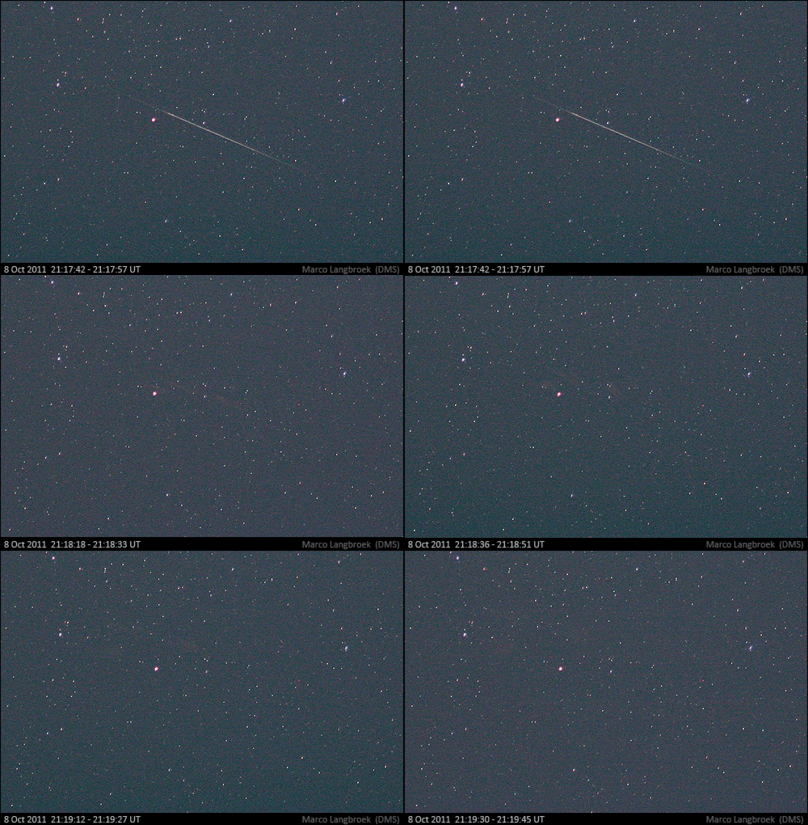
My photo camera with EF 2.0/35mm lens captured 16 Draconids (image above) in slightly less than two hours time: most meteors were simply too faint to be photographed. Our video camera's meanwhile, sensitive to much fainter meteors, filmed hundreds of meteors.

Some meteors left persistent trains. It are these trains of course, that were the target for the LiDAR. Below animated GIF shows a bright Draconid I photographed, with traces of a dissipating persistent trail drifting on the wind in several images obtained after it appeared:


The short movie shows the trail drifting from bottom right to upper left in about 2 minutes time: indeed consistent with a high altitude wind direction from the NE to SW.

After 22h local time (20h UT), activity was on the decline again. The peak was over. Around midnight, we stopped our observations (the CAMS system would run untill 1 am). It was still brilliantly clear: we couldn't have been in a better spot!


click image to enlarge
Four happy observers the morning after the outburst observations. From left to right: Carl Johannink, Peter van Leuteren, Sietse Dijkstra, and the author

Kühlungsborn

The next day, Peter van Leuteren and Sietse drove back to the Netherlands, and Carl and I drove back to Kühlungsborn. Ariving there near 11 am, we heard the story of Peter and Michael. They had a lot of clouds, but luckily also a largely clear period of about an hour around the peak time. This increased our hopes to have filmed at least a few meteors multistation, hopefully with a LiDAR detection as well.

With the data reduced we can now say we filmed at least 34 Draconids plus two sporadic meteors from both stations, yielding accurate atmospheric trajectories, lightcurves, and orbits in the solar system. The LiDAR did have detections as well, but work to correlate these with meteors filmed by us is still in progress. If we do have LiDAR detections that we can correlate with meteors we filmed (more precisely: with the atmospheric trajectories and lightcurves that our multistation filming produced), that will yield a lot of information about processes happening in the upper atmosphere because of these meteors.

Below is a compilation of video meteors filmed by three of the Lebatz cameras and one of the Kühlungsborn cameras. The latter images also shows the LiDAR beams (and clouds, unfortunately). Draconid meteors are moving from top to bottom, everything from another direction is an aircraft, satellite, or sporadic meteor.


It was ten years ago that I last had been involved in such a scientific meteor observing effort - I participated in several of the Leonid meteor outburst scientific campaigns in the 1990-ies. It was exciting to get involved again for the Draconids.

note: I want to warmly thank the people of the IAP and especially Dr Michael Gerding for housing us during the campaign.