Showing posts with label Soyuz. Show all posts

Tuesday, 28 April 2020

The reentry of the Soyuz r/b 2020-026B over Spain and Portugal

This morning, Jon Mikkelson (@Itzalpean) drew my attention to this Twitter message:


The movie was shot from A Coruña in NW Spain this morning (28 April 2020) around 6:45 local time, which equates 4:45 UT. It clearly shows space debris reentering and breaking up.

Here are a few screenshots from the video:


A brief look in the CSpOC TIP messages showed a very clear candidate: 2020-026B, the upper stage from the Soyuz rocket that launched Progress MS-14 to the ISS on 25 April.

The CSpOC TIP lists the reentry for this object at 4:45 +- 1 minute UT for 28 April, near 38.4 N, 15.5 W, west of Portugal. This matches both time and location of the Spanish movie well.

Below is a map I created showing the final revolution of this rocket stage. The red circle is the nominal CSpOC position for the reentry (we suspect these "+-1 minute" positions are based on SBIRS detections). A Coruña where the video was shot is also indicated in the map.

Note that an observer in A Coruña looking towards the trajectory would see it move from right to left (towards the east), and this matches the video. Also note that while CSpOC gives an instantanious time in its TIP messages, reentries in reality take some time (several minutes). The object would pass A Coruña about 2 minutes after the nominal CSpOC time, which is well within a typical reentry duration.

click map to enlarge

Addition 17:15 UT (28 April):

For clarity: the trajectory above was created by taking the last available orbital elements for 2020-026B (elset 20119.06935500) and evolving these to a final decay orbit with SatEvo.


Here is a second video of the event:

Sunday, 25 March 2018

The atmospheric reentry of the Soyuz upper stage 2018-026B on March 25

click map to enlarge

On March 21 at 17:44 GMT,  a Soyuz rocket (Soyuz MS-08) was launched from Baikonur in Kazakhstan, bringing three new astronauts to the International Space Station.

The upper stage from this rocket (2018-026B) reentered the atmosphere last night, producing a nice spectacle in the sky. The reentry was seen from southern Europe, and filmed from Italy. The still below is from video footage that you can find here on the Italian Ondanews website.

click image to enlarge. Link to newsitem with video

The US Military tracking network JSpOC gives a final TIP bulletin placing reentry at 25 March 1:25 UT ± 1 minute near 41.9 N, 8.1 E, depicted as a star symbol in the map in top of this page. The ± 1 minute indicates that this time and position come from an Infrared observation by one of the US Early warning satellites and hence should be very accurate.

I had been issuing forecast on twitter prior to this reentry, based on modelling in SatAna/SateEvo and GMAT. In addition to the JSpOC TIP position and time, the map above also gives some of my own modelling results for this reentry. The open circles were my two last proper forecasts, made before the actual reentry happened. The red dots are two "post-casts", i.e. forecasts made after-the -fact using orbital elements that were not yet available when I made my last forecast the evening before. The nominal position of the SatAna/SatEvo post-cast is only 10 minutes from the JSpOC TIP.

Tuesday, 19 July 2016

Reentry of Soyuz rocket upper stage from Progress MS-03 launch seen from New Zealand, 19 Jul 2016

On July 19, 2016, near ~6:30 UT (~18:30 local time), a bright very slow and long-lasting fireball was reported by many people from New Zealand's South Island. Several images are available, e.g. here and here and here. The fine video below is from YouTube user Ralph Pfister:


Perhaps the most accurate time given for the event is 6:26 UT as given by amateur astronomer Paul Stewart from Timaru on New Zealand's South Island. Stewart captured  the fireball on several all-sky images. A fine animation of his images is on his weblog.

From the video's it is immediately clear that this is not a meteoric fireball, but the re-entry of an artificial object (i.e. artificial Space Junk).

Time, direction of movement  and geographical position moreover match well with an obvious decay candidate: the Russian Soyuz upper stage (2016-045B, NORAD #41671) from the July 16 launch of Progress MS-03 to the International Space Station. In other words: this was a Space Junk re-entry.

At the moment of writing, the elements that are available for the Soyuz rocket stage are almost a day old and not unproblematic. For unknown reasons the B* drag value of the elsets is zero and the NDOT/2 value unrealistic.

This hampers analysis slightly, but using the almost a day old elements face-value, the upper stage would have passed over New Zealand's Southern Island near ~6:33 UT (~18:33 local time). This is within minutes of the time of the New Zealand event. The direction of movement of the rocket stage also matches that in Paul Stewart's imagery.

The maps below show the predicted position and track of the Soyuz upper stage for 19 July 2016, 16:30 UT (18:30 local time in New Zealand). They are based on the almost a day old element set  16200.42841345.

click map to enlarge

click map to enlarge

The few minutes discrepancy between predictions and actual sighting from New Zealand is not unusual for a re-entering object. The last available elements (at the moment of writing) for the Soyuz stage are actually from many hours before the reentry, and during the last moments of its life the orbital altitude drops quickly (i.e. the orbit alters).

Old elements hence will place it in a too high orbit compared to the reality of that moment. As it drops lower in orbital altitude, the rocket stage will get a shorter orbital period and hence appear somewhat earlier,  "in front" of predictions made using the old element set. Discrepancies of a few minutes are therefore normal in cases like these.

When it is "early" on the ephemerids, the orbital plane will be slightly more to the east as seen from a locality. In this case, the nominal pass predicted for Paul Stewart's locality would have been a zenith pass: but the a few minutes earlier pass time compared to the predicted time and the lower actual orbital altitude at the time of the re-entry would result in a sky track that is shifted eastwards and lower in the sky. This matches Paul Stewart's all-sky imagery.

Friday, 11 September 2015

Observing the Fregat upper stage with Galileo 9 and 10 manoeuvering into transfer orbit, just 22 minutes after launch

Fregat upper stage with Galileo 9 and 10 after shadow exit, 11 Sep 2015, 2:30:12 UTC
click image to enlarge

Last night (11 Sep 2015) at 2:08:10 UT, ESA and Roskosmos launched a Soyuz from Kourou, French Guyana, with the new navigation satellites Galileo 9 and 10. The payloads are intended for a circular MEO orbit at an altitude of about 23 522 km

Cees Bassa alerted observers in Europe to the fact that the Fregat upper stage (with payloads still attached) would be visible over Europe during it's initial orbit insertion burn, exiting Earth shadow near 02:30 UT at an altitude of about 400 km altitude while cruising over Germany/Denmark. Engine cut-off for this stage of the launch would be 2 minutes later near 02:31:40 UT

This burn brought the Fregat stage and payloads in a ballistic transfer trajectory. A second burn about 3.5 hours after launch then inserted the stage and payloads in a circular orbit, upon which the payloads separated and the upper stage was de-orbitted.

Both Cees and I managed to observe the Fregat near 02:30 UT. This was about 22 minutes after the launch. Cees observed from Drente in the Northeast of the Netherlands(closer to the trajectory and with better observing conditions), while I observed from Cronesteyn Polder at the edge of Leiden in the West of the Netherlands.

Observing conditions were mediocre at my location: the sky was hazy, and light pollution a problem at lower elevations (it can be seen as an orange glow in the image above).

After exiting Earth shadow near 02:30:00 UT at about 45 degrees elevation in Ursa major, the Fregat stage was easily seen by the naked eye as an object of magnitude +2.

Above is one of my images, a 4-second exposure (Canon EOS 60D, EF 2.5/50mm lens, 800 ISO) starting at 02:30:12 UT.

Descending towards the Northeastern horizon the object became fainter, until I lost it in the light pollution and haze about a minute later.

Cees managed to image a developing hazy envelope around the trail low above the horizon (when it was already invisible to me), which is related to engine shut-down near 02:31:40 UT.

Monday, 22 December 2014

Analysis of the 2014-074B Soyuz r/b re-entry on 26 Nov 2014


In the early morning of 26 November 2014 between 03:35 and 03:40 UT, a very slow, long duration fireball was observed from the Netherlands, Germany and Hungary (see earlier post).

The fireball was quickly suspected to be caused by the fiery demise of a Soyuz third stage, used to launch ISS expedition crew 42, including ESA astronaut Samantha Cristoforetti, to the International Space Station on November 23.

Video still image from Erlangen, Germany (courtesy Stefan Schick)

Analysis

In this blog post, which is a follow-up on an earlier post, I will present some results from my analysis of the re-entry images, including a trajectory map, speed reconstructions and an altitude profile. The purpose of the analysis was:

1) to document that this indeed was the re-entry of 2014-074B;
2) to reconstruct the approximate re-entry trajectory;
3) to reconstruct the approximate altitude profile during the re-entry.


Data used

Three datasets were available to me for this analysis:

1) imagery from three photographic all-sky meteor cameras in the Netherlands, situated at Oostkapelle, Bussloo and Ermelo (courtesy of Klaas Jobse, Jaap van 't Leven and Koen Miskotte);

2) data from two meteor video camera stations (HUBAJ and HUBEC) situated in Hungary (courtesy of Zsolt Perkó and Szilárd Csizmadia);

3) imagery from a wide angle fireball video camera situated at Erlangen, Germany (courtesy Stefan Schick).

Some example imagery is below:


Detail of one of the Bussloo Public Observatory (Netherlands) all-sky images, courtesy Jaap van 't Leven
Detail of the Cyclops Oostkapelle (Netherlands) all-sky image, courtesy Klaas Jobse
Detail of the Ermelo (Netherlands) all-sky image, courtesy Koen Miskotte
Stack of video frames from Erlangen (Germany), courtesy Stefan Schick
Stack of video frames from HUBEC station (Hungary), courtesy Szilárd Csizmadia and Szolt Perkó

Astrometry

The Hungarian data had already been astrometrically processed with METREC by Szilárd Csizmadia and came as a set of RA/Declination data with time stamps. The Dutch and German images were astrometrically processed by myself from the original imagery.

The German Erlangen imagery was measured with AstroRecord (the same astrometric package I use for my satellite imagery). An integrated stack of the video frames resulted in just enough reference stars to measure points on the western half of the image. As it concerns an extreme wide field image with low pixel resolution and limited reference stars, the astrometric accuracy will be low.

AstroRecord could not be used on the Dutch All-Sky images because of the extreme distortion inherent to imagery with fish-eye lenses. They were therefore measured by creating a Cartesian X-Y grid over the image, centered on the image center (the zenith). Some 25 reference stars per image were measured in this X, Y system, as well as points on the fireball trail. From the known azimuth and elevation of the reference stars, the azimuth and elevation of points on the fireball trail were reduced. While obtaining the azimuth with this method is a straight forward function of the X, Y angle on the images, obtaining the elevation is more ambiguous. Based on the known positions of the reference stars and their radius (in image pixels) with respect to the image center, a polynomial fit was made to the data yielding a scaling equation that was used to convert the radius with respect to the image center of the measured points on the fireball trail to sky elevation values.

Unlike meteoric fireballs, rocket stage re-entries are long-duration phenomena. The German and Hungarian data, being video data, had a good time control. The Dutch all-sky camera data, being long duration photographic exposures, had less good time control, even though the start- and end-times of the images are known. The trails for Oostkapelle and Ermelo had no meaningful start and end to the trails. Bussloo does provide some time control as the camera ended one image and started a new one halfway the event: the end point of the trail on the first image corresponds to the end time of that image, and similarly the start on the next image corresponds to the start time of that image. There was 7 seconds in between the two images. Time control is important for the speed reconstructions, but also for the astrometry (notably the determination of Right Ascension).


Data reduction and problems

The Azimuth/Elevation data resulting from the astrometry on the Dutch data were converted to RA/DEC using formulae from Meeus (1991). For these Dutch data, the lack of time control is slightly problematic as the RA is time-dependent (the declination is not). There is hence an uncertainty in the Dutch data.

The data where then reduced by a method originally devised for meteor images: fitting planes through the camera's location and the observed sky directions, and then determining the (average) intersection line of that plane with planes fitted from the other stations, weighted according to plane intersection angle. This is the method described by Ceplecha (1987). The plane construction was done in a geocentered Cartesian X-Y-Z grid and hence includes a spherical earth surface. The whole procedure was done using a still experimental Excel spreadsheet ("TRAJECT 2 beta") written by the author of this blog, coded serendipitously to reduce meteoric fireballs a few weeks before the re-entry.

I should warn that this method is actually not too well suited to reduce a satellite re-entry. The method is devised for meteoric fireballs, who's luminous atmospheric trajectory is not notably different from a straight line (fitting planes is well suited to reconstruct this line). A rocket stage re-entering from Low Earth Orbit however has a notably curved trajectory: as it is in orbit around the geocenter, it moves in an arc, not a straight line. This creates some problems, notably with the reconstructed altitudes, and increasingly so when the observed arc is longer. Altitudes reconstructed from the fitted intersection line of the planes come out too low, notably towards the middle of the used trajectory arc. The resulting altitude profile hence is distorted and produces a U-shape. The method is also problematic when stations used for the plane fitting procedure are geographically far removed from each other. In addition, the method is not very fit for long duration events.

The data were reduced as three sets:

1) data from the Dutch stations (independent from the other two datasets);
2) data from the German station combined with the two eastern-most Dutch stations;
3) data from the Hungarian stations (independent from the previous two datasets).

Dataset (2) combines data from stations geographically quite far apart. This is probably one of the reasons why this dataset produces a slightly skewed trajectory direction compared to the other two datasets.

The Dutch images have the event occurring very low in the sky (below 35 degrees elevation for Oostkapelle and below 25 degrees elevation for Bussloo and Ermelo). The convergence angles between the observed planes from the three stations is low (14 degrees or less). This combination of low convergence angles and low sky elevations, means that small measuring errors can have a notable scatter in distance as a result.


Results (1): trajectory

reconstructed trajectory (red dashed line and yellow dots)

The map above (in conic equal-area projection) shows the reconstructed trajectory as the yellow dots and the red dashed line. White dots are the observing stations.

The thin grey line just north of the reconstructed trajectory is the theoretical ground track resulting from a SatAna and SatEvo processed TLE orbital efemerid set for the rocket stage. This expected ground track need not perfectly coincide with the real trajectory, as the orbit changes rapidly during the final re-entry phase.

The reconstructed trajectory converges towards the theoretical (expected) ground track near the final re-entry location, above Hungary, but is slightly south of it earlier in time. The horizontal difference is about 30 km over southern England, 25-20 km over northern France due south of the Netherlands, 17-16 km over southern Germany and less than 3 km over Hungary.

This difference is most likely analytical error, introduced by the low sky elevations and convergence angles as seen from the Netherlands. On the other hand, the Hungarian observations (with stations on the other, southern side of the trajectory compared to the Dutch and German stations and reduced completely independent from the other data) place it slightly south too. So perhaps the deviation is real and due to orbital inclination changes during the final re-entry phase. Indeed, a SatEvo evolution of the last known orbit suggest a slight decrease in orbital inclination over time, although not of the observed magnitude.

The results from Erlangen come out slightly skewed in direction, likely for reasons already discussed above. The Hungarian results are probably the best quality results.


Results (2): altitudes and speed

altitudes (in km) versus geographic longitude

As mentioned earlier, the altitudes resulting from the fitted linear planes intersection line come out spurious due to the curvature of the trajectory. Altitudes were therefore calculated from the observed sky elevations and known horizontal distance to the trajectory. The horizontal distance "d" between the observing station and each resulting point on the trajectory were calculated using the geodetic software PCTrans (software by the Hydrographic Service of the Royal Dutch Navy). Next, for each point the (uncorrected) altitude "z" was calculated from the formula:

         z = d * tan(h),

where "h" is the observed sky elevation in degrees.

This is the result for a "flat" earth. It has hence to be corrected for earth surface curvature, by adding a correction via the geodetic equation:

        Zcr - sqrt (r 2 + d 2)     [all values in meters],

where "r" is the Earth radius for this latitude, "d" the horizontal distance between the observing station and the point on the trajectory, and "Zc" the resulting correction on the altitude calculated earlier.

The results are shown in the diagram above, where the elevation has been plotted as a function of geographic longitude. It suggests an initial rapid decline in altitude from ~125 km to ~100 km between southern England and northern France, an altitude of ~100 km over southern Germany, and a very rapid decline near the end, with altitudes of 60-50 km over Lake Balaton in Hungary. Whether the curvature in the early part of the diagram is true or analytical error is difficult to say, although it is probably wise to assume it is analytical error.

Apart from the match in trajectory location, speed is another measure to determine whether this was the decay of 2014-074B or not. Meteors always have an initial speed larger than 11.8 km/s (but: for extremely long duration  slow meteors deceleration can decrease the terminal speed considerably below 11.8 km/s later on in the trajectory). Objects re-entering from geocentric (Earth) orbit have speeds well below 11.8 km/s, usually between 7-8 km/s depending on the orbit apogee. When speed determinations come out well below 11.8 km/s, a re-entry is a likely although not 100% certain interpretation. When speed determinations come out at 11.8 km/s or faster, it is 100% certain a meteor and no re-entry.

By taking the distance between two points on the trajectory with a known time difference, I get the following approximate speeds:

- from the Hungarian data: 7.0 km/s;
- from the Dutch data: 9.0 km/s;
- from the German data: 9.4 km/s.

These are values that are obviously not too accurate, but nevertheless reasonably in line with what you expect for a re-entry of artificial material from geocentric (Earth) orbit.

It should be noted that if the southern deviation (see trajectory results above) of the trajectory data is analytical error, the speed of the Dutch and German observations is a slight overestimation, while the Hungarian results will be a slight underestimate. This would bring the speeds more in line with each other, and even closer to what you expect from a rocket stage re-entry from Low Earth Orbit.


Discussion and Conclusions

The trajectory and speed reconstructions resulting from this analysis strongly indicate that the fireball seen over northwest and central Europe on 26 November 2014, 03:35-03:40 UT indeed was the re-entry of the Soyuz  third stage 2014-074B from the Soyuz TMA-15M launch. Although there are some slight deviations from the expected trajectory, the results are close enough to warrant this positive identification.

The deviations are easily explained by analytical error, given the used reduction method and the not always favourable configuration of the photographic and video stations with regard to the fireball trajectory. Notably, the large distance of the Dutch stations to the trajectory resulting in very low observed sky elevations and low plane fitting convergence angles for these stations is a factor to consider. Nevertheless, and on a positive note, the final result fits the expectations surprisingly well.

The data suggest that the object was at an altitude approaching 125 km (close to the expected final orbital altitude on the last completed orbit) while over southern England and the Channel, had come down to critical altitudes near 100 km while over southern Germany, and was coming down increasingly fast at altitudes of 60 km and below while over Hungary.

The Hungarian observations show that the rocket stage re-entry continued beyond longitude 19.3o E and below 46.45o N, and happened some time after 03:39:20 UT. It likely not survived much beyond longitude 21o E.

The nominal re-entry position and time given in the final JSpOC TIP message for 2014-074B are 03:39 +/- 1 min UT and latitude 47o N longitude 17o E, with the +/- of 1m in time corresponding to a +/- of several degrees in longitude. This is in reasonable agreement with the observations.

Acknowledgements

I thank Zsolt Perkó, Szilárd Csizmadia, Stefan Schick, Jaap van 't Leven, Klaas Jobse and Koen Miskotte for making their images and data available for analysis. Carl Johannink contributed some mathematical solutions to the construction of the spreadsheet used for this analysis.

Note: another Soyuz rocket stage re-entry from an earlier Soyuz launch towards the ISS was observed from the Netherlands and Germany in December 2011, see earlier post here. As to why it takes such a rocket stage three days to come down, read FAQ here.


Literature:
- Ceplecha Z., 1987: Geometric, dynamic, orbital and photometric data on meteoroids from photographic fireball networks. Bull. Astron. Inst. Czech. 38, p. 222-234.
- Meeus J. (1991): Astronomical Algorithms. Willmann-Bell Inc., USA. 


Thursday, 27 November 2014

[UPDATED] Re-entry of Soyuz third stage 2014-074B from Soyuz-TMA 15M launch observed from the Netherlands and Hungaria.

Update 23 Dec 2014: further analysis of imagery in new post
(28 Nov 2014, 10:45 UT: updated with more imagery)

click image to enlarge

Today Carlos Bella alerted the seesat list that Hungarian amateur astronomers had captured imagery of a re-entry in the early morning of November 26.

It concerns the re-entry of 2014-074B, the Soyuz third stage from the launch of Soyuz-TMA 15M which launched expedition crew 42 to the ISS on 23 November 2014.

Below is one of several casual phone-camera video's also shot from Hungaria Serbia, showing the fragmenting fireball:


(video by Aleksandar F, Belgrade)

According to the TIP message of  JSpOC, the re-entry happened near 3:39 UT on the early morning of 26 November, 2014, near 47 N,  17 E. This perfectly fits the Hungarian observations. See also the map above, which shows the predicted trajectory of 2014-074B resulting from processing the last known orbital elements with SatAna and SatEvo.

Moreover, the speed determination by the Hungarian meteor camera network, 7.4 km/s, confirms this is not a meteor but a re-entry. The speed is too low for a meteor (which are always faster than 11.8 km/s, the earth escape velocity) but matches the speed of an object re-entering from Low Earth Orbit.

Realizing that the rocket stage made a pass over the Netherlands/Belgium only minutes earlier,  I asked the operators of the DMS All-Sky meteor cameras to check their imagery of that morning. As it turns out, three Dutch All-sky stations did capture the re-entry: Bussloo (Jaap van 't Leven), Oostkapelle (Klaas Jobse) and Ermelo (Koen Miskotte).
 
Detail of the Bussloo Public Observatory all-sky image (courtesy Jaap van 't Leven)

Detail of the Cyclops Oostkapelle all-sky image (courtesy Klaas Jobse)

Detail of the Ermelo image (courtesy Koen Miskotte)

Parts of the three Dutch images (courtesy Jaap van 't Leven, Klaas Jobse and Koen Miskotte) are shown above. All stations have it very low above the horizon at elevations of 20 degrees or lower.

The Oostkapelle image shows that the incandescent phase of the re-entry already started over the UK, as the image shows the trail well to the west (and Oostkapelle is on the Dutch West coast).

As soon as I can find some time, I will analyze the imagery to see whether I can get altitude data from them. It would be nice to document the last minutes of this rocket stage in this way!

So stay tuned for an update....

UPDATE 23 Dec 2014: new post with a further analysis with trajectory and altitude reconstructions based on observations from the Netherlands, Hungaria and Germany now available

(I thank Jaap van 't Leven, Klaas Jobse and Koen Miskotte for permission to use their imagery)

Saturday, 8 June 2013

Another fine pass of ATV-4, and objects from a recent Russian Persona launch


 click image to enlarge

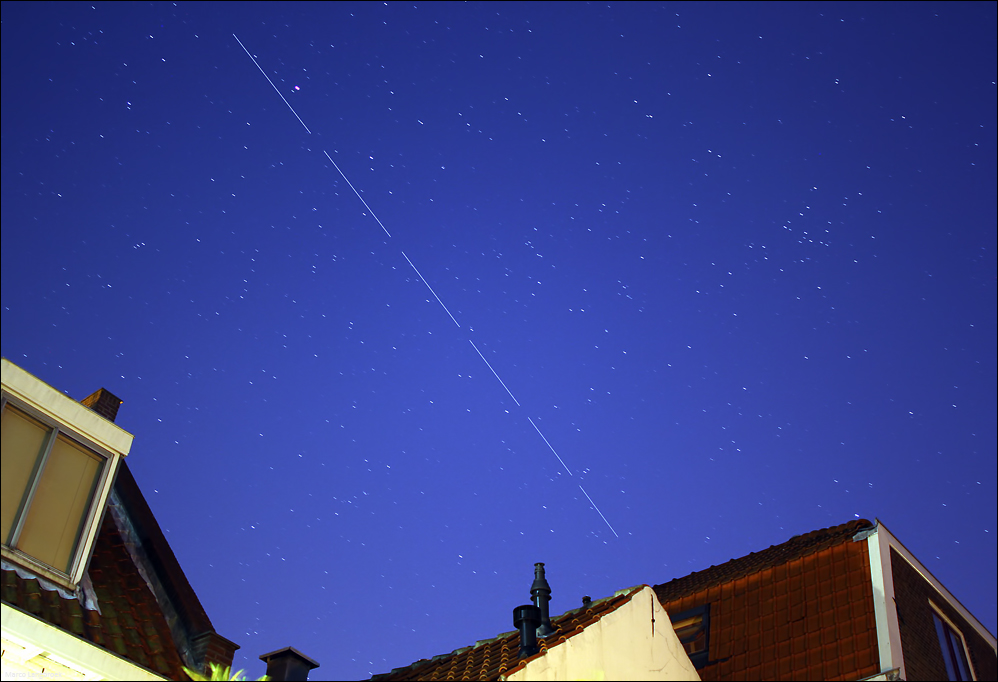
Following my observations of June 5-6 (see photo's and video here) and a visual observation on June 6-7, yet another fine sighting of the ATV-4 Albert Einstein was done yesterday around local midnight. First I watched the ISS pass, followed 17 minutes later by the ATV. The image above, which is a stack of six images of 5 seconds exposure each (Canon EOS 60D + EF 2.8/24mm, 640 ISO), shows the ATV-4 ascending over the rooftops as seen from the courtyard of my home in Leiden.

I also obtained video again using the WATEC. The video below shows part of the passof the ATV, and then continues with some footage of the earlier ISS pass. While the ISS is ascending over the roof, two other objects can be seen (from 1:28 in the video onwards), chasing each other from left to right just over the rooftops, in a trajectory perpendicular to that of the ISS:


These two objects are related to the launch of Kosmos 2486, a Russian military Persona satellite, the Russian version of the US Keyhole optical reconnaisance satellites. Kosmos 2486 was launched 3.5 hours before this sighting (at 18:37 UTC on June 7th) by a Soyuz rocket from Plesetsk. These objects have been catalogued as 2013-028A and B - the B object is the leading object in the video above. This would indicate the trailing object is the Persona satellite, the leading object the upper Soyuz stage.

Wednesday, 13 February 2013

Fireball over NW Europe of the evening of 13 February 2013: Re-entry of a Soyuz r/b

Reports are pouring in of a very long duration, bright fireball near 22:15 CET (21:15 GMT) seen from Belgium, the Netherlands and Germany. Reports indicate 30-40 seconds visibility, and an "explosion" halfway, and some reports indicate sonic booms.

This fireball was with a high degree of certainty the re-entry of a Russian Soyuz 3rd stage, #39083 (2013-007B), the 3rd stage from the Soyuz that launched the Progress cargoship Progress-M 18M towards the ISS on February 11th.

USSTRATCOM issued a TIP message indicating decay at 21:15 +/- 1 m UTC near 49N, 13 E.

Below is a quick map (made using Orbitron) of the trajectory and approximate position of the re-entry.
click map to enlarge

Time, general description and reentry data all fit quite well.

Wednesday, 16 May 2012

Voice reception (radio) of Soyuz TMA-04M bringing crew 31 to the ISS

On May 15 the Soyuz TMA-04M spacecraft was launched from Baikonur, bringing a fresh crew (crew 31) of Kosmonauts to the International Space Station.


At 09:04 UTC (11:04 am local time) this morning (May 16), it passed over Leiden. Using my old scanner radio (Realistic Pro-2042) and a homebrew dipole antenna, I listened in on 121.75 MHz as the Soyuz crew was talking (in Russian) to groundcontrol in Russia. Above is a 54 second record with the best part of the reception, starting at 09:03:40 UTC.


Wednesday, 28 March 2012

(video) A last view of ESA's ATV-3, with ISS, FIA Radar 1 and an old Russian Soyuz upper stage


click image to enlarge


This morning near 3:39 UTC (5:39 am local time), Europeans could witness the last visible pass of ESA's Space Freighter ATV-3 'Edoardo Amaldi' on its way to the International Space Station (ISS), less than a day away from docking to the ISS in the night of March 28/29.

I watched, photographed and filmed the pass from Leiden: footage shot with the WATEC 902H + 1.4/12mm lens, and a photograph made with the Canon EOS 450D + EF 2.0/35mm lens, can be seen above.

I got a very fine view with more than just the ISS and ATV visible. Just before the ISS became visible around 3:56 UTC a bit of  bright (mag +1) space-debris, an old Russian Soyuz Zenit upper stage crossed the sky (see first seconds of the video above, left in the FOV): 99-039B, the upper stage from the OKEAN-O launch in 1999 [edit 30/03/2012: it is a Zenit rather than a Soyuz r/b - with thanks to Ralf Vandeberg]. Next, the ISS emerged out of earth shadow eclipse near Arcturus, quickly attaining a brightness of -3 to -4. As it moved through Bootes, Corona Borealis, Hercules and into Lyra, the American military satellite FIA Radar 1 (10-046A) came into view, going the opposite direction of the ISS (nicely demonstrating that it is in a rare retrograde orbit, i.e. moves from east to west rather than west to east). As FIA Radar 1 started to descend to the west through Corona Borealis, ESA's ATV-3 came into view, again as a nice and bright naked eye object attaining about mag. 0 to +1. It followed the ISS by almost exactly 3 minutes, just a little bit too much separation alas to image the ATV and it's destination the ISS together. The photograph above (and the video) shows it together with the FIA Radar 1: ATV-3 is moving up, the FIA Radar 1 down! (note: for easthetic reasons, I photoshopped an annoying trail from the aircraft that can be seen in the video, out of the photograph).

The video ends with ATV-3 descending in the east and disappearing behind the roof of our appartement building.

I wish to thank Laurent Arzel (ESA) for providing me with predicted orbital elements with manoeuvres of ATV-3 taken into account. Some web-based satellite prediction services (and surprisingly, the German DLR in a tweet) used "old" elements from the 27th, that lead to erroneous pass times (off by over 5 minutes: these suggested the ATV was leading the ISS by 2.5 minutes, while in reality it was following by 2.5 to 3 minutes!). Thanks to Laurent's elements, I could plan for the correct situation and point some fellow amateur observers to the correct pass times.

With docking less than half a day away as I write this, our Dutch astronaut André Kuipers onboard ISS can look forward to fresh supplies of Dutch cheese soon!

Tuesday, 27 December 2011

Further confusion on Saturday's Soyuz r/b reentry

I earlier wrote about the confusion reigning in the press concerning the sky event over Europe of last Saturday evening. Initial confusion was over wether it was a meteor, "comet" or (and that was the correct explanation, but many Dutch and German news outlets failed to properly pick that up): the reentry of  a Soyuz rocket.

Now a new confusion has arrisen: some news outlets and weblogs, e.g. that of Physorg, mistakenly link the event to last Friday's failed Russian launch of the Meridian satellite. Due to a rocket failure, this never reached earth orbit but crashed in Siberia within minutes after the launch.

As I wrote earlier, what reentered and was seen over France, Germany and the Netherlands last Saturday evening, was the 3rd stage of last Wednesday's Soyuz launch to the ISS.

The confusion probably comes from the fact that both launches used a Soyuz rocket. The failed launch that crashed in Siberia on Friday got some press attention because fragments hit a house in Russia (see a.o. here (English), with pictures of a recovered fuel tank here (Russian)).

But again: that failed launch had nothing to do with Saturdays sky event over Europe. The reentry over Europe was the 3rd stage of the earlier Wednesday launch to the ISS, that included Dutch astronaut Andre Kuipers.

(More on Last Saturday's Soyuz reentry over Europe: here and here)

Monday, 26 December 2011

11-078B Soyuz 3rd stage reentry: answers to some frequently asked questions

In the wake of the spectacular reentry over NW Europe of the Soyuz 3rd stage 2011-078B on Saturday 24 December 2011, several common questions popped up in comments, e-mails, on Twitter and in newspaper discussions. I will answer a few below.

Frequently Asked Questions:

(Q1): Are these things predictable and who makes such predictions?
(Q2) Does it really take a Soyuz rocket 3rd stage three days to fall back to earth?
(Q3) Why doesn't this happen with each Soyuz launch? Or: why not over the same location on Earth?
(Q4) has anything of the rocket stage survived to earth surface?

Answers:

(Q1): Are these things predictable and who makes such predictions?

(A): It is "sort of" predictable. Using computer models which take into account many factors of influence, one can make a prediction yielding an indication of the time a rocket stage or satellite will re-enter the atmosphere. However, even very close to that actual time of reentry, the uncertainty in these predictions is still very large. Exactly when a rocket stage will start to burn up depends on many factors, including the exact condition of the atmosphere at that moment, the shape of the rocket stage, and whether it is tumbling or not. In practise,  this turns out to be very difficult to model, even with the best computer models.

Several organisations and individuals do such predictions (and you can even find software for it on the internet). However, one of the most authoritive sources of such predictions is USSTRATCOM, the American military organisation that tracks manmade objects in space (many people think NASA does that job. But that is incorrect: it is USSTRATCOM, better known as 'NORAD'). They publish these predictions as 'TIP' messages. Their first prediction is published 2 months in advance. These still have a very large uncertainty (think of: weeks). In the days close to decay, they publish new estimates as new TIP messages that gradually become more exact. But even these can have uncertainties of several hours, even for predictions made on the day of the reentry itself.

For example, the last pre-reentry TIP message issued only 2 hours before the Soyuz 3rd stage came down, still had an uncertainty window of six hours.....

Once an object has reentered, USSTRATCOM does a post-analysis of the last orbital information, and publishes a "final' TIP message mentioning when and where the object came down (so this is done "after the fact"). These can be (but are not always, as it depends on how well the object was tracked during it's last hours of existence) very accurate. Sometimes, as was the case with this reentry of the Soyuz 3rd stage, they provide a time with an uncertainty of only minutes, plus a quite accurate position. In other cases, where less recent tracking data is available, the final uncertainty is much larger.

Note that a re-entering satellite or rocket booster has a speed of 7.5 km per second (4.7 miles per second)! So even if the predicted time has an uncertainty of just 15 minutes, this amounts to an uncertainty of 13,500 km (8,400 miles) in the position of the object when it reenters! This is why it is impossible to pinpoint the expected point of re-entry beforehand, when it is not a "controlled" re-entry. (in a "controlled" re-entry, the satellite operators send a command to the satellite to make a rocket burn at a precise time, kicking it down over a designated spot, usually the Pacific ocean. This Soyuz reentry was however not such a "controlled" reentry).

Many people mistakenly think that in this day and age of supercomputers, scientists (or the military) can predict everything. In reality, satellite/rocket reentries like this are so complex that even the best computer models can only give rough indications untill just minutes before the actual re-entry.


(Q2) Does it really take a Soyuz rocket 3rd stage three days to fall back to earth?

(A) Yes, it does. That last rocket stage is jettisoned that high above earth surface, that it does not just rapidly fall back on a ballistic trajectory (such as the 1st and 2nd stages do) but actually reaches Low Earth Orbit, and stays in orbit around the earth for several days. In effect, it becomes a satellite for a while in a very low orbit around Earth. Under influence of gravity and drag from the outer atmosphere, the orbit slowly evolves and becomes smaller and smaller. On the first day only gradually, but as it slowly comes down, this gradually goes faster and faster.

The influence of our atmosphere reaches several hundreds of kilometers up: even the International Space Station experiences some atmospheric drag, and would fall down within a year if its orbit was not regurlarly raised using the rocket engines of the Progress spacecraft docked to the ISS.

It takes about 3-4 days for a Soyuz 3rd stage from a launch to the ISS to come down. The exact amount of time is variable and different in each new case, as it depends on many factors. Our atmosphere is variable in extent and density, notably under the influence of solar activity. When the sun is active and many charged particles from solar outbursts reach earth, these interact with our atmosphere and the atmosphere slightly expands as a result of this. This means that objects at the altitude of the Space Station and below that (such as the Soyuz rocket stage) will experience a "thicker atmosphere", i.e. more drag from the atmosphere's outermost layers, and as a result they will come down faster. When it reaches at altitude of only 120 km (75 miles) it goes very quick: within minutes the rocket stage has dropped tens of kilometers, slowed down considerably, and finaly plunges straight down from that moment onwards.

The exact moment this happens, is highly dependant on these variations in extend of our atmosphere due to variations in solar activity. This is another reason why a satellite or rocket re-entry is so difficult to predict: one short but intense outburst occuring on the sun will next make a rocket stage fall back much quicker than expected.

Below diagram shows the orbital evolution of the Soyuz 3rd rocket stage that decayed last Saturday. It had to make 52 full orbits (full circles) around the Earth before it burned up. It's orbit was a bit "eccentric", which means that it was not a perfect circle but an ellipse. So on each revolution around the earth, there is a point where it is a bit higher above earth (called the "apogee") and a point where it is closest to the earth (called "perigee"). In the diagram, the values for these altitudes have been plotted as a red and blue line. Note how fast these altitudes change in the final hours before re-entry.


(Q3) Why doesn't this happen with each Soyuz launch? Or: why not over the same location on Earth?

(A) It does happen with each Soyuz launch to the ISS. The Soyuz 3rd stage always comes down some 3-4 days after the launch.

That reentry however is never over the same location on earth. The reasons for this, have already been outlined as part of the answer to question (2) above. An important factor of influence on how quickly a rocket stage comes down, is the variable earth's atmosphere, under influence of variability in solar activity. These factors are different for each new case. This is why the 3rd stages of Soyuz launches to the ISS never fall down near the same spot twice.


(Q4) has anything of the rocket stage survived to earth surface?

(A) Not that we so far know of. Usually, the rocket stage almost completely burns up in the atmosphere. Sometimes, a few smaller bits survive (quite often spherical fuel tanks). For example, an object that is likely a rocket fuel tank came down in Namibia in November and might be part of a rocket stage used in a Russian November  launch to the International Space Station.


Saturday, 24 December 2011

[Updated] Breaking News: Decay of Soyuz r/b stage from André Kuipers' launch to ISS observed from the Netherlands!


UPDATE - the final TIP for Soyuz r/b 38037 / 2011-078B has been released by USSTRATCOM near 18h GMT and it indeed shows that this was the Soyuz r/b: reentry time is quoted as 16:25 +/- 1 minute GMT at 49 deg N, 7 deg E. This fits the observations well.
In the Dutch press, there meanwhile appears to be a lot of confusion. The Dutch National Police claims that they talked to "NASA" who apparently said it was a "meteor" (or "comet"). So THAT is widely claimed in the press now, to the point of calling the identification with the Soyuz 3rd stage "speculation". Which it is not: it is based on factual data and now clearly confirmed by the USSTRATCOM JSpOC TIP message. What more do you want?!

I have no idea to whom (or even where: NASA is big...) the Police spoke, but for all things it could have been the JPL janitor....
At any rate: appart from my analysis below (which is already clear), the USSTRATCOM TIP message mentioned above makes unambiguously clear that this was the Soyuz 3rd stage.
Note that to access the USSTRATCOM TIP message via the link above you need an approved account. USSTRATCOM is the US military Command responsible for tracking manmade objects in space, and perhaps better known under their former name NORAD.
- end of update

Multiple reports are coming in, among others by experienced Dutch meteor observers Carl Johannink (Gronau) and Arnold Tukkers (Denekamp), of a bright and very slow fragmenting object seen low in the west-southwest near Venus at 16:26 UTC, 24 December.

From the descriptions it clearly was a reentry of an artificial object (space junk), as the event was too long in duration and too slow to be a meteoric fireball.

And it was not "just" a random bit of space debris, it turns out:

The observations fit with 2011-078B (#38037), the last stage of the Soyuz rocket that brought Dutch astronaut Andre Kuipers up to the ISS earlier this week. It was already predicted to decay near this moment by USSTRATCOM.

Below is the  predicted trajectory of the Soyuz  3rd stage for the Gronau/Enschede area (and below that, the ground trajectory). It is based on an orbit with an epoch near noon of 24 December (epoch 11358.49032868. Source: USSTRATCOM), so a few hours old, which will introduce some minor discrepancies (a few seconds in time). But it fits the descriptions very well in terms of time and trajectory in the sky.
click images to enlarge


[UPDATE 7 October 2017]:

I recently modelled the re-entry of 2011-078B in GMAT, using the MSISE90 model atmosphere with actual Spaceweather of that time. Drag surface was set at 60% of the maximum drag surface for a Soyuz upper stage: this yields a decay position and decay time well in agreement with the JSpOC TIP position and is close to what the drag value for a tumbling, fragmenting object would be.

As seen from Gronau in Germany, it yields the following sky trajectory. Compare with Carl Johannink's description below: it matches his description well.

click map to enlarge
- end of update

- continuing original post:

Some quickly translated descriptions by two experienced Dutch meteor observers (compare to the sky trajectory map above for their area):

Arnold Tukkers, Denekamp (Netherlands):

At 17:26 CET (=16:26 UTC) I looked out of the window and saw a strange phenomena just above the rooftops behind us. It looked like a very, very slow meteor fragmented in several pieces. Like Peekskill but less bright.
Multiple fragments. Because it was so low in the sky, I walked upstairs and could still see the last part from the bedroom window. So it at least took 20 seconds. [...]
What a sight! Trajectory for me (did not see initial part) southwest-southeast. Altitude maximum 20 degrees. Colour brown-red.


Carl Johannink, Gronau (Germany):

Just was looking at Venus in evening twilight.
Left of it an object appeared from behind a cloud that I first thought to be an aircraft, but next I found something was not right. The thing sometimes brightened and became fuzzy, trailing a circa 8 degree long tail. Maximum brightness about -4.
The object roughly moved from SSW to SE at an elevation of about 15 degrees. The whole phenomena took over half a minute.

To see the second part of the trajectory I had to walk to a different room. Called in Elisabeth, together we saw the object fragment into pieces (each individual piece about mag. 0 to +1) and then fade out.

The whole event looked much alike to the New Years Eve satellite decay of 1978, albeit being somewhat less bright.
Update:
A number of video's from Germany have surfaced which likely show the event. Here are a few:
video 1
video 2
Video 3 (on the Bad Astronomer's blog)
Video 4
Video 5

FAQ

Read the answers to Frequently Asked Questions for this reentry case I published later here.