Showing posts with label space junk. Show all posts

Tuesday, 23 March 2021

[UPDATED] Reentry predictions for the Falcon 9 RB 2021-017BN

click diagram to enlarge

In my previous post, I discussed 2021-017BN, the Falcon 9 upper stage from the March 4 Starlink launch that should have been deorbitted after 1.5 revolutions on March 4th, but didn't.

It is still on orbit. At the moment of writing, 23 March 2021 at 11:00 UT, it is in a 217 x 200 km orbit according to the latest available elements from CSpOC, and it will stay on orbit for a couple of days to come. But the end is near: the orbital altitude of the rocket stage is quickly decaying, as can be seen in the diagram below:

click diagram to enlarge

My current reentry prediction (see diagram in top of post and table below) is that it will come down in the early hours of March 26 (2021). My prediction, based on modelling in GMAT R2020a using the MSISE90 model atmosphere, appears to be well in line with the TIP from CSpOC so far.

[UPDATE: my final post-cast predicted reentry at 26 Mar 04:34 UT, which is some 35 minutes too late. It is based on a 2/3rd maximum drag surface value. Interstingly, using the maximum drag surface leads to a reenrty at 3:56 Ut, within minutes f the actual time]

Revisit this post for prediction updates in the coming days.

orbit epoch     pred. date     reentry time (UT)
21081.600725    26 Mar 2021    02:33 +- 16.8 hr
21081.922054    26 mar 2021    03:36 +- 15.5 hr
21082.113317    26 Mar 2021    03:59 +- 14.7 hr
21082.216601    26 Mar 2021    03:40 +- 14.1 hr
21082.278149    26 Mar 2021    03:43 +- 13.8 hr
21082.462749    26 Mar 2021    05:29 +- 13.3 hr
21082.585776    26 Mar 2021    05:29 +- 12.7 hr
21082.708770    26 Mar 2021    05:37 +- 12.1 hr
21082.954651    26 Mar 2021    06:13 +- 11.1 hr
21083.138960    26 Mar 2021    05:03 +-  9.9 hr
21083.261785    26 Mar 2021    05:15 +-  9.4 hr
21083.296296    26 Mar 2021    05:20 +-  9.2 hr
21083.507296    26 Mar 2021    05:28 +-  8.3 hr
21083.875164    26 Mar 2021    05:26 +-  6.5 hr
21084.120127    26 Mar 2021    05:59 +-  5.4 hr
21084.181325    26 Mar 2021    05:20 +-  5.0 hr
21084.486963    26 Mar 2021    05:00 +-  3.5 hr
21084.548018    26 Mar 2021    03:19 +-  2.8 hr
21084.974688    26 Mar 2021    04:46 +-  1.1 hr * post-cast
21085.095602    26 Mar 2021    04:34 +-  0.5 hr * final post-cast


UPDATE  26 March 2021  12:30 UT:

The reentry happened last night, over North America, and was widely seen from the US States Washington and Oregon, near 4:00 UT (March 26 UT: that is 9 pm on March 25 local time for that area).

CSpOC's final TIP places the reentry at 03:58 +- 1 min UT. This time matches the reports from Washington and Oregon well, and based on the last orbit it would indeed place the rocket stage near the NW United States coast.

The listed geographic position in the TIP, 24.5 N, 151 W, does however not match well (it is further down the track, near Hawaii, corresponding to the Falcon 9 position about 6 minutes prior to the observed reentry). We have  noted such discrepancies more often in recent TIP messages. In this case, I half suspect the position was that given by their reentry model, and they forgot to update it when the SBIRS detection of the actual reentry fireball came in.

click map to enlarge

My own final "post-cast" places reentry some 35 minutes after the actual reentry.

Here are some of the reentry sightings as reported on Twitter:


UPDATE 2 April 2021 23:00 UT:

Debris has been recovered from this reentry. In Grant Country, Washington, a Composite Overwrapped Pressure Vessel (COPV) was found on farmland.


Saturday, 4 July 2020

ISS Debris Avoidance Manoeuvre of 3 July 2020

click to enlarge


ROSCOSMOS has announced that the International Space Station (ISS) had to make an unscheduled orbit adjustment (a debris avoidance manoeuvre)  at 18:53 Moscow Time (15:53 UT) on July 3, in order to dodge a piece of space debris. The rocket engine of the Progress MS-14 cargoship attached to the ISS were used for the manoeuvre, burning 100 seconds giving the ISS a delta V of 0.5 m/s. The ISS orbit was raised by about 900 meters as a result.

The brief bulletin did not identify which piece of space debris was dodged. Using COLA, I could however identify it as object 27923 (1987-079AG), a piece of debris from the Russian Proton rocket that launched the Kosmos 1883 GLONASS satellite on 16 September 1987.

One of the rocket stages from this launch shed some 31 pieces of debris in 2003, most of which decayed rapidly. The object that necessitated the July 3 ISS manoeuvre is one of the larger, and one of the few remaining shed pieces on-orbit. It is is a very eccentric, 350 x 4454 km, 64.9 degree inclined orbit (it's apogee has come down considerably over the past 17 years, from almost 20 000 km in 2003). The CSpOC catalogue characterizes its size as 'medium' (i.e. an RCS of 0.1 - 1.0 m2).

Had the ISS not changed it's orbit, this piece of space debris would have made a pass to a nominal distance of ~0.5 km at 18:28:19.07 UT on July 3. Note that this is a nominal value based on two TLE's: so there is a possible error of 1-2 km. But it is clear that this larger piece of debris would have passed well within the 4 x 4 x 10 km safety box around the ISS, necessitating the debris avoidance manoeuvre.

COLA output:

DATE       UT            RANGE   dALT    ANGLE
3 Jul 2020 18:28:09.07   0.5     0.1     107.1

The encounter would have occurred at 436 km altitude over the south Atlantic some 600 km northeast of the Falklands, near 48.1 S,  51.7 W (see illustration above and movie below).

ISS debris avoidance manoeuvres like this are not very frequent: it happens maybe once per 1-2 years.

Tuesday, 28 April 2020

The reentry of the Soyuz r/b 2020-026B over Spain and Portugal

This morning, Jon Mikkelson (@Itzalpean) drew my attention to this Twitter message:


The movie was shot from A Coruña in NW Spain this morning (28 April 2020) around 6:45 local time, which equates 4:45 UT. It clearly shows space debris reentering and breaking up.

Here are a few screenshots from the video:


A brief look in the CSpOC TIP messages showed a very clear candidate: 2020-026B, the upper stage from the Soyuz rocket that launched Progress MS-14 to the ISS on 25 April.

The CSpOC TIP lists the reentry for this object at 4:45 +- 1 minute UT for 28 April, near 38.4 N, 15.5 W, west of Portugal. This matches both time and location of the Spanish movie well.

Below is a map I created showing the final revolution of this rocket stage. The red circle is the nominal CSpOC position for the reentry (we suspect these "+-1 minute" positions are based on SBIRS detections). A Coruña where the video was shot is also indicated in the map.

Note that an observer in A Coruña looking towards the trajectory would see it move from right to left (towards the east), and this matches the video. Also note that while CSpOC gives an instantanious time in its TIP messages, reentries in reality take some time (several minutes). The object would pass A Coruña about 2 minutes after the nominal CSpOC time, which is well within a typical reentry duration.

click map to enlarge

Addition 17:15 UT (28 April):

For clarity: the trajectory above was created by taking the last available orbital elements for 2020-026B (elset 20119.06935500) and evolving these to a final decay orbit with SatEvo.


Here is a second video of the event:

Saturday, 19 October 2019

The structure of space: orbital families

click diagram to enlarge

Asteroid observers are well acquainted with the kind of diagram above: a plot of the semi-major axis of the orbit against orbital inclination. Doing this for asteroids allows to discern resonances, and clusters visible in such a diagram point to related objects with a shared origin (asteroid 'families').

The diagram above is however not showing asteroids in heliocentric orbits, but is a similar diagram showing orbits for all 18439 well-tracked artificial objects (satellites, rocket stages and debris) in orbit around our Earth. A number of clusters can be seen: the distribution of the objects in a-i space (*) is not random but structured.

The structure corresponds to satellites with a specific purpose (and the related rocket stages and debris), or from a specific family. Some functions of satellites demand a specific type of orbit distinguishable in a-i space.

Well recognizable clusters for example in the plot above, are Geosynchronous satellites; and satellites in HEO ('Molniya') orbit. These are often communication or SIGINT satellites. NAVSTAR navigation satellites (GPS) form a recognizable cluster too.

Two loose clusters of objects can be seen that correspond to Geostationary Transfer Orbits (GTO). These are the rocket stages left from launches into Geostationary orbit. They move in eccentric orbits with low inclination. Two groups can be discerned: those launched from Kourou in French Guyana by ESA, and those launched from Cape Canaveral by NASA and NRO. The fact that these two groups group and distinguish in inclination, is because the inclination of GTO launches correlates to the latitude of the launch site.

Some clusters are debris clusters which are the result of the breakup of objects (usually exploding rocket stages) in space: two of these are indicated in the plot above.

Interesting is also the cluster that represents Earth Observation satellites in sun-synchronous Polar orbit. Let us look at this part of the plot in more detail:

click diagram to enlarge

Sun-synchronous objects are objects in orbits designed to have a rate of RAAN (node) precession that matches the precession of the sun in Right Ascension. This is beneficial to optical remote sensing observations of the earth, as it means the orbital plane moves along with the shift in Right Ascension of the sun, thus ensuring that images are made around the same solar time each day, which aids shadow analysis.

The objects in this cluster display a clear obliquely slanted trend in a-i space. This is because the sunsynchronous character of an orbit is a function of semi-major axis, eccentricity and orbital inclination. Hence, a specific orbital inclination is necessary for each orbital altitude, causing the slant in the distribution in the plot above.

[EDIT 19 oct 2019, 21:55 UT]

In the diagram below, the black line is the theoretical trend in a-i space for a circular sun-synchronous orbit. For more elliptical orbits, the slant of the line is slightly different:

click diagram to enlarge

I am not entirely sure what is behind the noticable gap visible in the distribution around inclination 101 degrees. The upper sub-cluster around 102 degrees inclination contains a number of meteorological satellites, plus debris from associated, broken up rocket stages, so it might be a sub-cluster representing a specific family of satellites

A couple of other object 'families' can be seen in this detail diagram as well, as distinct clusters. There is another breakup event visible (Kosmos 1275, a Soviet navigation satellite that disintegrated in orbit some 50 days after launch), as well as two payload families, including the Iridium satellites. The Westford Needles are tiny metal rods that are the result of a weird,  ill-conceived and eventually abandoned communication experiment during 1961 and 1963 (read more here).


* note: a-i means: semi major axis (a) versus orbital inclination (i)

Friday, 27 September 2019

Six months after India's ASAT test


Six months ago today, on 27 March 2019 at 5:42:15 UT, India conducted its first successful Anti Satellite (ASAT) Test, under the code name Mission Shakti. I wrote an in-depth OSINT analysis of that test published in The Diplomat in April 2019.

Part of that analysis was an assessment - also discussed in various previous posts on this blog - on how long debris from this ASAT test would stay on-orbit. Half-a-year after the test, it is time to make a tally of what is left and what is gone - and make a new estimate when the last piece will be gone.

A few more debris pieces have been catalogued by CSpOC since my last tally. As of 27 September 2019, orbits for 125 debris pieces from the ASAT test have been catalogued. Of these 125 objects, 87 (or 70%) had reentered or had likely reentered by 27 September, leaving 38 (or 30%) still on orbit.


click diagram to enlarge


Remember that the Indian DRDO had made the claim that all debris would have reentered 45 days after the test. This is clearly not correct: of the well-tracked debris for which we have orbits (presumably there is a lot more for which we have no orbits), only 29%, i.e. barely one-third, reentered within 45 days. Over 70% did not. At 120 days after the test, only half of the catalogued population of larger debris had reentered.


click diagram to enlarge


I used SatEvo to produce reentry estimates for the 38 objects still on orbit on 27 September 2019. By the end of the year, some 15 to 16 of these larger debris fragments should still remain on-orbit.

One year after the test, at the end of March 2020, about 90% of all tracked debris should have reentered. The last or the tracked debris fragments for which we have orbits, might not reenter untill mid 2024.

The current apogee altitudes of the objects on-orbit spread between 270 and 1945 km. They have now well-dispersed in RAAN too, no longer sharing the same orbital plane:

click to enlarge
click to enlarge

Some 90% of the debris fragments still on-orbit have an apogee altitude above that of the ISS, meaning that they almost all have orbits that reach well into the orbital altitudes of operational satellites.

Tuesday, 18 June 2019

Two-and-a-half months after the Indian ASAT test: What's Up?


On 27 March 2019, India conducted it's first succesful Anti-Satellite (ASAT) test, destroying Microsat-R on orbit. I have blogged on this before here, here, here and here; and published a detailed OSINT analysis of this test in The Diplomat, in which I have shown that the Indian version of events concerning this ASAT test is not entirely correct.

So what is the current situation? The Indian government claimed right after the test that 45 days after the test, the space debris generated by the ASAT test would be gone. We are now a month after that deadline. Is everything gone indeed? Far from it.

Some 92 larger debris pieces resulting from the test have been catalogued by CSpOC. Of these, 56,  i.e. some 60% were still on orbit 45 days after the ASAT test. And 46 (that is 50%) were still in orbit on June 15, one full month after all should have been gone according to the Indian Defence Research and Development Organisation (DRDO). These numbers are in line with my earlier forecast here.

The diagrams below visualize these data, including (grey lines) a new forecast for the remainder of the debris still orbiting. The top diagram is the cumulative percentage of reentered debris from the test, the lower diagram gives the number of objects reentering per week.


click diagram to enlarge

Many of these objects still on-orbit have apogees still well into the range of operational satellites, i.e. they remain a threat to other objects in space. In my current forecast for these remaining objects, at least 5 objects will stay in orbit for at least a year to come, and the last one might not reenter until mid-2021. So clearly, Indian DRDO estimates were much too optimistic.

click diagram to enlarge

Wednesday, 1 May 2019

Why India's ASAT test was reckless (updated)


Today, I published a large article in The Diplomat:

"Why India’s ASAT Test Was Reckless. Publicly available data contradicts official Indian assertions about its first anti-satellite test"

The paper is online here: https://thediplomat.com/2019/05/why-indias-asat-test-was-reckless/

Summary - In this paper, I present an OSINT analysis of data available from Indian and US sources. From missile telemetry data visible in a DRDO released video (!) I reconstruct the last 2.7 seconds of the missile's trajectory relative to the trajectory of Microsat-R, showing that the missile hit the satellite under a clear upwards angle. I also discuss what can be gleaned from the orbital elements of the 84 debris pieces tracked so far.

The main conclusion is that the ASAT test was conducted in a less responsible way than originally claimed by the Indian government. First, the missile hit the target satellite on a clear upwards angle, rather than “head-on” as claimed by DRDO. Second and third, the test generated debris with much longer orbital lifetimes (up to 10 times longer), which ended up at much higher altitudes than the Indian government is willing to admit.

As much as 79 percent of the larger debris fragments tracked have apogee altitudes at or above the orbit of the International Space Station. Most of the tracked debris generated by the test orbits between 300 km and 900 km altitude, well into the range of typical orbital altitudes for satellites in Low Earth Orbit. As these debris fragments are in polar orbits, they are a potential threat to satellites in all orbital inclinations at these altitudes.This threat will persist for up to half a year (rather than the 45 days claimed by the Indian government), with a few fragments lingering on (much) longer, up to almost two years.


UPDATE, 2 May 2019:

On Twitter, I was asked to elucidate a bit more on how I did the analysis.

The delta V calculations have been done using equations from chapter 6 of "Space Mission Analysis and Design", third edition (Wetz and Larson (eds.), 1999).

The missile trajectory relative to the satellite trajectory was calculated with quite simple goniometry from the telemetry values (azimuth, range and elevation from the camera site) extracted from the DRDO video. Azimuth and range allow to calculate delta X, delta Y relative to the camera site on the flat reference plane. Elevation and range allow to calculate altitudes above the reference plane. AS the calculations are done with respect to a flat reference plane tangent to the earth surface at the camera location, this approach is sufficient. Earth curvature and true altitudes above the earth surface are irrelevant, a we are only interested in relative postions with regard to the satellite vector of movement.


Wednesday, 5 April 2017

VIDEO: the ISS Fabric Shield (again), and North Korea's Kwangmyongsong-4


Yesterday I posted April 3 photographic imagery of the ISS Fabric Shield (1998-067 LF), a 1.5 x 0.6 meter anti-micrometeoroid shield astronauts inadvertently let fly into space during an EVA on March 30 (see my previous post for more details).

Yesterday evening April 4, in late twilight, I managed to film the object, which was now 1m 45s ahead of the ISS. The video, shot with a WATEC 902H low-light-level camera and a Samyang 1.4/85 mm lens, is above.

Later in the evening I also targetted  North Korea's Kwangmyongsong-4 (KMS-4, 2016-009A) which I had filmed, but as a very faint object, a week before as well. This time, KMS-4 was much brighter due to a more favourable illumination angle, and is easy to see as it cruises past Alcor and Mizar:


Both the ISS Fabric Shield and KMS-4 do not show a clear periodic brightness variation in the video imagery. The only variation that is there are slow trends (altitude and illumination angle related) and fluctuations within the fluctuation expected from atmospheric scintillationand oscillations in the video signal (estimated by looking at variations in the apparent brightness of a comparison star) :


click diagram to enlarge

Monday, 3 April 2017

The ISS Fabric Shield accidentally released from the ISS imaged in orbit

On March 30, 2017, NASA astronauts Shane Kimbrough and Peggy Whitson conducted an EVA from the International Space Station to prepare a new docking port and install new equipment on the outside of the ISS.

click to enlarge

During this spacewalk, they accidentally released a 1.5 x 0.6 meter large protective Fabric Shield, a shield against micrometeoroids that was one of four to have been installed that day on one of Tranqility module's ports. Somehow it got loose  and floated away in space, before the astronauts were able to retrieve it. Oopsy!

Once floating free in space, and having become space debris, it was catalogued by JSpOC as object nr. 42434, 1998-067LF.

The image above shows the shield, imaged from Leiden last night during a zenith pass with an 1.4/85 mm lens. It is faint and was almost exactly a minute in front of the ISS. It seemed steady in brightness on the 3 images I obtained (spanning an arc of 15 seconds in time).

Here is a screencap of the moment the object floated away during the EVA, somehow having come loose of its tether:


click to enlarge

The image below shows the ISS, a minute later (bright stars are kappa and iota UMa):


The accidentally released Fabric Shield has a relatively large surface relative to its weight [added edit: it weights 8 kg and measures 1.5 x 0.6 meter], which means it will quickly decay and re-enter, probably within 5 to 6 months from now.

Tuesday, 15 September 2015

The tumble periodicity of the Chang'e 3 upper stage (2013-070B) revisited

click image to enlarge

Brightness variation due to tumbling of the Chang'e 3 upper stage (2013-070B)
stack of 15 images taken with the 0.51-m telescope of MPC Q65 Warrumbungle
11 September 2015

I have written before on this blog about tracking very distant space debris: the CZ-3C upper stages of the Chinese Lunar missions Chang'e 2 and Chang'e 3, which move in chaotic trans-Lunar orbits. I have embarked on a long-term project to follow these objects.

Apart from positions to keep their orbits up to date, these observations also provide information about the tumbling behaviour of these objects. Both objects have a periodic variation in brightness: a very rapid one for 2010-050B, the Chang'e 2 upper stage, and a slow one for 2013-070B, the Chang'e 3 upper stage.

Earlier, in July 2015, I had established a tumbling periodicity of  ~7 minutes for 2013-070B. I have now been able to refine that value much better, to only a few hundreds of a second.

With the help of Peter Starr from Warrumbungle Observatory (MPC Q65) in Australia and Krisztián Sárneczky from Szeged University's Piszkéstető Observatory (MPC 461) in Hungary, I could obtain two nice series of data the past week. The data were gathered on September 11 (Warrumbungle 0.51-m telescope) and September 14 (Piszkéstető 0.60-m Schmidt telescope).

The first set, taken by Peter from Warrumbungle, is a set of 15 exposures of 30 seconds each, taken in ~1 minute intervals. The image at the top of this post is a stack of these images. The brightness maxima can be clearly seen.

The second set, obtained in twilight by Krisztián from Piszkéstető at the end of a run of the Szeged Asteroid Survey, is a set of 18 exposures of 3 seconds (!) each, in ~20 second intervals, with a brief pause halfway the series.

Single sinusoid fit to data from Sep 11 (lef) and Sep 14 (right)
click diagram to enlarge

The data allow to fit a sinusoid to both sets simultaniously, and from that get a very accurate periodicity. The double diagram above shows this sinus-fit to the data. It allows to establish a peak-to-peak periodicity of 423.01 ± 0.03 seconds for the tumbling of 2013-070B.

Monday, 11 May 2015

Tracking distant space debris: more Chang'e 2 r/b observations


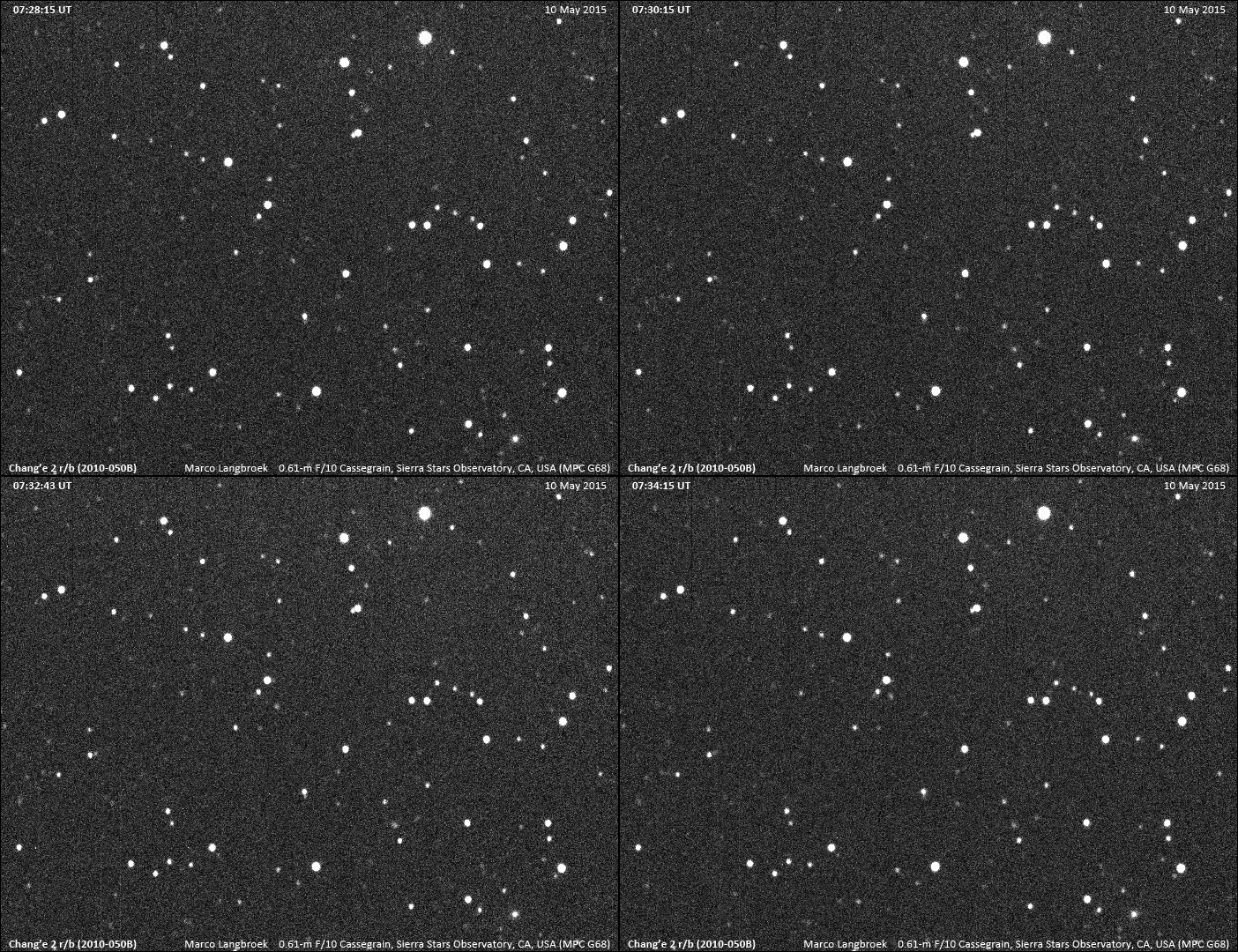
In my previous post I related how on May 7 a distant piece of Space junk was briefly mistaken for a Near Earth Asteroid. It concerned 2010-050B, the upper stage of the Long March 3C rocket that launched the Chinese Lunar mission Chang'e 2 in October 2010. This upper stage is moving in a trans-Lunar orbit, with apogee up to almost two Lunar distances away from Earth. The rocket stage is 12.4 by 3 meters large.

Yesterday May 10, I obtained new images of the object, using the 0.61-m Cassegrain telescope of Sierra Stars Observatory in California, USA. Above is an animated GIF of the images. My resulting astrometric data are here.

The object was near mag. +15.3, at a distance of almost 518 800 km at that time. For a comparison: the distance to earth of the moon varies between about 356 400 and 406 700 km. It is quite cool to image space junk at this large a distance!

Click image to enlarge

Using my May 10 observations combined with the May 7 observations by the Catalina Sky Survey (MPC 703) and Peter Starr in Warrumbungle (MPC Q65), I compute the following orbit for the object:

Orbital elements: 2010-050B Chang'e 2 r/b

Perigee 2015 May 22.689019 +/- 0.00747 TT 
= 16:32:11 (JD 2457165.189019) 
Epoch 2015 May 7.0 TT = JDT 2457149.5       Find_Orb 

M 198.75910 +/- 0.037        
n 10.27730942 +/- 0.00562

a 452220.817 +/- 165 km    Peri. 151.22410 +/- 0.028 
e 0.2197903 +/- 0.000308   Node 226.29285 +/- 0.00006
i 41.13389 +/- 0.00028 
  
q 352827.032 +/- 267 km    Q 551614.602 +/-  68 km       
P 35.03 d        H 28.1 

From 23 observations 2015 May 7-10; mean residual 0".307.

In TLE form:

Chang'e 2 r/b                                 352827 x 551615 km 
1 00000U         15127.00000000  .00000000  00000-0 00000-0 0 09
2 00000 41.1326 226.5090 2163618 150.9650 199.0248 0.02835833 01

For those people with access to a  sufficiently large instrument that want to try it themselves: efemerids for the object can be obtained here.

I plan to include this object in my periodic observations of distant satellites.

Friday, 8 May 2015

An 'asteroid' that wasn't: the Chinese Chang'e 2 upper stage (2010-050B) imaged at almost twice the Lunar distance

WJ297AD = Chang'e 2 r/b. Images (c) Peter Starr, Australia

On 7 May 2015 near 7:35 UT, the Catalina Sky Survey (MPC 703) in Arizona detected a bright mag. +17  fast moving object moving at about 12"/minute through Virgo. The object was reported as a potential Near Earth Asteroid and entered the NEO Confirmation Page (NEOCP) of the IAU's Minor Planet Center with temporary NEOCP designation WJ297AD.

Some 6 hours later, Peter Starr at Warrumbungle Observatory (MPC Q65) in Australia targetted the object with his 0.51-m Dall-Kirkham telescope, in order to confirm it and obtain more positions.

As he often does with NEOCP objects he images, Peter sent the imagery to me for astrometric processing.

image (c) Peter Starr. Click image to enlarge

After I measured the images (a part of one is shown above, showing the object as a short trail amidst the stars) and tried to fit an orbit to the astrometry obtained from Peter's images and the Catalina Sky Survey observations, the result was odd.

FindOrb suggested that this object was in orbit around the Earth, in a trans-lunar orbit with perigeum at  352 666 +/- 426 km, apogeum at 552 356 +/- 934 km, an orbital inclination of 41 degrees and an orbital period around the Earth of 35 days! The MPC itself, fitting several preliminary orbits, also presented solutions pointing to an object in an odd, very earth-like orbit with semi-major axis about 1.05 AU and a heliocentric orbital period of ~1.0 year.

At that time, after an initial "Huh? That's odd..." I already developed some feeling that this might perhaps be an artificial object, if this fit was not spurious. I was not sure though (preliminary orbit fits to small observational arcs can come out weird on occasion), so I sent Peter an e-mail mentioning that it was a "weird object that seems to be in a very Earth-like orbit".

Meanwhile, another asteroid observer, Jacques Cristovao, also thought that this NEOCP object was odd. Around the time Peter was doing his observations from Warrumbungle, Cristovao suggested in a message on the Minor Planet Mailing List that the object was artificial, and specifically was 2010-050B, the upper stage of the Chinese Chang'e 2 Lunar probe.

That turned out to be correct: WJ297AD indeed is the rocket stage from this launch.

This rocket stage moves in a very wide translunar orbit with perigeum close to one lunar distance, and apogeum at almost twice the Earth-Moon distance. At the time of the observations it was near apogee at a distance of about 535 500 km, well beyond the moon at almost twice the Earth-Moon distance.


Chang'e 2 orbit in the Earth-Moon system (based on May 7 observations)

The rocket stage was used to bring the second Chinese Lunar mission, Chang'e 2, into a temporary orbit around the moon. Chang'e 2 itself later left the Earth-Moon system for a journey to asteroid Toutatis, but the rocket stage it left behind is still in orbit around the Earth-Moon barycenter.

It was not the first time that the Chang'e 2 rocket  was initially confused with a Near Earth Asteroid. The same happened in 2013 when the rocket was briefly known as 'asteroid' 2013 QW1.

These days, even the asteroids are Made in China....

Friday, 16 July 2010

Ozzie space junk dreams

Northern Hemisphere summertime is the usual period that the news is lazy, and strange mistaken news items pop up like another sighting of the Loch Ness Monster, Bigfoot, chickens that came before the egg (or not), and now an Ozzie corporation that thinks it can solve the space junk threath by selling tracking data from to-be-build tracking lasers.

This company must live in the Dream Time. It is not tracking itself that is the problem. USSTRATCOM basically tracks everything 10 cm+ in LEO plus a lot smaller stuff. The real problems, are problems that additional laser tracking data is not going to solve:

a) the lack of computer power to determine which detections concern the same object;

b) most importantly: the lack of computer power to timely calculate risk situations for thousands of objects in dynamic orbits.