|
Artemis II imaged with the TU Delft 41.5-cm MISO telescope on 8 April 2026 |
 |
| 'track & stack' of 13 images on the Spacecraft movement. Artemis II is the dot in the yellow circle. |
I was only two years old when, in December of 1972, Apollo 17 left the Moon, so I don't remember it. But untill last week it was the last time in my lifetime that humans had entered and left the Lunarsphere. So for me, as a nominal "consciously just post-Apollo person", the crewed Lunar flyby of Artemis II 'Integrity' this week was exciting and new. Humans flying to the Moon again!
Of course, as a satellite tracker, it would be nice to capture something of that yourself: not from a TV screen, but as an actual observation. And since shortly, I have access to a nice tool for that: our new MISO telescope ("Multiple Input Single Output'), part of the SCOMlab on the rooftop of our Delft University of Technology Faculty of Aerospace Engineering. It is a 41.5-cm F8 Aluna Ritchey-Chretien telescope on a planewave L500 mount, realised by my colleague Rudolf Saathof for experiments with laser satellite communication. Rudolf involved me in the acquisition process and as a result, the telescope got a configuration to make it also useful for SSA/SOT when not being used for lasersatcom. I specifically want to use this telescope for XGEO/CisLunar observations in the future.
 |
| TU Delft 41.5-cm MISO telescope |
 |
| MISO telescope dome on the roof of the TU Delft Aerospace Engineering Faculty |
 |
| TU Delft MISO 41.5-cm telescope |
Unfortunately the ARTEMIS II flight trajectory during this mission was not very favourable for the Netherlands, with the Moon (its target) very low in the sky in this season. Over the full mission it barely came over the horizon, and initially weather was not quite cooperative as well.
On the night of April 7/8 2026, a day after the Lunar flyby, with Artemis II homebound but still close to one Lunar distance from Earth, weather prospects were good. Although I had my doubts (unjustified, as it turned out!), Rudolf encouraged me to try to capture ARTEMIS in the early morning of April 8.
Conditions were not very encouraging: the spacecraft would reach a maximum elevation of no more than 8.8 degrees (!) over the horizon, it would be twilight already by that time, and the waning gibbous moon would be a mere 15 degrees distant. Prospects of success looked dim to me. Yet, I decided to go for it, and downloaded the ephemeride predictions for that night through JPL HORIZONS.
I only recently have had my training on the MISO telescope from our technician Martin. Much of the system is still in the commissioning phase (and I still have to create good flats and darks for example, as this calibration imagery is not yet existent), and it still has its occasional quirks and glitches. This would be only the second time I would use the system on my own, via a remote connection from my home to the dome and instrument: and this deep into the night I'd rather not get Martin out of his bed if things went south. So I was a bit nervous.
I logged in at about 4 am local time, and started the process of going through the checklist, powering up and activating the dome, telescope and sensors, opening the dustcover and dome doors, followed by some time spent on focussing and finding the best camera settings. Then I moved the telescope to where Artemis II should be, only 8.7 degrees over the horizon (...!). After initially trying 1x1 binning, I moved to 4x4 binning and started to snap 10-second unfiltered images with the QHY600 MM PRO camera that is attached to the prime focus of the telescope.
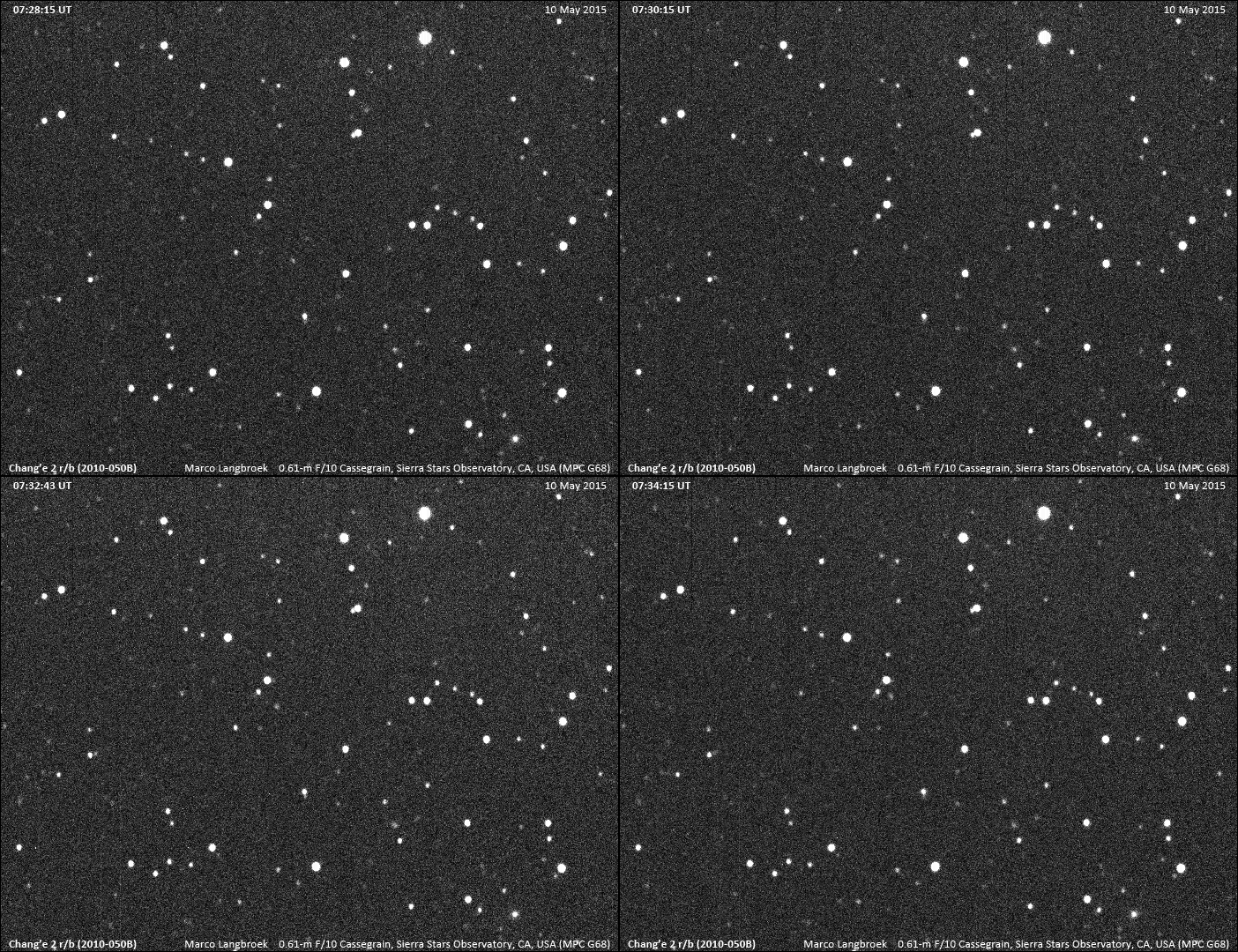
After transferring the FITS files from the observatory server to my laptop at home, I looked through them. From a previous observing run, I already had created a configuration file for the telescope/camera combination for Astrometrica, my favourite astrometric software. I created a 'blink' (animated sequence, to look for moving objects) of four of the images in Astrometrica, obtained near 3:34 UTC (5:34 am local time), around the start of nautical twilight.
And next my heart skipped a beat: there was a faint but unmistakable moving dot right where ARTEMIS should be! Hallelujah! This was very cool!
|
Artemis II imaged with the TU Delft 41.5-cm MISO telescope on 8 April 2026 |
The image above shows the 'blink' I created of four 10-second exposures that were taken over a 1.5 minute timespan, with Artemis II visible as a faint moving dot.
I frankly did not expect the attempt to be successful, so I definitely was very positively surprised by this! The spacecraft turned out to be around magnitude +14, brighter than I had expected and that helped. The sky at low elevation was clear, and our telescope is located on a high-rise at 55 meters above the surrounding landscape, which also helps (a bit). Yet, the influence of atmospheric turbulence and extinction at such a low sky elevation is well visible in the imagery.
The image below is composed of 13 images (each a 10-second exposure) taken some 20 minutes earlier, where I have used the 'track and stack' method, stacking the images with each image shifted in the direction of movement of the spacecraft. As a result, the stars become trails, but the spacecraft is still a dot, and because it combines the light collected over 13 x 10 seconds, Artemis II is much better visible now. It is the dot in the yellow circle:
|
| 'track & stack' of 13 images on the Spacecraft movement. Artemis II is the dot in the yellow circle. |
(this image was created without flat- and dark substraction, which shows, as it has vignetting and some obnoxious "dust donuts". Not the prettiest picture, but happy with the result).
Artemis was at a whopping range of 359 000 km (pretty much still one Lunar distance) from the observatory at that time!
At the moment of writing, Artemis II is still on its way back to Earth. The capsule with crew should reenter the earth atmosphere near 00:00 UTC on the night of 10-11 April 2026 (April 10 local time on the US west coast), having separated from the Command module around 23:44 23:33 UTC (April 10). It then parachutes down for a splashdown in the ocean near San Diego.
Below, I have created a map showing the ground-projected return trajectory. It is based on vector and event timeline data from NASA and a ballistic continuation of the last predicted vector with Tudat towards the splashdown area. The red boxes are the exclusion zones from Navigational Warning NAVAREA XII 232/26 and NAVAREA XII 242/26: they represent the areas where the Command Module reenters into the atmosphere, and the Crew Capsule splashdown area some 35 km out of the California coast.
(updated map, as a new exlusion area in front of the California coast was added in Navigational Warning NAVAREA XII 242/26, and the map is now based on NASA provided trajectory and event data rather than JPL HORIZONS).
 |
| UPDATED MAP. Click to enlarge |
Note that this is a ground-projected trajectory, and in the early part of the approach (before 23:00 UTC) the spacecraft is still at a large distance. The seemingly accute "turn" around 22:00 UTC is not a real turn, but a perspective effect created by the earth surface rotating underneath the approach path, specifically parts of the earth surface that initially were "behind" the earth limb turning to the front as seen from the approaching spacecraft: and initially the effects of earth rotation nunder the trajectory being the major factor, the as Artemis comes closer, relative speed with respect to the Earth surface taking over..
 |
| click image to enlarge |
Note: Astrometry from the observations is here, with a typo correction here.