Showing posts with label meteorite. Show all posts

Tuesday, 26 September 2017

OT: The brilliant fireball over the Netherlands of 21 September 2017, 19:00 UT, a piece of comet Encke

The fireball as photographed from Ermelo, the Netherlands. Image (c) Koen Miskotte


In the evening of 21 September 2017 at 21:00:10 CEST (19:00:10 UT), a brilliant fireball, as bright as the first quarter moon, appeared over the Netherlands. It was widely seen and reported and garnered quite some social media and press attention (e.g. here). The next day I was live in a Dutch TV program to talk about it.

The fireball was captured by six all-sky camera stations of the Dutch-Belgian all-sky meteor camera network operated by amateurs of the Dutch Meteor Society and KNVWS Meteor Section: stations Ermelo, Oostkapelle, Borne, Utrecht, Twisk and Wilderen, operated by respectively Koen Miskotte, Klaas Jobse, Peter van Leuteren, Felix Bettonvil, Marco Verstraaten and Jean-Marie Biets.

The image in the top of this post shows the photograph taken by the all-sky camera in Ermelo (courtesy Koen Miskotte), where the fireball appeared almost right overhead. The image below was taken by the all-sky camera in Utrecht (courtesy Felix Bettonvil), showing it slightly lower in the sky (click the images to enlarge).


The fireball as photographed from Utrecht, the Netherlands. Image (c) Felix Bettonvil

In the photographs above, the "dashed" appearance of the fireball trail is caused by an LCD shutter between the lens and the camera CCD, which briefly interupts the image at a set interval. For Ermelo this was 14 interuptions per second, for Utrecht 10 interuptions per second.

Knowing the shutter frequency you get the duration of the fireball by counting the number of shutter breaks in the trail: in the case of this fireball, it lasted over 5.3 seconds. Together with triangulation information on the path of the trail in the atmosphere, it gives you the speed of the fireball in km/s, which is necessary to calculate the orbit in the solar system. It also provides you with information about the deceleration of the meteoroid in the atmosphere. In this case, it entered the atmosphere with a speed of 31 km/s and by the time it had completely burned up at 53 km altitude, the speed had decelerated to 23 km/s.

The fireball fragmented into pieces quite early during its atmospheric entry. Some of these fragmentation events can be seen as brief brightenings (flares) in the images.

Triangulation of the six all-sky images yields the following atmospheric trajectory:

Atmospheric trajectory of the fireball, calculated by the author. Camera stations in yellow.

The  fireball moved almost due east-west. It started over Deventer, crossed over southern Amsterdam and Schiphol airport, and ended over sea. The end altitude at 53 km and end speed of 23 km/s indicate that nothing was left of the original meteoroid by the time the fireball extinguished: no meteorites reached earth surface, it completely ablated away.

The apparent radiant of the fireball was located low in the sky, at 16 degrees elevation and almost due east. The grazing entry into the atmosphere resulted in a long trajectory length of over 150 km.

The geocentric radiant of the fireball is located on the Pegasus-Pisces border, just north of the ecliptic. The radiant and speed, and the resulting orbit in the solar system, show that this was an early member of the northern branch of the Taurid stream complex, a meteor stream complex associated with comet P/Encke. It is active from September to December with a  peak in activity in November. The stream is broken up in several substreams, and the early Northern Taurids from September are sometimes called Northern delta Piscids, one of these substreams in the Taurid complex.

The radiant position and heliocentric orbit for this fireball are shown below.

apparent (observed) and geocentric radiant of the fireball

calculated heliocentric orbit of the meteoroid


Acknowledgement: I thank the photographers (Koen Miskotte, Klaas Jobse, Peter van Leuteren, Felix Bettonvil, Marco Verstraaten and Jean-Marie Biets) for providing their imagery for this analysis.

Saturday, 1 July 2017

OT: Broek in Waterland, the sixth Dutch meteorite (observed fall, 11 January 2017)


Last Monday was a special and extremely busy day. At Naturalis, the Dutch National Museum of Natural History, we presented a new meteorite: Broek in Waterland (provisional name). It is an L6 chondrite and only the 6th authenticated meteorite of the Netherlands in 177 years time, after Uden (LL7, fall, 1840), Utrecht (L6, fall, 1843), Diepenveen (CM-an, fall, 1873), Ellemeet (DIO, fall, 1925) and Glanerbrug (L-LL4-5, fall, 1990).

(left to right) The author and Leo Kriegsman (Naturalis) and Niek de Kort (Royal Dutch Association for Astronomy) with the new Broek in Waterland meteorite at the presentation in Naturalis Biodiversity Center, 26 June 2017

On 11 January 2017 at 16:08:40 UT (17:08:40 local time), just after sunset, a bright fireball appeared over the Netherlands. The sun was only 3 degrees below the horizon and the sky still bright blue and star-less at that moment, so unfortunately the Dutch-Belgian photographic all-sky network and the CAMS BeNeLux videonetwork where not yet operational. Dozens of people from the Netherlands and Belgium however visually spotted the fireball and reported it.

A driver on a highway near Weerde in Belgium, 165 km from the fall locality, captured the fireball with a dashcam and uploaded the video to a Belgian UFO investigation website. No other video records besides this one have surfaced, unfortunately. From a comparison of the road marking patterns on the video with Google Earth imagery, I determined that the fireball (going almost straight down in the video) appeared near geodetic azimuth 11-15 degrees. Broek in Waterland, where the meteorite was subsequently found, is in azimuth 11.5 degrees as seen from this locality, i.e. a very good match.


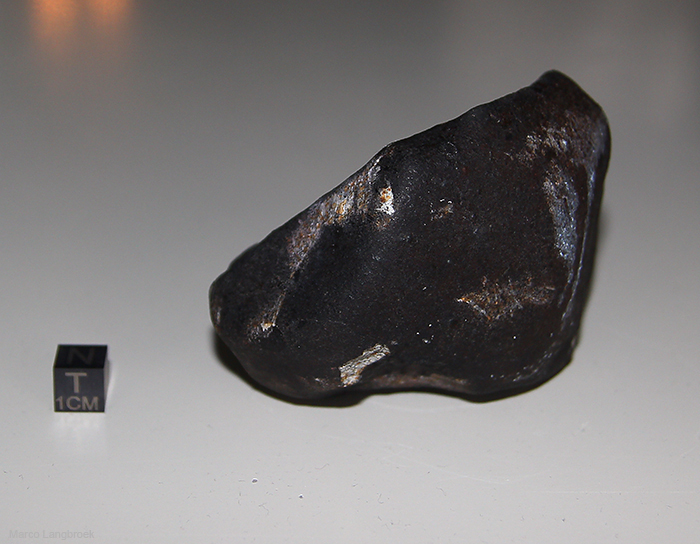
The next day, the owners of a garden shed near Broek in Waterland, a rural village just a few km north of Amsterdam, noted roofing tile shards on the ground next to the shed. Upon investigation, they discovered something had smashed through the roof and lodged on the supporting latticework. It was a 530 grams black stone, about 9 cm in diameter, the size of a small fist.


The Broek in Waterland L6 chondrite (click images to enlarge. Photographs by the author, 3 Feb 2017)

Puzzled by the curious incident, one of the finders started to search the internet for explanations. Two and a half weeks after the fall, she phoned Niek de Kort, who runs the Meteorite Documentation Center of the Royal Dutch Association for Astronomy and Meteorology. Niek was abroad at that moment, but the description and subsequent e-mail with pictures sounded very promising. He allerted Leo Kriegsman and the author (Naturalis Biodiversity Center, the Dutch National Museum of Natural History). We made an appointment with the finders and visited them at the fall locality on February 3, where we formally established that the stone was indeed a meteorite. From the look of it, I provisionally determined it as likely an L6 Ordinary Chondrite (a common type of stony meteorite). Subsequent laboratory testing has confirmed that initial assessment.

We arranged a temporary loan of the stone with the owners and got permission to cut off 20 grams for research. Subsequent laboratory research at Naturalis and Utrecht University with thin sections, XRF and microprobe confirmed that the petrology, mineralogy and chemistry was consistent with an L6 Ordinary Chondrite. Measurement of shortlived isotopes at the VU University Amsterdam found isotopes that confirm this is a recent fall.

The meteorite's pre-sampling weigth was 530 grams. It is fist size, and almost completely fusion crust covered, bar a few chips and scratches from the impact on the roof. One side of the stone is rounded, the other side shows flat facets, the larger ones of which are covered in "thumb prints" (regmaglypths). This evidences breakup of the stone during the ablative phase of entry into the atmosphere.


search activities in the fall area, February 2017 (photograph by author)

In the weeks after the stone came to light, I teamed up with Felix Bettonvil of Leiden Observatory to organise a search for more fragments in the surrounding area. Some fifteen volunteers, many of them veterans from earlier meteorite search attempts, from the Dutch Meteor Society, the KNVWS meteor section, Naturalis and Leiden Observatory, spend several weekends  meticulously searching a large area around the fall site, but no other fragments were found. The area in question has a lot of open water and is very swampy: part of the area is a nature reserve and a peat bog where, if you jump up and down, the ground surface starts to form waves, and it makes squishy sounds when you walk there. We used long metal rods to probe suspicious holes in the ground. Searches were halted when late March the bird breeding season started, and the area became temporarily prohibited for that reason.

Broek in Waterland is only the 6th authenticated meteorite of the Netherlands. The previous meteorite fall, Glanerbrug on 7 April 1990, was 27 years ago. It impacted on the roof of a house. We suspect, based on the total land surface of our small country, that on average about each three years a 0.5 kg meteorite lands somewhere in the country. Yet, we have on average recovered one only each 30 years. Evidently, a lot of them, 9 out of 10, fall straight into oblivion. The large amount of open water and generally swampy nature of much of the Netherlands, with very soft peaty and clayey substrates, might play a role here.


The location of Broek in Waterland, and the other Dutch meteorite fall localities (map by author)

All six Dutch meteorites are witnessed falls. The pre WW-II falls (Uden, Utrecht, Diepenveen and Ellemeet) all were recovered because the meteorite landed close to someone working the fields. With the mechanisation of agriculture post WW-II this no longer happened. The two post WW-II meteorites, Glanerbrug and the new Broek in Waterland, were recovered because they hit a building and caused damage.

We are actively trying to find meteorites and have been organizing dedicated searches a number of times, based on fireballs captured multistation by our photographic all-sky fireball camera network. Examples are a fireball from 2013 near Hoenderloo and another one from 2015 in Gaasterland. None of these searches was succesful.

The press attention on June 26, when the existence of the Broek in Waterland meteorite was made public by Naturalis, was enormous. We have been busy from 7 am in the morning to 1:30 am the next night, with Leo, Niek and I giving dozens of newspaper, radio and TV interviews. In the late evening of June 26 I was a table guest in a well-watched talkshow on Dutch television, RTL Late Night, live broadcast from Hotel Schiller in Amsterdam, showing the meteorite and talking about it with host Humberto Tan, with science journalist Govert Schilling as my side kick (or me as his, depending on your point of view).

the author (middle) as well as science journalist Govert Schilling (left) with the meteorite in RTL Late Night, 26 June 2017
RTL Late Night show host Humberto Tan with the meteorite

Friday, 15 February 2013

[updated] HUGE fireball over Russia this morning! Not 2012 DA14 related.

A HUGE fireball has appeared over Chelyabinsk, Russia, this morning. And with HUGE I mean: HUGE. Apparent brightness rivalling the sun, and very strong sonic booms leading to glass damage and people being wounded by flying glass. This must have been a seizable object entering the atmosphere.

Phil Plait, the "Bad Astronomer" has very good coverage including some amazing videos here, so I will refer to him for imagery and the general story (apart from two I include below: one showing the meteor, the other one the arrival of the shock wave).


Below, I will briefly explain why this fireball cannot have been a fragment of 2012 DA14, the ~50 meter wide asteroid that will pass very close to earth coming evening (Feb 15, 2013).

First of all (and Phil Plait points this out as well), the fireball in Russia came from the wrong direction. Several of the videos show it appearing in the east near the rising sun, coming from a N-NE direction. That is the wrong direction: fragments of 2012 DA14 are on a south-north trajectory.

What is even more important: fragments of 2012 DA14 could never enter the atmosphere as far north as latitude 55 N (Chelyabinsk). Fragments in orbits similar to that of the asteroid, have a theoretical geocentric radiant at declination -81 degrees, i.e. almost at the southern celestial pole. They hence approach earth from due south. This means that the northern hemisphere is out of reach of these fragments: the northern hemisphere represents (as seen from these approaching fragments) the "far side" of the earth.

[video added 18/02/2013]


[added 18/02/2013] In the above video I explain this more visually, with the help of an orange. In reality, it is slightly more complicated than I present it in the video, as objects grazing the earth's limb are actually slightly attracted by earths gravity and can end up a little bit over the line between "front" and "far" side of the earth. Ending up at latitude 55 N is nevertheless out of the question.

The funny thing is that the latitude of Chelyabinsk and the approach direction of 2012 DA14 (and fragments in a swarm around it) are well established facts, even if the trajectory of the Russian fireball is less so at the moment. So it is quite nice that from the encounter geometry with the 2012 DA14 orbit and the latitude of the Russian meteor alone, we can actualy already exclude a connection between the two with a quite strong certainty.

Fragments in 2012 DA14-like orbits and the Russian fireball itself are also too fast to be temporarily captured in earth-orbit, so that is no explanation either.

This fireball was not man-made space junk either. Besides coming from an unlikely direction, it is too fast and much too bright for that.

These are amazing times: the reentry of a Russian rocket stage seen from NW Europe on the evening of the 13th, then this hughe meteoric fireball over Russia this morning, and a close pass of asteroid 2012 DA14 tonight. Wow!

Wednesday, 13 February 2013

Fireball over NW Europe of the evening of 13 February 2013: Re-entry of a Soyuz r/b

Reports are pouring in of a very long duration, bright fireball near 22:15 CET (21:15 GMT) seen from Belgium, the Netherlands and Germany. Reports indicate 30-40 seconds visibility, and an "explosion" halfway, and some reports indicate sonic booms.

This fireball was with a high degree of certainty the re-entry of a Russian Soyuz 3rd stage, #39083 (2013-007B), the 3rd stage from the Soyuz that launched the Progress cargoship Progress-M 18M towards the ISS on February 11th.

USSTRATCOM issued a TIP message indicating decay at 21:15 +/- 1 m UTC near 49N, 13 E.

Below is a quick map (made using Orbitron) of the trajectory and approximate position of the re-entry.
click map to enlarge

Time, general description and reentry data all fit quite well.

Monday, 24 September 2012

More on the 21 September 2012 fireball: why it definitely was a meteor

I should have done this analysis earlier but did not have the time available until now. What follows now is a quick and back-of-the-envelope kind of calculation, but in my (not so) humble opinion it is adequate to the question at hand.

It concerns, of course, the splendid slow fireball seen widely over NW Europe near 21:55 UT on 21 September 2012. I posted on it before, focussing on saying "no" to the suggestion that this could have concerned a satellite reentry. In the post that now follows, I further strengthen the conclusion that it was not a satellite reentry, but a genuine meteoric fireball.


The map above gives a quick (and not particularly accurate) back-of-the-envelope reconstruction of the fireball trajectory. It is based on trajectory descriptions from Bussloo in the Netherlands and Dublin in Ireland: by taking reported altitudes (with respect to stars) and general directions of reported start and endpoints, and an assumed altitude of 50 km, the trajectory above is what approximately results. (update 19:10 UT, 24 Sep: an updated version of the map is at the bottom of this post).

The resulting trajectory is some 1000-1200 km long. In what now follows, I have taken 1100 km as the distance travelled by this fireball.

Observers near the western and eastern ends of the trajectory would probably not see the complete trajectory. Observers approximately mid-way, in mid-Britain, would potentially see most if not all of the trajectory (from experience I know you can see bright fireballs from distances of 500 km).

Observers report durations between 20-60 seconds: most video's on the web suggest a 40+ seconds duration.

It would take a reentering satellite travelling at 8 km/s (the orbital speed at decay altitudes) about 138 seconds or roughly 2.25 minutes to travel this distance. While the reported fireball durations are long, none of the reports nor videos comes even remotely close to that value.

A meteoric fireball travelling at the lowest speed possible for such an object, 11.8 km/s, would take 93 seconds to travel that distance. This is still longer than almost all of the reports suggest, but clearly getting closer.

If we take an estimated duration of 60 seconds, the 1100 km trajectory length results in a speed of  approximately 18 km/s.

18 km/s is a very reasonable speed for a slow, asteroidal origin fireball.

(it is, let me repeat, also way too fast for a satellite reentry).

Meteorite dropping fireballs typically have speeds between 11.8 and 27 km/s. A speed near 18 km/s sits squarely in the middle of that speed interval.

(update: diagram added 14:45 UT, 24 Sep)
(click diagram to enlarge)

The 60 seconds probably represents the upper boundary value for the duration of the fireball. If we take a shorter duration of 40 seconds, the speed already increases to 27.5 km/s.

This quick back-of-the-envelope reconstruction therefore shows that this must have been a meteoric fireball, quite likely of asteroidal origin, and we definitely can exclude a satellite reentry.

The fragmentation described and filmed is not unusual for meteorite dropping fireballs (see the video's of the Peekskill meteorite fall in my previous post). The object probably entered the atmosphere under a very shallow angle, which together with the slow speed explains the unusually long duration of the event.

Meteors of this kind are rare, but they have been seen before. Think of the Peekskill meteorite fall, but also the famous 1972 daylight fireball over the Grand Tetons (that had a duration of over 100 seconds) and the Cyrilid Meteor Procession from 1913 (that lasted minutes).

Note: a previous post gives a number of other lines of evidence which likewise suggest this fireball was not man-made space debris.

UPDATE: a further update is given in a new post: a very cautious orbital solution suggests an Aten orbit.

Note 2: on how I made this quick and (emphasis) rough trajectory reconstruction. I took observations that contain clear sky locations: e.g. a sighting from Dublin stating it went "through the pan of the Big Dipper"; the description from Bussloo observatory in the Netherlands; and later adding a.o. a photo from Halifax, UK, showing it just above the tail of Ursa Major. These descriptions can be turned into directions and elevations. Next, I drew lines from these sighting points towards the indicated directions, marking distances roughly corresponding to 30, 50 and 80 km altitude as indicated by the observed elevation [ distance = altitude / tan(elevation) ]. Near the start of the trajectory I marked 50 and 80 km, for Britain and Ireland I marked 30 and 50 km. These points then provide you with a rough trajectory.
From Dublin the object passed through North towards west. From Bussloo the object started NE (azimuth 60 degrees): these are important points of information too as it shows that the object started at least as far east as the Dutch-German border (and more likely over Sleswig-Holstein in N-Germany) and had its endpoint at least as far west as the northern part of Ireland.


Above: Updated map version, 24 Sep 19:10 GMT , also showing the principle of how it was reconstructed for three sighting locations. With thanks to Ramon van der Hilst for providing more detailed information on sky trajectory as seen from Bussloo (NL) on request.