For quite a while, I have had a wish to add video to my observing techniques. That moment is now there.
During last October's Draconid meteor campaign, I was introduced to working with WATEC 902H camera's (see my previous post here), and discovered it was not that technically complicated after all. So when I saw one offered for a very good price in a clearance sale in October, I bought one.
The WATEC 902H is a sensitive surveillance camera, which is able to film stars - and satellites- in the night sky. It is small (fits in the palm of a hand).
I still need to add a GPS time inserter (it has been ordered already) for adding precision timing to the video frames. Once that is done, the system is complete.
Meanwhile, I did some test imaging when it briefly cleared last Wednesday evening. Conditions were not optimal: moonlight and a bit of haze. Below are two results, both movies made using a Canon EF 2.0/35mm lens attached to the camera and in both cases the opening shot shows the "dipper" of Ursa minor, with the brightest stars being beta and gamma Umi.
The first movie shows Lacrosse 5 (2005-016A), at one point doing its "disappearance trick":
The next movie shows the NOSS 3-4 duo (2007-027A & C):
The first experiments were a bit more problematic than anticipated. Initially, I tried to feed the video signal from the camera directly
into the laptop (and record using the laptop) using an EasyCap capturing
device. That turned out to not work that well. My laptop is old and
apparently too slow, and too many frames were dropped resulting in
movies that did not flow well.
On the advice of Scott
Campbell, Kevin Fetter and Greg Roberts, I then added a HDD recorder to
the equipment, recording with this device rather than with the laptop.
That turns out to work fine, and resulted in the footage above (note: the original movie files are a bit better in quality than these YouTube versions).
I do not intend for video to replace photography at my observatory: I intend it as an augmentation to the photography. Every once in a while, it is nice to have actual moving footage.
Both techniques have their pro's and con's. Video has accurate timing but low astrometric accuracy (due to the low resolution of the imagery). Photography has a high astrometric accuracy, but less timing accuracy (although by now, after much practise my time residuals are usually well below 0.1s). I think the pro's and con's of both techniques largely even out. One pro point of photography, is that it doesn't need a power supply - meaning you can be more mobile.
Apart from using it on satellites, I also intend to employ the WATEC for meteor surveillance (Peter Jenniskens' CAMS system, if I can get the software to work here, which so far turned out to be problematic) and for observing asteroid occultations.
Showing posts with label NOSS 3-4. Show all posts
Showing posts with label NOSS 3-4. Show all posts
Friday, 11 November 2011


Sunday, 30 January 2011
Satellites near the Pleiades
Yesterday evening (Saturday 29 January) some satellites seemed to be in love with the Pleiades. In a somewhat hazy sky, I observed Lacrosse 3 (97-064A) cruising near the Pleiades and Hyades in twilight, and half an hour later watched the NOSS 3-4 duo (07-027 A & C) cruise right through the Pleiades.
Below are the resulting images. The top image of the NOSS duo cruising through the Pleiades (movement is from top to bottom, with 07-027A leading) was made using the Canon EF 100/2.8 Macro USM lens: the images of Lacrosse 3 were made using the EF 50/2.5 Macro lens.


The FIA Radar 1 (10-046A) was imaged as well. Unlike a few nights ago, it did not flare.
The previous night had a better quality sky, so I targetted a few geostationary satellites low above the horizon. Classified geostationary targets imaged were PAN (09-047A), Mentor 2 (98-029A), Mentor 4/USA 202 (09-001A) and the Milstar 5 r/b (02-001B). A number of commercial geostationary satellites were captured as well.
Below image, taken with the Carl Zeiss Jena Sonnar MC 2.8/180mm, shows PAN with the nearby commercial geostationary Yamal 202 (03-053A).

The image below, taken with the EF 2.5/50mm Macro, shows Mentor 2, with the stars of Orion's belt and Orion's nebula M42 at left:

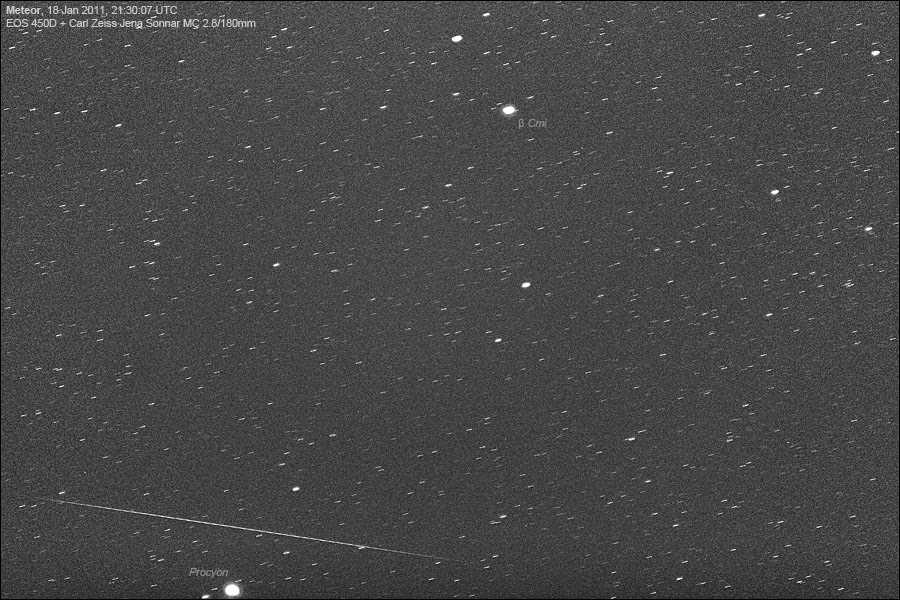
I also accidentally captured a mag. +2.5 sporadic meteor in one of the images taken with the Carl Zeiss 180 mm (FOV only 5 x 7 degrees!):

Below are the resulting images. The top image of the NOSS duo cruising through the Pleiades (movement is from top to bottom, with 07-027A leading) was made using the Canon EF 100/2.8 Macro USM lens: the images of Lacrosse 3 were made using the EF 50/2.5 Macro lens.
click images to enlarge


The FIA Radar 1 (10-046A) was imaged as well. Unlike a few nights ago, it did not flare.
The previous night had a better quality sky, so I targetted a few geostationary satellites low above the horizon. Classified geostationary targets imaged were PAN (09-047A), Mentor 2 (98-029A), Mentor 4/USA 202 (09-001A) and the Milstar 5 r/b (02-001B). A number of commercial geostationary satellites were captured as well.
Below image, taken with the Carl Zeiss Jena Sonnar MC 2.8/180mm, shows PAN with the nearby commercial geostationary Yamal 202 (03-053A).
click image to enlarge

The image below, taken with the EF 2.5/50mm Macro, shows Mentor 2, with the stars of Orion's belt and Orion's nebula M42 at left:
click image to enlarge

I also accidentally captured a mag. +2.5 sporadic meteor in one of the images taken with the Carl Zeiss 180 mm (FOV only 5 x 7 degrees!):
click image to enlarge
Saturday, 17 January 2009
NOSS 3-4 duo through Perseus
An initially very clear evening today allowed observations again. Lacrosse 3 (97-064A) was captured, along with NOSS 2-3D (96-029D) and the NOSS 3-4 duo (07-027A & C). USA 32 (88-078A) was captured as a very faint trail but not measured.
A mistake of one minute in the timing while trying to photograph the 96-029 objects made me miss the C & E objects, but captured the D object at the end of what seems to be a slow flare.
One of the images of the NOSS 3-4 duo, the one where they cross Perseus just below the alpha Persei star association, turned out particularly nice, with lots of stars and two bright trails:

A mistake of one minute in the timing while trying to photograph the 96-029 objects made me miss the C & E objects, but captured the D object at the end of what seems to be a slow flare.
One of the images of the NOSS 3-4 duo, the one where they cross Perseus just below the alpha Persei star association, turned out particularly nice, with lots of stars and two bright trails:
(click image to enlarge)

Sunday, 16 March 2008
Bright Keyhole Satellites
A late report on my observations of Wednesday evening 12 March.
After a strong gale in daytime the sky cleared in the evening, although fields of clouds still came and went. A near first quarter moon in the sky was no real nuisance.
Several objects were observed: NOSS-es 2-3 and 3-4 and the NOSS 3-4 rocket, plus two KeyHoles: USA 129 and USA 186.
USA 129 (96-072a) was bright again just after it emerged from eclipse. I observed it telescopically and obtained a photograph, yielding 4 positions in total. The visually obtained data dn the photographically obtained data agree well. The image is below and shows it near Castor and Pollux:

The other Keyhole observed, USA 186, flared short and bright while the camera was open:

96-072A was 0.5s early, 05-042A 0.5s late, 07-027A on-time, 07-027C perhaps some 0.3s early (I might have been a tad "fast"with the stopwatch on this one though), and the rocket 07-027B was 1.6s late. The 96-029 C & D components were both 0.4s early, the E component 0.2s early.
Yesterday evening (Saturday 15 March) the sky was too hazy to do serious satellite observations. I did shoot some nice moon images though. Below is an image of the craterland on the southern hemisphere (click it to see it at full screen, full resolution), plus a mosaic image constructed from 3 partial moon images. They were taken through my Meade ETX-70 with my Canon Digital Ixus 400 compact camera.


After a strong gale in daytime the sky cleared in the evening, although fields of clouds still came and went. A near first quarter moon in the sky was no real nuisance.
Several objects were observed: NOSS-es 2-3 and 3-4 and the NOSS 3-4 rocket, plus two KeyHoles: USA 129 and USA 186.
USA 129 (96-072a) was bright again just after it emerged from eclipse. I observed it telescopically and obtained a photograph, yielding 4 positions in total. The visually obtained data dn the photographically obtained data agree well. The image is below and shows it near Castor and Pollux:
(click image to enlarge)

The other Keyhole observed, USA 186, flared short and bright while the camera was open:
(click image to enlarge)

96-072A was 0.5s early, 05-042A 0.5s late, 07-027A on-time, 07-027C perhaps some 0.3s early (I might have been a tad "fast"with the stopwatch on this one though), and the rocket 07-027B was 1.6s late. The 96-029 C & D components were both 0.4s early, the E component 0.2s early.
Yesterday evening (Saturday 15 March) the sky was too hazy to do serious satellite observations. I did shoot some nice moon images though. Below is an image of the craterland on the southern hemisphere (click it to see it at full screen, full resolution), plus a mosaic image constructed from 3 partial moon images. They were taken through my Meade ETX-70 with my Canon Digital Ixus 400 compact camera.
(click images to enlarge)


Sunday, 3 February 2008
NOSS 3-4, Lacrosse 5 oddity, and not every DCF-77 clock is the same... (updated)
This morning, unlike yesterday evening, it was reasonably clear. There was some haze in the sky, but conditions were good enough for decent observations. Targets were the ELINT sat USA 32 (88-078A), two of the NOSS 2-3 components (96-029C & E) and the NOSS 3-4 duo (07-027A & C). USA 193 (060-57A) stayed too low in the sky for my location this morning.
The NOSS 3-4 duo (07-027A & C) is still actively manoeuvering. I observed them on two consecutive passes this morning. Compared to their 08031.475 elsets they were 46-50 seconds late, indicating that they have moved up again between Jan 31 and early Feb 3.
The reason for this manoeuvering is that during their launch last year, the final stage of their rocket booster quit too early, and the payloads as a result entered into a too low orbit. Since that moment, they are gradually working themselves upward to their intended orbits, using their own onboard engines.
In my previous post I noted the purchase of a new DCF-77 clock, following the failure of my old trusted Oregon Scientific DCF-77 clock. Careful comparison to several other DCF-77 clocks however, reveiled that the new clock is 0.40 seconds early to other DCF-77 clocks. That was an unpleasant surprise. I ditched the clock and purchased yet a new one, which runs synchronous with other DCF-77 clocks I compared it too. Interestingly, this new clock was a cheap 7 euro one purchased in a large store chain here in Leiden (HEMA: clock name is "Portland"). The clock that runs 0.40s early (brand: Cresta) was much more expensive. So more expensive evidently not always translates to "more reliable".
As a result, my observations on the evening of Feb 1 need to be corrected by 0.40 seconds.
Those observations concern USA 32 again, and Lacrosse 5 (05-016A). I have the latter 2 seconds early and 0.6 degree off-track compared to elset 08027.73865531. However, this was a difficult observation during a short clearing, with clouds moving into the FOV almost right after the sat passed it, so I cannot rule out I made a mistake in the reference stars used.
Update: an 05-016A observation I made on the evening of Feb 3rd is in-line with elset 08027.73865531 again (delta T only 0.07s, x-track 4 arcminutes), so the Feb 1st result indeed must be the result of a mistake in reference stars used.
The NOSS 3-4 duo (07-027A & C) is still actively manoeuvering. I observed them on two consecutive passes this morning. Compared to their 08031.475 elsets they were 46-50 seconds late, indicating that they have moved up again between Jan 31 and early Feb 3.
The reason for this manoeuvering is that during their launch last year, the final stage of their rocket booster quit too early, and the payloads as a result entered into a too low orbit. Since that moment, they are gradually working themselves upward to their intended orbits, using their own onboard engines.
In my previous post I noted the purchase of a new DCF-77 clock, following the failure of my old trusted Oregon Scientific DCF-77 clock. Careful comparison to several other DCF-77 clocks however, reveiled that the new clock is 0.40 seconds early to other DCF-77 clocks. That was an unpleasant surprise. I ditched the clock and purchased yet a new one, which runs synchronous with other DCF-77 clocks I compared it too. Interestingly, this new clock was a cheap 7 euro one purchased in a large store chain here in Leiden (HEMA: clock name is "Portland"). The clock that runs 0.40s early (brand: Cresta) was much more expensive. So more expensive evidently not always translates to "more reliable".
As a result, my observations on the evening of Feb 1 need to be corrected by 0.40 seconds.
Those observations concern USA 32 again, and Lacrosse 5 (05-016A). I have the latter 2 seconds early and 0.6 degree off-track compared to elset 08027.73865531. However, this was a difficult observation during a short clearing, with clouds moving into the FOV almost right after the sat passed it, so I cannot rule out I made a mistake in the reference stars used.
Update: an 05-016A observation I made on the evening of Feb 3rd is in-line with elset 08027.73865531 again (delta T only 0.07s, x-track 4 arcminutes), so the Feb 1st result indeed must be the result of a mistake in reference stars used.
Thursday, 10 January 2008
NOSS-es, Lacrosses and ISS
Yesterday evening the 9th it was clear in twilight, but clouds came in a while later. Nevetheless there was time enough to get out the ETX-70 again and bag the NOSS 3-4 duo (07-027A and 07-027C), the NOSS 3-3 duo (05-004A and 05-004C) and Lacrosse 3 (97-064A). In total, 7 points were obtained. In the morning of the 10th, I observed the International Space Station just before clouds again interfered.
About 3 minutes before the NOSS 3-4 duo pass, another faint sat crossed the telescope field in a similar trajectory. I was just making a last check of the star field in view against a plotted map to ensure I had the correct location in view, so hadn't the stopwatch in my hands. At first I was a bit worried it was one of the 07-027 objects but very early, so I was relieved when 3 minutes later the real 07-027A sailed into the FOV.
Later that night it cleared again. Below is the image of the ISS I shot a few hours later, during the morning hours. It can be seen passing from Corona borealis into Hercules. It was bright, around mag. -4. My main intended target for that early morning was Progress M-61, but clouds (already visible in the ISS image) intervened.

About 3 minutes before the NOSS 3-4 duo pass, another faint sat crossed the telescope field in a similar trajectory. I was just making a last check of the star field in view against a plotted map to ensure I had the correct location in view, so hadn't the stopwatch in my hands. At first I was a bit worried it was one of the 07-027 objects but very early, so I was relieved when 3 minutes later the real 07-027A sailed into the FOV.
Later that night it cleared again. Below is the image of the ISS I shot a few hours later, during the morning hours. It can be seen passing from Corona borealis into Hercules. It was bright, around mag. -4. My main intended target for that early morning was Progress M-61, but clouds (already visible in the ISS image) intervened.
(click image to enlarge)

Tuesday, 8 January 2008
More NOSS 3-4
It shortly cleared around twilight this evening. There were flying clouds and some thin high altitude streaks in the sky, but I managed to get a pass of the NOSS 3-4 A and C pair (07-027A, 07-027C) and get two points on each as they passed close to mu Andromeda. Like during my observ ations on the 6th, the sats had a clear yellow colour.
This time I had no trouble with handling the stopwatch to retrieve the logged timings any more. Also, comparing with other observer's results, my timings seem good, but I might need to work a bit on the cross-track error.
Shortly after the observation cloud cover returned.
This time I had no trouble with handling the stopwatch to retrieve the logged timings any more. Also, comparing with other observer's results, my timings seem good, but I might need to work a bit on the cross-track error.
Shortly after the observation cloud cover returned.
Subscribe to:
Posts (Atom)