On November 14th and 15th, Alan Figer from France first noted that one of the objects of the NOSS 3-1 pair (2001-040 A & C) was missing. Following up on his message, I could confirm this the next evening, using photography and video. Only one object instead of the usual close pair of two was visible:
Above is the video footage that was shot by me. What turns out to be the A-component can be seen crossing Lyra (bright star is Vega. The glow in the lower left corner is from a nearby lamp), but no C component is to be seen in this video segment (nor was it for one minute before and 3 minutes after this segment). Next, Derek Breit missed it as well in a window of 8 minutes centered on the A object pass, and so did Brad Young.
Over the past few days, two possible obervations have been made of the missing C-object, now well away from the A object, by Brad Young and Bill Arnold.
The break-up of the NOSS 3-1 pair probably means it had reached end of mission. It is interesting to see that some of the older NOSS pairs (and one trio) do still maintain their pair bonding though..
Lacrosse 3 has gone missing - perhaps deorbitted
Another satellite, the 14 year old SAR satellite Lacrosse 3 (1997-064A) has gone missing in a more serious way. It has not been seen since early October. Several observers including me and Pierre Neirinck have done plane searches but so far, it hasn't been recovered. So it has either manoeuvered into a completely different orbit, or has been de-orbitted. If the latter is true, this possible de-orbit comes half a year after the de-orbit of Lacrosse 2 late March 2011. It leaves two remaining Lacrosses in orbit (Lacrosse 4 and 5).
Showing posts with label Lacrosse 3. Show all posts
Showing posts with label Lacrosse 3. Show all posts
Sunday, 20 November 2011


Wednesday, 1 June 2011
More flashing NanoSail-D, and flaring KH-12 USA 224
A week after my May 24 observations, I observed NanoSail-D (2010-062L) again, the experimental NASA solar sail.

As a week ago, it became very bright after culmination, while descending in the south, and was rapidly flashing again. It was easily seen by the naked eye, reaching mag. +1 or possibly +0.5.
In fact it is so bright, that the pixel brightness of the trail reached saturation on two of the three images. The first image (below) did yield brightness information: the resulting curve is shown beneath it. The flash period is irregular, but periods of 0.5s and 1.0s pop up frequently in the diagram (for actual determined flash times, see here. Astrometry on the satellite itself can be found here).


As can be seen on the images, the satellite was in a race with an untimely field of clouds (the orangish streaks in the images), staying just ahead of it. Visually, the brightness fluctuation was much more apparent than it is on these images (due to the saturation of the latter): it was very clearly flashing.
Nanosail-D was not the only object flashing. USA 224 (11-002A), the new KH-12 Keyhole launched on January 20 this year, flared too, while passing through the zenith, with flares at 23:48:27.3 and 23:48:31.8 UTC (May 31). The "saddle" and elevated brightness between the two flares is interesting (the trail is notably fainter before the first flash, and subsequent images show it is fainter again after the second flash):


This was the second time I imaged USA 224 (The first time was May 24). In addition to USA 224 and NanoSail, I also imaged another KH-12 Keyhole, USA 161 (01-044A), and a Lacrosse SAR, Lacrosse 3 (97-064A).
NanoSail-D (image: NASA/MSFC)

As a week ago, it became very bright after culmination, while descending in the south, and was rapidly flashing again. It was easily seen by the naked eye, reaching mag. +1 or possibly +0.5.
In fact it is so bright, that the pixel brightness of the trail reached saturation on two of the three images. The first image (below) did yield brightness information: the resulting curve is shown beneath it. The flash period is irregular, but periods of 0.5s and 1.0s pop up frequently in the diagram (for actual determined flash times, see here. Astrometry on the satellite itself can be found here).
click images to enlarge


As can be seen on the images, the satellite was in a race with an untimely field of clouds (the orangish streaks in the images), staying just ahead of it. Visually, the brightness fluctuation was much more apparent than it is on these images (due to the saturation of the latter): it was very clearly flashing.
Nanosail-D was not the only object flashing. USA 224 (11-002A), the new KH-12 Keyhole launched on January 20 this year, flared too, while passing through the zenith, with flares at 23:48:27.3 and 23:48:31.8 UTC (May 31). The "saddle" and elevated brightness between the two flares is interesting (the trail is notably fainter before the first flash, and subsequent images show it is fainter again after the second flash):
click images to enlarge


This was the second time I imaged USA 224 (The first time was May 24). In addition to USA 224 and NanoSail, I also imaged another KH-12 Keyhole, USA 161 (01-044A), and a Lacrosse SAR, Lacrosse 3 (97-064A).
Thursday, 7 April 2011
Bright and fast KH-12 USA 129 zapping through perigee
Yesterday evening was clear, and I observed the KH-12 Keyholes USA 129 (96-072A) , USA 186 (05-042A) as well as the SAR satellite Lacrosse 3 (97-064A).
USA 129 was making a pass at 40 degree altitude in the east, at an altitude of only 303 km only minutes from passing through perigee. As a result, it was bright and very fast, zipping through the sky at notable speed: very cool to watch. It resulted in two long bright trails on the images. Two strays were captured as well: a very faint Russian rocket stage (84-067B) in one image, and a brighter Russian rocket stage (Kosmos 1484 r, 83-075B) in the second. The latter cruised up parallel to USA 129, being overtaken by it when both were passing through the tail of the Big Dipper. See the image below, where the longer brighter trail (the lower one of the two) is USA 129, the other the Russian rocket stage:

KH-12 USA 186 passed through the same sky area 20 minutes later, but at a much different altitude (830 km, against only 303 km for USA 129). The clear difference in trail length this generates, is shown by the image below, which is a stack of the two images of 19:41 and 20:03 UTC:

USA 129 was making a pass at 40 degree altitude in the east, at an altitude of only 303 km only minutes from passing through perigee. As a result, it was bright and very fast, zipping through the sky at notable speed: very cool to watch. It resulted in two long bright trails on the images. Two strays were captured as well: a very faint Russian rocket stage (84-067B) in one image, and a brighter Russian rocket stage (Kosmos 1484 r, 83-075B) in the second. The latter cruised up parallel to USA 129, being overtaken by it when both were passing through the tail of the Big Dipper. See the image below, where the longer brighter trail (the lower one of the two) is USA 129, the other the Russian rocket stage:
click image to enlarge

KH-12 USA 186 passed through the same sky area 20 minutes later, but at a much different altitude (830 km, against only 303 km for USA 129). The clear difference in trail length this generates, is shown by the image below, which is a stack of the two images of 19:41 and 20:03 UTC:
click image to enlarge

Sunday, 20 March 2011
Flaring Keyholes in a moonlit sky, and a BWGS meeting
The "Supermoon" of yesterday was not my only observational target. The sky was very transparent, and hence even with this full "supermoon" low in the southeast, conditions were fine for satellite observations.
I imaged two Lacrosses and two KH-12 Keyholes: Lacrosse 3 (97-064A), Lacrosse 5 (05-016A), USA 129 (96-072A) and USA 186 (05-042A). In one of the images, Rubin 4/SL-8 (03-042B) was captured as a faint stray.
Both of the Keyholes and one of the Lacrosses (Lacrosse 3) flared: KH-12 USA 129 did so while the camera was open, yielding the picture below (note the Hyades at the bottom):

Flare times:
USA 129: 20:29:08 UTC
USA 186: 20:14:40 UTC
Lacrosse 3: 19:52:40 UTC
Below images show Lacrosse 3 ascending and brightnening over the chimney (with Canis minor in the upper right corner: this was just before it flared), and Lacrosse 5 descending through the tail of the Big Dipper (the fuzzy arc is a reflection from a nearby lightsource):


These observations were all done just after returning from a trip to Belgium, where we had a meeting of the BWGS (Belgian Working Group Satellites). It was a small but nice gathering (six attendants, including this author). Below some pictures showing me (left) and Leo Barhorst (right): and BWGS president Bram Dorreman (all pictures taken by Koen Geukens):


On the agenda were amongst others the future of flash observations; the observations of flaring geostationary satellites earlier this month; while I did a very short photo-presentation on the recent PAN relocation story (see also here). Our host that day was Koen Geukens.
I imaged two Lacrosses and two KH-12 Keyholes: Lacrosse 3 (97-064A), Lacrosse 5 (05-016A), USA 129 (96-072A) and USA 186 (05-042A). In one of the images, Rubin 4/SL-8 (03-042B) was captured as a faint stray.
Both of the Keyholes and one of the Lacrosses (Lacrosse 3) flared: KH-12 USA 129 did so while the camera was open, yielding the picture below (note the Hyades at the bottom):
click image to enlarge

Flare times:
USA 129: 20:29:08 UTC
USA 186: 20:14:40 UTC
Lacrosse 3: 19:52:40 UTC
Below images show Lacrosse 3 ascending and brightnening over the chimney (with Canis minor in the upper right corner: this was just before it flared), and Lacrosse 5 descending through the tail of the Big Dipper (the fuzzy arc is a reflection from a nearby lightsource):
click images to enlarge


These observations were all done just after returning from a trip to Belgium, where we had a meeting of the BWGS (Belgian Working Group Satellites). It was a small but nice gathering (six attendants, including this author). Below some pictures showing me (left) and Leo Barhorst (right): and BWGS president Bram Dorreman (all pictures taken by Koen Geukens):
click images to enlarge


On the agenda were amongst others the future of flash observations; the observations of flaring geostationary satellites earlier this month; while I did a very short photo-presentation on the recent PAN relocation story (see also here). Our host that day was Koen Geukens.
Sunday, 30 January 2011
Satellites near the Pleiades
Yesterday evening (Saturday 29 January) some satellites seemed to be in love with the Pleiades. In a somewhat hazy sky, I observed Lacrosse 3 (97-064A) cruising near the Pleiades and Hyades in twilight, and half an hour later watched the NOSS 3-4 duo (07-027 A & C) cruise right through the Pleiades.
Below are the resulting images. The top image of the NOSS duo cruising through the Pleiades (movement is from top to bottom, with 07-027A leading) was made using the Canon EF 100/2.8 Macro USM lens: the images of Lacrosse 3 were made using the EF 50/2.5 Macro lens.


The FIA Radar 1 (10-046A) was imaged as well. Unlike a few nights ago, it did not flare.
The previous night had a better quality sky, so I targetted a few geostationary satellites low above the horizon. Classified geostationary targets imaged were PAN (09-047A), Mentor 2 (98-029A), Mentor 4/USA 202 (09-001A) and the Milstar 5 r/b (02-001B). A number of commercial geostationary satellites were captured as well.
Below image, taken with the Carl Zeiss Jena Sonnar MC 2.8/180mm, shows PAN with the nearby commercial geostationary Yamal 202 (03-053A).

The image below, taken with the EF 2.5/50mm Macro, shows Mentor 2, with the stars of Orion's belt and Orion's nebula M42 at left:

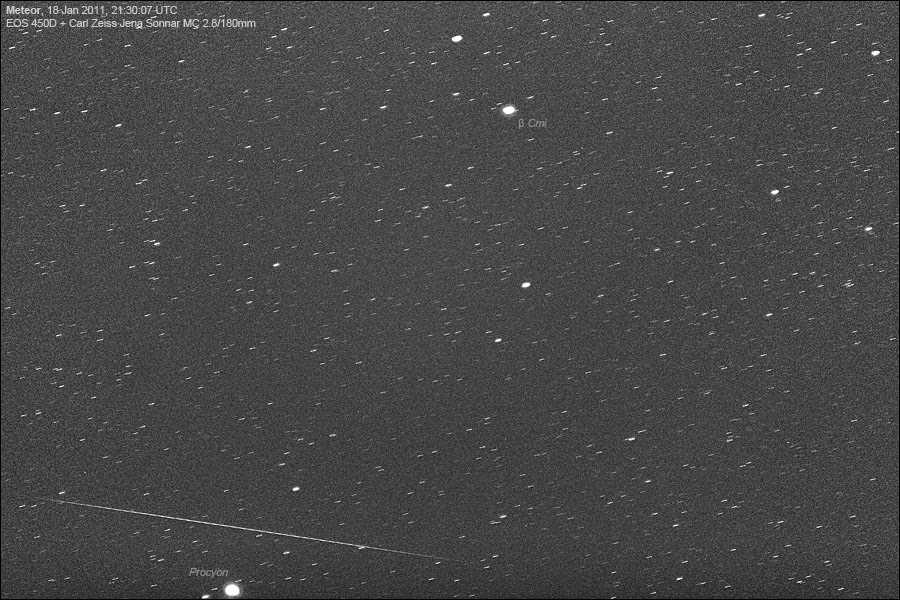
I also accidentally captured a mag. +2.5 sporadic meteor in one of the images taken with the Carl Zeiss 180 mm (FOV only 5 x 7 degrees!):

Below are the resulting images. The top image of the NOSS duo cruising through the Pleiades (movement is from top to bottom, with 07-027A leading) was made using the Canon EF 100/2.8 Macro USM lens: the images of Lacrosse 3 were made using the EF 50/2.5 Macro lens.
click images to enlarge


The FIA Radar 1 (10-046A) was imaged as well. Unlike a few nights ago, it did not flare.
The previous night had a better quality sky, so I targetted a few geostationary satellites low above the horizon. Classified geostationary targets imaged were PAN (09-047A), Mentor 2 (98-029A), Mentor 4/USA 202 (09-001A) and the Milstar 5 r/b (02-001B). A number of commercial geostationary satellites were captured as well.
Below image, taken with the Carl Zeiss Jena Sonnar MC 2.8/180mm, shows PAN with the nearby commercial geostationary Yamal 202 (03-053A).
click image to enlarge

The image below, taken with the EF 2.5/50mm Macro, shows Mentor 2, with the stars of Orion's belt and Orion's nebula M42 at left:
click image to enlarge

I also accidentally captured a mag. +2.5 sporadic meteor in one of the images taken with the Carl Zeiss 180 mm (FOV only 5 x 7 degrees!):
click image to enlarge
Saturday, 9 January 2010
GOCE keeps flaring
Yesterday evening (Jan 8) started clear. I captured GOCE (09-013A) flaring again, and then observed Lacrosse 3 (97-064A). I also tried the HEO objects USA 179 and 198 but due to a mistake in software parameters I keyed in, I photographed the wrong sky locations...
Next the sky got clouded again, the forerunners of snow.
The GOCE flare behaviour is by now getting familiar (if still in aspects unexplained: see the previous post). This time, the flare occurred at 17:02:55.1 UTC (Jan 8). This corresponds to an angle of 93.4 degrees and a tilt of 25.8 degrees.
Below is the picture and the resulting brightness diagram.


I also photographed a GOCE flare on 5 January, under appaling sky conditions. Start and end of the trail were not visible (hence, I cannot produce a brightnes sprofile for that flare) and in fact the flare even shos up only marginally (see image below). By measuring the brightest point of the flare and comparing to the GOCE orbit, it resulted in a flare time though: 17:15:48.1 UTC (Jan 5). This corresponds to an angle of 93.2 degrees and a tilt of 37.8 degrees.


Next the sky got clouded again, the forerunners of snow.
The GOCE flare behaviour is by now getting familiar (if still in aspects unexplained: see the previous post). This time, the flare occurred at 17:02:55.1 UTC (Jan 8). This corresponds to an angle of 93.4 degrees and a tilt of 25.8 degrees.
Below is the picture and the resulting brightness diagram.
click images to enlarge


I also photographed a GOCE flare on 5 January, under appaling sky conditions. Start and end of the trail were not visible (hence, I cannot produce a brightnes sprofile for that flare) and in fact the flare even shos up only marginally (see image below). By measuring the brightest point of the flare and comparing to the GOCE orbit, it resulted in a flare time though: 17:15:48.1 UTC (Jan 5). This corresponds to an angle of 93.2 degrees and a tilt of 37.8 degrees.
click image to enlarge


Monday, 4 January 2010
Another GOCE flare
Yesterday evening started very clear, but ended cloudy. Nevertheless I was able to bag several objects: the Lacrosses 2 & 3, the NOSS 3-4 Centaur rocket, GOCE flaring, and the HEO objects USA 179 and USA 184.
GOCE (the European Gravity field and steady state Ocean Circulation Explorer) made a zenith pass, zipping close to M31 at mag. +4 to +5 and then flaring briefly to mag. +2 at 17:24:23.15 UTC. It was nice to watch. GOCE is in a very low orbit and moves very fast: the flare almost looks like a meteor to the eye.
The flare was caused by the 67.5 degree panel and the time yields a flare angle of 93.6 degree and tilt of 51.9 degree. The 93 degree angle is consistent for all GOCE flares I so far observed (theoretically, that angle should be 90 degrees, i.e. at the moment of culmination when the sun-observer-satellite flight direction makes a square angle). The miss distance to the theoretical central flare path (quite large in this instance: some 175 km!) doesn't really seem to matter with regard to the flare brightness: they always come out at +2 to +3 (even when, as in this case, the tilt is off from 67.5 degree by over 15 degrees).
Below is the image, the derived brightness profile (edit - please note that the time stated in the upper left corner of the diagram is wrong: I inadvertently mentioned the end of the exposure here instead of the flare peak time), and the observing geometry. Note how the flare peak is slightly asymmetrical, the descending branch is slightly steeper.


GOCE (the European Gravity field and steady state Ocean Circulation Explorer) made a zenith pass, zipping close to M31 at mag. +4 to +5 and then flaring briefly to mag. +2 at 17:24:23.15 UTC. It was nice to watch. GOCE is in a very low orbit and moves very fast: the flare almost looks like a meteor to the eye.
The flare was caused by the 67.5 degree panel and the time yields a flare angle of 93.6 degree and tilt of 51.9 degree. The 93 degree angle is consistent for all GOCE flares I so far observed (theoretically, that angle should be 90 degrees, i.e. at the moment of culmination when the sun-observer-satellite flight direction makes a square angle). The miss distance to the theoretical central flare path (quite large in this instance: some 175 km!) doesn't really seem to matter with regard to the flare brightness: they always come out at +2 to +3 (even when, as in this case, the tilt is off from 67.5 degree by over 15 degrees).
Below is the image, the derived brightness profile (edit - please note that the time stated in the upper left corner of the diagram is wrong: I inadvertently mentioned the end of the exposure here instead of the flare peak time), and the observing geometry. Note how the flare peak is slightly asymmetrical, the descending branch is slightly steeper.
click images to enlarge


Saturday, 2 January 2010
Off to a good start: a GOCE and a Lacrosse 2 flare
2010 started off well with a very clear evening of January 1st. I observed GOCE (09-013A), the Lacrosses 2 & 3 (91-017A & 97-064A), the tumbling NOSS 3-4 Centaur rocket (07-027B), and the HEO objects USA 179, 184 and 200.
I was treated to two small flares: one by GOCE (09-013A) and one by Lacrosse 2 (91-017A).
The GOCE flare was a mild one to about +3, at 17:32:58.0 UTC. It was caused by the 67.5 degree panel. The time of the flare (accurate to 0.1s) yields an angle of 93.2 and tilt of 66.3 with a nominal mis distance to the theoretical flare path (angle 90 degrees, tilt 67.5 degrees) of 19.4 km at the time of observation (and closest approach to 17.1 km 1.2 seconds earlier at 17:32:56.8 UTC).
So far, all the GOCE mild flares I observed were with an angle ~93 degrees. The distance to the nominal flare path of this one was much less than for the three flares previously observed by me, but that doesn't seem to have much influence on the observed flare brightness: they were all around +3 magnitude.
Below are the picture, the derived brightness profile, and a depiction of the flare path geometry based on Simone Corbellini's Visual Sat-Flare Tracker 3D software.


Unexpectedly, I also captured a brief (<0.5s) flare/glint by Lacrosse 2 (91-017A) at 17:56:58.4 UTC. Below is the image and the resulting brightness profile:


I was treated to two small flares: one by GOCE (09-013A) and one by Lacrosse 2 (91-017A).
The GOCE flare was a mild one to about +3, at 17:32:58.0 UTC. It was caused by the 67.5 degree panel. The time of the flare (accurate to 0.1s) yields an angle of 93.2 and tilt of 66.3 with a nominal mis distance to the theoretical flare path (angle 90 degrees, tilt 67.5 degrees) of 19.4 km at the time of observation (and closest approach to 17.1 km 1.2 seconds earlier at 17:32:56.8 UTC).
So far, all the GOCE mild flares I observed were with an angle ~93 degrees. The distance to the nominal flare path of this one was much less than for the three flares previously observed by me, but that doesn't seem to have much influence on the observed flare brightness: they were all around +3 magnitude.
Below are the picture, the derived brightness profile, and a depiction of the flare path geometry based on Simone Corbellini's Visual Sat-Flare Tracker 3D software.
click images to enlarge


Unexpectedly, I also captured a brief (<0.5s) flare/glint by Lacrosse 2 (91-017A) at 17:56:58.4 UTC. Below is the image and the resulting brightness profile:
click images to enlarge


Tuesday, 18 August 2009
Observations, a flare, and a logo
Over the past week I could observe on four evening: 11/12, 15/16, 16/17 and 17/18 August. Targets imaged on these nights were the three KH-12 Keyholes (USA 129, 161 and 186), the Japanese prematurely defunct SAR IGS 1B, and the US SAR Lacrosse 3.
USA 186 (05-042A) provided a nice mag. -2 flare on 16 Aug at 20:52:07.0 UTC. It was captured in an image, but unfortunately a too hasty camera pointing meant the satellite run out of the image before the end of the exposure. the flare is on it though, close to the image edge. Below is a crop of the relevant part of the image, and the derived brightness profile.
Note that the "saw-tooth" pattern in the profile is due to the satellite trail being at ~45 deg angle to the pixel orientation, i.e. it is an artifact of the pixel grid.


In a moment of boredom last weekend, I designed something long overdue for SatTrackCam Leiden (Cospar 4353): a logo.
It is a bit inspired by the "patches" the NRO employees create for their covert space missions (see here and here for a discussion and examples). Hence all symbols used have some meaning (have fun interpreting!). The Latin(ish) roughly translates to "All Your Nightly Secrets Are Belong To Us", a pun at the NRO's credo "We Own the Night" used in some of their patches and the infamous "All Your Base Are Belong To Us" of gaming/internet lore.

USA 186 (05-042A) provided a nice mag. -2 flare on 16 Aug at 20:52:07.0 UTC. It was captured in an image, but unfortunately a too hasty camera pointing meant the satellite run out of the image before the end of the exposure. the flare is on it though, close to the image edge. Below is a crop of the relevant part of the image, and the derived brightness profile.
Note that the "saw-tooth" pattern in the profile is due to the satellite trail being at ~45 deg angle to the pixel orientation, i.e. it is an artifact of the pixel grid.
(click images to enlarge)


In a moment of boredom last weekend, I designed something long overdue for SatTrackCam Leiden (Cospar 4353): a logo.
It is a bit inspired by the "patches" the NRO employees create for their covert space missions (see here and here for a discussion and examples). Hence all symbols used have some meaning (have fun interpreting!). The Latin(ish) roughly translates to "All Your Nightly Secrets Are Belong To Us", a pun at the NRO's credo "We Own the Night" used in some of their patches and the infamous "All Your Base Are Belong To Us" of gaming/internet lore.

Wednesday, 20 May 2009
Flare evening
Yesterday evening 19-20 May was an evening of unpredicted flares.
It started with the International Space Station (ISS) in deep twilight. After a splendid zenith pass, while at 40 degrees altitude descending to the East, it shortly brightened to a dazzling mag. -8.
Somewhat later, still in twilight, it was the Keyhole USA 129 (96-072A) flaring to mag. 0. I caught one of the flares on photograph, just south-east of Regulus against a bright blue twilight background. Below the image ( plus a detail) and the brightness profile:


Somewhat later in the evening, I was next treated to a spectacular mag. -7 flare of IGS 1B (03-009B) while it was passing through the zenith, alas just after the camera shutter closed. The flare was a bright orange-yellow and lasted maybe a second (approximate time, not too accurate: 21:25:00 UTC).
Apart from these flaring objects, observations were also obtained of the NOSS 3-4 rocket (07-027B), showing its regular slow brightness variation; the keyhole USA 186 (05-042A), the SAR satellite Lacrosse 3 (97-064A) and the STSS-ATRR rocket (09-023B).
I also visually observed the STSS-ATRR itself (09-023A), but due to pressing a wrong button of the stopwatch lost my two points on it alas.
In all, a very fruitful night!
It started with the International Space Station (ISS) in deep twilight. After a splendid zenith pass, while at 40 degrees altitude descending to the East, it shortly brightened to a dazzling mag. -8.
Somewhat later, still in twilight, it was the Keyhole USA 129 (96-072A) flaring to mag. 0. I caught one of the flares on photograph, just south-east of Regulus against a bright blue twilight background. Below the image ( plus a detail) and the brightness profile:
(click images to enlarge)


Somewhat later in the evening, I was next treated to a spectacular mag. -7 flare of IGS 1B (03-009B) while it was passing through the zenith, alas just after the camera shutter closed. The flare was a bright orange-yellow and lasted maybe a second (approximate time, not too accurate: 21:25:00 UTC).
Apart from these flaring objects, observations were also obtained of the NOSS 3-4 rocket (07-027B), showing its regular slow brightness variation; the keyhole USA 186 (05-042A), the SAR satellite Lacrosse 3 (97-064A) and the STSS-ATRR rocket (09-023B).
I also visually observed the STSS-ATRR itself (09-023A), but due to pressing a wrong button of the stopwatch lost my two points on it alas.
In all, a very fruitful night!
Tuesday, 24 March 2009
Nice pass of USA 129
The evening initially started clear. I observed the ISS, the Lacrosse 3 & 4 (97-064A & 00-047A) and the Keyhole USA 129 (96-072A).
Lacrosse 3 was very bright (+1) while descending to the west, showing multiple slow flares. USA 129 was very nice, +2.5 and grazing the tip of the Big Dipper's tail. It resulted in the nice picture below. The bright star grazed halfway by the trail is eta Uma, the tip of the Big dipper tail. Alcor and Mizar are in top. Movement is from righ to legt. The smudge at the left edge of the picture is clouds.

Lacrosse 3 was very bright (+1) while descending to the west, showing multiple slow flares. USA 129 was very nice, +2.5 and grazing the tip of the Big Dipper's tail. It resulted in the nice picture below. The bright star grazed halfway by the trail is eta Uma, the tip of the Big dipper tail. Alcor and Mizar are in top. Movement is from righ to legt. The smudge at the left edge of the picture is clouds.
(click image to enlarge)

Wednesday, 11 March 2009
Iridium 33 and Kosmos 2251 wreckages observed
I visually observed the main wrecks of both Iridium 33 and Kosmos 2251 with the Meade ETX-70 (7 cm F5 refractor) this evening.
The Iridium 33 wreckage (24946, 97-051C) was easy to see and notably irregular in brightness, with many short flashes (several per second, with a brighter one approximately each second. This is an estimate: I did not time them). I observed it as it passed close to Pollux near 19:55:10 UTC (11 March). At its brightest it might have been +6 or +6.5. I did not observe the kind of bright flares as reported by Simone from Italy yesterday.
The Kosmos 2251 wreckage (22675, 93-036A) was much fainter, about +8 at its brightest as it passed close to alpha Uma at 20:11:30 UTC. It too was irregular, but its brightness variation seemed slightly slower than that of the Iridium 33 wreckage.
I also observed Lacrosse 3 in twilight and got 6 positions on it.
The Iridium 33 wreckage (24946, 97-051C) was easy to see and notably irregular in brightness, with many short flashes (several per second, with a brighter one approximately each second. This is an estimate: I did not time them). I observed it as it passed close to Pollux near 19:55:10 UTC (11 March). At its brightest it might have been +6 or +6.5. I did not observe the kind of bright flares as reported by Simone from Italy yesterday.
The Kosmos 2251 wreckage (22675, 93-036A) was much fainter, about +8 at its brightest as it passed close to alpha Uma at 20:11:30 UTC. It too was irregular, but its brightness variation seemed slightly slower than that of the Iridium 33 wreckage.
I also observed Lacrosse 3 in twilight and got 6 positions on it.
Sunday, 18 January 2009
Lacrosse 3 and Uranus
This evening it unexpectedly cleared. I photographed the only available pass of Lacrosse 3 (97-064A) to clearify whether it was still on-time. It was: I obtained two points with delta t resp. 0.03 and -0.08s and delta positions 0.019 and 0.039 degree respectively.
The pass was a very low pass however, the satellite did not come higher than 25 degrees in the sky. This made it difficult, and I only managed to capture it on two images when the satellite was just above rooftop level, in a "gap" between two roofs. On the first image it appears from behind the roof (endpoint measurable), on the second it disappears behind the roof (startpoint measurable).
When astrometrically measuring the images, I noted a relatively bright star near the end of the trail that I could not identify. It was also on the 2nd image. The star was bright enough that it should appear in the database AstroRecord uses, and my Sky Atlas didn't show a star there either. So...?
As I was measuring the image anyway, I decided to measure the star to get a position for it. it yielded (18 Jan 2009, 17:49:12.3 UTC):
RA 350.855, dec -4.751
= 23h 23m 25.2s, -4 45' 03.6" (2000.0)
I checked AstPlot: it did not show a star nor an asteroid on that position. I downloaded a NEAT image of the region: again, no star on that position....
By that time, I was thinking: Oi, what's this?!? A nova?!?
Then I got a hunch. I started up MICA, and obtained accurate positions for Uranus and Neptune. And yes, there it was:
Uranus
Astrometric Positions Mean Equator and Equinox of J2000.0
Date Time RA Declination
h m s h m s ° ' "
2009 Jan 18 17:49:12.3 23 23 24.115 - 4 45 03.16
So, I accidently "re-discovered" Uranus... 228 years too late... :-p
A reduced resolution crop from one of the images is below, with objects annotated:

The pass was a very low pass however, the satellite did not come higher than 25 degrees in the sky. This made it difficult, and I only managed to capture it on two images when the satellite was just above rooftop level, in a "gap" between two roofs. On the first image it appears from behind the roof (endpoint measurable), on the second it disappears behind the roof (startpoint measurable).
When astrometrically measuring the images, I noted a relatively bright star near the end of the trail that I could not identify. It was also on the 2nd image. The star was bright enough that it should appear in the database AstroRecord uses, and my Sky Atlas didn't show a star there either. So...?
As I was measuring the image anyway, I decided to measure the star to get a position for it. it yielded (18 Jan 2009, 17:49:12.3 UTC):
RA 350.855, dec -4.751
= 23h 23m 25.2s, -4 45' 03.6" (2000.0)
I checked AstPlot: it did not show a star nor an asteroid on that position. I downloaded a NEAT image of the region: again, no star on that position....
By that time, I was thinking: Oi, what's this?!? A nova?!?
Then I got a hunch. I started up MICA, and obtained accurate positions for Uranus and Neptune. And yes, there it was:
Uranus
Astrometric Positions Mean Equator and Equinox of J2000.0
Date Time RA Declination
h m s h m s ° ' "
2009 Jan 18 17:49:12.3 23 23 24.115 - 4 45 03.16
So, I accidently "re-discovered" Uranus... 228 years too late... :-p
A reduced resolution crop from one of the images is below, with objects annotated:
(click image to enlarge)

Saturday, 17 January 2009
NOSS 3-4 duo through Perseus
An initially very clear evening today allowed observations again. Lacrosse 3 (97-064A) was captured, along with NOSS 2-3D (96-029D) and the NOSS 3-4 duo (07-027A & C). USA 32 (88-078A) was captured as a very faint trail but not measured.
A mistake of one minute in the timing while trying to photograph the 96-029 objects made me miss the C & E objects, but captured the D object at the end of what seems to be a slow flare.
One of the images of the NOSS 3-4 duo, the one where they cross Perseus just below the alpha Persei star association, turned out particularly nice, with lots of stars and two bright trails:

A mistake of one minute in the timing while trying to photograph the 96-029 objects made me miss the C & E objects, but captured the D object at the end of what seems to be a slow flare.
One of the images of the NOSS 3-4 duo, the one where they cross Perseus just below the alpha Persei star association, turned out particularly nice, with lots of stars and two bright trails:
(click image to enlarge)

Tuesday, 30 December 2008
Clear skies continue!
The series of clear frosty skies is continuing here. Following my last report on December 22nd observations, I have been able to do more observations on the 26nd, 27th and 29th, plus a number of deep-sky guided astrophotography sessions.
But first the satellites. Captured targets on these nights were Lacrosses 3 & 4 (97-064A & 00-047A), the NOSS 3-4 rocket (07-027B), which is still slowly variable, and the NOSS 3-2 duo (01-040A & C).
The latter NOSS duo made a very nice pass across the Pleiades yesterday evening:

Yesterday, I slao shot this photograph of the open star cluster M35 in Gemini. It is a stack of 65 x 10s images, taken with the Canon EOS 450D piggyback on my Meade ETX-70. Lens was the same EF 50/2.5 (at F2.8) I use for the satellite imagery, and ISO was set at 1200.

Near the edge of the original, M1, the Crab Nebula, actually shows up as well:

I used an image of the Pleiades shot the evening of the 25th to glean some more indications of the astrometric positional accuracy of the EF 50/2.5 lens. The stacked image contains several asteroids up to mag. +12 (10 Hygiea, 21 Lutetia, 94 Aurora, 182 Elsa and 264 Libussa), and by measuring these in Astrometrica (highly accurate astrometric software I use for my asteroid searches in NEAT data) and comparing to the predicted positions, it turns out that the positional deviations are typically within 5" (that is arcseconds).
That is the same accuracy AstroRecord (the wide field astrometry software I use for my satellite images) indicates from the fit to the reference stars. So it is the timing uncertainty which is the main cause of uncertainty in my satellite positions.
But first the satellites. Captured targets on these nights were Lacrosses 3 & 4 (97-064A & 00-047A), the NOSS 3-4 rocket (07-027B), which is still slowly variable, and the NOSS 3-2 duo (01-040A & C).
The latter NOSS duo made a very nice pass across the Pleiades yesterday evening:
(click image to enlarge)

Yesterday, I slao shot this photograph of the open star cluster M35 in Gemini. It is a stack of 65 x 10s images, taken with the Canon EOS 450D piggyback on my Meade ETX-70. Lens was the same EF 50/2.5 (at F2.8) I use for the satellite imagery, and ISO was set at 1200.
(click image to enlarge)

Near the edge of the original, M1, the Crab Nebula, actually shows up as well:
(click image to enlarge)

I used an image of the Pleiades shot the evening of the 25th to glean some more indications of the astrometric positional accuracy of the EF 50/2.5 lens. The stacked image contains several asteroids up to mag. +12 (10 Hygiea, 21 Lutetia, 94 Aurora, 182 Elsa and 264 Libussa), and by measuring these in Astrometrica (highly accurate astrometric software I use for my asteroid searches in NEAT data) and comparing to the predicted positions, it turns out that the positional deviations are typically within 5" (that is arcseconds).
That is the same accuracy AstroRecord (the wide field astrometry software I use for my satellite images) indicates from the fit to the reference stars. So it is the timing uncertainty which is the main cause of uncertainty in my satellite positions.
Monday, 11 February 2008
Twice the ISS, and a bag of other objects
Yesterday I observed the International Space Station (ISS) twice. The first observation was in deep twilight, 20 minutes after sunset with the sun at only 4 degrees below the horizon.
I filmed this pass, using the "movie"-mode of my Canon Digital Ixus photo camera. The resulting short movie is below: it shows the ISS descending towards the east.
Later that evening, one pass later, I shot this photograph, which shows the ISS crossing Taurus just before entering earth shadow:

Both this evening and the morning of today (the 11th) I telescopically observed a number of other objects; the keyhole USA 129 (96-072A), the ELINT USA 32 (88-078A), the SAR satellites Lacrosse 5 (05-016A) and Lacrosse 3 (97-064A), and the NOSS 3-2 duo (03-054A & C) and, as a stray while waiting for USA 32, the old NOSS 6F (84-012F).
In addition, I shot this photograph of the crescent moon through my Meade ETX-70 in the late afternoon/early evening:

I filmed this pass, using the "movie"-mode of my Canon Digital Ixus photo camera. The resulting short movie is below: it shows the ISS descending towards the east.
Later that evening, one pass later, I shot this photograph, which shows the ISS crossing Taurus just before entering earth shadow:
(click image to enlarge)

Both this evening and the morning of today (the 11th) I telescopically observed a number of other objects; the keyhole USA 129 (96-072A), the ELINT USA 32 (88-078A), the SAR satellites Lacrosse 5 (05-016A) and Lacrosse 3 (97-064A), and the NOSS 3-2 duo (03-054A & C) and, as a stray while waiting for USA 32, the old NOSS 6F (84-012F).
In addition, I shot this photograph of the crescent moon through my Meade ETX-70 in the late afternoon/early evening:
(click image to enlarge)

Thursday, 10 January 2008
NOSS-es, Lacrosses and ISS
Yesterday evening the 9th it was clear in twilight, but clouds came in a while later. Nevetheless there was time enough to get out the ETX-70 again and bag the NOSS 3-4 duo (07-027A and 07-027C), the NOSS 3-3 duo (05-004A and 05-004C) and Lacrosse 3 (97-064A). In total, 7 points were obtained. In the morning of the 10th, I observed the International Space Station just before clouds again interfered.
About 3 minutes before the NOSS 3-4 duo pass, another faint sat crossed the telescope field in a similar trajectory. I was just making a last check of the star field in view against a plotted map to ensure I had the correct location in view, so hadn't the stopwatch in my hands. At first I was a bit worried it was one of the 07-027 objects but very early, so I was relieved when 3 minutes later the real 07-027A sailed into the FOV.
Later that night it cleared again. Below is the image of the ISS I shot a few hours later, during the morning hours. It can be seen passing from Corona borealis into Hercules. It was bright, around mag. -4. My main intended target for that early morning was Progress M-61, but clouds (already visible in the ISS image) intervened.

About 3 minutes before the NOSS 3-4 duo pass, another faint sat crossed the telescope field in a similar trajectory. I was just making a last check of the star field in view against a plotted map to ensure I had the correct location in view, so hadn't the stopwatch in my hands. At first I was a bit worried it was one of the 07-027 objects but very early, so I was relieved when 3 minutes later the real 07-027A sailed into the FOV.
Later that night it cleared again. Below is the image of the ISS I shot a few hours later, during the morning hours. It can be seen passing from Corona borealis into Hercules. It was bright, around mag. -4. My main intended target for that early morning was Progress M-61, but clouds (already visible in the ISS image) intervened.
(click image to enlarge)

Wednesday, 26 December 2007
USA 193
A belated report on my December 22 observations. December 22 was a clear, albeit moonlit night. Three objects were captured: Lacrosse 3 (97-064A), Lacrosse 5 rk (05-016B), and the failed reco satellite USA 193 (06-057A), which was the highlight of the evening. In addition, a stray was captured in one of the USA 193 images, which turned out to be the Russian Okean-O rk (99-039B).
USA 193 made a high pass. Bright and very fast due to it's low altitude, it was a spectacular appearance. It was over 20 seconds early relative to Mike's elset 07352.74304755. Below two pictures: the first showing it zipping through Cygnus (passing close to Deneb); the second showing it didappear behind the roof, with the Okean-O rk captured in the same image as a stray. Cassiopia is at top right.


USA 193 made a high pass. Bright and very fast due to it's low altitude, it was a spectacular appearance. It was over 20 seconds early relative to Mike's elset 07352.74304755. Below two pictures: the first showing it zipping through Cygnus (passing close to Deneb); the second showing it didappear behind the roof, with the Okean-O rk captured in the same image as a stray. Cassiopia is at top right.
(click images to enlarge)


Monday, 23 July 2007
Another fine night, USA 193 bright & a Lacrosse 3 flare
Friday evening and Sunday evening saw two other observing opportunities. On Friday it remained restricted to Lacrosse 3 & the Lacrosse 5 rk (97-064A & 05-016B), as clouds came in at a certain point (this made me miss a predicted -8 Iridium flare alas). I saw Lacrosse 3 (97-064A) flare to mag +0.5 however at 23:30:44 UTC (Jul 20).
Sunday night was very fine however, and I catched Lacrosse 3 & 4, plus IGS 4A/R2 (07-005A) and USA 193 (06-057A). The latter was quite bright (+0.5) while passing in the northwest. The second of the two images below shows it as it is just disappearing out of sight behind the roof. The other image shows IGS 4A/R2.
USA 193 was 2.3s early relative to Ted's elset 07202.04020244.


Note: the time indicated in above image is in error, apologies.
Sunday night was very fine however, and I catched Lacrosse 3 & 4, plus IGS 4A/R2 (07-005A) and USA 193 (06-057A). The latter was quite bright (+0.5) while passing in the northwest. The second of the two images below shows it as it is just disappearing out of sight behind the roof. The other image shows IGS 4A/R2.
USA 193 was 2.3s early relative to Ted's elset 07202.04020244.
(click images to enlarge)


Note: the time indicated in above image is in error, apologies.
Subscribe to:
Posts (Atom)