On request of one of the editors I have written a long guest post for ESA's Rocket Science blog titled:
"Predicting GOCE re-entry: a citizen- scientist’s view"
The post details how I tried to forecast GOCE's re-entry time and position, using Alan Pickup's SatAna and SatEvo software. It provides some information about what factors are involved, and what problems you bump into. Basically, it is a consolidation and extension of posts that earlier appeared on this SatTrackcam blog.
Read the post on ESA's blog here.
Showing posts with label GOCE. Show all posts
Showing posts with label GOCE. Show all posts
Tuesday, 24 December 2013


Monday, 11 November 2013
GOCE re-entry photographed from the Falklands?
This has just appeared on Twitter:
Reported time and geographic location seem a match (21:20 Falkland time is 00:20 UT)!
@BBCAmos We saw GOCE satellite burn up over East Falkland at about 9.20pm last night. pic.twitter.com/KpFGAYALkY
— Bill Chater (@Cheds23) November 11, 2013
Reported time and geographic location seem a match (21:20 Falkland time is 00:20 UT)!
Alas, poor GOCE, I knew him well...

click map to enlarge
Last night just after 0h UT, GOCE, ESA's Gravity Field and Steady-State Ocean Circulation Explorer, died an heroic death, plunging into the atmosphere while passing over the ice cold wastes of Antarctica, within minutes of passing over the Falkland islands.
ESA reported the decay time as "close to 01:00 CET on Monday 11 November" (= close to 00:00 UT, Nov 10-11).
USSTRATCOM gives a final TIP placing decay at 11 Nov 00:16 UTC +/- 1 m near 56 S 60 W.
My initial last pre-decay forecast, made in a haste late last evening after returning from a full day surveying in the field (later more on that...), was too early.
This was before the final few orbits for GOCE were published, and before I learned from Alan Pickup of a secret setting in SatAna and SatEvo that makes it possible to tweak details that are important in the last few orbits at very low altitude. My tweet at that time:
Reentry forecast #GOCE: Nov 10, 22:10 UT +/- 25 min #GOCEreentry
— Dr Marco Langbroek (@Marco_Langbroek) November 10, 2013
As this window was including a pass over Australia, I also tweeted:
Observers in mid-Australia: watch if #GOCE is perhaps reentering above you NOW @drspacejunk
— Dr Marco Langbroek (@Marco_Langbroek) November 10, 2013
ESA however next reported having received telemetry from a GOCE pass at 22:42 UT from Troll station on Antarctica, making clear GOCE was still alive and functioning while only just above 110 km altitude!
So my 22:10 UT forecast was wrong. We now know it was wrong by
Alan Pickup mailed me around that time about some 'hidden' experimental options in SatAna and SatEvo that take into account spacecraft dimensions and some dimension-related effects that are significant at very low altitudes only.
Together with the addition of two more orbital updates that have since appeared, I have therefore re-done the exercise, as an "aftercast".
With solar flux at 154, a 0.3 day tle arc (the last 5 available orbit updates) processed in SatAna and the result then fed into Satevo, and setting the length of GOCE at 5.0, I get re-entry at:
11 Nov 00:13 UT +/- 14 m
69 S, 52 W
This is only 3 minutes from the time given by USSTRATCOM.
In the map on the top of this post, the blue dot gives the USSTRATCOM position, the red dot and red line give the SatAna + SatEvo nominal prediction and window.
Below is the SatEvo result in 3D, looking towards the south polar region:

I am rather surprised about how well (after tweaking some internal settings) the final SatEvo result compares to USSTRATCOM's final TIP. Kudo's to Alan who wrote the software! (of course, and Alan agrees, the near-perfect match can be a lucky coincidence).

One of the most amazing things about the re-entry of GOCE is that the spacecraft retained its drag-reducing attitude right up to the end. The designers of the spacecraft deserve some serious kudo's for that.
Of all the ways a spacecraft can go, GOCE died gracefully and heroically! GOCE, clutching on to life to the bitter end, victim of the same forces that it helped map in so much detail. Now let us mourn our brave little spacecraft...

R.I.P.
GOCE
GOCE
(17 Mar 2009 - 11 Nov 2013)
(here imaged 1.5 months before it's re-entry)
Saturday, 9 November 2013
Brief update on Goce (9 Nov): one day from reentry!
My current re-entry forecast for GOCE, made with Alan Pickup's SatAna and SatEvo software, is re-entry in a 11.3 hr window centered on Nov 10.806 UT.
Any deviation from the nominal value is more likely to be towards the later part of that window (i.e. up to the early hours of Nov 11 is possible) unless attitude control fails earlier, in which case it will come down earlier.
Due to circumstances I will not be able to update my forecasts tomorrow. I will do an "aftercast" on Monday.
Any deviation from the nominal value is more likely to be towards the later part of that window (i.e. up to the early hours of Nov 11 is possible) unless attitude control fails earlier, in which case it will come down earlier.
Due to circumstances I will not be able to update my forecasts tomorrow. I will do an "aftercast" on Monday.
Friday, 8 November 2013
Another brief update on #GOCE, 8 Nov 2013
The average orbit of GOCE is now below 172 km altitude, with perigee below 170 km. It is hence approaching the critical value of 150 km.

Due to the effects of several recent solar outbursts on the atmosphere, drag levels went up and fluctuated over the past 1.5 days (see ESA's blog here and the diagram below). This makes forecasting difficult. Forecasts at different times today varied as a result, but they all are somewhat earlier in time than they were yesterday.
The forecast at the moment of writing (SatEvo prediction on a 1-day SatAna arc up to Nov 8.55 UT) is for a 1-day window centered on Nov 10.7 UT. With the same caveat as in my previous posts: this forecast assumes GOCE will keep its drag-reducing attitude up to re-entry, which is by no means certain.

USSTRATCOM has issued two first TIP-bulletins for GOCE, yesterday and today. The last of these forecasts is re-entry at Nov 11.12 UT, +/- 48 hours.
Due to the effects of several recent solar outbursts on the atmosphere, drag levels went up and fluctuated over the past 1.5 days (see ESA's blog here and the diagram below). This makes forecasting difficult. Forecasts at different times today varied as a result, but they all are somewhat earlier in time than they were yesterday.
The forecast at the moment of writing (SatEvo prediction on a 1-day SatAna arc up to Nov 8.55 UT) is for a 1-day window centered on Nov 10.7 UT. With the same caveat as in my previous posts: this forecast assumes GOCE will keep its drag-reducing attitude up to re-entry, which is by no means certain.
USSTRATCOM has issued two first TIP-bulletins for GOCE, yesterday and today. The last of these forecasts is re-entry at Nov 11.12 UT, +/- 48 hours.
Thursday, 7 November 2013
Brief GOCE update, 7 November
This morning the average orbital altitude of GOCE had dropped to 181 km. The orbital droprate is now near 6 km per day. There is no sign yet that attitude control is failing.


The nominal re-entry forecast is slightly shifting backwards. My current forecast using Alan Pickup's SatAna and SatEvo software is re-entry in a 1.5 day uncertainty window centered on Nov 11.17 UT. This is assuming that the attitude control will hold until decay (see discussions in previous posts).
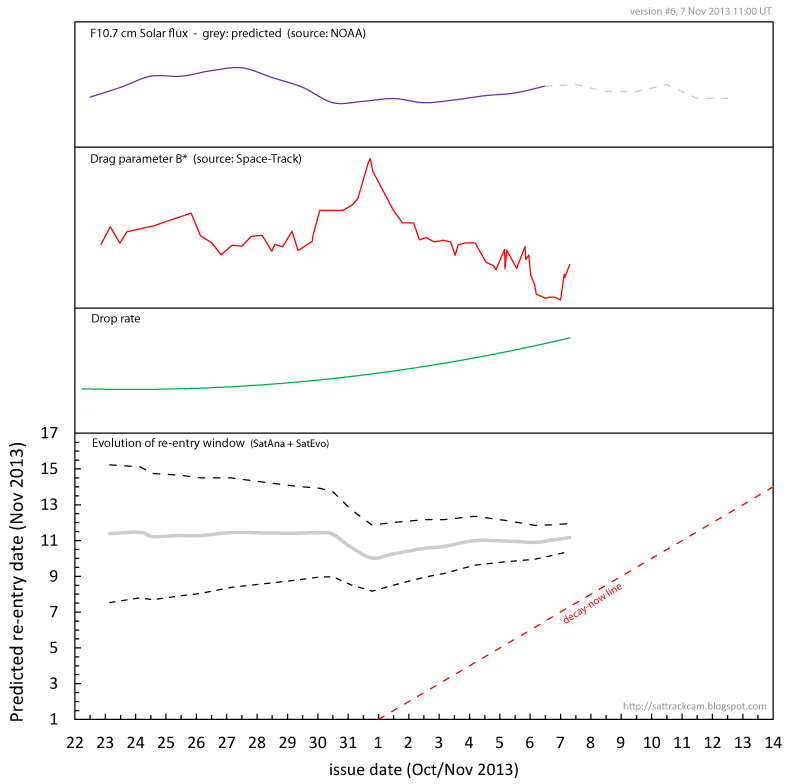
The nominal re-entry forecast is slightly shifting backwards. My current forecast using Alan Pickup's SatAna and SatEvo software is re-entry in a 1.5 day uncertainty window centered on Nov 11.17 UT. This is assuming that the attitude control will hold until decay (see discussions in previous posts).
Wednesday, 6 November 2013
Brief (semi-) daily GOCE update, 6 November
GOCE's perigee is now below 183.5 km, the average orbit has dropped to 187 km (from 227.5 km originally).
The orbital droprate is now close to 5 km/day.
The nominal forecast re-entry window is currently a two-day period centered on Nov 10.90 UT. However, see the caveat in my previous post. If GOCE loses its current drag-reducing attitude (flight orientation), the re-entry forecast above will turn completely obsolete.


A more elaborate explanation of factors involved can be found in my previous post, including an explanation on why re-entry forecasts for GOCE must be approached very cautiously.
Forecasts were made using Alan Pickup's SatAna and SatEvo software: for an explanation on the workings of this software and factors of influence, see an earlier post here.
The nominal forecast re-entry window is currently a two-day period centered on Nov 10.90 UT. However, see the caveat in my previous post. If GOCE loses its current drag-reducing attitude (flight orientation), the re-entry forecast above will turn completely obsolete.
A more elaborate explanation of factors involved can be found in my previous post, including an explanation on why re-entry forecasts for GOCE must be approached very cautiously.
Forecasts were made using Alan Pickup's SatAna and SatEvo software: for an explanation on the workings of this software and factors of influence, see an earlier post here.
Tuesday, 5 November 2013
GOCE update (5 Nov 2013)
GOCE, ESA's Gravity Field and Steady-State Ocean Circulation Explorer, is still steadily coming down (see previous posts). This morning, the average orbital altitude had dropped below 191.5 km (from originally 227.5 km before Oct 21) and perigee is already down to 188 km. The orbital altitude has dropped 36 km in 15 days and it is currently coming down at a rate of 4.5 - 5 km per day, and increasing.


The nominal center of the re-entry forecast window, a period of several days, is still hovering near November 10-11. My latest forecast (issue date Nov 5.22 UT) has it nominally at Nov 10.97, +/- 1.2 days. This is the approximate date the satellite would re-enter, if it remains in its current drag-reducing attitude (orientation).

The latter caveat is an important point to note in this case and its implication should not be ignored. The special aerodynamic design of GOCE means that (much more so than for other satellites) there is a large difference in the amount of drag it is experiencing in drag-reducing attitude compared to what it will experience when that attitude is lost. If the attitude control mechanism (magnetic torques) fails somewhere during the coming days and the drag reducing attitude is lost as a result, GOCE will come down much earlier than the current forecast suggests. That is one reason to be very cautious with GOCE re-entry predictions, certainly at this point in time.
It is currently impossible to say if, and if so when, such a loss of attitude will happen. But if it does, the current re-entry forecast will be turned completely obsolete.
Meanwhile, let us not forget that GOCE is still functioning! As it spirals down to its doom faster and faster, it continues to gather valuable data on the Earth's gravitational field.

The nominal center of the re-entry forecast window, a period of several days, is still hovering near November 10-11. My latest forecast (issue date Nov 5.22 UT) has it nominally at Nov 10.97, +/- 1.2 days. This is the approximate date the satellite would re-enter, if it remains in its current drag-reducing attitude (orientation).
The latter caveat is an important point to note in this case and its implication should not be ignored. The special aerodynamic design of GOCE means that (much more so than for other satellites) there is a large difference in the amount of drag it is experiencing in drag-reducing attitude compared to what it will experience when that attitude is lost. If the attitude control mechanism (magnetic torques) fails somewhere during the coming days and the drag reducing attitude is lost as a result, GOCE will come down much earlier than the current forecast suggests. That is one reason to be very cautious with GOCE re-entry predictions, certainly at this point in time.
It is currently impossible to say if, and if so when, such a loss of attitude will happen. But if it does, the current re-entry forecast will be turned completely obsolete.
Meanwhile, let us not forget that GOCE is still functioning! As it spirals down to its doom faster and faster, it continues to gather valuable data on the Earth's gravitational field.
Sunday, 3 November 2013
GOCE below 200 km - now one week or less from reentry
Over the past 12 days I have been covering the demise of GOCE, ESA's Gravity Field and Steady-State Ocean Circulation Explorer. Following the cut-off of its ion engine on October 21st, it is coming down, at an increasing speed. It is heading towards an uncontrolled re-entry later this month, perhaps even within a week from now.


The diagram above shows the increasing rate at which the orbital altitude is dropping since October 21st. As I write this, the drop rate has increased to about 4 km/day (from initially about 1.5 km/day on October 21st) and that rate is increasing exponentially, as can be seen in the diagram.
The average orbit of GOCE, at 227.5 km altitude before the engine cut off, has now dropped to below 200 km altitude. Perigee is already below 195 km. The Mean Motion (the number of orbital revolutions per day) of the satellite is increasing fast.


While it is still too early to provide really meaningful predictions, I currently have a nominal re-entry prediction for a window of a few days centered on November 10.7. It hence now seems possible that GOCE is within a week of plunging into the atmosphere.
The diagram below shows how predictions of the re-entry window have been evolving the past days (the grey line is the nominal prediction value, i.e. the center of the uncertainty window, and the dashed lines show the window of uncertainty on the prediction. The top three panels give observed and predicted solar flux; drag terms; and the orbital drop rate trend).

These predictions were made using two satellite orbital decay programs written by Alan Pickup, called SatAna and SatEvo. The program called SatAna analyses the orbital evolution over a number of recent orbit determinations and (taking into account the average solar flux for that period) fits a decay term that should be a bit more realistic than the decay terms from one single orbit only (which vary widely, see the second subwindow with B* values in the diagram above). The SatAna result and the predicted average solar flux for the next few days is next fed into SatEvo, a program that evolves the orbit into the future, up to re-entry.
The calculated moment of re-entry becomes more accurate based on orbital elements closer to decay. Currently, some 7 days before the prognosed moment of re-entry, the uncertainty window is still very large (several days), so giving an exact time at this moment is still meaningless. It is also still completely impossible to say where it will come down.
A lot can still happen the coming few days, that can drastically alter the picture. I have written about this before: e.g., if GOCE for some reason loses its current drag-reducing attitude (flight orientation) or is starting to shed bits and pieces at some point, the drag it experiences will significantly change, and with that the re-entry predictions will significantly change. Differences between the predicted solar activity for the upcoming days and real solar activity values the coming days, likewise can change the re-entry time.
click diagram to enlarge
The diagram above shows the increasing rate at which the orbital altitude is dropping since October 21st. As I write this, the drop rate has increased to about 4 km/day (from initially about 1.5 km/day on October 21st) and that rate is increasing exponentially, as can be seen in the diagram.
The average orbit of GOCE, at 227.5 km altitude before the engine cut off, has now dropped to below 200 km altitude. Perigee is already below 195 km. The Mean Motion (the number of orbital revolutions per day) of the satellite is increasing fast.
While it is still too early to provide really meaningful predictions, I currently have a nominal re-entry prediction for a window of a few days centered on November 10.7. It hence now seems possible that GOCE is within a week of plunging into the atmosphere.
The diagram below shows how predictions of the re-entry window have been evolving the past days (the grey line is the nominal prediction value, i.e. the center of the uncertainty window, and the dashed lines show the window of uncertainty on the prediction. The top three panels give observed and predicted solar flux; drag terms; and the orbital drop rate trend).
These predictions were made using two satellite orbital decay programs written by Alan Pickup, called SatAna and SatEvo. The program called SatAna analyses the orbital evolution over a number of recent orbit determinations and (taking into account the average solar flux for that period) fits a decay term that should be a bit more realistic than the decay terms from one single orbit only (which vary widely, see the second subwindow with B* values in the diagram above). The SatAna result and the predicted average solar flux for the next few days is next fed into SatEvo, a program that evolves the orbit into the future, up to re-entry.
A lot can still happen the coming few days, that can drastically alter the picture. I have written about this before: e.g., if GOCE for some reason loses its current drag-reducing attitude (flight orientation) or is starting to shed bits and pieces at some point, the drag it experiences will significantly change, and with that the re-entry predictions will significantly change. Differences between the predicted solar activity for the upcoming days and real solar activity values the coming days, likewise can change the re-entry time.
(note: I thank Alan Pickup for making available SatAna and SatEvo)
Thursday, 31 October 2013
About half-way: another short update on GOCE, 10 days after its engine cut off
Ten days ago the ion engine of GOCE, the European Space Agency's 1-tonne Gravity field and steady-state Ocean Circulation Explorer scientific satellite (2009-013A), cut off after the satellite ran out of fuel.
Originally orbiting at an average orbital altitude of 227.5 km, it is since coming down (see earlier posts here and here and the first two diagrams below). Its perigee is now below 205 km and it is currently coming down at a rate of 2.7 km/day. That rate is increasing (see third diagram below): it is already a factor 3 larger than it was on October 21st just after the ion engine of GOCE cut off.


As I wrote earlier, for various reasons it is still too early to provide reliable re-entry estimates. I nevertheless estimate that GOCE is now about half-way, in terms of days not altitude, from inception of its fall to re-entry.
After the latest orbital updates, the nominal re-entry date appears to slowly creep to an earlier date. Currently I have re-entry forecast for a several-day window around November 10.
That date can still (dramatically) shift if anything happens to GOCE, for example if it loses its current drag-reducing attitude (flight orientation - see also a previous post) or if we see a drastic change in solar activity.
The Sun has been very active the past few days, spewing several CME's. This solar activity has an influence on the density of the upper atmosphere, and this in turn has an influence on the magnitude of the atmospheric drag on GOCE, influencing how fast its orbit evolves.
I do expect the prognosed re-entry date to slowly creep to an earlier date over the coming few days. It therefore does seem that GOCE has less than two weeks, and possibly closer to a week, of lifetime left.
Originally orbiting at an average orbital altitude of 227.5 km, it is since coming down (see earlier posts here and here and the first two diagrams below). Its perigee is now below 205 km and it is currently coming down at a rate of 2.7 km/day. That rate is increasing (see third diagram below): it is already a factor 3 larger than it was on October 21st just after the ion engine of GOCE cut off.
click diagrams to enlarge
As I wrote earlier, for various reasons it is still too early to provide reliable re-entry estimates. I nevertheless estimate that GOCE is now about half-way, in terms of days not altitude, from inception of its fall to re-entry.
After the latest orbital updates, the nominal re-entry date appears to slowly creep to an earlier date. Currently I have re-entry forecast for a several-day window around November 10.
That date can still (dramatically) shift if anything happens to GOCE, for example if it loses its current drag-reducing attitude (flight orientation - see also a previous post) or if we see a drastic change in solar activity.
The Sun has been very active the past few days, spewing several CME's. This solar activity has an influence on the density of the upper atmosphere, and this in turn has an influence on the magnitude of the atmospheric drag on GOCE, influencing how fast its orbit evolves.
I do expect the prognosed re-entry date to slowly creep to an earlier date over the coming few days. It therefore does seem that GOCE has less than two weeks, and possibly closer to a week, of lifetime left.
Saturday, 26 October 2013
A short update on GOCE, five days after engine cut-off
It is now five days ago that the ion engine of GOCE, the European Space Agency's 1-tonne Gravity field and steady-state Ocean Circulation Explorer scientific satellite (2009-013A), cut off after the satellite ran out of fuel. Originally orbiting at an average orbital altitude of 227.5 km, it is since coming down (see earlier post here). The diagrams below provide an update on the evolution of the orbit's apogee, perigee and Mean Motion (see also earlier post here for explanations) .


As I write this, the average orbital altitude has dropped over 8 km already since the ion engine shut down on October 21st. Yesterday afternoon (25 October) the average orbital altitude had already dropped below 220 km altitude, with the perigee now below 217 km (see first diagram above).
GOCE is currently losing altitude at a rate near 2 km per day. That rate will notably increase over the coming days, as GOCE will drop faster and faster.
It is too early yet to provide meaningful estimates of the re-entry date. My current prognosis (for which I used Alan Pickup's SatAna and SatEvo software) suggests a re-entry in the second week of November, but note that this date will probably shift to an earlier date over the coming week.
Currently, the satellite is still maintaining an attitude (orientation) that is optimizing for low drag. It does so using magnetic torques. At some point close to re-entry, that system will probably fail and GOCE will then lose attitude control. As it does so, drag will increase, which will seriously influence the re-entry date, shifting it to an earlier time. Meanwhile, the sun has been quite active the last few days, which speeds up the decay as well as the density of the Earth's outer atmosphere changes under the influence of solar activity. My very preliminary prognosis was made with an average forecast F10.7 cm solar flux of Fx=135 for the coming 20 days, but unexpected solar outbursts might alter the true picture.
I expect that several sources will start to provide re-entry estimates in the days before re-entry. The chief authoritive sources will be ESA itself, and the TIP-messages by USSTRATCOM on their Space-Track portal (needs an account to access). I expect that several independent analysts will provide re-entry estimates as well. The Aerospace Corporation provides re-entry estimates based on their own re-entry models, but is usually lagging behind. Their predictions sometimes strongly differ (up to several hours) from the final re-entry times and locations determined by USSTRATCOM (which I consider to be a more reliable and authoritive source).
(note: in the first diagram above, the values for perigee and apogee show some short-term fluctuation during the first 2-3 days after engine cut-off. These fluctuations are the result of errors in the orbit determinations, which easily occur (and are inevitable) when the data-arc used is still short and fitting error margins are hence wide. As the observational arc grows, the orbital determinations become more stable, which is indeed what we see over the last two days.
The apogee and perigee altitudes in the first diagram have been calculated from the values for Mean Motion and eccentricity using a fixed Earth radius of 6378 km, ignoring Earth's oblateness. Orbital elements are from USSTRATCOM (needs an account to access) with a secondary source (open access) here).
Note 31 Oct 2013: a new update here.
click diagrams to enlarge
As I write this, the average orbital altitude has dropped over 8 km already since the ion engine shut down on October 21st. Yesterday afternoon (25 October) the average orbital altitude had already dropped below 220 km altitude, with the perigee now below 217 km (see first diagram above).
GOCE is currently losing altitude at a rate near 2 km per day. That rate will notably increase over the coming days, as GOCE will drop faster and faster.
It is too early yet to provide meaningful estimates of the re-entry date. My current prognosis (for which I used Alan Pickup's SatAna and SatEvo software) suggests a re-entry in the second week of November, but note that this date will probably shift to an earlier date over the coming week.
Currently, the satellite is still maintaining an attitude (orientation) that is optimizing for low drag. It does so using magnetic torques. At some point close to re-entry, that system will probably fail and GOCE will then lose attitude control. As it does so, drag will increase, which will seriously influence the re-entry date, shifting it to an earlier time. Meanwhile, the sun has been quite active the last few days, which speeds up the decay as well as the density of the Earth's outer atmosphere changes under the influence of solar activity. My very preliminary prognosis was made with an average forecast F10.7 cm solar flux of Fx=135 for the coming 20 days, but unexpected solar outbursts might alter the true picture.
I expect that several sources will start to provide re-entry estimates in the days before re-entry. The chief authoritive sources will be ESA itself, and the TIP-messages by USSTRATCOM on their Space-Track portal (needs an account to access). I expect that several independent analysts will provide re-entry estimates as well. The Aerospace Corporation provides re-entry estimates based on their own re-entry models, but is usually lagging behind. Their predictions sometimes strongly differ (up to several hours) from the final re-entry times and locations determined by USSTRATCOM (which I consider to be a more reliable and authoritive source).
(note: in the first diagram above, the values for perigee and apogee show some short-term fluctuation during the first 2-3 days after engine cut-off. These fluctuations are the result of errors in the orbit determinations, which easily occur (and are inevitable) when the data-arc used is still short and fitting error margins are hence wide. As the observational arc grows, the orbital determinations become more stable, which is indeed what we see over the last two days.
The apogee and perigee altitudes in the first diagram have been calculated from the values for Mean Motion and eccentricity using a fixed Earth radius of 6378 km, ignoring Earth's oblateness. Orbital elements are from USSTRATCOM (needs an account to access) with a secondary source (open access) here).
Note 31 Oct 2013: a new update here.
Tuesday, 22 October 2013
[Updated diagrams] GOCE is falling!
[diagrams updated 23 Oct 2013, 9:15 UT]
GOCE, The European Space Agency's 1-tonne slick Gravity field and steady-state Ocean Circulation Explorer scientific satellite (2009-013A), is now truely coming down.

During the night of October 17-18, fuel reserves became so low that the pressure in GOCE's ion engine fuel system dropped below a critical 2.5 bar. Next, between October 21.12 and 21.54, the ion engine stopped functioning, and as a result GOCE is now clearly losing altitude.


 The first orbital determinations after the engine cut-off on October 21 are still inaccurate and as a result they are fluctuating, as the observational arc is still very short. But in the diagrams above, it can be clearly seen that the Mean Motion (the number of orbital revolutions per day that the satellite makes, i.e. how many times it circles the earth each day) jumps to much higher values. More orbital revolutions per day means that the orbit is getting smaller. The orbit getting smaller means the satellite is coming down.
This can be seen in the second diagram too. The apogee (the highest point in GOCE's slightly elliptical orbit) is steadily coming down since yesterday. The perigee (the lowest point in GOCE's slightly elliptical orbit) is dropping too.
GOCE's ion engine, when still working, provided a force countering the drag that the satellite experienced from the outer layers of the atmosphere in its low ~225 km orbit. As a result the drag parameter Bstar fluctuated around zero. When the ion engine cut out, the satellite suddenly experienced the full force of atmospheric drag. This can be seen in the lowermost diagram, which shows that the drag parameter Bstar made a strong jump to high positive values. The drag slows down the satellite, and as a result it drops in orbital altitude.
Over the coming days GOCE will rapidly lose altitude. So shortly after ion engine cut-off it is still too early to provide an accurate prediction about when it will truely re-enter and largely burn up: but as a ballpark figure this will happen somewhere between 2 to 3 weeks from now, somewhere during the first two weeks of November. In the days before re-entry, I will update re-entry forecasts on this blog.
Most of GOCE's one-tonne mass will burn up on re-entry, but some 250 kg (in many small fragments) might survive re-entry. At this point, it is still impossible to predict where (and when) these fragments may come down as that is dependant on many contributing factors, some of which are difficult to predict (e.g. the effect of fluctuating solar activity on the density gradient of the atmosphere). It will only be possible to predict this with some confidence in the final hours directly before re-entry.
Although the satellite is now without propulsion, its scientific sensors are still working. GOCE will continue to gather important scientific data on the Earth's gravity field until very shortly before its final demise.
The satellite controllers at ESOC have told me they have put the satellite in Fine Pointing Mode: a series of magnetic torques which react to the Earth's magnetic field keep the satellite stable in attitude (orientation), preventing it from tumbling, even though it has lost propulsion.
Since 2009, the GOCE satellite has gathered highly detailed data on the Earth's gravitational field and ocean surface heights.
Note: the apogee and perigee altitudes in the 2nd diagram were calculated with a fixed Earth radius of 6378 km, ignoring Earth oblateness

GOCE, The European Space Agency's 1-tonne slick Gravity field and steady-state Ocean Circulation Explorer scientific satellite (2009-013A), is now truely coming down.
During the night of October 17-18, fuel reserves became so low that the pressure in GOCE's ion engine fuel system dropped below a critical 2.5 bar. Next, between October 21.12 and 21.54, the ion engine stopped functioning, and as a result GOCE is now clearly losing altitude.
click diagrams [updated 23 Oct 9:15 UT] to enlarge

This can be seen in the second diagram too. The apogee (the highest point in GOCE's slightly elliptical orbit) is steadily coming down since yesterday. The perigee (the lowest point in GOCE's slightly elliptical orbit) is dropping too.
GOCE's ion engine, when still working, provided a force countering the drag that the satellite experienced from the outer layers of the atmosphere in its low ~225 km orbit. As a result the drag parameter Bstar fluctuated around zero. When the ion engine cut out, the satellite suddenly experienced the full force of atmospheric drag. This can be seen in the lowermost diagram, which shows that the drag parameter Bstar made a strong jump to high positive values. The drag slows down the satellite, and as a result it drops in orbital altitude.
Over the coming days GOCE will rapidly lose altitude. So shortly after ion engine cut-off it is still too early to provide an accurate prediction about when it will truely re-enter and largely burn up: but as a ballpark figure this will happen somewhere between 2 to 3 weeks from now, somewhere during the first two weeks of November. In the days before re-entry, I will update re-entry forecasts on this blog.
Most of GOCE's one-tonne mass will burn up on re-entry, but some 250 kg (in many small fragments) might survive re-entry. At this point, it is still impossible to predict where (and when) these fragments may come down as that is dependant on many contributing factors, some of which are difficult to predict (e.g. the effect of fluctuating solar activity on the density gradient of the atmosphere). It will only be possible to predict this with some confidence in the final hours directly before re-entry.
Although the satellite is now without propulsion, its scientific sensors are still working. GOCE will continue to gather important scientific data on the Earth's gravity field until very shortly before its final demise.
The satellite controllers at ESOC have told me they have put the satellite in Fine Pointing Mode: a series of magnetic torques which react to the Earth's magnetic field keep the satellite stable in attitude (orientation), preventing it from tumbling, even though it has lost propulsion.
Since 2009, the GOCE satellite has gathered highly detailed data on the Earth's gravitational field and ocean surface heights.
Note: the apogee and perigee altitudes in the 2nd diagram were calculated with a fixed Earth radius of 6378 km, ignoring Earth oblateness
My last view of GOCE, an image taken on 29 September 2013 during a twilight pass over Leiden (click image to enlarge)
Monday, 30 September 2013
A farewell to GOCE
In the past, I have observed ESA's gravity probe GOCE (2009-013A), the Gravity field and steady state Ocean Circulation Explorer, a number of times (e.g. here, here, here, here and here), usually as a rather faint object producing brighter specular flares near culmination.
This weekend I tried again, spurred to do so by some people at ESA's ESOC in Darmstadt. The reason was that GOCE does not have much lifetime left. It's ion engine will run out of Xenon and cut-off somewhere mid- to end October, and the expectation is that the spacecraft will then re-enter and disintegrate in the atmosphere within 2 to 3 weeks. Some 250 kilo of the one-ton spacecraft might survive re-entry, divided over 50+ fragments.
The Goce orbit already had been brought down in November 2012: its orbital altitude currently is no more than 225 km. As a result, it currently zips across the sky at high speed. Because of the low altitude, it is visible in twilight or very shortly after twilight only.
The image above shows GOCE over the roof of my home in Leiden center in deep evening twilight of Sunday 29 September. It was visible with the naked eye, but only barely.
The image was shot with an EF 2.0/35mm lens and because of the bright twilight sky I used a short exposure of 2.5 seconds. The elevation of the spacecraft was around 40 degrees, passing east of me. The sky background shows stars in Andromeda: about halfway of the chimney and the GOCE trail you can see the fuzzy glow of M31, the Andromeda nebula.
I had also tried to image the spacecraft the evening before (Saturday the 28th), but Murphy struck. I was a bit late in checking for passes that day (in twilight already) and discovered that the only visible pass would happen within minutes of me checking for passes! So I ran outside, grabbed the camera, slammed it on the tripod, aimed it...and forgot to take off the lens-cap....
That particular pass, in a somewhat darker late-twilight sky and at a higher elevation through Cygnus, was a nice one, where GOCE was clearly visible to the naked eye. GOCE was racing through the sky, about the fastest you will ever see a satellite move in the sky. Quite apt for "the Ferrari among the satellites"!
This might have been my last view of GOCE ever: over the coming days the passes will become increasingly more unfavourable for my location.
It will be interesting to follow the satellite to decay once its engine has cut off. The ESOC people told me they will try to put it in a fine-pointing mode just before it does so, but there is a possibility that at one point it will lose attitude and will start tumbling.
click image to enlarge
This weekend I tried again, spurred to do so by some people at ESA's ESOC in Darmstadt. The reason was that GOCE does not have much lifetime left. It's ion engine will run out of Xenon and cut-off somewhere mid- to end October, and the expectation is that the spacecraft will then re-enter and disintegrate in the atmosphere within 2 to 3 weeks. Some 250 kilo of the one-ton spacecraft might survive re-entry, divided over 50+ fragments.
The Goce orbit already had been brought down in November 2012: its orbital altitude currently is no more than 225 km. As a result, it currently zips across the sky at high speed. Because of the low altitude, it is visible in twilight or very shortly after twilight only.
The image above shows GOCE over the roof of my home in Leiden center in deep evening twilight of Sunday 29 September. It was visible with the naked eye, but only barely.
The image was shot with an EF 2.0/35mm lens and because of the bright twilight sky I used a short exposure of 2.5 seconds. The elevation of the spacecraft was around 40 degrees, passing east of me. The sky background shows stars in Andromeda: about halfway of the chimney and the GOCE trail you can see the fuzzy glow of M31, the Andromeda nebula.
I had also tried to image the spacecraft the evening before (Saturday the 28th), but Murphy struck. I was a bit late in checking for passes that day (in twilight already) and discovered that the only visible pass would happen within minutes of me checking for passes! So I ran outside, grabbed the camera, slammed it on the tripod, aimed it...and forgot to take off the lens-cap....
That particular pass, in a somewhat darker late-twilight sky and at a higher elevation through Cygnus, was a nice one, where GOCE was clearly visible to the naked eye. GOCE was racing through the sky, about the fastest you will ever see a satellite move in the sky. Quite apt for "the Ferrari among the satellites"!
This might have been my last view of GOCE ever: over the coming days the passes will become increasingly more unfavourable for my location.
It will be interesting to follow the satellite to decay once its engine has cut off. The ESOC people told me they will try to put it in a fine-pointing mode just before it does so, but there is a possibility that at one point it will lose attitude and will start tumbling.
Saturday, 9 January 2010
GOCE keeps flaring
Yesterday evening (Jan 8) started clear. I captured GOCE (09-013A) flaring again, and then observed Lacrosse 3 (97-064A). I also tried the HEO objects USA 179 and 198 but due to a mistake in software parameters I keyed in, I photographed the wrong sky locations...
Next the sky got clouded again, the forerunners of snow.
The GOCE flare behaviour is by now getting familiar (if still in aspects unexplained: see the previous post). This time, the flare occurred at 17:02:55.1 UTC (Jan 8). This corresponds to an angle of 93.4 degrees and a tilt of 25.8 degrees.
Below is the picture and the resulting brightness diagram.


I also photographed a GOCE flare on 5 January, under appaling sky conditions. Start and end of the trail were not visible (hence, I cannot produce a brightnes sprofile for that flare) and in fact the flare even shos up only marginally (see image below). By measuring the brightest point of the flare and comparing to the GOCE orbit, it resulted in a flare time though: 17:15:48.1 UTC (Jan 5). This corresponds to an angle of 93.2 degrees and a tilt of 37.8 degrees.


Next the sky got clouded again, the forerunners of snow.
The GOCE flare behaviour is by now getting familiar (if still in aspects unexplained: see the previous post). This time, the flare occurred at 17:02:55.1 UTC (Jan 8). This corresponds to an angle of 93.4 degrees and a tilt of 25.8 degrees.
Below is the picture and the resulting brightness diagram.
click images to enlarge


I also photographed a GOCE flare on 5 January, under appaling sky conditions. Start and end of the trail were not visible (hence, I cannot produce a brightnes sprofile for that flare) and in fact the flare even shos up only marginally (see image below). By measuring the brightest point of the flare and comparing to the GOCE orbit, it resulted in a flare time though: 17:15:48.1 UTC (Jan 5). This corresponds to an angle of 93.2 degrees and a tilt of 37.8 degrees.
click image to enlarge


Monday, 4 January 2010
GOCE flares compared (second UPDATE)
With four timed brightness profiles now available for GOCE flares, I created a comparison chart.
In this diagram, each profile has been shifted in Y value to keep them clearly separated. The delta values refer to the offset of the observed flare path tilt and the theoretical panel tilt (either 67.5 or 22.5 degree, depending on which panel caused the flare). This is a measure of distance to the theoretical central flare path.
As can be seen, there appears to be no clear correlation between delta/distance and the quality of the flare peak.
The profile for November 26th 2009 is less reliable as it suffered from thin cloud interference.

The flares are (perhaps - see below) caused by the solar-panel covered sun-facing side of the space probe:
With regard to the identification of the panels: below is a schematic cross-section of the GOCE probe. Two solar panels on the solar-facing side of the eight-plane shaped probe are responsible for the flares: one inclined at 22.5 degree and one at 67.5 degree.

This creates the geometric situation below (with the green trails being the theoretical central flare paths for the two panels indicated):

There is a baffling aspect to these flares and this model though. Flares from flat panels should be highly specular ("narrow") in both directions: angle and tilt. In essence: with regard to the probe's major axis (angle) and minor axis (tilt).
But they are not!
They are highly specular in angle ( = with regard to the probe's long axis) as evidenced by the short duration of the flares (FWHM ~0.5s). But not in tilt.
This is not what you expect from a satellite with an angular surface such as GOCE: it is what you expect from a tubular object (which GOCE isn't). This is a bit baffling. It could mean it aren't actually the solar panels which are causing the flaring behaviour, but some other part of the GOCE body. Problem is, there is no clear candidate for it...
In this diagram, each profile has been shifted in Y value to keep them clearly separated. The delta values refer to the offset of the observed flare path tilt and the theoretical panel tilt (either 67.5 or 22.5 degree, depending on which panel caused the flare). This is a measure of distance to the theoretical central flare path.
As can be seen, there appears to be no clear correlation between delta/distance and the quality of the flare peak.
The profile for November 26th 2009 is less reliable as it suffered from thin cloud interference.
click diagram to enlarge

The flares are (perhaps - see below) caused by the solar-panel covered sun-facing side of the space probe:

With regard to the identification of the panels: below is a schematic cross-section of the GOCE probe. Two solar panels on the solar-facing side of the eight-plane shaped probe are responsible for the flares: one inclined at 22.5 degree and one at 67.5 degree.
click image to enlarge

This creates the geometric situation below (with the green trails being the theoretical central flare paths for the two panels indicated):
click image to enlarge

There is a baffling aspect to these flares and this model though. Flares from flat panels should be highly specular ("narrow") in both directions: angle and tilt. In essence: with regard to the probe's major axis (angle) and minor axis (tilt).
But they are not!
They are highly specular in angle ( = with regard to the probe's long axis) as evidenced by the short duration of the flares (FWHM ~0.5s). But not in tilt.
This is not what you expect from a satellite with an angular surface such as GOCE: it is what you expect from a tubular object (which GOCE isn't). This is a bit baffling. It could mean it aren't actually the solar panels which are causing the flaring behaviour, but some other part of the GOCE body. Problem is, there is no clear candidate for it...
Another GOCE flare
Yesterday evening started very clear, but ended cloudy. Nevertheless I was able to bag several objects: the Lacrosses 2 & 3, the NOSS 3-4 Centaur rocket, GOCE flaring, and the HEO objects USA 179 and USA 184.
GOCE (the European Gravity field and steady state Ocean Circulation Explorer) made a zenith pass, zipping close to M31 at mag. +4 to +5 and then flaring briefly to mag. +2 at 17:24:23.15 UTC. It was nice to watch. GOCE is in a very low orbit and moves very fast: the flare almost looks like a meteor to the eye.
The flare was caused by the 67.5 degree panel and the time yields a flare angle of 93.6 degree and tilt of 51.9 degree. The 93 degree angle is consistent for all GOCE flares I so far observed (theoretically, that angle should be 90 degrees, i.e. at the moment of culmination when the sun-observer-satellite flight direction makes a square angle). The miss distance to the theoretical central flare path (quite large in this instance: some 175 km!) doesn't really seem to matter with regard to the flare brightness: they always come out at +2 to +3 (even when, as in this case, the tilt is off from 67.5 degree by over 15 degrees).
Below is the image, the derived brightness profile (edit - please note that the time stated in the upper left corner of the diagram is wrong: I inadvertently mentioned the end of the exposure here instead of the flare peak time), and the observing geometry. Note how the flare peak is slightly asymmetrical, the descending branch is slightly steeper.


GOCE (the European Gravity field and steady state Ocean Circulation Explorer) made a zenith pass, zipping close to M31 at mag. +4 to +5 and then flaring briefly to mag. +2 at 17:24:23.15 UTC. It was nice to watch. GOCE is in a very low orbit and moves very fast: the flare almost looks like a meteor to the eye.
The flare was caused by the 67.5 degree panel and the time yields a flare angle of 93.6 degree and tilt of 51.9 degree. The 93 degree angle is consistent for all GOCE flares I so far observed (theoretically, that angle should be 90 degrees, i.e. at the moment of culmination when the sun-observer-satellite flight direction makes a square angle). The miss distance to the theoretical central flare path (quite large in this instance: some 175 km!) doesn't really seem to matter with regard to the flare brightness: they always come out at +2 to +3 (even when, as in this case, the tilt is off from 67.5 degree by over 15 degrees).
Below is the image, the derived brightness profile (edit - please note that the time stated in the upper left corner of the diagram is wrong: I inadvertently mentioned the end of the exposure here instead of the flare peak time), and the observing geometry. Note how the flare peak is slightly asymmetrical, the descending branch is slightly steeper.
click images to enlarge


Saturday, 2 January 2010
Off to a good start: a GOCE and a Lacrosse 2 flare
2010 started off well with a very clear evening of January 1st. I observed GOCE (09-013A), the Lacrosses 2 & 3 (91-017A & 97-064A), the tumbling NOSS 3-4 Centaur rocket (07-027B), and the HEO objects USA 179, 184 and 200.
I was treated to two small flares: one by GOCE (09-013A) and one by Lacrosse 2 (91-017A).
The GOCE flare was a mild one to about +3, at 17:32:58.0 UTC. It was caused by the 67.5 degree panel. The time of the flare (accurate to 0.1s) yields an angle of 93.2 and tilt of 66.3 with a nominal mis distance to the theoretical flare path (angle 90 degrees, tilt 67.5 degrees) of 19.4 km at the time of observation (and closest approach to 17.1 km 1.2 seconds earlier at 17:32:56.8 UTC).
So far, all the GOCE mild flares I observed were with an angle ~93 degrees. The distance to the nominal flare path of this one was much less than for the three flares previously observed by me, but that doesn't seem to have much influence on the observed flare brightness: they were all around +3 magnitude.
Below are the picture, the derived brightness profile, and a depiction of the flare path geometry based on Simone Corbellini's Visual Sat-Flare Tracker 3D software.


Unexpectedly, I also captured a brief (<0.5s) flare/glint by Lacrosse 2 (91-017A) at 17:56:58.4 UTC. Below is the image and the resulting brightness profile:


I was treated to two small flares: one by GOCE (09-013A) and one by Lacrosse 2 (91-017A).
The GOCE flare was a mild one to about +3, at 17:32:58.0 UTC. It was caused by the 67.5 degree panel. The time of the flare (accurate to 0.1s) yields an angle of 93.2 and tilt of 66.3 with a nominal mis distance to the theoretical flare path (angle 90 degrees, tilt 67.5 degrees) of 19.4 km at the time of observation (and closest approach to 17.1 km 1.2 seconds earlier at 17:32:56.8 UTC).
So far, all the GOCE mild flares I observed were with an angle ~93 degrees. The distance to the nominal flare path of this one was much less than for the three flares previously observed by me, but that doesn't seem to have much influence on the observed flare brightness: they were all around +3 magnitude.
Below are the picture, the derived brightness profile, and a depiction of the flare path geometry based on Simone Corbellini's Visual Sat-Flare Tracker 3D software.
click images to enlarge


Unexpectedly, I also captured a brief (<0.5s) flare/glint by Lacrosse 2 (91-017A) at 17:56:58.4 UTC. Below is the image and the resulting brightness profile:
click images to enlarge


Thursday, 26 November 2009
More flares by GOCE!
After my observation of GOCE (09-013A), ESA's Gravity field and steady state Ocean Circulation Explorer, mildly flaring at 19 November (see here and here), I observed it flaring again on two other occasions: November 25 and November 26th.
Times of these new flares were 17:14:43.6 UTC (Nov 25) and 17:10:25.8 UTC (Nov 26). The November 25th flare was again of about +2.5 magnitude. The November 26th flare had cloud interference.
Below are two images of the November 25th flare (one full, in negative to show the very faint non-flare part of the trail; and a detail of the flare part), and the resulting brightness profile. FWHM of the flare peak is ~0.4s.


The observation of the flare of the 26th was hampered by clouds. In fact, I only just managed to photograph the satellite at culmination through a temporary gap in the cloud cover. Still, the image (see below) clearly shows it flaring again, quite similar to how it did the evening before:


Note that these flares are probably cases where my observing locality was not that near to the central flare path. In fact, the theoretical flare path for the solar panel that probably caused these two flares of the 25th and 26th was over the UK, not the Netherlands.
I have to wait untill I have the opoortunity to observe a flare when the theoretical center of the flare path is closer to my location. Earliest opportunity, weather willing, is next Sunday evening.
Times of these new flares were 17:14:43.6 UTC (Nov 25) and 17:10:25.8 UTC (Nov 26). The November 25th flare was again of about +2.5 magnitude. The November 26th flare had cloud interference.
Below are two images of the November 25th flare (one full, in negative to show the very faint non-flare part of the trail; and a detail of the flare part), and the resulting brightness profile. FWHM of the flare peak is ~0.4s.
click images to enlarge


click diagrams to enlarge


The observation of the flare of the 26th was hampered by clouds. In fact, I only just managed to photograph the satellite at culmination through a temporary gap in the cloud cover. Still, the image (see below) clearly shows it flaring again, quite similar to how it did the evening before:
click images to enlarge


Note that these flares are probably cases where my observing locality was not that near to the central flare path. In fact, the theoretical flare path for the solar panel that probably caused these two flares of the 25th and 26th was over the UK, not the Netherlands.
I have to wait untill I have the opoortunity to observe a flare when the theoretical center of the flare path is closer to my location. Earliest opportunity, weather willing, is next Sunday evening.
Subscribe to:
Posts (Atom)