THE SECRET SPIES IN THE SKY - Imagery, Data Analysis, and Discussions relating to Military Space
SatTrackCam Leiden (Cospar 4353) is a satellite tracking station located at Leiden, the Netherlands. The tracking focus is on classified objects - i.e. "spy satellites". With a camera, accurate positional measurements on satellites of interest are obtained in order to determine their orbits. Orbital behaviour is analysed.
This blog analyses Missile tests too.
OTV 7 imaged from Leiden at 12 Feb 2024. Click image to enlarge
In my previous post, I wrote about the first on-orbit detections, by Tomi Simola, of the US Space Force's X-37B space plane mission OTV 7, and how it is in an orbit that is certainly unusual for a space plane.
Yesterday (February 12, 2024) I finally had a clear sky, and an almost near-zenith pass of OTV 7 in the early evening just after twilight. So I could finally image it too.
Using the ZWO ASI 6200MM PRO with a 1.2/85 mm lens, OTV 7 showed up well in the imagery, as a reasonably bright object that was not difficult to detect. Above is one of the images, a 10 second exposure near 19:06 UTC while OTV 7 was over Europe at ~6700 km altitude, descending towards perigee.
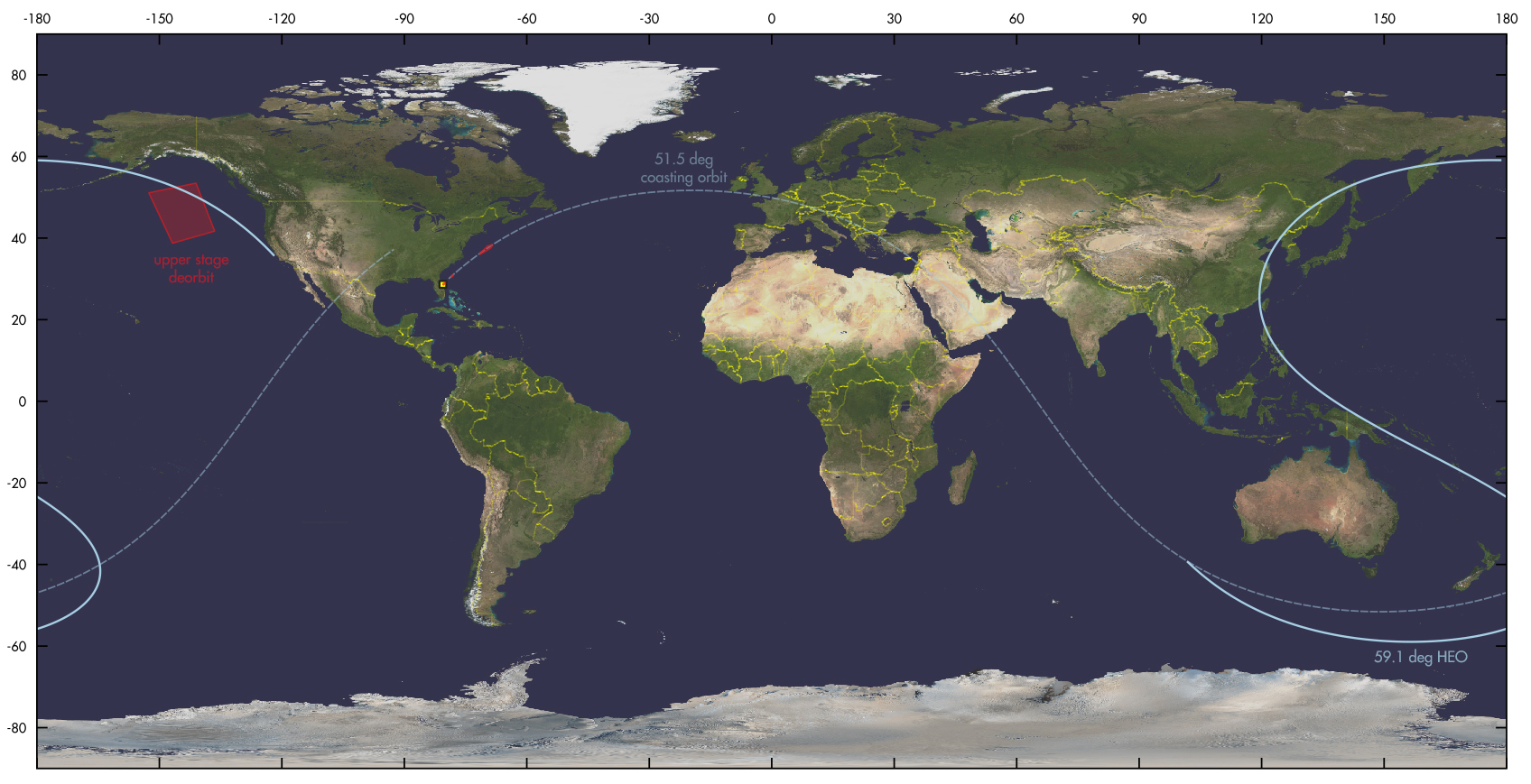
The orbit is now a bit better constrained, and about 38600 x 300 km at 59.15 degree inclination. Perigee is currently over the equatorial region. The image below shows the orbit, and the orbital position of OTV 7 around the time I imaged it:
click image to enlarge
OTV 7 was several minutes early on one day old elements, meaning it appears to be actively manoeuvering. This fits an X-37B, the previous OTV missions (all to LEO) were also frequently manoeuvering.
It is possible that the spacecraft is using a continuous thrust ion engine.
In the current Highly Elliptical Orbit (HEO), the orbital velocity at perigee is close to 10.2 km/s, which is 2.4 km/s more than in a Low Earth Orbit (previous X-37B missions all went to Low Earth Orbit). To eventually land the spaceplane, the orbit likely will be circularized first, by lowering apogee drastically, perhaps with the help of aerobraking in perigee, before doing a deorbit and landing.
This is my current orbital fit, which is still up for improvement, based on observations by Tomi Simola, Eelke Visser, Scott Tilley and me:
OTV 7 discovery image by Tomi Simola, Finland ((c) Tomi Simola, used with permission)
On 29 December 2023 at 1:17 UTC, after several delays, SpaceX launched a Falcon Heavy for the US Space Force with OTV 7, the seventh X-37B Spaceplane mission. Now its payload has been found!
OTV 7 was the subject of much speculation. The use of a Falcon Heavy, and the locations and time windows of related rocket stage splash-down and reentry zones, as well as statements by the US Space Force, indicated it might go into a different, higher altitude orbit than the previous six missions. On this blog, I speculated about a ~74-degree inclined Highly Elliptical Orbit (HEO).
Thanks to the dedicated efforts of Tomi Simola from Finland, OTV 7 has been found on-orbit this week. It is indeed in a HEO orbit, but inclined by 59.1 degrees, not 74 degrees.
Tomi performed a dedicated plane scan using a fixed staring camera. On the night of 7-8 February, he finally nabbed the elusive payload (see the discovery image above), while it was at ~3400 km altitude descending towards perigee. He used a WATEC 902H2 Ultimate camera with a 1.2/50 mm lens and 10 seconds integration.
Subsequent observations show that OTV-7 is in a 38840 x 323 km, 59.1 degree inclined Highly Elliptical Orbit. Perigee is just North of the equatorial region (currently clearly North of it near latitude 30 N, but short after launch it was at a lower latitude near 15 N).
(a Highly Elliptical Orbit (HEO) is an orbit with a low perigee - generally at a few hundred km altitude - and distant apogee, at 35 000 km altitude or more. As a result, the shape of the orbit is highly elliptical (highly elongated). An object in HEO typically makes two orbital revolutions a day. Due to the shape of its orbit, it spents most of its time in the higher parts of the orbit and a relatively small amount of time near perigee. When apogee is over high latitudes, as is usually the case for these orbits, this allows a long dwell-time over these latitudes with view of a very large area (a full hemisphere when in apogee). HEO orbits are hence the polar equivalents of a GeoSynchronous Orbit (GEO) and often used for communications relay or long-term monitoring of areas. They are a favoured orbit for Communications, SIGINT and Infra-Red missile launch monitoring. The OTV 7 HEO is unusual in that perigee is not over the southern hemisphere).
orbit of X-37B OTV-7 as of 10 Feb 2024. Click to enlarge
The observed orbital plane of the object matches well with a launch from Cape Canaveral on 29 December 1:07 UTC. Together with the fact that the orbit is quite unusual for a HEO object with it's Northern hemishere perigee location, an identification with OTV 7 is very likely.
Propagating the orbit backwards, the suggestion is that, after initial launch into a 51.5 degree inclined low coasting orbit, it was pushed into HEO by a manoeuvre when crossing the descending node, about half a revolution after launch. It subsequently probably manoeuvered a couple of times, adjusting apogee and perhaps also inclination.
The upper stage probably did a second manoeuvre after payload separation, changing its inclination to 74 degrees as suggested by the shape, orientation and location of the deorbit area from the Navigational Warnings related to the launch.
click map to enlarge
The map above plots the current orbit of OTV 7 propagated back to the day of launch, as well as the estimated initial low coasting orbit.
As can be seen, the OTV 7 orbit after one revolution actually does cross over the deorbit area from the Navigational Warnings: but in an oblique way that does not seem to match the orientation of the area. This is why I believe that the upper stage after payload separation was boosted into a higher inclined orbit. Perhaps as a collision avoidance manoeuvre (but the implied magnitude of the inclination change, 15 degrees, is rather large), perhaps - but that is pure speculation - it might have delivered a second payload to a higher inclination.
Because their orbital inclinations are about half a degree apart, I did look into a possible relation with another odd object launched into an odd orbit recently: USA 310. Their orbits are quite dissimilar though: USA 310 is in a circular MEO orbit inclined by 58.5 degrees, not a HEO orbit. I do note that their orbital planes, even though quite dissimilar, are 90 degrees apart. But most likely, that is coincidence.
click to enlarge
It will be interesting to follow OTV 7, and see whether it changes orbital altitude as often as the missions to LEO did (see this post from a few years ago).
A re-usable space-plane in HEO: who had that in the cards for 2024....?!
Our coverage of classified objects in high altitude orbits has been waning over the past few years. In February, I made a first attempt to recover some. In the past two weeks, I again recovered a number of these objects, as a by product of testing a ZWO ASI6200MM camera (that ultimately is going to be installed on the roof of the Delft Technical University Aerospace faculty).
One of the objects I recovered, is a very unusual one: USA 310 (2020-083A). This object is in an odd 58.5 degree inclined, 11097 x 11074 km MEO orbit. It was launched on 13 November 2020 as NROL-101 (see this 2020 blogpost). We tracked it and it's Centaur upper stage for a couple of weeks, but lost it after February 2021. In other words: it had not been seen for the last 2.5 years!
That is, untill I serendipitously picked it up last August 22, while imaging geostationary satellites. In the imagery, a streak was encountered (see image above). It is a fit with USA 310. I managed to track it again during several nights the past two weeks. Frankly, I am not 100% sure whether it is USA 310 or the Centaur upper stage from that launch, but it does not seem to have the periodic brightness variation the Centaur upper stage showed in 2020/2021. And it is (relatively) bright only in the eastern part of the sky, just like USA 310 back in 2020/2021.
More objects were recovered. Several geosynchronous objects that hadn't
been observed for a while, were imaged. One of them, the enigmatic PAN (2009-047A), had moved (just as it used to frequently do in the past, see my in-depth article on PAN in The Space Review from October 2016). I recovered it at longitude 39.7 degrees East, in the vicinity of Express AM-7. Observations over the past two week show it is stationkeeping, so it appears to be still operational (see also this post from 2021, when after several years of being stable at 47.7 E, it started to drift). Below is the recovery image:
click image to enlarge
Coverage of high altitude objects in HEO has likewise become spotty. I observed a number of them late February (see this blogpost), and again did so the past two weeks (a.o. TRUMPET 1 and USA 278). I recovered the SIGINT satellite TRUMPET-2 (1995-034A) on September 5, which had not been seen for almost 2 years:
One reason why I only sporadically track objects in GEO and HEO is that identifying and measuring them is much more labour-intensive than video-tracking objects in Low Earth Orbit, as identifying and measuring is still done manually for these objects by me. One day, I should get myself some software to make this a more easy task...
USA 200 (2008-010A) in HEO on 28 Feb 2023. Click image to enlarge
Only a few observers in our network are observing high altitude objects - objects in MEO, HEO and GEO. This is especially the case for HEO objects.
Due to various reasons, my own tracking of these objects over the past year had lapsed as well. But a series of bright clear nights late February, allowed me to pick up on them again. I recovered a number of objects that had not been observed by our network for over a year. USA 200 (2008-010A), in the image above from Feb 28, is one of them. I recovered it on Feb 28 after it had not been observed for almost exactly one year.
Below are a few more (but not all) objects that I observed late February that hadn't been tracked for a long time. All objects were imaged with a Canon EOS 80D + Samyang 2.0/135 mm lens.
USA 179 (2004-034A) in HEO on 26 Feb 2023. Click image to enlarge
USA 269 (2016-047A) in GEO (click image to enlarge)
USA 278 (2017-056A) in HEO. Click image to enlarge
post UPDATED with new maps and new value for inclination parking orbit
EDIT 2, 22:50 UT (Nov 4): the launch has been SCRUBBED for at least 48 hours...
EDIT 3, 7 Nov 22: launch is now currently scheduled for 11 Nov, 22:22 UT
EDIT 4, Nov 13: NROL-101 cleared the tower at 22:32 UT (Nov 13)
If weather cooperates,ULA will launch NROL-101, a classified payload for the NRO, on November 11 (postponed from November 3 and 4). Based on Navigational Warnings, the launch window is from 22:00 UT (Nov 11) to 02:45UT (Nov 12), with ULA indicating a launch window start at 22:22 UT.
[ EDIT: eventually, NROL-101 launched on 13 Nov 2020 at 22:32 UT ]
The launch is from platform 41 on Cape Canaveral, using an Atlas V rocket in 531 configuration (5-m fairing, 3 strap-on boosters, 1 single engine Centaur upper stage). It would have originally flown in 551 configuration but this was changed. It is the first Atlas V flight to feature the new GEM 63 solid fuel strap-on boosters.
This Navigational Warning has appeared in connection to this launch (updated):
062038Z NOV 20
NAVAREA IV 1074/20(GEN).
WESTERN NORTH ATLANTIC.
FLORIDA.
1. HAZARDOUS OPERATIONS, ROCKET LAUNCHING
   112200Z TO 120245Z NOV, ALTERNATE
   122200Z TO 130245Z AND 132200Z TO 140245Z
   IN AREAS BOUND BY:
   A. 28-38-50N 080-37-34W, 29-58-00N 079-28-00W,
      29-54-00N 079-21-00W, 29-34-00N 079-36-00W,
      29-15-00N 079-45-00W, 28-36-00N 080-23-00W,
      28-30-57N 080-33-15W.
   B. 30-01-00N 079-33-00W, 31-08-00N 078-36-00W,
      30-54-00N 078-14-00W, 29-47-00N 079-11-00W.
   C. 36-38-00N 073-35-00W, 39-03-00N 071-00-00W,
      38-30-00N 070-13-00W, 36-05-00N 072-46-00W.
   D. 51-37-00N 049-45-00W, 53-32-00N 044-58-00W,
      52-54-00N 044-15-00W, 51-03-00N 049-07-00W.
2. CANCEL THIS MSG 140345Z NOV 20.
The launch azimuth from the location of the hazard zones in this Navigational Warning and the initial launch azimuth depicted in a map tweeted by ULA point to an initial lauch into a [value updated] ~56-degree ~57.75 degree inclined orbit:
click map to enlarge
However: this is likely only a temporary parking orbit. The 531 rocket configuration has never been used for a launch into LEO so far, but always for launch into GEO. Given the launch azimuth, NROL-101 will certainly not be launched into GEO.
So either the payload is destined for LEO but unusually heavy or (more likely) the final orbit aimed for is a HEO orbit (also known as a Molniya orbit) with inclination ~63 degrees, perigee at ~2000 km over the southern hemisphere and apogee near 37 8000 km over the Arctic. [But: see major update at bottom! It might have been MEO rather than HEO, but this remains uncertain!]
A 63-degree inclined Molniya orbit cannot be reached directly from the Cape, because of overflight restrictions. Hence the initial launch azimuth corresponding to a ~58-degree inclined orbit. If NROL-101 goes into a Molniya orbit, it will do a dog-leg some time after launch, or (more likely) coast in a ~58-degree inclined parking orbit for perhaps several hours before being boosted into a Molniya orbit by the Centaur.
This appears to be underlined by the fact that to date (Sunday Nov 1) no
Navigational Warnings have been issued for the reentry area of the Centaur
upper stage. This could indicate that the upper stage will be left
orbiting in a ~2000 x 37 8000 km transfer orbit, or is disposed into a
Heliocentric orbit.
The NRO so far launched three kinds of satellites into HEO orbits:
3) combined SIGINT (Trumpet FO) and SBIRS Early warning satellites.
The last SIGINT/SBIRS combination launched into HEO was USA 278, launched in 2017. The last SDS launch into HEO was USA 198 in 2007 (there was also a launch in 2017 but this was into GEO, not HEO). As Ted Molczan pointed out in a private com, SIGINT launches into HEO usually were done from Vandenberg, SDS launches from Cape Canaveral. So perhaps NROL-101 will carry a new SDS satellite, but this is far from certain. Radio observations after launch might shed some light on both orbit and payload character.
The initial trajectory will take it over NW Europe some 23 minutes after launch, but in Earth shadow, so the pass will not be visible:
click map to enlarge
UPDATE 15 Nov 2020 15:20 UT
Around 2:30 UT on Nov 14, four hours after launch, sightings of a fuel venting event were observed from the western USA.
This image tweeted by Marc Leatham shows the V-shaped cloud in Saggitarius, imaged from Joshua Tree National Park:
🔎**EXPAND**🔍 Early in the evening last night in Joshua Tree, California, I was taking some test shots of the Milkyway. While editing, something popped out at me. If I'm not mistaken, that diffuse V shape must be #NROL101 launched from Florida! @torybruno, Am I right?!? 🔭☄️✨ pic.twitter.com/j2tNAICqji
There is also allsky imagery of the fuel cloud from Taos, New Mexico (look low at the horizon where the milky way touches the horizon(right side), for a 'moving' piece of Milky Way. This is the fuel cloud):
These sightings lead us to believe that the payload perhaps went into the lower part of MEO, not HEO. This is however (emphasis) not certain at this moment.
The launch sequence then could have been insertion into a LEO parking orbit; an apogee raising burn; a perigee raising/circularization burn bringing it into HEO; and fuel vent/orbit separation burn by the Centaur rocket. That latter event caused the observed fuel cloud, at about 8500 km altitude.
ULA reported 'mission successful' around 1:48 UT. For the launch provider, their mission is completed upon payload separation. 1.48 UT corresponds to a pass through the southern apex of the orbit, suggesting payload separation was at that point. This, in combinbation with the observed Centaur vent, would argue against insertion into HEO but does fit insertion into MEO.
If my guess is correct, then this should be the approximate orbit (orbital position is the approximate position for the time of the Joshus Tree fuel cloud sighting):
click to enlarge
Both the Centaur and payload have been catalogued (but without orbital elements) by CSpOC, as #46918 (2020-083A) USA 310 and #46919 (2020-083B) Atlas V Centaur R/B.
If USA 310 indeed went into HEO, then the identity/character of the payload remains a big guess.
Added note, 4 Nov 2020, 21:30 UT: the maps and inclination of the initial parking orbit have been updated based on a map showing the initial trajectory up to fairing jettison tweeted by ULA boss Tory Bruno.
This post benefitted from discussions with Cees Bassa, Scott Tilley, Ted Molczan and Bob Christy.
The past week brought some clear skies. It also brougt me a new lens, a SamYang 2.0/135 mm ED UMC.
This lens had been on my wish-list for a while, as a potential replacement for the 1979-vintage Zeiss Jena Sonnar MC 2.8/180 mm I hitherto used for imaging faint Geosynchronous (GEO) and Highly Elliptical Orbit (HEO) objects, objects which are typically in the magnitude +10 to +14 range.
The 2.0/135 mm SamYang lens has gotten raving reviews on photography websites, several of these reviews noting that the optical quality of this lens is superior to that of a Canon 2.0/135L lens. And this while it retails at only half the price of an L-lens (it retails for about 460 to 500 Euro).
While I have the version with the Canon EF fitting, the SamYang lens is
also available with fittings for various other camera brands.
Focussing is very smooth and easy with this lens. Unlike a Canon-L lens, the SamYang lens is fully manual (both focus and
F-stop), but for astrophotography, manually focussing is mandatory
anyway. The general build of the lens is solid. It is made of a combination of metal and plastic.
While not particularly lightweight, the lens is lighter in weight than my 1979-vintage Zeiss (which is all-metal and built like a tank, in true DDR fashion). The SamYang has a somewhat larger aperture (6.75 cm) than the Zeiss (6.42 cm), meaning it can image fainter objects. It also has a notably wider field of view (9 x 7 degrees, while the Zeiss has 7 x 5 degrees).
So for me, this seemed to be the ideal lens for GEO and HEO.
And after two test nights I can confirm: this SamYang lens indeed is spectacularlysharp. The first test images, made on January 15 and 16, have truely impressed me. Even at full F2.0 aperture, it is sharp from the center all the way to the edges and corners of the image.
Here is a comparison of the image center and the upper right corner of an image, at true pixel level. There is hardly any difference in sharpness:
click to enlarge
The images below, taken with the SamYang on a Canon EOS 80D, are crops of larger images, all but one at true pixel level.
The first image is a test image from January 15, a nice clear evening.
It shows two objects in HEO: a Russian piece of space debris (a Breeze-M
tank), and the classified American SIGINT satellite TRUMPET 1 (1994-026A). Note how sharp the trails are (this is a crop at true pixel level):
Click image to enlarge
The next night, January 16, I imaged several geostationary objects (which at my 51 degree north latitude are low in the sky, generally (well) below 30 degrees elevation). While the sky was reasonably clear, there were lingering aircraft contrails in the sky, locally producing some haze. Geostationary objects showed up well however, better than they generally did in the Zeiss images in the past.
The image below, which is a crop of a larger image, is not true pixel size, but slightly reduced in size to
fit several objects in one image. It shows the Orion Nebula, several
unclassified commercial GEO-sats, the Russian military comsat KOSMOS
2538 (BLAGOVEST 14L), and the classified Italian military communications satellite SICRAL 1B (2009-020A):
Click image to enlarge
The images below are all crops at true pixel level. The first one shows the US classified SIGINT satellite PAN/NEMESIS I (2009-047A), shadowing the commercial satellite telephony satellite YAHSAT 1B. It also shows a number of other unclassified commercial GEO-sats.
PAN/NEMESIS 1 is an NSA operated satellite that eavesdrops on commercial satellite telephony (see my 2016 article in The Space Review).
Note that this image - just like the next images- was taken at very low elevation, and from a light-polluted town center.
click image to enlarge
The image below shows another US classified SIGINT satellite, Mentor 4 (2009-001A), an ADVANCED ORION satellite. It shadows the commercial satellite telephony satellite THURAYA 2 (more backgrounds on this in my 2016 article in The Space Review). At magnitude +8, it is one of the brightest geosynchronous objects in the sky (note how it is much brighter than THURAYA 2):
click to enlarge
The last image below again is a classified US military SIGINT satellite, MERCURY 2 (1996-026A). While 24 years old it is, together with its even slightly older sibling MERCURY 1 (which I also imaged but is not in this image), probably still operational:
Click image to enlarge
After these two test nights, I am very enthusiastic about the SamYang lens. It is incredibly sharp, also in the corners, easy to focus, goes deep (in terms of faint objects), and overall performs excellent. I also like the wide field of view (compared to the 180 mm Zeiss which I previously used to target GEO). Together with the equally well performing SamYang 1.4/85 mm, it might be the ideal lens for imaging GEO and HEO.
Astrometric data on the targetted satellites from these test images are here and here. The astrometric solutions on the star backgrounds in the images had a standard deviation of about 2".
Added 20 Jan 2020:
This last image (reduced in resolution to fit) was taken this evening (20 January) and shows Trumpet 1 (1994-026A) passing the Pleiades:
In wintertime at latitude 51 degrees North, satellites in Low Earth Orbit are mostly invisible except for twilight, as all their passes are completely within the Earth shadow.
This season is therefore the season that I focus on HEO and GEO objects. HEO stands for Highly Elliptical Orbit and is almost synonymous with the more informal name 'Molniya orbit', after a class of Russian communication satellites employed in such orbits.
Military SDS COMSAT USA 198 (SDS 3F5), imaged in Cassiopeia on 4 Jan 2014
Satellites in a Molniya orbit have an orbital period of about 2
revolutions per day, an orbital inclination near 63.4 degrees, perigee
at a few hundred kilometers altitude over the southern hemisphere and
apogee at altitudes near 36000 km over the Arctic. They spend most of
their orbital time near their apogee.The 63.4 degree orbital inclination ensures that perigee keeps at a stable position over the southern hemisphere.
US military payloads and 'unknowns' in Molniya orbit
The advantage of a Molniya orbit is that it allows a good, long duration view of high northern latitudes, including the Arctic region, which are not well visible from a geostationary orbit. This is ideal for communications satellites serving these regions, for SIGINT satellites, and other applications (such as infrared ICBM early warning systems, e.g. SBIRS) that benefit from a long 'stare' and good view of high Northern latitudes.
The US military has several systems in a Molniya orbit (see image above): communication satellites (e.g. two components of the SDS system), several SIGINT satellites (TRUMPET and TRUMPET-FO), and components of the SBIRS system (piggybacked on three TRUMPET-FO SIGINT satellites). Identifiable payloads include:
- TRUMPET 1, 2 and 3 (SIGINT); - TRUMPET-FO and SBIRS USA 184, 200 and 259 (SIGINT and SBIRS); - SDS COM satellites USA 179 and 198
There are a couple more which we cannot (yet) tie to a specific launch and function (see note at end of post).
Near their apogee, satellites in Molniya orbit are located high in the sky for my location,
and because of their high northern position, they are sun-illuminated
and hence visible (typically at magnitudes near +9 to +12) even at midnight and in winter. They move
very slowly when near apogee, creating tiny trails on the images.
On December 13, the NRO launched (as NROL-35) a new SIGINT and SBIRS platform into a Molniya orbit: USA 259 (see a previous post). It is currently still actively manoeuvering to attain its final orbit, which makes it an interesting object to track. The image below was taken in late twilight of Jan 4, when the satellite was past its apogee and on its way to perigee. It was 4 minutes early against orbital elements based on observations of only a few days old.
SIGINT/SBIRS satellite USA 259 (NROL-35) imaged in Andromeda in the evening of Jan 4
I image these objects with an old but good Zeiss Sonnar MC f2.8/180 mm telelens (made in the former DDR and sturdy -and heavy- as a tank). This lens has a 67 mm aperture at f 2.8, which means it shows faint objects. As these objects move very slowly, the relatively small FOV is no problem. My observational data from January 4th can be found here and here.
Note: the 'unknowns' in the orbital plot above are objects we track that are not in public orbital catalogues and which we cannot tie to a specific launch. Although some of them certainly are, not all of these need to be payloads: some might be spent rocket stages from launches into HEO.
On December 13th, 2014, the NRO launchedNROL-35 out of Vandenberg AFB into a Molniya orbit. The payload, USA 259 (2014-081A) is most likely a SIGINT, and possibly piggybacks a SBIRS sensor, according to analysts.
USA 259 (NROL-35) imaged by me on 28 December 2014
Our tracking network quite quickly picked up the payload. Peter Wakelin first picked it up from Britain on December 13, followed by Scott Tilley in Canada and Cees Bassa in the Netherlands a few hours later. In the two weeks since, the payload has been observed to be manoeuvering in order to get into its intended orbit.
My own first observations of the payload were done in the evening of December 28 (see image above, taken with the F2.8/180mm Zeiss Sonnar) during short clearings. It had been a clear day, but clouds rolled in around nightfall. The satellite was located high over the Northern Atlantic near aphelion at this time at an altitude of 34500 km, and situated high in the sky in Cepheus as seen from Leiden.
Friday evening I missed the LEO window because of a dinner. When back home near midnight, conditions were dynamic: intermittent clear skies and roving cloud fields.
A HEO (Highly Elliptical Orbit) object called "Unknown 051230" (2005-864A) was well-placed near the zenith, in Cepheus. I targetted it using the 2.8/180mm Zeiss Sonnar MC lens, snapping pictures during clear spells. It shows up well, as a tiny but clear trail (indicated by the arrow in the image):
click image to enlarge
This object is one which our analysts cannot link to any particular launch - hence the designation "Unknown". It is being tracked by us for quite a couple of years now (since Greg Roberts discovered it on 30 December 2005). It could be either a (defunct) payload, or an old rocket booster.
At the time of my observations it was at an altitude of 36650 km, close to its apogee, situated over the Arctic circle roughly above Iceland:
orbital position of Unknown 051230 at the time of observation
click image to enlarge
Nadir view from orbital position of Unknown 051230 at the time of observation
click image to enlarge
Highly Elliptical Orbits (also called a Molniya orbit) typically have an orbital inclination near 63.4 degrees, an apogee near 36000 km, and perigee at only a few hundred km altitude, usually over Antarctica.
63.4 degree orbital inclination of Unknown 051230
click image to enlarge
The ~63.4 degree inclination with these orbital parameters ensures that the perigee is stable, i.e. always stays over the southern hemisphere.
An object in this orbit has a period of 0.5 day, so it makes 2 revolutions per day. Its residence time in perigee over the southern hemisphere is only brief: most of the time it is at high altitude over the northern hemisphere, allowing many hours of continued presence above that area (see image above).
Objects in these orbits are therefore typically used to provide communications at high Northern latitudes, or for SIGINT and infra-red surveillance.
It had been a while since I last observed objects in HEO (Highly Elliptical Orbit). Most of my recent focus has been on the KH-11 in Low Earth Orbit and on geosynchronous objects.
USA 184, 29 March 2014, 21:34 UTC click image to enlarge
Last Saturday evening I however targetted USA 184 (2006-027A), a classified US military satellite in HEO which hovered almost in the zenith for my locality during the observation. It is the tiny trail indicated by the arrow in the image above, taken with my Canon EOS 60D and a 2.8/180mm Zeiss Sonnar MC. Stars in the image belong to Ursa maior.
A Highly Elliptical Orbit (HEO) is an orbit which is highly eccentric ("elliptical") with a low perigee at only a few hundred kilometers altitude (usually in the southern hemisphere) and a high apogee, often in the 20 000 to 39 000 km altitude range. The orbit is typically inclined by about 63 degrees. USA 184 is in a 63.58 degrees inclined, 1590 x 38 760 km orbit.
USA 184, orbital position 29 March 2014 21:34 UTC
click image to enlarge
Satellites in such an orbit spend a long time near the apogee of the orbit. As a result, they hover high above the northern hemisphere for many hours a day. Just like a geosynchronous orbit, this allows long duration coverage of a (large) area. The difference with a geosynchronous orbit is that a HEO orbit is well suited to cover high polar latitudes, while a geosynchronous orbit has a poor coverage of such high latitudes. HEO orbits are therefore typically used for applications that demand long-duration coverage of high Northern latitudes. It concerns communications satellites (notably by the Russians), SIGINT satellites and Infrared Early Warning satellites.
USA 184 falls in the latter two categories. It is a TRUMPET-FO (the FO stands for "follow-on", i.e. it is an improved version of the older TRUMPET) SIGINT satellite. In addition, it has a piggyback SBIRS (Space Based Infrared System) package, which is dedicated to the detection of ICBM launches by their Infrared signatures. It is one of two HEO sensors in the SBIRS system (the other one is on USA 200, 2008-010A), in addition to the two dedicated SBIRS satellites in geostationary orbit (SBIRS-GEO 1 and SBIRS-GEO 2, 2011-019A and 2013-011A).
At the time of the observation, USA 184 was at an altitude of 38 355 km over the Northern Atlantic at 62.74 N, 4.84 W. It was almost in its apogee, and hovered at 76 degrees elevation in the sky. This is the approximate view from the satellite at that time:
view from USA 184, 29 March 21:34 UTC
click image to enlarge
The images below are uniform patches related to the launch of USA 184 (as NROL-22 on 27 June 2006), and the SBIRS program:
Last weekend saw my first observation, at last, of the payload of the NROL-41 launch: the FIA Radar 1 (2010-046A). At 4:25 am local time it made a pass in the northern sky over Polaris, and became visible to the naked eye at a brightness of mag +3.5. Below is one of the two pictures, plus a picture of the launch patch of NROL-41.
click images to enlarge
The orbit of the satellite is unusual, as it is retrograde, and in fact resembles a retrograde version of the Lacrosse orbits. There is some speculation as to the why of this.
The object currently is actively manoeuvring: when I captured it, it was 34 seconds late with regard to just one day old elements after one such manoeuvre. The apparent intention is to create a frozen orbit.
A new lens added to the equipment
This weekend saw the first active use of a new piece of optics added to the repertoire: an old, DDR-made, Carl Zeiss Jena Sonnar MC 2.8/180mm lens. The lens itself is renowned, for its sharpness. Originally made for 6x7 cameras, it provides very good sharpness from edge to edge on a DSLR image. Fitted with a P6 to EOS adapter, it works perfectly on my Canon EOS 450D. It yields almost twice the aperture of my EF 100/2.8, and hence will be used to capture faint distant objects such as Molniya orbit objects. The lens is of very heavy build: solid metal and glass with no plastics. It weights 1.5 kg!
Below is an image of the optics I am now using in my observations: a Canon EF 2.5/50 mm Macro used for LEO and some GEO objects; a Canon EF 2.8/100 mm Macro USM used fro MEO and HEO objects; and the Carl Zeiss Jena Sonnar MC 2.8/180 mm for HEO and GEO objects.
click image to enlarge
The advantage of the lens is that it goes deeper in magnitude of the objects it captures. A disadvantage is that it has a smaller FOV (6.8 x 5.0 degrees) which, with the software I use for astrometry (AstroRecord), means I have to carefully select the part of the sky to aim for (it should have enough stars brighter than +8 and at last 3 stars with a Flamsteed number, as the AstroRecord sequence starts with identifying 3 of those after which it starts to auto-identify stars). Especially the requirement of the 3 Flamsteed numbers in such a small FOV is limiting. Anoher drwaback of this lens is that with 1.5 kg it is heavy! It is at the edge of what my lightweight camera tripod can carry, and hence vulnerable to vibrations.
On October 9 and 10 I used the lens to capture two Molniya-orbit (HEO) objects: USA 184 (06-027A), and USA 198 (07-060A, SDS 3F5). As a stray, it also captured another Molniya, the Russian US-KS Oko IR missile detection platform Kosmos 2393 (02-059A), and an old Russian rocket body in LEO (Kosmos 411 r, 71-041J). The image sequence shows that Kosmos 2393 was flaring at that time (20:14:02 - 20:14:12 UTC, 9 Oct 2010)
Below are two parts (at full pixel resolution) of one image that contained both USA 184 and Kosmos 2393 (the latter close to the edge of the image); and one of the images of USA 198.
While reducing the remainder of my May 9-10 observations, I found what appears to be a UNID (unidentified object) on one of the images, close to eta Uma:
click image to enlarge
It does not identify with any known catalogued object, or classified object known to us. The appearance is HEO-like (very short trail), it is present on only one (out of a series of five) images taken with the EF 100/2.5 Macro USM, and the trail looks to be part of a flare.
Most likely, it is a tumbling rocket stage of some past HEO launch.