Showing posts with label space plane. Show all posts

Monday, 18 October 2021

The Chinese space plane test of 16 July 2021: orbital, not suborbital?

click map to enlarge
 

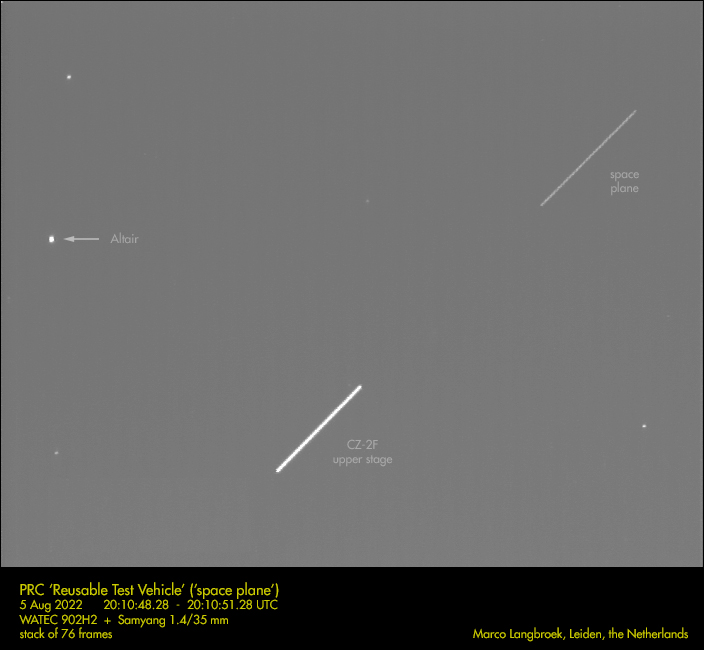
In my previous post I debated at length a claim by the Financial Times on October 16 that China recently did a FOBS test. This claim seems to be currently disintegrating, as suspicion is rising (following rebuttal comments by a Chinese Government offcial) that it all seems to refer to a Chinese reusable Space Plane test flight on July 16 instead. A test flight which was already reported earlier and hence known.

At the time when that Chinese Space Plane test flight was reported in July, it was reported as having been suborbital. This was (I think) mostly based on the proximity of the reported launch site (Jiuquan) and landing site (Badanjilin Airport), which are only some 220 km apart (indicating a short suborbital "hop").

But I now think that judgement was in error

If the whole FOBS-story indeed actually refers to the July 16 test flight, then it seems that it was orbital, completing one revolution.

Indeed, upon looking into it and trying some orbital scenario's, I found that a launch from Jiuquan into a 41.07 degree inclined orbit would actually very well match with a landing at Badajilin Airport at the end of one full revolution. I have depicted the resulting trajectory in the map in top of this post.

So: FOBS or space plane? Jeffrey Lewis has a point when he tweets:

"China just used a rocket to put a space plane in orbit and the space plane glided back to earth. Orbital bombardment is the same concept, except you put a nuclear weapon on the glider and don’t bother with a landing gear." - Jeffrey Lewis

But then, Mark Gubrud is likely also right about design differences when he tweets that:

"A FOBS/hypersonic missile would be optimized differently from a space plane. The plane would be designed to slow as much as possible on reentry (hence the blunt design of the Shuttle). It would have landing gear. It would have a payload bay, instead of an integral warhead."


The trajectory of the July 16 space plane flight, if my interpretation is correct, is not very FOBS-like. But this was only a test flight. Jeffrey is right that a space plane or glider in principle is suited for a deorbit with something in it's cargo bay that can go BOOM. This is why some other nations look with suspicion at the US X-37B space plane, currently on its sixth mission.

About the airport at Badanjilin: it seems to have been constructed rather recently. It is not present in Google Earth imagery from as recent as 2016. The landing strip is some 2.4 km long, oriented northwest-southeast, azimuth 313-133 degrees, and located at 39.2264 N, 101.5477 E. Below is a Copernicus Sentinel 2A image of the airport taken on 31 July 2021 (note the Camel!):


click image to enlarge

UPDATE 18 Oct 2021 19:45 UT:

Something very confusing is that, while the Chinese Government now seems to suggest that the orbital flight reported on by the Financial Times in fact was this July 16 space plane flight, Chinese news items on this space plane flight from that time seem to state that the flight was "suborbital", as Jonathan McDowell has pointed out. 

Still, I am not convinced as the word is used several times in a context where it is odd (e.g. when describing the space plane as a technology). The same in an English language bulletin by Xinhua, which also talks about a "reusable suborbital carrier". That sounds more like an aircraft to me (perhaps one launched with a booster stage and then flying through the upper atmosphere), than a space plane. I have no knowledge of the Chinese language at all (the only thing I can say in Chinese is "thank you") so do not know what is possibly lost in translation here.

Even more confusingly, the first Chinese item linked above seems to name yet another airport (so another one than that pictured above) as the landing site:  Youqi airport. I found a Youqi airport which is near 48.5764 N, 116.9377 E. The runway of that airport however seems a bit short for a space plane landing. Jonathan McDowell  thinks I got the wrong Youqi and points out that the Badanjilin Airport imaged above is also called Youqi....oh well. He probably is right (he usually is). We can use some more confusion in this already confusing case...

Both with regard to "FOBS or not", and the July 16 "space plane", many things remain very ambiguous.

It could be that the Chinese Government is now seizing on the July 16 test to explain away a later FOBS test.

Saturday, 5 September 2020

China launches a 'Reusable Experimental Spacecraft' - a Space Plane? [UPDATED MULTIPLE TIMES]


Early September 2020, the space tracking community was in nervous anticipation of a rather mysterious Chinese launch. Amidst tight security measures, a Changzeng-2F (CZ-2F) rocket was readied at SLS-1 of Jiuquan's Launch Area 4. Chinese tracking ships were taking up positions near South America and in the Arabian Sea. Two NOTAM's appeared suggesting a launch between 5:20 and 6:00 UT on September 4. Something was afoot! Speculation was, that this was the long anticipated inaugural launch of a robottic Space Plane, a version of the Shenlong, China's answer to the American Air Force's X-37B robottic Space Plane.

Then, on September 4th, the Chinese news agency Xinhua published a very brief news item announcing that a CZ-2F from Jiuquan had launched a 'Reusable Experimental Spacecraft' earlier that day. 

The bulletin was scarce in information but stated that "after a period of in-orbit operation, the spacecraft will return to the scheduled landing site in China. It will test reusable technologies during its flight, providing technological support for the peaceful use of space".

No further details were given on launch time, orbit or character of the spacecraft. The description of the spacecraft is a bit ambiguous. Instead of a space plane, a 'reusable spacecraft' could in theory also be some sort of capsule (e.g. like the SpaceX Dragon): but most analysts think this indeed refers to the long rumoured space plane, China's answer to the US X-37B.

Pre-launch, and based on the positions of the hazard zones from the two NOTAM's, I calculated a launch into an orbital inclination of ~45 degrees, incidentally similar to the orbital inclination of the X-37B OTV 6 mission currently on-orbit. What's more, the launch window given (the NOTAM windows were from 5:23 to 6:05 UT) indicated the possibility of a launch into the orbital plane of OTV 6! The orbital plane of OTV 6 passed over Jiuquan at 6:00 UT - near the end of the launch window.

I published the following expected track for a launch into a 45 degree inclined orbit (which we now know is wrong):

Initial pre-launch trajectory guess. Click map to enlarge


When later that day the first orbital elements by the US military tracking network appeared on the CSpOC portal, it turned out that the orbital inclination was not ~45 degrees, but 50.2 degrees, 5 degrees higher than I anticipated. The reason for the mismatch, is that the rocket apparently did a dog-leg manoeuvre during ascend. This is very clear when we plot the orbital ground track in relation to the launch site and hazard zones from the two NOTAM's: it passes obliquely between them rather than lining up.

Actual orbital track. Click map to enlarge

 A 'dog-leg' manoeuvre is usually done for safety reasons, to avoid overflying a particular area downrange (e.g. a city or a foreign nation), but can also be done to insert the spacecraft into an orbital inclination that otherwise cannot be reached from the launch site. The latter is however not the case here - [editted] the orbital inclination is higher than the launch site latitude (you cannot reach an orbital inclination that is lower than your launch site latitude without a dog-leg, but higher you can.). So the reason must be range safety.

It is clear that the launch occurred well outside the NOTAM time window (why, is not clear). My analysis, based on a proximity analysis using the orbits of the spacecraft, the upper stage of the CZ-2F rocket, and that of four engine covers ejected upon spacecraft separation, indicate spacecraft separation and insertion into orbit around 7:41 UT on September 4th, over the Chinese coast with the orbital plane lining up with Jiuquan (see image below which depicts the orbital position at orbit insertion). The launch itself then should have occured some 8-10 minutes earlier i.e. around 7:30 UT, give or take a few minutes.

Moment of orbital insertion. click to enlarge
 

The spacecraft was inserted into a 50.2 degree inclined, initially 332 x 348 km orbit. During the hours after launch, the spacecraft made small orbital manoeuvres (see diagram below). At the time of writing (5 September 20:45 UT) it is in a 331 x 347 km orbit.

click diagram to enlarge

The later than initially expected launch time and, through a dog-leg manoeuvre, insertion into a 50.2 degree inclined orbit moved the orbital plane away from that of the X-37B OTV 6, although the two orbital planes are still near. Igor Lissov has pointed out some resemblance to the orbital plane of another US classified payload, USA 276, which has a similar orbital inclination to the Chinese spacecraft (but 50 km higher orbital altitude). The RAAN difference is 8 degrees:

click to enlarge

Based on the current orbits of all three spacecraft, there will be no close approaches of the Chinese spacecraft to either of these classified US payloads over the coming two weeks.

OTV 6 is currently in a 383 x 391, 45.0 degree inclined orbit. The difference in RAAN with respect to the Chinese spacecraft is 13.4 degrees, with a 5.2 degree difference in inclination and about 40-50 km difference in orbital altitude.

USA 276, the mysterious spacecraft that made a close approach to the ISS in May 2017 (see my July 2017 article in The Space Review), is currently in a 397 x 395, 50.0 degree inclined orbit. The difference in RAAN with respect to the Chinese spacecraft is 7.9 degrees, with a 0.2 degree difference in inclination and about 50-60 km difference in orbital altitude.

The Chinese 'reusable' spacecraft was launched from SLS-1, one of two launch platforms at Launch Area 4 of the Jiuquan Space Launch Center. Below is a Copernicus Sentinel 2B image of the launch complex, taken on September 2nd, two days before the launch. The two launch platforms are indicated: the southernmost one is the platform used for this launch.

click image to enlarge


It will be interesting to see where the 'reusable spacecraft' will eventually land. One likely candidate is a military airfield, the Dingxin Test and Training Base, that is located some 75 km southwest of the launch site. I have indicated both the launch site (A) and the potential landing site (B) in the Copernicus Sentinel 2B image below. The second image gives a more detailed look on the airbase.

Click image to enlarge

 
Click image to enlarge

We have no clue how long the spacecraft will stay in orbit. It will be interesting to see when and where it lands.

The 'reusable spacecraft' has the CSpOC catalogue entry #46389 (COSPAR ID 2020-063A). The CZ-2F upper stage is object #46390 (2020-063B). The four ejected engine covers (with apogees in the 458 to 566 km range), have numbers 46391-46394 (2020-063A to 202-063F).


UPDATE 6 Sept 2020 8:45 UT:

Xinhua reports on Sept 6 that the spacecraft has landed after 2 days on-orbit. Depending on the landing site, landing should have been (based on orbital overpass) either around 1:55 UT at Lop Nor (an alternative landing site suggested), or 6:45 UT at Dingxin Airbase.

UPDATE 2, 9:30 UT:
As the Chinese version of the Xinhua bulletin dates to an hour after the first option (1:55 UT), it seems that the landing was near 1:55 UT near Lop Nur in the Taklamakan desert (HT to Jonathan McDowell).

UPDATE 3, 10:30 UT:
This is the potential landing site, a triangular arrangement of 5 km long landing strips in the Taklamakan Desert. The orbital track of the spacecraft passed some 42.5 km northwest of it around 1:54 UT, more or less parallel to what appears to be the main landing strip:

Click image to enlarge

Click image to enlarge

UPDATE  4, 14:00 UT:
This is an updated diagram of the orbital evolution over the test flight. It seems no large manoeuvers were tried during this flight.


Click diagram to enlarge

UPDATE 5, 16:00 UT:

Jonathan McDowell noted that a new object related to the launch has been catalogued, object 2020-063G, #46395. My analysis suggests it was ejected from the experimental spacecraft near 22:25 UT on the 5th, two revolutions before landing. It likely is a cubesat of some sort. It is in a  332 x 348 km, 50.2 degree inclined orbit. (Update 8 Sept: on Twitter, Bob Christy has suggested that it might be a small inspector satellite, used to inspect the outside of the experimental spacecraft prior to deorbit)

Wednesday, 13 May 2020

[UPDATED] OTV 6 (USSF 7), the next X-37B launch, appears to go into a 44-degree inclined orbit

OTV 6.  Image: US Air Force. Click to enlarge

If weather cooperates, the next X-37B launch, mission OTV 6 ,also known as launch USSF 7, is slated for May 16, with backup dates on May 17 and 18 in case launch is postponed. The small uncrewed space plane will be launched for the US Air Force by the United Launch Alliance, with an Atlas 5 rocket, from Cape Canaveral SLC-41.

Navigational Warnings have now appeared for this launch, which shed light on the launch window and the orbit aimed for:

NAVAREA IV 388/20(GEN).
WESTERN NORTH ATLANTIC.
FLORIDA.
1. HAZARDOUS OPERATIONS, ROCKET LAUNCHING
   161224Z TO 161453Z MAY, ALTERNATE
   171314Z TO 171532Z AND 181354Z TO 181434Z MAY
   IN AREAS BOUND BY:
   A. 28-36-51N 080-35-57W, 28-41-00N 080-26-00W,
      28-36-00N 080-23-00W, 28-31-36N 080-33-34W.
   B. 32-28-00N 075-12-00W, 33-50-00N 072-51-00W,
      33-08-00N 072-17-00W, 31-45-00N 074-41-00W.
   C. 38-43-00N 062-38-00W, 40-23-00N 058-26-00W,
      39-18-00N 057-47-00W, 37-34-00N 061-56-00W.
2. CANCEL THIS MSG 181534Z MAY 20.//


HYDROPAC 1415/20(74,75).
SOUTHEASTERN INDIAN OCEAN.
DNC 03, DNC 04.
1. HAZARDOUS OPERATIONS, SPACE DEBRIS
   161319Z TO 161528Z MAY, ALTERNATE
   171409Z TO 171607Z AND 181449Z TO 181509Z MAY
   IN AREA BOUND BY
   36-03S 096-54E, 33-40S 098-30E,
   37-32S 108-22E, 40-03S 107-00E.
2. CANCEL THIS MSG 181609Z MAY 20.//


The launch azimuth defined by the three launch hazard areas A, B and C in the Atlantic Ocean and the location of the Centaur upper stage deorbit zone in the Indian Ocean, point to a launch into a ~44-degree inclined orbit, give or take half a degree. The Centaur upper stage will be deorbitted about half a revolution (55 minutes) after launch.

The following map depicts the hazard areas and the trajectory of the first orbit, for a 44-degree inclined orbit and an orbital altitude of ~350 km. The latter orbit fits the locations of the hazard zones well, and the ~55 minutes time difference between the start of the launch windows and the start of the Centaur upper stage deorbit windows in the Navigational Warnings combined with the position of the deorbit zone, fits a ~350 km altitude orbit:

Click map to enlarge

Launch into a 44-degree inclined orbit unfortunately means I do not get to track it from the Netherlands, as my observing location is too high north in latitude to see it in such an orbit. Following the previous OTV 5 launch, that went into a 54.5 degree inclined orbit and could be well observed from the Netherlands, I had some hopes for OTV 6, but alas no, it is not to be apparently...

A 44-degree orbital inclination would be similar to mission OTV 3 from 2012-2014. These are the orbital inclinations of all past OTV missions:

Mission     inclination    operational period        flight duration
OTV 1       40.0o          22/04/2010 - 30/11/2010   224 days
OTV 2       42.8o          05/03/2011 - 16/06/2012   468 days
OTV 3       43.5o          25/10/2012 - 17/10/2014   675 days
OTV 4       38.0o          20/05/2015 - 07/05/2017   718 days
OTV 5       54.5o          07/09/2017 - 27/10/2019   780 days
OTV 6       44.0o ?        16/05/2020 - ?

With regard to the upcoming launch, the given launch windows for May 16 and the two backup dates are curious. These launch windows are not the same duration (May 16 is 2h 29m in duration; May 17 is 2h 18m in duration; and May 18 only 40 minutes in duration).  They shift oddly from date to date too. The start of the given windows shifts 50 minutes between May 16 and 17; and shifts 40 minutes between May 17 and 18. It moreover shift to a later time between consecutive dates: while a given targetted orbital plane would make the launch shift to an earlier time, not a later time

Perhaps this is done to obfuscate the launch time and RAAN aimed for (or maybe it is just simply Range availability at play). If we look at the common ground: all three launch windows have a potential 10-degree wide RAAN window between 331o.14 and 341o.17 in common, so perhaps that is what is aimed for. If that interpretation is correct, this would lead to the following potential 40-minute launch windows, shifting back by 4 minutes each day:

16 May     13:58 - 14:38 UT
17 May     13:54 - 14:34 UT
18 May     13:50 - 14:30 UT

But of course, it is always possible that they launch straight away at the 12:24 UT opening of the May 16 window...we will see!

[Edit 15 May 2020 23:20 UT: but see note at end of post!]

A lot has been written about the X-37B and its purpose, and there are a lot of persistent misconceptions regarding the fact that it is a "space plane" (see my blogpost "X-37B fact and fiction" from July 2019).

Far from being a nefarious device, the X-37B appears to be a testbed for experimental space technology. According to the US Space Force, one of the things that will be tested during the next OTV 6 mission is an experiment to transmit solar power by microwave. It will also contain two NASA experiments that study the effects of radiation on materials and seeds, and it will deploy at least one military cubesat, FalconSat 8 (the previous OTV mission, OTV 5, released three cubesats).

The US Space Force Press Release also indicates that, as a first, OTV 6 will be fitted with a "service module" to the aft of the vehicle, that will house experiments (previous OTV missions housed experiments in the cargo bay). It will be interesting to see what happens to this service module at the end of the mission.

Addendum 13 May 22:05 UT:
More on the microwave experiment in this article (HT to Brian Weeden). It seems it is not so much transmission by microwave, but the generation of microwaves from solar power, which is then send through a cable, if I get it correctly. Anyway: something with microwaves...

Addendum 15 May 23:20 UT:

Bob Christy wrote a very interesting analysis on his Zarya blog, in which he links similar odd jumps in past OTV launch windows to times of close KH-11 passes, the idea being that these KH-11 satellites image the OTV after launch to see whether everything is allright. If that is correct, then this leads to four possible launch times on May 16: 12:24, 13:15, 14:06 and 14:53 UT.
My estimated elsets for these four launch times can be found here.

Addendum 18 May 13:55 UT:

OTV 6 launched on 17 May 2020 at 14:13 UT. A pre-launch estimated elset can be found here;  a preliminary radio-observation based orbit here.

Based on the preliminary radio elset, OTV 6 appears to have been inserted into a 45-degree inclined orbit at ~390 km altitude. The ground track repeats every 3 days:

click to enlarge

Here is how the launch track based on the radio orbit (red dashed line) compares to my pre-launch estimated launch track based on the locations of the hazard areas from the Navigational Warnings (blue dashed line):

click map to enlarge

Thursday, 25 July 2019

X-37B fact and fiction

X-37B. Photo: USAF

If there is one classified space object that speaks to the public's imagination, then it is the US Air Force's  X-37B robottic space plane, also known as Orbital Test Vehicle (OTV).  These 9 meter long uncrewed spacecraft have wings, with a wingspan of 4.5 meter, and look like a mini Space Shuttle. They are launched on a rocket like a normal satellite, but return to earth by landing like an airplane (or indeed like the Space Shuttles did). They have a payload bay of 2.1 by 1.2 meter in which they carry experiments and from which they could perhaps also release and retrieve small satellites. They are launched in very low orbits, between 250 and 450 km orbital altitude (i.e. generally below the orbit of the ISS).

The US Air Force has two X-37B's and is currently flying it's 5th OTV mission with one of them, with 685 days on orbit on the day of writing.

The winged design and the coloquial 'space plane' lead many people to think the X-37B flies and banks like an airplane or a Star Wars X-wing fighter while in space - its infamous purported "manoeuverability", a notion recently fuelled again by remarks of former SecAF Heather Wilson (see below).

This is mostly a misunderstanding and part of the mythos that surrounds the X-37B: in space, the wings of the X-37B are useless and it behaves and orbits the earth like any other satellite. The X-37B does not change its orbital plane at a whim - or at least not generally. That is quite clear from amateur monitoring of the five OTV missions so far.

In this post I will show that the only significant manoeuvers the OTV's make are frequent alterations of their orbital altitude: they do not significantly change orbital plane during a mission. Periodically changing orbital altitude is something other satellites do too, so the X-37B is not special in this either, except that during recent OTV missions the X-37B's have done this more often than ordinary satellites typically do. And let me add, so you understand me well: you don't need (or indeed use) wings for that. These orbital altitude changes are done with an engine burn, just like 'normal' satellites do.


The X-37B OTV 5 filmed by the author on 26 June 2019


The wings of the X-37B are not for manoeuvering in space, but primarily for use in the lower atmosphere upon its return to earth, when it lands like an aircraft (as the Space Shuttle did). Yet every now and then, the myth of the supposed wing-supported "manoeuverability" pops up again, and connected to it is a whole ecosystem of suspicions and theories about the potential "function" of the X-37B - most notoriously the (almost certainly incorrect) notion that it is some kind of "Space Bomber" ready to be flown to any target on earth within 90 minutes to drop a destructive weapon. The Space Treaty, to which the USA is a signatory, prohibits to deploy weapons from space, and it is really unlikely that the X-37B is such a 'space bomber'.

The X37-B instead likely is a testbed for new space hardware, testing new technologies under real space conditions and then returning them to earth for inspection. We know for example that during the OTV 4 mission, a XR-5a Hall-effect thruster was tested. The frequent changes in orbital altitude are part of this: testing space hardware under various drag regimes.

So what about that "manoeuverability" then? New fuel was fanned on the idea of extraordinarily "manoeuverability" recently by intriguing statements made by former SecAF Heather Wilson. She claimed that the X-37B:

"Can do an orbit that looks like an egg and, when it's close to the Earth, it's close enough to the atmosphere to turn where it is. [...] Which means our adversaries don't know -- and that happens on the far side of the Earth from our adversaries -- where it's going to come up next. And we know that that drives them nuts."

Two things are apparently being claimed here:

(1)  The X-37B can manoeuvre by briefly dipping into the upper atmosphere;

(2)  This makes the X-37B difficult to track.

The wording of the statement is wonderfully opaque, but Wilson seems to suggest that the X-37B can seriously change its orbital inclination by briefly dipping into the upper atmosphere and using its wings to manoeuvre.

I have two problems with this. One is that bringing the X-37B down into the upper atmosphere by an engine burn (there is no other way), have it change orbital plane by using the wings, and then do a burn to get back to orbital altitude again, probably costs as much fuel as a more regular on-orbit engine burn to change orbital plane. So where is the gain in using this dip-and-wing-manoeuvre?

The other problem I have, is that I do not see the claimed behaviour in our tracking data. Contrary to the impression that Wilson is trying to give us, i.e. that the X-37B's are difficult to track due to the tricks they perform, the X-37B OTV missions have been regularly tracked by our amateur network. And we do not see significant changes in the orbital plane during a given OTV mission.


The X-37B OTV 5 imaged by the author in April 2018 (click to enlarge)


Looking at the tracking data we have for these X-37B missions, they show only very minor changes in orbital inclination during a given mission. There is no evidence for sudden, significant changes in the orbital plane, as is illustrated by these diagrams that for each OTV mission plots the orbital inclination against time (the data are from observations by the satobs amateur network):


The only exception appears to be mission OTV 4, which does show a temporary change in orbital inclination and then back again in the last quarter of 2016. The orbital plane change is of little significance however (only 0.6 degrees) and could have been done by a normal engine burn. So if the X-37B indeed can use a drop into the upper atmosphere to make use of it wings to significantly change orbital plane, they so far do not seem to have clearly demonstrated this capability.

(the changes in orbital inclination at the end of the OTV 2 and OTV 3 missions, probably are in preparation for landing).

What the X-37B missions in contrast do have demonstrated, especially during the last two missions, are repeated changes in orbital altitude and orbital eccentricity (in Wilsons words: it "can do an orbit like an egg"). This is illustrated by these plots of the apogee and perigee altitudes against time for the five OTV missions so far:


As I already mentioned this is something other satellites do too, so the X-37B is not particularly special in this either, except that during recent OTV missions the X-37B's do this more often than ordinary satellites typically do. The changes in orbital altitude probably are related to testing equipment under different drag, gravity and irradiation regimes.

So the X-37B missions so far set themselves apart from regular satellite missions by their low orbital altitudes and frequent changes in orbital altitude (in which the wings play no role at all). They can do so because their missions are relatively short compared to a typical satellite mission. Unlike a regular satellite, at one point they will land and be refuelled, and then relaunched after a while.

But as intriguing as the suggestions are, the orbital history of the five X-37B OTV missions so far do not evidence the alledged manoeuverability in orbital plane.

Nor of course, are the X-37B that difficult to track as is claimed. Our amateur network regularly observed and observes the OTV missions. We might lose the OTV for a (usually brief) moment when it has made a manoeuvre to a higher or lower orbit, but a plane scan is enough to relocate it (and as the diagrams above show, they do not manoeuvre daily or even weekly).

So Wilson's remarks appear to be just part of the myth-making around the X-37B.

Monday, 23 April 2018

Pinpointing the OTV 5 orbital manoeuvre on 19 April 2018

click map to enlarge

As related in a previous post, the X-37B robottic space plane OTV 5 made an orbital manoeuvre on the 19th, lowering its orbital altitude from ~355 km to ~315 km.

It has been observed in its new orbit enough by now (pass predictions for yesterday evening were spot on), to allow an analysis to reconstruct the time and location of the manoeuvre. This can be done by looking for a moment where the positions in the old orbit and the new orbit were close.

Using Mike's pre-manoeuvre OTV 5 orbit of epoch 18104.41928168 and my own post-manoeuvre orbit solution of epoch 18112.84880111, and feeding these into the COLA program written a long time ago by Rob Matson, the resulting time of coincidence is 19 April 2018 at 5:20 UT.

OTV 5 was near perigee and in its descending node at the time, over west Africa, as can be seen on the map above. Manoeuvres typically happen near the nodes and near either perigee or apogee, so that fits well with this reconstructed moment of manoeuvre.

Since the manoeuvre entailed both a lowering of the perigee and a lowering of the apogee, the time and location listed above is likely the second of two manoeuvre moments.

The first manoeuvre burn probably happened near 4:35 UT, near apogee and the ascending node of the original orbit, south of Hawaii. This burn lowered the perigee altitude of the orbit to 310 km. Next, a second burn lowering the apogee altitude to 323 km was conducted half an orbital revolution later at 5:20 UT, near perigee and the ascending node of the orbit over west Africa. The two points are depicted by red circles in the map above.

Past OTV missions frequently made such manoeuvres between different orbital altitudes. They probably are meant to be able to test experimental technology in the payload bay under various thermospheric density and irradiation regimes.

Meanwhile, we continue to track OTV 5 in its new orbit. My observations yesterday were hampered a bit by an untimely field of clouds, but I did get some astrometry. Here is some imagery from yesterday, showing OTV 5 ascending amidst a thin cloud cover (bright star in clouds at right is Capella):

click photograph to enlarge

Sunday, 3 April 2011

Sense and non-sense about the X37-B "Space Plane"

Quite some non-sense is appearing on the internet regarding the USAF's classified X-37B "Space Plane".


Most of this non-sense concerns the orbit of the X-37B and it's presumed extra "manoeuverability". Some typical examples can be found in the comments to this Slashdot coverage of the second X37-B flight (OTV-2), and I have seen similar misconceptions pop up in the comments to many other web-articles as well.


1. "Orbit targets Libya"

First: the claims that the current 43 degree inclination orbit for X37-B OTV-2 (and the 39 degree orbit for the previous OTV-1 mission) have been chosen to maximize coverage of a particular target, e.g. Libya. This "argument" stems from the difference with the more typical Polar orbit (60 to 90 degrees inclination) of reconnaissance satellites like the Keyholes and Lacrosses.

However: in terms of reconnaissance opportunities for any given location within the bounds of the orbital inclination, a 43 degree inclination orbit gives you no advantage over a polar orbit. On the contrary, while a polar orbit brings any latitude within reach for reconnaissance, a 43 degree orbit does not, as latitudes above 43 degree are less well covered (and far North or South latitudes aren't covered at all).

Note that for targets below 43 degree latitude, it really doesn't matter whether the satellite is in a 43 degree, 60 degree or 90 degree (polar) inclination orbit: all these orbits will bring such a target in reach, and the 43 degree orbit has no extra benefit compared to a 60 or 90 degree orbit at all in terms of target coverage.

Below diagram shows you the number of passes bringing Tripoli in range for 3 April 2011, for the X37-B as well as the KH-12 (polar orbit) and Lacrosse (57/67 degree orbit) satellites:


As can be clearly seen, the 43 degree inclined orbit of the X37-B does not result in many more passes compared to the other satellites in higher inclination orbits.

There is at best a marginal advantage over a true 90-degree polar orbit (the KH-12 Keyholes), but only marginal: and compared to the 57-67 degree orbits of the Lacrosses, the advantage in terms of number of passes over Libya is nil.

The maps below show the geographic coverage by a polar orbit (USA 186, a KH-12), a 57-degree orbit (Lacrosse 5) and the 43 degree orbit of the X37-B OTV-2. Limits of the geographic coverage of these satellites is indicated by the red lines: all locations inbetween these lines (the span of latitudes indicated by the red double arrow lines) get covered: where the limit is, is determined by the inclination of the orbit.

As the earth surface rotates beneath the orbital plane, strips of land get covered orbital cycle after orbital cycle. The X37-B does this in the same way as the other, "conventional" satellites.

Any given location inbetween the red lines on the X37-B map gets as well covered by the other satellite's higher inclination orbits: see also the previous diagram.


So it is nonsense to think that the 43 degree inclination orbit has been chosen to have a "better" look on a target near 43 degree latitude: a 90 or 60 degree inclination orbit will cover such a target just as well.

Instead, the 43 degree inclination has probably been chosen to maximize coverage of the X-37B orbit by US tracking and control facilities. So, it is a very prozaic explanation connected to the experimental nature of the craft, and the fact that it frequently re-boosts (it has to: it is in a low orbit and hence subject to quick decay).


2. "Manoeuverability"

Another frequent non-sensical remark about the X-37B is that it supposedly would be "more manoeuverable" than the typical reconnaissance satellite: and somehow able to "quickly get over a target" if necessary.

Again, this is a wrong view on how orbital dynamics and the dynamics of target coverage work. The X37-B might have wings and behave like an airplane in the atmosphere near landing: but in space, it is just a satellite subject to the same orbital laws as any other satellite. Like any satellite, it will cover any target within reach of the orbital inclination at least twice a day. And you just don't "steer" a spaceship to a target within an hour: it is not similar to flying an airplane (unlike suggestions in Battlestar Galactica or Star Wars). You change the orbital period and/or inclination and this determines when and how the satellite (X37-B in this case: but it is the same for any other satellite) will encounter a target, about twice a day (I say "about", because it actually concerns a number of passes centered on two times each day, 12 hours apart).

Below illustrations show this. The people who seem to think of the X37-B as a highly manoeuverable "plane" in space, are thinking along the lines of the first picture. That however, is not how it is! The second picture shows the true orbital movement of the X37-B, and as the pictures for Lacrosse 5 and USA 186 below that show, this is not different from the orbital movement of a "regular" reconnaissance satellite in any way:


Also take note of the fact that both on the previous mission and so far during this mission, the inclination of the X37-B orbit remains stable. It is not changing orbital plain repeatedly

The X37-B frequently makes small orbital maintenance manoeuvres (it has to, because of the quick rate of orbital decay at it's orbital altitude). Please note that, contrary to assumptions to the contrary often made, "conventional" reconnaissance satellites like the Keyholes and Lacrosses frequently manoeuvre as well. They have to, to maintain their orbital constellation, as zonal harmonics and atmospheric drag (even at their altitudes!) would quickly change their orbits otherwise, making them drift from the intended orbits.

Nothwithstanding this frequent manoeuvring (they do so multiple times a year) they stay operational for many, many years (Lacrosse 2 was finally de-orbited last week after being operational for 20 years, with very frequent manoeuvering during those 20 years).

So the X37-B doesn't really have much of an edge in sense of "manoeuverability" over any other satellite, contrary to what many people seem to think. The same in the sense of the benefits of "land and refuel" capabilities: other reconnaisance satellites operate many, many years including frequent manoeuvering.

The frequent manoeuvres the craft makes are manoeuvres to maintain orbital altitude and stay in a "frozen" orbit (an orbit that brings you over a target at the same time of the day, day after day, or each 2nd, 3rd or 4th day), and primarily this has to do with the low orbit (= high drag, high decay) the craft is in (this necessitates these frequent reboosts). It are not manoeuvres to change the orbit to quickly target new targets. That idea, is simply wrong and originates with people who have no clue about orbital dynamics in space.

The only real edge the X-37B has over other satellites is that it enables you to sent up and then retrieve payloads. For the rest, it cannot do anything more than any conventional satellite can do.