Sunday, 22 April 2007

4 flares in 15 minutes

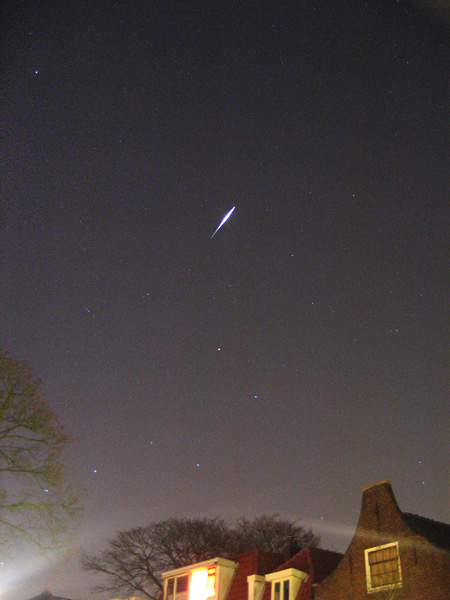
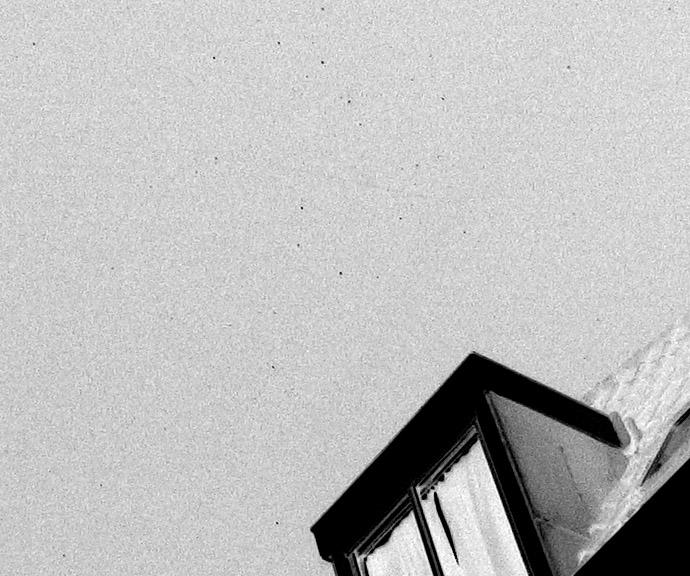
This morning and evening of the 22nd, I managed to catch a number of fine flares again, four of which occurred within a time span of 15 minutes:

- two Iridium flares (-2 and -5, by Iridium 61 and 03 resp.);
- two USA 186 flares (-0.5 and 0), 20:44:33 and 20:45:26 UTC;
- a Lacrosse 4 flare (+1, predicted by Phil Masding), 20:41:54 UTC.

Images are below. The evening ended early when cirrus came in.

The Lacrosse flare was predicted by Philip Masding (just like the Lacrosse flare of yesterday) to within 2 seconds of time exactly.

Flares never bore me, they are always exciting to watch, and even more so when they occur at random and are so nice to do so while the camera is open....

(click images to enlarge)


A timing re-calibration and another flare bonanza

Following the discovery of time discrepancies having crept into my results, I have added a -0.35 second correction as of last evening's results. The results now come much more in-line again.

In order to test this I targeted a number of objects last night, including some Iridium passes. Apart from two Iridium flares, I managed to catch some flares of classifieds again.

Here is Keyhole USA 186 (05-042A) flaring to mag. 0 in the east at 20:21:25 UTC:

(click image to enlarge)


Philip Masding notified me ahead of a possible Lacrosse 4 (00-047A) flare at 21:46:15 UTC: I observed it flaring to mag. +0.5 at 21:46:17 UTC:

(click image to enlarge)


USA 129 (96-072A) flared to -1 at 20:34:30 UT in the sickle of Leo, alas inbetween two images, and in general was bright in the first half of its pass:

(click images to enlarge)


ISS made a nice pass close to Procyon in deep twilight. The wisps of cirrus still present at that time would rapidly dissolve:

(click image to enlarge)

Saturday, 21 April 2007

Timing errors and a mag. -5 IGS 1B flare

After the unexpected METOP-A flare of yesterday evening, I was surprised by another unexpected flare. And what a flare: it concerned the failed Japanese radar satellite IGS 1B (03-009B) flaring at about 21:06:20 UTC to magnitude -5!

It happened after I had taken a photograph of IGS 1B and was in the process of moving my tripod to another corner of the courtyard. I suddenly saw it flaring so brilliantly with a distinct yellowish colour and my jaw dropped. I didn't get the chance to aim and get a shot of it.

I have never seen IGS 1B do this before. Together with the somewhat irregular brightness behaviour in past evening sightings, I think it underlines that it is tumbling out of control.

On a less positive note, I seem to have developed a time lag in my positions lately. They seem to be about 0.35 seconds too late in general. All positions produced from now on will incorporate a 0.35s correction therefore and we'll see whether things get in line again.

The most likely source of the timing error is in the camera (another much less likely option is in the DCF77 signal). Indeed I recently did access my camera with other software than usual, which seems to have done something to my settings.

The timing accuracy keeps being a head-ache and the bottle-neck of the technique I employ, together with the effects of random noise (and the noise suppression routine) in the image.

Yet for now my current equipment is all I can afford, so I'll just have to do with it.

Below is another image of yesterday, showing Keyhole USA 129 (96-072A) crossing at mag. +1 close to the coma cluster (here shown at reduced resolution, so some of the fainter stars are lost).

(click image to enlarge)

Friday, 20 April 2007

Bonus flare of unknown (=Metop-A) with USA 129 (UPDATED)

"Something" just produced a fine mag. -1.5 flare only a few degrees from USA 129. I have not identified the flaring object yet. I could see the two cruise up with each other on roughly parallel tracks, a few degrees apart, USA 129 at +2.5, in Ursa Major. The flarer was leading and produced the flare at 20:12:10 UTC. See image below. The fainter trail is USA 129.

USA 129 itself (I believe) produced a flare of mag. 0 low in the east at about 20:11:00 and remained bright for tens of seconds after that. I catched it still being +1 some 20 seconds later.

More later, including (I hope) the flarer ID after I have measured the image and have dan an ID run with the positions.

Update: the flaring object is identified as Metop-A, 06-044A. With thanks to Russell Eberst and Arnold Barmettler.

(click image to enlarge)

Thursday, 19 April 2007

Flare Galore! And IGS 1B tumbling?

Flare Galore this evening! Three objects were observed flaring: keyholes USA 186 (05-042A), USA 129 (96-072A), and Lacrosse 4 (00-047A).

The USA 186 flare was spectacular, see the image below. It was a complex double flare. First it very slowly flared to mag. -1.5, peaking round about 20:53:00 UTC. When it was still fading from that flare, a second very short flare was seen at about 20:53:11 UTC. This flare terminated very suddenly, the sat becoming faint in an instance.

Below image shows it all. The peak of the first -1.5 flare coincides more or less with start of the exposure and is at down left (movement is from down left to upper right). The second flare can be seen at upper right. It ended very abruptly with the sat going to naked eye near-invisibility almost at an instance. update (19/04/07): the faint trail extension I thought was real, turns out to be an image artifact.

(click images to enlarge)


Shortly after this, USA 129 flared as well, albeit more modest than USA 186 ten minutes earlier. It reached about mag. +1 at 21:03:30 UTC. The image below shows it fading directly after the flare peak.

(click image to enlarge)


The third flare of this night was produced by Lacrosse 4, and predicted to me by Philip Masding. His prediction was for 21:37:34 UTC: it flared at 21:37:37 UTC. It was a modest flare only. The image is below, the brightness modestly peaks in the second part of the trail.

(click image to enlarge)


This evening I finally successfully observed and captured IGS 1B (03-009B), the Japanese radar satellite that recently reportedly failed. It made a shadow exit at 23:52:50 UTC and was of mag. +2 immediately following that. In the next minute it slowly, irregularly but clearly varied in brightness with an amplitude of about 0.5 to 1 magnitude.

This is quite unlike its steady brighness in past years, so it appears that after the power failure its attitude is now out of control and it is tumbling.

In the image below it is fading, shortly after the end of the exposure it shortly gained brightness again.

(click image to enlarge)


In addition to this all I also watched and photographed a fine pass of the International Space Station around 20:32 UTC, and spotted and photographed a bright stray object near 20:51 UTC while waiting for USA 186: I still have to identify this object as I have not measured that image yet.

Monday, 16 April 2007

Flares of Iridium 14, ISS (!), USA 186 and Lacrosse 4

This evening (the 16th) and the evening of the 14th I observed two nice flares of the same Iridium satellite, Iridium 14 (99-032A). On the 14th it flared to mag. -5, and this evening to -6 (top foto), in twilight. Less than a minute earlier Iridium 70 flared at virtually the same position, but less brightly.

(click images to enlarge)


The International Space Station (ISS) made a number of fine bright passes as well the past days. below are two images of April 14 and 15, including a fine mag. -3.5 twilight pass (top image).

(click images to enlarge)


My new neighbours were on the courtyard enjoying the mid-summer like temperatures (+28 C daytime this weekend, very unusual for mid-April) when I was targetting the twilight pass on the 15th. Seeing me put up my tripod, they asked me what I was doing. I explained, and then pointed out the rising ISS to them. At first they didn't believe me, thinking it was an aircraft, but then they realized I had predicted it to appear, so I probably was right. Still, I could see a look in their face that probably meant something like: "A nutter, but not a dangerous one...".

ISS did something unusual during the 2nd evening pass on the 15th. It was low in the west crossing into Gemini at mag. -2 or so, when suddenly (as if a switch was turned) it flared up by at least 1.5 to 2 extra magnitudes, for maybe a second or 2-3, and then back to its previous brightness again. Very conspicuous. I also had the impression of an orange colour but that could be due to the low elevation. Never seen this before with ISS. Time was approximately 21:07:15 UTC (Apr 15).

Lacrosse 4 (00-047A) flared as well that evening, briefly to mag. +0.5. This was either at 23:09:53 or 23:10:03 UTC (there is some confuson with me about the correct time).

05-042A (USA 186) shortly flared to mag. 0 at 19:45:58 UTC on Apr 15. I catched this flare on photograph but it is so short it is almost stellar. I saw it flare again on the 16th at 20:08:27, to mag. -1 and again very short (maybe a second duration).

Strangely enough I again failed to spot IGS 1B (03-009B), the Japanese radar satellite that recently had a power failure, on the 15th. This although this was a zenith pass, with the sat emerging out of eclipse in the zenith. But I could see no trace of it visually and on the photographs. This while previously this satellite would easily be visible, attaining magnitude +1.5 to +2 during high passes.

Especially the 15th resulted in a nice batch of positions on various objects.

Wednesday, 11 April 2007

USA 129: 0.6s early and bright

USA 129 (96-072A) flared again to mag. -1 at about 19:56:50 UTC in the bum of Leo. It was some 0.6s early, so it looks like no manoeuvre yet. On the 9th perigee of the satellite coincided with equator crossing, which is usually the moment KH's manoeuvre.

Below image started some 10 seconds after the flare peak and shows USA 129 still bright, fading from +1 to +2, between Leo's bum and the coma cluster.

(click image to enlarge)

Monday, 9 April 2007

Chasing Keyholes

The past two evenings where very clear again. I spent them chasing Keyholes and Lacrosses.

USA 129 (96-072A) and USA 186 (05-042A) provided some nice flares again. On Saturday the 7th, USA 129 displayed a slow -1 flare at 20:01:00 UTC, and a +2 flare very low in the west during the second pass at 21:38:40. The next evening, its cousin USA 186 flared to mag. 0 at 20:22:30 UTC in pretty much the same local sky area as USA 129 did the previous evening. In both cases they peaked in brightness before my first exposure started, and I catched them fading again (see image below).

I also obtained my first point on the Japanese radar sat IGS 1B (03-009B) since its reported failure. It came out of eclipse just above the rooftops, the trail on the image is still faint and hence I am not too confident in the single position I obtained.

In the next few weeks, moving away from spring equinox, the IGS-es will come higher and higher in the sky. There is a new set of recently launched IGS objects I hope to start tracking besides IGS 1B.

As usual the Lacrosses were covered again too. Lacrosse 5 (05-016A) did its "disappearance trick" again on the 7th at 19:30:17 UTC. The other Lacrosse target was Lacrosse 2 (91-017A).

For yesterday evening, I had USA 129 less than 0.1 s "late", but clearly off-track by 0.08 degree. USA 186 was as much as 0.9s late but on-track. Lacrosse 2 was less than 0.1s "early" and on-track.

The image below shows USA 129 (96-072A) some 15 seconds after a flare peak, still being mag. +2, crossing near the Coma cluster on the 7th.

(click image to enlarge)

Friday, 6 April 2007

Flaring USA 193 and USA 186

The past 3 nights were very clear and transparent, and with the moon gone, this meant good opportunities for observations in the evening.

Yesterday evening I was treated to some nice flares, and observed USA 193 (06-057A) being very bright for the second time.

The bright appearance of USA 193 was again on a west-southwest pass, just like two days ago. In other parts of the local sky, it remains too faint to observe for me. But like my observation of two days ago, it now again reached magnitude +1.5, easily visible to the naked eye (and camera eye).

The bonus was in a sudden bright flare it produced at 19:37:50 UTC. It was a short but bright flare (about 1 second duration) reaching magnitude -1.5 and with a conspicuous yellow-orange colour. This alas happened some 10 seconds after the end of my exposure.

Now I do know it is so bright when appearing in this part of the sky, I'll start to monitor these south-western passes of USA 193 (earlier I had given up after trying to observe several passes in the northern sky in vain).

Keyhole USA 186 (05-016A) was another target of last evening, and it produced two flares, a slow one to mag. -2 at 20:53:40 UTC and a fast one to mag. 0 at 20:54:10 UTC. Again, not while the camera was opene: I did catch the last fading part of the first flare though, the sat still being mag. +2.5 when my camera opened some 5 seconds after the peak of the first flare.

I had USA 193 some 0.6 to 0.7 seconds late and on-track with regard to Ted's latest elset 07094.84492728, and USA 186 some 3.1 to 3.3 seconds early with regard to Mike's elset 07090.85107920 and notably off-track by 0.05 to 0.08 degree.

During the two nights previous to this I obtained a rich haul of positions on USA 129 (96-072A), USA 193 (06-057A), and Lacrosse 2 & 5 (91-017A & 05-016A). Especially the evening of the 3rd was a bounty, with 15 positions gathered.

Below images from last evening show USA 193 traversing Gemini at mag. +1.5, and USA 186 fading from it's first flare.

(click images to enlarge)


Tuesday, 3 April 2007

My first USA 193 (06-057A) observation

I just observed the (reportedly failed) spysat USA 193 (06-057A) for the first time. Usually it stays too faint for me, but this time it was very bright, about mag. +1, just before eclipse entry, crossing Gemini. It was moving fast, a very fine sight. Below is the image I obtained.

Full report on the other observations of this fine evening later.

(click image to enlarge)

Monday, 2 April 2007

More KH flare fun

Observing a flare as a bonus to position determinations keeps being the icing on the cake for me. Last night Keyhole USA 186 (05-042A), the real one this time ;-) , did it again. I flared to magnitude -1 in the zenith at 21:01:10 UTC.

My camera opened about 10 seconds later, when the satellite was already well past the flare maximum. It is still of about mag. +2 at the start of the trail on the image, but fades to invisibility during the exposure.

Other targets imaged last night were the SAR satellites Lacrosse 5 (during two passes) and Lacrosse 2.

Lacrosse 2 (91-017A) was 2.3s early. Lacrosse 5 (05-016A) 0.4s late. USA 186 was on-time.

I am eagerly awaiting the opening of the springtime visibility window of the Japanese radar satellite IGS 1B (03-009B). After several years of operation this satellite recently reportedly failed in orbit. While operational its orbit was tightly controlled by almost daily small orbit manoeuvres keeping it very steady. It is interesting to see whether that level of control is now dropped (early results by other trackers indeed suggest such).

Wednesday, 28 March 2007

Another case of identity confusement

It must be in the air or something, but yesterday evening I again mixed up two satellites, and again it involved USA 186.

This time, I observed a magnitude zero flare in the zenith at 20:35:10 UTC and mistakenly reported it to the Seesat list as being a flare of USA 186 (05-042A).

In reality, it was another Keyhole, USA 129 (96-072A). USA 186 would pass 10 minutes later along a similar track...

It shows up on two images (both taken after the flare) and yielded 4 positions, the last of which is probably in error.

I also covered two passes of Lacrosse 5 (05-016A). The first pass was a twilight pass and Lacrosse 5 remained "hidden" most of that pass, except for a brief period of maybe 30 seconds after 19:14:10 UTC, when it suddenly appeared just east of Polaris at about mag. +2.5. Lutz reported it was gone again by 19:14:47 UTC.

The second pass saw no disappearance event. Lacrosse 5 was bright and steady, and four photographs yielded 8 positions.

With regard to the night previous to this, I can add a few things. First the confusion between Keyhole USA 186 and the weathersatellite NOAA 14 when the latter was producing a brilliant flare. As can be seen from the following diagram, the two were indeed cruising up very closely at that time, hence why they were so easily confused. At the time of the bright flare which I captured on photograph, they were only 8 degrees apart in azimuth and 0.2 degrees in elevation.

(click diagram to enlarge)


In addition, I can also report that I obtained positions on USA 129 and Lacrosse 5 that night.

Monday, 26 March 2007

Of brilliant flares, and confusion... (UPDATED & CORRECTED)

UPDATED & CORRECTED

In the original version of this post, I wrote:

A quick post about the two nice flares by Keyhole USA 186 (05-042A)I just observed. The first occurred in the zenith at 20:23:25 UTC just after the end of my first exposure. It reached mag. 0. A second bright slow flare reaching magnitude -1 happened at 20:24:15 UTC and this time the camera was open. The very fine result can be seen below.
Well, forget that. And shamefaced here. When measuring the images, the delta T came out several seconds errative, and the cross-track error in position some 3-4 degrees.....and I don't make such mistakes, so the only option was that it must be another object...

Hence it was not USA 186 flaring. In fact, an ID run with IDSat and a full satellite catalogue identified the flaring object as NOAA 14 (94-089A, #23455), a weather satellite.

They were cruising up together only a few degrees apart, hence the misidentification. USA 186 is known to produce flares, so when I saw a satellite flaring up near the USA 186 position I assumed it was USA 186....in error.

More results on this night will be posted later in a second post.

(click image to enlarge)

Friday, 23 March 2007

A Lacrosse 5 Disappearance and Re-appearance

Yesterday evening at about 20:20 UTC I saw Lacrosse 5 (05-016A) do its "disappearance trick" again: this time however followed by a re-appearance about half a minute later.

Disappearance - I observed it being very bright (mag. 0) while ascending in the sky. Just when I was aiming my camera and about to trigger it, it disappeared in a few seconds time. Completely out of naked-eye range. This was at about 20:19:30 UTC, but this time can be somewhat off for reasons stated below.

Re-appearance - At 20:19:50 ± 5 seconds UTC (I am more certain of this time) it re-appeared again in a few seconds time, close to Capella, attaining a brightness of magnitude +1. From that moment on it was steady, gradually fading to mag. +2, crossing the Big Dipper and Draco untill I lost it behind the building.

The photograph below was taken within half a minute of it re-appearing again and shows that it was very bright again.

The observation was a bit chaotic because my neighbour started a chat with me and I was explaining my observations to her when Lacrosse 5 disappeared (hence why the time of that event did not entirely stuck in my memory). Moreover her cat tried to hug my tripod, so I gently had to scoop the animal away.

I also catched USA 129 (96-072A) and USA 186 (05-042A) last evening, but the trails were very faint and I could not get unambiguous positions from them.

I also have a late report to make on the evening of March 14th, when I gathered a total of 6 positions on Lacrosses 2 & 3.

(click image to enlarge)

Monday, 12 March 2007

Lacrosse 2 running early

Lacrosse 2 (91-017A), the oldest in the Lacrosse (Onyx) SAR-satellite series still in orbit, is running increasingly early. Yesterday evening it already was over 7 seconds early and clearly off-track relative to a 4 day old elset. Is it going down for a de-orbit?

Yesterday evening saw very clear skies. I gathered a nice batch of data: two images (4 positions) on Lacrosse 2 (91-017A), two images (4 positions) on Lacrosse 3 (97-064A), and three images (6 positions) on USA 129 (96-072A). Plus in addition to this, I catched a stray in one of the Lacrosse 3 images, which turned out to be a 22-year-old Russian rocket booster, Kosmos 1689 Rk (85-090B, #16111).

Below is one of the three images I shot of USA 129.

This evening I skipped tracking activities. I am not feeling well and decided to take some rest instead.


(click image to enlarge)

Saturday, 10 March 2007

Flaring Keyhole USA 129

There was cirrus in the sky in daytime, persisting after sunset. Only after 9 pm local time, the sky had cleared enough from haze to attempt photography. This left only one target, USA 129 (96-072A, #24680), a Keyhole imaging satellite.

It made a zenith-pass near 20:21 UTC during which it put on a spectacular show.

As it cleared the edge of the roof and came into my view in the zenith, it was very bright and clearly flaring. It must have been around mag. 0 to -1, peaking near or before 20:21:20 UTC. When my camera opened it was already past peak brightness for several seconds but still bright, gradualy fading. The image is below.

Obtained two positions from the image. My timings suggest it was 1.15s early with regard to elset 07066.85705303

(click image to enlarge)

A Keyhole and two Lacrosses

Another clear evening last night. I managed to catch one KH and two Lacrosses.

The KH was USA 129 (96-072A). It appears as two rather faint trails on two images: the starting point on the first trail is behind the building. I have it running 0.7s early relative to a 2-day-old elset. I obtained 3 positions

Lacrosse 2 (91-017A) was as much as 1.5s early and 0.1 degree off in cross-track relative to a similar aged elset. I obtained 3 positions.

Lacrosse 3 (97-064A) by contrast was pretty much on-time and on-track. It made a nice bright trail. It briefly and modestly flared up to maybe +1.5 at about 19:49:45 UTC, just before shadow entry. I obtained 2 positions.

Thursday, 8 March 2007

Clear skies at last!

After a month of being clouded out, clear skies at last this evening! I targetted two Lacrosse satellites: Lacrosse 2 (91-017A) and Lacrosse 3 (97-064A). An attempt was also made to capture USA 129, but it was too faint for the camera.

Both Lacrosse satellites made a nice pass, reaching about mag. +2.5. Lacrosse 3 (97-064A) was on-time and on-track. Lacrosse 2 (91-17A) however, was some 0.2s late and 0.1 degree off-track. The photograph (see below) shows that it slowly brightened about midway in the exposure. I dare not call it a flare however, as it is rather marginal.

On below image of the Lacrosse 2 trail: Castor and Pollux at left, alpha Auriga at right. The sat moves from bottom to top.

(click image to enlarge)

Saturday, 3 March 2007

GRRRRR!!!!!

Yesterday we were having steel blue skies in the afternoon. So I reckoned that perhaps that evening I would get a chance to see sats again, as the past 3-4 weeks were grey and cloudy.

But nope. Heavy cirrus cover wandered in at dusk. I tried to shoot a Lacrosse 3 pass, saw it visually but the image is too fogged.

Meanwhile, the crocuses in the garden have withered. Their place have been taken by the small bright blue-purple flowers of the lesser Periwinkle. The image below was shot by me last Wednesday. Due to the strange weather, flowers etc. are about 1 month early in schedule this year.

(click image to enlarge)

Wednesday, 28 February 2007

Clouded skies, first signs of Spring

The skies again have been (and are) clouded again for a long time here. So I have little in term of observations to report lately. I do hope the conditions improve soon.

This anyway is a strange winter so far. It is the warmest on record since the start of measurements in AD 1706. So far, I measured only two days with the minimum temperature below zero degrees C on the station.

As a result, shrubs and plants are flowering already. Especially the crocuses have been flowering in abundance the past two weeks. Below are two photographs I shot with the Canon Digital Ixus 400 (the same camera used for the satellite imagery). The top one is from last Friday (shot in a small forest nearby), the other one a week earlier. The latter are crocuses in the courtyard of SatTrackCam.


(click images to enlarge)


Tuesday, 6 February 2007

Current situation

It is back to clouded here. I could not take advantage of the very clear days last weekend, as satellite passes high enough for my location and bright enough were all morning passes. Due to the return of severe insomnia problems, I am back on a 1 week cure of sleeping medication currently, which means it is not a good idea to set the alarm-clock for early in the morning as my docter wants me to sleep at that time.

I did take advantage in the daytime however, by going through the city with my camera. You can see some of these recent photographs of scenic Leiden (single shots as well as composed panorama's) here.

If you hover your mouse over a picture thumbnail before clicking it to view it, the tag on the location where it was taken will highlight on the Leiden map on the page.

Friday, 26 January 2007

More Lacrosse 5, and an old-timer (Kosmos 624) showing up

Having bouts of insomnia is not fun, as it is very tiring. yet the good thing about it, is that it promotes satellite observations.

I was awake very early in the morning yesterday (Jan 25th) after managing only a few hours of sleep. At 5:30 am local time I decided to make something good out of something bad, by checking whether there were any satellite passes to observe. It turned out Lacrosse 3 (97-064A, #25017) made a nice zenith pass, emerging out of eclipse just south of the Big Dipper. So I observed and imaged it.

It was a very dark and transparent, cold night (-0.7 C, the first night with true frost at Cospar 4353 this winter, ridiculously late). Lacrosse 3 was bright, magnitude +2, and I obtained 2 images (hence 4 positions).

As an unanticipated extra, there was a faint second trail on the first image. It was clearly shorter than the Lacrosse trail, so at first I was in some doubt whether it was a satellite at all and not for example a meteor.

I could subsequently positively ID it however as Kosmos 624 (73-104H, # 06992) an old 1973 Soviet Strela-1M communications satellite. Amazing as it "should" have been mag. +7 only (instead it was something like mag. +4, judging from the trail. I did not see it visually)!

The reason the trail was so short, is that its orbit is higher than that of my usual targets: it was at over 1500 km altitude at the time of observation. It must also be the smallest object I imaged so far, as its RCS is only 0.8 m^2.

In the evening I made a second observing run, imaging Lacrosse 5 (05-016A) and Lacrosse 4 (00-047A). Like the previous nights, Lacrosse 5 performed its "disappearance trick" again, this time at 17:23:23 UTC. Before that time is already was somewhat variable, alternating between mag. +1 and +2.5. The observation was done in a blue twilight sky. Upcoming cirrus and a nearby moon prevented me from observing a later second pass of the satellite.

(click images to enlarge)


Successful simultanious observations of Lacrosse 5 "disappearance"!

On January 22 and 24, Philip Masding in the UK and me in the Netherlands managed to observe and time two Lacrosse 5 (05-016A) "disappearances" simultaniously. Phil obtained some marvelous lightcurves showing the brightness behaviour of the satellite during these passes.

Interestingly, the clocked times of disappearance are similar for Phil's location in the UK near Manchester (53.4 N, 2.4 W) and for me in Leiden, the Netherlands (52.2 N, 4.5 E), 485 km to the East of Phil.

Table with 05-016A "disappearance events" on-line

For anyone interested in having a go at modelling the enigmatic "disappearance" events of Lacrosse 5 (05-016A): in addition to the list maintained by Philip Masding at his website, I have posted my own timings of such disappearance event over the past year at:

http://home.wanadoo.nl/marco.langbroek/L5d_4353.txt

The list on that URL ( a link to it is in the right-hand sidebar of this blog too) will be updated whenever I time a new event of this type.

Wednesday, 24 January 2007

Another Iridium flare, Lacrosse 4 and another Lacrosse 5 "disappearance"

This evening another Iridium flare was predicted for my location. Iridium 76 (98-048B, #25432) was predicted to flare to mag. -4.8 at 18:16:41.7 UTC at virtually the same sky location as yesterdays Iridium 03 flare.

The flare was very fine again. A field of clouds passing by added a dramatic touch to the scene, as can be seen in the photograph below.

(click image to enlarge)


A quarter of an hour earlier, I observed and photographed a fine pass of Lacrosse 4 (00-047A, #26473). It passed close to the Pleiades cluster again, making for a scenic picture (see below). I obtained two images, hence 4 points. Lacrosse 4 was some 0.35s late.

(click image to enlarge)


A minute after the Iridium 76 flare, I switched my attention to Lacrosse 5 (05-016A, #28646). It was bright as it climbed from Cygnus through Andromeda to Cassiopeia. Just before my camera opened for the first exposure, it however did its "disappearance trick" again, this time at 18:18:18 UTC (ugh, if you are nutty enough to believe in numerology (which I don't) that is a Devilish time to do trics for a clandestine sat....6+6+6:6+6+6:6+6+6 !).

Odds of a mag. -7.5 Iridium flare, and twice Lacrosse 5 its tricks

Another clear (and cold) evening, although clouds began to appear at 19h UTC. Positions were obtained on Lacrosse 5 (05-016A, #28646) and Lacrosse 4 (00-047A, #26473), as well as Iridium 03 (98-048A, #25431).

Highlight of the evening was a splendid magnitude -7.5 flare by Iridium 03 at an altitude of 44 degrees and azimuth 28 degrees (north-northeast) at 18:22:50.8 UTC.

(click image to enlarge)
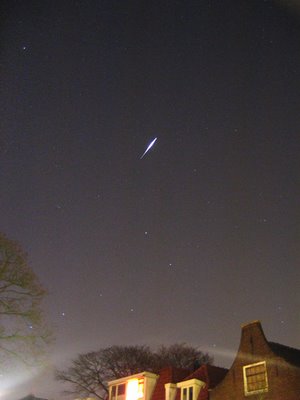

The image above was shot from the street in front of the almshouse complex (it was just too low in the sky to be visible from the courtyard of the complex) with a 10.7s exposure between 18:22:47.1-18:22:57.8 UTC. The flare had a predicted brightness of mag. -7.5, and indeed must have been in that order. The center of the flare path was 4.8 km West of me (while the Iridium satellite was over Denmark, at 785 km altitude and a range of 1069 km north-northwest of me).

Chance had it that the people from Grimbergen observatory in Belgium (Philippe Mollet et al.) located 135.9 km south of my location, observed the same flare from the same Iridium. While I had the center of the flarepath at 4.8 km West of me at 18:22:50.8 UTC, they had the center of the flare path at 4.6 km East of them at 18:22:28.9 UTC. So the geometries were virtually the same (with a predicted brightness of mag. -7.7 for Grimbergen, versus -7.5 for me), they having the flare maximum 20.9s earlier in time than me. What a coincidence!

I observed one pass of Lacrosse 4 (two good images, yielding 4 positions), and two of Lacrosse 5 (3 images, half of the points dropped because of too faint trail ends, hence 3 positions).

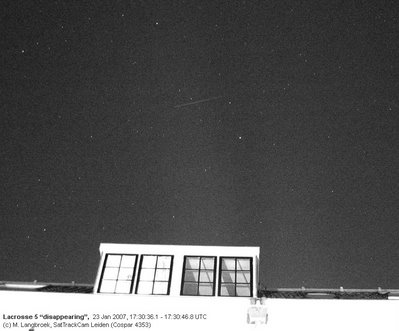
Lacrosse 5 (05-016A, #28646) did its "disappearance trick"again at both passes. During the first pass it did it at 17:30:44 UTC, while the camera was open for its second exposure, resulting in the image below. The true end of the trail at the end of the exposure should be at the right of the star near the trail end: it is at the left in the image, as the satellite dropped below the imaging treshold in brightness before the end of the exposure. The drop was rather fast.

(click image to enlarge)

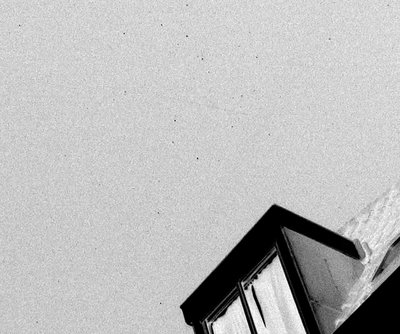
A few tens of seconds after it, I could see the satellite as a very faint object (mag. +4 to +4.5) with the naked eye (before the drop in brightness it had been +2). A third image exposed between 17:31:46.1-17:31:56.8 UTC shows a very faint trail after some image manipulation (see below)

(click image to enlarge)

Lacrosse 5 did the same trick again during a second pass. This time it disappeared some 5 seconds before my camera opened, at 19:13:15 UTC.

Monday, 22 January 2007

Lacrosse 5 tricks again, and Lacrosse 4 cruising near the Pleiades

Another clear (and cold) evening. I observed the radar birds Lacrosse 5 (05-016A) and Lacrosse 4 (00-047A) within a minute of each other (making the imaging quite hectic, having to swap the camera to a different part of the sky within a few tens of seconds).

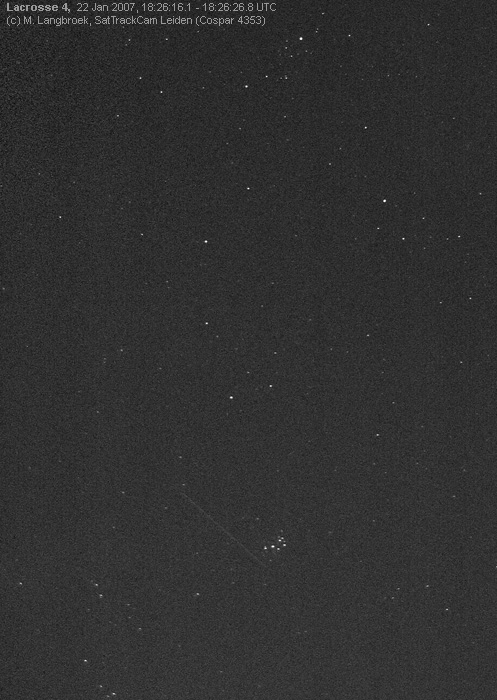
I obtained two images (hence 4 positions) on Lacrosse 4, the first one of which captured the sat cruising at a steady mag. +3 close to the Pleiades cluster (image below):

(click image to enlarge)


A minute earlier I had captured Lacrosse 5 in the act of doing its infamous "disappearance trick" again. The image below shows it fading rapidly, in fact the apparent trail end on the image predates the end of the exposure. Visually, I timed the disappearance at about 18:25:30 (+/- 2s) UTC.

(click image to enlarge)


I dropped the second point on Lacrosse 5 as it probably does not represent the position at the end of the exposure, but rather the point where it became too faint for the camera. The first points suggest it was perhaps some 0.15s late and on-track.

Lacrosse 4 was perhaps some 0.2s late (delta T's vary a bit between 0.05s and 0.30s) and somewhat off-track (about 0.05 degree).

Sunday, 21 January 2007

Its flaring time again...! (updated)

Drifting fields of clouds made observing a gamble this evening. In between the cloud fields however, it was marvellously clear again.

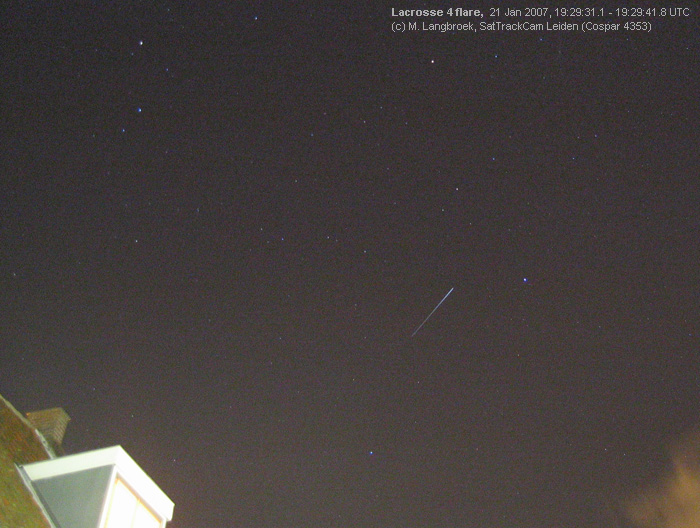
I had the fortune to observe and photograph another very nice flare of Lacrosse 4 (00-047A, #26473), again just before eclipse entry. It briefly flared to mag. 0 at 19:29:41 +/- 2s UTC, near the Andromeda-Pegasus border. The decline in brightness after the flare was very rapid, unlike the rise to it, perhaps due to the eclipse entry (predicted for 19:29:53 UTC).

(click image to enlarge)


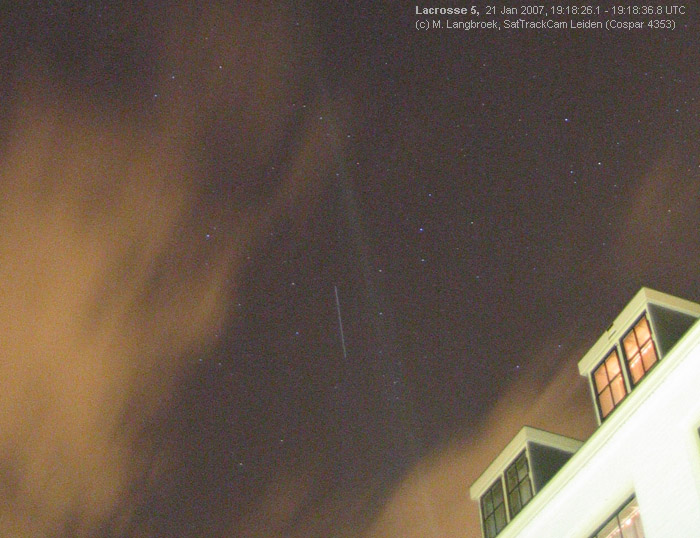
I lost the first pass of Lacrosse 5 (05-016A, #28646) at 17:35 UTC to an untimely pass of a field of clouds (3 minutes after the pass, it was completely clear again...). The same almost happened to the second pass at 19:19 UTC. I did capture it on one image through a hole in the cloud cover though (see below). In fact the second image shows it too, through the cloud cover...but is useless of course for position determinations.

(click image to enlarge)
note: times should read 19:18:36.1 -19:18:46.8 UTC


Update: Like yesterday, 00-047A was 0.8s late, 0.05 degree off-track.
05-016A was exactly on-time and on-track: it doesn't happen every day that you get such results:

STAT__YYday HH:MM:SS.sss___XTRK____deltaT___Perr
4353__07 21 19:18:36.100___0.00____0.00_____0.003
4353__07 21 19:18:46.800__-0.00____0.00_____0.005

Saturday, 20 January 2007

A Lacrosse 4 flare, and a Lacrosse 5 "disappearance trick"

This evening was a very clear evening. The storms of the past days (there was another one last night, and there is yet another one predicted for tonight) have blown the atmosphere very transparent. It was a bit windy and chilly, but observing conditions were perfect otherwise.


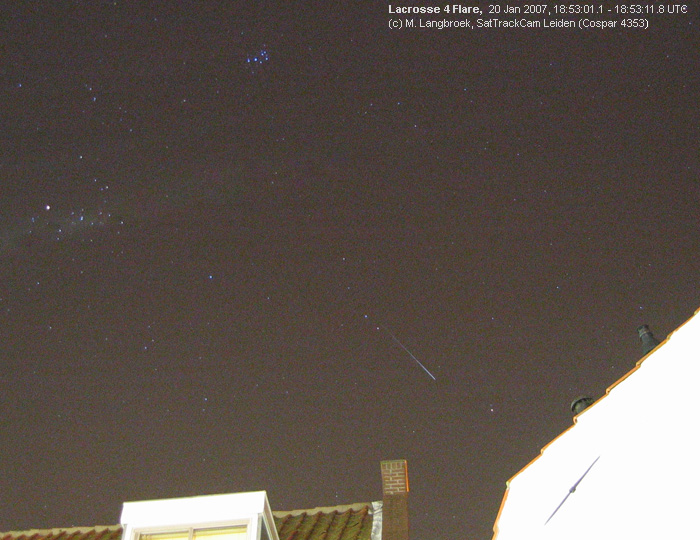
(click image to enlarge)

Highlight of the evening was a fine short and bright magnitude +0.5 flare by Lacrosse 4 (00-047A, # 26473) at 18:53:00 +/- 1s UTC, just before it entered into eclipse in Taurus.

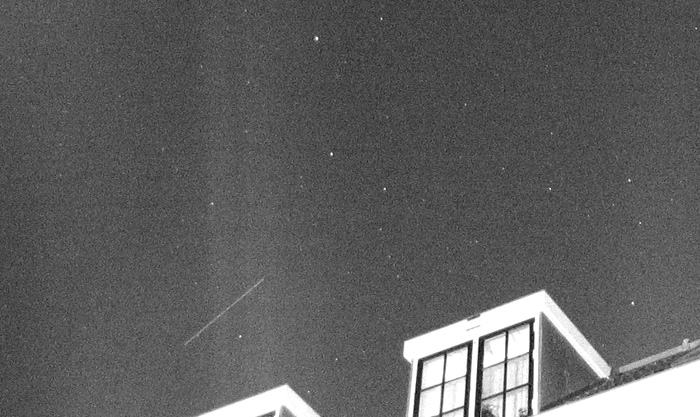
Earlier that evening, Lacrosse 5 (05-016A, #28646) did the opposite: it did its "disappearance trick" again at 18:31:27 +/- 2 s UTC, some 1.5 minutes before eclipse entry. The camera was open while it happened: the first of below two pictures, where it is already much fainter than before and disappears. The second picture below was taken a minute before the first, and shows just how bright Lacrosse 5 was at that time (about mag. +1.5).

After it disappeared, it did not re-appear visually (naked eye) or photographically.

Update: Lacrosse 4 (00-047A) was about 0.8s late relative to a two week old elset. Lacrosse 5 was on-time.
After image enhancement in Photoshop, the third image does show Lacrosse 5 as well, but barely. It must have been mag. +4 or fainter.
Bruce MacDonald from the UK reports he observed Lacrosse 5 "disappearing"as well on seesat.


(click images to enlarge)

Friday, 19 January 2007

Storm over Cospar 4353


A Gale-force storm has been raging in our country yesterday, killing 6 people and bringing all train traffic to a halt. At 11:03 am the first roofing tiles came down here at Cospar 4353. The peak in wind-force was at about 7-8 pm. In Zeeland province, wind speeds of 133 km/h were recorded.

The closest distance to the center of the storm depression for Cospar 4353 was at about 15:30 CET (14:30 UTC), as can be deduced from the above barogram obtained by my courtyard weather-station.

The sky was clear during twilight, but this was also the peak of the storm. A roofing tile had already come down some 2.5 yards from where I normally put my tripod, so I did not dare to risk my head and camera to other plunging roofing tiles. Moreover, the tripod would have blown over I think.

Monday, 15 January 2007

Again Lacrosse 5, and a comet observation in daylight!

A poor evening after a nice day. Alas, late in the afternoon and in the early evening cirrus moved in. This after it had been nice and clear blue skies earlier, allowing a rare view of a daylight comet!

At 14:35 local time (CET) during the clear part of the day, I managed (with difficulty, but certainty) to observe comet C/2006 P1 McNaught with the unaided naked eye in daylight, close to the sun! It was a tiny smudge at a 7-8 o' clock position relative to the sun. Not easy, but once located unmistakable. The sun was covered from direct vision.

Due to the cirrus that came in later today, Lacrosse 5 (05-016A) was the only one of three sats (Lacrosse 2, Lacrosse 5 and USA 193) I tried this evening that was captured. The first point on Lacrosse 5 might be a bit iffy, the second is good I think. delta T is similar to yesterday (+0.2s).

Shortly after this exposure, Lacrosse 5 "disappeared" again. This happened between 17:56:00 and 17:56:30 UTC (I did not see it disappear as I was handling the camera, but when I looked up again after triggering the 2nd image it was gone visually, and it is not visible on the 2nd image either).

Sunday, 14 January 2007

Failed Lacrosse flare

Phillip Masding predicted a potential flare by Lacrosse 5 (05-016A, #28646) for my location for 17:06:59 UTC this evening. This was to be in late twilight, and at a favourable sky elevation of 70 degrees (almost in the zenith).

Streaks of cirrus occupied the sky at that time. About 1 minute before Lacrosse 5, I observed Lacrosse 2 (91-017A, #21147) pass through the zenith at a bright mag. +2. A minute later Lacrosse 5 however turned out to be very faint, mag. +3.5 or fainter. It did not flare, and the trail on the photographic image is very marginal. I only used one position of it, as the other one came out as an obvious anomaly.

Lacrosse 2 is visible in the same image, but in a streak of cirrus, and hence very marginal. I did not get usable positions on it.

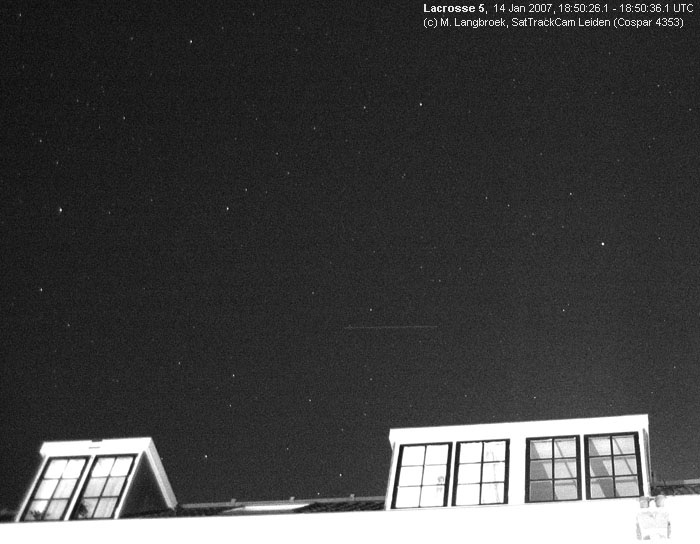
During the next pass of Lacrosse 5, at 18:50 UTC and 48 degree maximum sky elevation due North, it was brighter (about mag. +2.5) . It easily registered on the photographic image (see below), and added two positions.

The three positions obtained on Lacrosse 5 in total suggest it was on-track, and about 0.2s late relative to a 4-day-old elset.


(click image to enlarge)

Thursday, 11 January 2007

Lacrosse 5 flare, and comet C/2006 P1 McNaught

The weather persistently has been very bad since 1 January. Today was the first day I have seen a satellite again.

This evening I observed Lacrosse 5 (05-016A) in a clear sky and saw it briefly flare from mag. +2 to mag. +0.5 during about 2-3 seconds at 18:08:27 ± 5 s UTC.
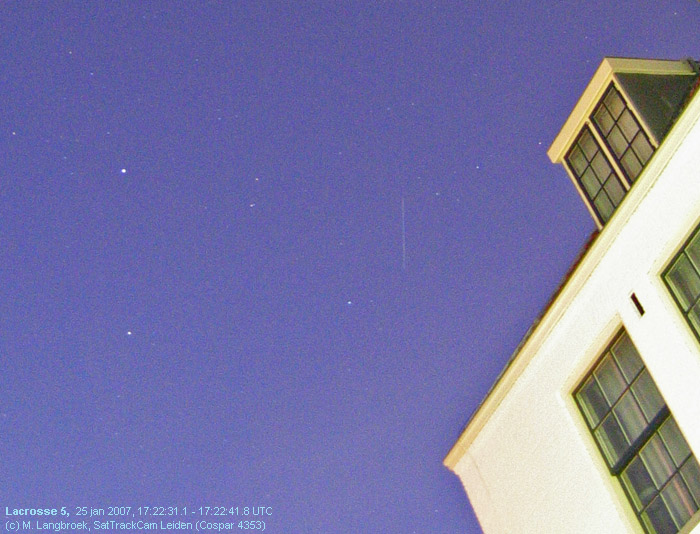
But allas I have no positions to report. When the camera tried to write the first image to the CF card, a writing error occurred and the image data got corrupted. I had to restart the camera, made a mistake in the settings (forgot the 10 second self-timer), so lost a second imaging opportunity, and then the sat disappeared behind the roof.

Al this while it was very windy. An hour earlier, windforce shortly reached storm values.

Earlier this evening (from another location), during this stormy phase, I caught a glimpse of comet C/2006 P1 McNaught, in deep twilight a few degrees above the horizon. Not very spectacular under these conditions but at least I have seen it. I even could see a short tail by the naked eye.

Monday, 1 January 2007

A good start of the new year!

The first evening of 2007 was very clear. Hopefully this sets the trend for 2007!

It was quite windy, and observations were done in twilight and with a near-full moon above the horizon. As a result, the images are quite fogged out.

Targets were Lacrosse 3 (97-064A, #25017) and the International Space Station (see image below)

97-064A did not show up well on the images: faint trails which almost drowned in the background fog. It was about mag. +3. I dropped one point from the second image obtained, as it was obviously in error. Hence 3 positions were left. 97-064A was some 0.5s late relative to a 3 day old elset.

ISS (98-067A) made a nice pass culminating at 40 degrees elevation. I picked it up low in the west, it was mag. -1 throughout the pass (I could not see its low eastern trajectory part though). Around culmination and after it it was a bit orange again. Positions were obtained for calibration purposes. Below is the first of the two images of ISS I took: it is still low in the West here:

(click image to enlarge)

Sunday, 24 December 2006

Lacrosse 3 & Lacrosse 5 Rk in hazy skies

A late report on observations from December 18. The grant committee hearing last Thursday took too much of my time and energy to report earlier to this log.

This were the first observations being back on-line and tracking with a new laptop ("Elvis") after a fatal crash of my old laptop ("HAL") the 12th. Conditions were poor: hazy. No pretty pictures this time...

I observed Lacrosse 3 and the Lacrosse 5 Rocket (05-016B). The Lacrosse 3 (97-064A) was trail very marginal on the image. I dropped a second trail image on 97-064A obtained during its next pass as it was even more marginal. My two points on the first trail come out a few tenths of seconds different from those of other observations around this time.

By contrast, the Lacrosse 5 Rocket (05-016B) trail was of good quality and agreed well with other observations obtained around that time. 05-016B was 4.6s early and 0.11 degrees off-track with regard to an 8 day old elset; 97-064A some 0.9s early and on-track with regard to similar aged elset.

A female neighbour came by for a chat when seeing me photograph and watched 05-016B passing over Polaris with me.

Friday, 15 December 2006

SatTrackCam temporarily down

SatTrackCam has been temporarily down the past week and will be for a few more days. The reason is that my old faithful lap-top HAL died last Tuesday.

I have a new lap-top since late this afternoon. I need a few more days however to configure it, re-install software etcetera. Moreover, I have to be at a committee hearing of our National Science Foundation coming Friday in connection to my Post-Doc proposal and have to prepare for that. So I think it will not be before Christmas before I am fully up and running again.

Sunday, 10 December 2006

Lacrosse 2 & Lacrosse 5 Rocket in hazy skies

Unlike the clear skies of this morning (see previous post), it was quite hazy this evening. Images were considerably fogged as a result - no pretty pictures.

Targets were Lacrosse 2 (91-017A, #211147) and the Lacrosse 5 Rocket stage (05-016b, #28647). Got two images on each object. The trail of 91-017A on the first image was very marginal. 05-016B was nice and bright, I saw it go into eclips near the end of the last exposure. Both objects crossed Pegasus and then Andromeda/Aries, 20 minutes apart in time.

05-016B was some 6.4 to 6.5s early and some 0.15 degree off-track relative to 6 day old elset 06339.03434948. 91-017A was nicely on-time and on-track.