Showing posts with label Zuma. Show all posts

Sunday, 22 April 2018

OTV 5 or Zuma? A brief explanation why this object is OTV 5 and not Zuma

click image to enlarge

The image above shows the US Air Force's "secret" X-37B space plane OTV 5 ascending in the western sky (the two bright stars above the roof are Castor and Pollux), in the evening of 21 April 2018.

I was asked the question: "how do we know this is OTV 5? Why can't it be Zuma?". I will explain here why it is definitely OTV 5 and definitely not Zuma.

The key is in the orientation of the orbital plane. Both OTV 5 and Zuma were launched from Cape Canaveral into a northwest direction, towards azimuth 40-50 degrees (see map with launch hazard zones below). That direction establishes the orbital plane the objects were launched into.

click to enlarge

From our tracking of the OTV 5 candidate the past 10 days, we have the orbital plane this object is moving in. We can project that orbital plane back to the launch dates of both OTV 5 and Zuma.

For the launch date and launch time, it should pass over the launch site, with a correct orientation in terms of direction. That means, in this case: it should pass over Cape Canaveral, into a northeastern direction.

Now let us first do that for OTV 5, which was launched by SpaceX from Cape Canaveral pad 39A on 7 Sept 2017 at 14:00 UT. The 3D plot below shows the orbital plane of the object we track projected backwards, for the moment of OTV 5 orbit insertion (7 Sep 2017, ~14:09 UT):

click to enlarge

As can be clearly seen, the orbital plane we established for the object we have been tracking the past few days, for this date and time lines up with the launch site, and it is oriented into the correct direction (southwest to northeast). This strongly indicates that the object we track is from the OTV 5 launch.

If we do the same for the Zuma launch, we do not get a good match. Zuma was launched by SpaceX on 8 Jan 2018 at 01:00 UT from Cape Canaveral pad 40. The 3D plot below shows the orbital plane of the object we track projected backwards, for the moment of Zuma's orbit insertion (8 Jan 2018, ~01:09 UT):


click to enlarge

As we can see, the orbital plane we established for the object we have been tracking the past few days, for this date and time does not line up with the launch site, and it is moreover oriented into the wrong direction too (northwest to southeast instead of southwest to northeast: a 90-degree angle!). This strongly indicates that the object we track is not from the Zuma launch.

(As avid readers of this blog know, Zuma presumably failed to detach from the Falcon 9 upper stage due to a faulty adapter provided by the satellite's builder Northrop Grumman, and reentered with the upper stage a few hours after its launch).

So the object's orbital plane lines up with a launch from Cape Canaveral on 7 Sept 2017 and orbit insertion at 14:09 UT, the launch date of OTV 5. Ad to this the very low orbit which was also typical for past OTV missions, and it is very clear that the object we are currently tracking is the X-37B mission OTV 5.

Below is a video of OTV 5 which I shot yesterday evening, 21 April 2018:


Saturday, 21 April 2018

Imaging the X-37B Space Plane OTV 5 post-manoeuvre

click image to enlarge

The image above shows the secretive X-37B Space Plane OTV 5, a robottic mini space shuttle flown by the US Air Force, over my house in Leiden, cruising through Leo (the bright star above the chimney is Regulus). It was a bright, easy naked eye object with a brightness of magnitude +1.

In a previous post I detailed how (and why), following the launch in September 2017, we had a hard time tracking down the whereabouts of this fifth OTV mission. Untill Cees Bassa located it on April 11th, in a 54.4 degree inclined orbit. It is the first OTV mission bringing it to the latitudes of the Netherlands.

Clouded weather in the Dutch coastal region after Cees' recovery prevented me from seeing it untill yesterday. During the past week, OTV 5 moved from morning passes to evening passes. Weather improved too medio last week, but still OTV 5 initially escaped me. Because it manoeuvered!

On April 18th, a week after it was first located in orbit, OTV 5 made a manoeuvre. It was a no-show for several observers, including me, on the 19th, but two observers, Tristan Cools in Belgium and Marian Sabo in Slovakia, reported an "unidentified" object some 8 minutes earlier (which means it passed while I was setting up my camera on the 19th). Based on Tristan's photograph of that object, a post-manoeuvre orbit was guessed by Mike McCants as well as by me. Yesterday evening on the 20th, we were ready to look for it, and we did recover OTV 5, a few minutes in front of the estimated new orbit.

The new orbit is still preliminary, but it seems as if the orbit has been lowered from a ~355 km circular orbit to a 307 x  320 km orbit. In a few days, when we have more observations, we'll know more about the new orbit, and when the manoeuvre exactly happened.

The video below which I shot yesterday evening shows OTV 5 cruising through the Coma Berenice cluster:


This was my very first observation of an X-37B! Very cool to see this enigmatic object pass in my own sky. Given that previous OTV missions frequently manoeuvered, it will be an interesting object to follow.

All kinds of nefarious motives and purported specific targets have been ascribed to the X-37B program by the aluminium hat brigade, but the reality probably is that the X-37B is an experimental test-bed for new space technologies, testing these under real space conditions and at various thermospheric regimes, over a prolonged time period, before retrieving them.

I do find it interesting though that this new OTV mission is in a 54.4 degree inclined orbit, rather than the previous 38-43 degree inclined orbits (see comparison in my previous post). Over the past year we have now seen three experimental missions going (or planned to go) into 50-55 degree inclined orbits: USA 276; the failed Zuma; and OTV 5. All three are clearly experimental missions. For Zuma, I suspect it was meant as an experimental radar satellite, and maybe OTV 5 tests radar as well. Or maybe not.

At any rate, I welcome this new attention to ~50-55 degrees inclination, as objects in such orbits are well observable from my 52-degree latitude in the Netherlands.

Thursday, 11 January 2018

[Updated] A potential use for satellites in Zuma-like 50-degree inclined orbits


SpaceX's launch of the Zuma satellite on 8 January was interesting, and not just because of the ongoing saga of whether it failed or not (see a previous post).  

The odd 50-degree orbital inclination is another element that made this launch interesting (see discussion in my pre-launch post here: sightings of the Falcon 9 Upper Stage over Sudan after launch later confirmed this orbital inclination).

New ideas started to form post-launch after the Falcon 9 sightings from Sudan made me realize that while it indeed was launched into a 50-degree inclined orbit, the orbital altitude (900-1000 km apogee) was higher than I initially expected, making a proposed link to USA 276 unlikely.

And then @Cosmic_Penguin posted this small message thread on Twitter, referencing this interesting publication. That struck a chord and reinforced an emerging idea about a potential role for satellites in such 50-degree inclined, ~1000 km altitude orbits.

As @Cosmic_Penguin notes, the publication specifically discusses ~50-60 degree inclined, ~1000 km altitude orbits. And it is all about Space-based Radar.


I had just been looking into the coverage of the Zuma orbit, and it lines up with content in that report.

The map below is a ground coverage map of Zuma, would it have been alive and well. One of the uses of a ~50 degree inclined ~1000 km altitude Space Based Radar satellite mentioned in the report, is for shipping surveillance.

Indeed, a satellite in a Zuma-like orbit would basically cover all Ocean surfaces, except for the high Arctic and Antarctic, which are not that interesting for the purpose discussed below (moreover, the Arctic is extensively covered by groundbased and airborne radar).


click map to enlarge

A (Radar) satellite in this kind of orbit therefore would be very useful to keep track of illicit shipping movements on the High Seas.

Think stuff like embargo-runners, e.g. embargo-breaking shipments of coal and oil to for example North Korea, illegal weapons exports from North Korea, oil exports from Syria, illicit weapons transports to the Middle East, and human trafficking as well as drugs shipments.

Ships engaged in such illegal activities sometimes turn off their transponder, making it harder to track their whereabouts once out of sight of landbased shipping radar (see also the story about one particular embargo-breaking ship here). The classified US NOSS duo ELINT satellites and similar Chinese Yaogan triplets are meant to track ships from passive radiosignal crosslocation, but when a ship displays strict radio silence, these systems will not detect them either. But Space-Based Radar will.

Embargoes have become an important geopolitical tool when outright war is deemed not an alternative. We currently see embargoes enforced with regard to for example Syria and North Korea. Means to enforce embargoes including detecting and stopping potential embargo violations therefore have become important. Human trafficking and drugs trafficking are growing geopolitical problems as well.

So was Zuma meant to be an (experimental, i.e. a technology demonstrator) version of such a Space Based Radar for Ocean shipping surveillance? It is an option.

What might argue against it is the extreme secrecy surrounding the launch. Very few details were made public about the Zuma payload, the Agency operating it was not disclosed, and the launch was announced very late.

For all of this, explanations can be sought, but that admittedly all is "special pleading". For example, maybe the secrecy is there because the mission involves cutting edge experimental Radar technology. Or the secrecy could simply be the result of the "secrecy cult" in some parts of the US Government going over the top. Or it could point to operation by an Agency that wants to keep this operation on the down low - e.g. the CIA. And I can think of a few more - much more outlandish, which is why I won't mention them here - potential reasons.

We have seen this kind of secrecy before with PAN (and its later sister ship CLIO), with Prowler, and more recently with USA 276. All of these were experimental satellites doing unusual things: PAN roved between, snug up to and eavesdropped on commercial geostationary satellite telephony satellites. Prowler was an experiment for covertly inspecting other geostationary satellites on-orbit. And USA 276 remains mysterious but a series of very close encounters to the International Space Station suggest it might be a technology demonstrator for observing rendez-vous manoeuvres in space.

Zuma (the more so now it might have failed) also strongly brings the infamous USA 193 satellite to mind, although there we do know that it was a satellite for the NRO, and likely an experimental radar satellite [edit: see added note 2 below].

Nevermind what Zuma really was meant to be, and who was to operate it: the message to take home is that High Seas shipping surveillance is a potential and viable role to keep in mind for any future satellite launched in a ~1000 km altitude, ~50 degree inclined orbit.


Added note 1: Cosmic Penguin pointed out to me that this was also earlier brought up in a forum post by Ed Kyle.

Added note 2, 12 January 2018:  This article suggests Zuma might be an electro-optical/SAR hybrid and a follow-on to the infamous USA 193:

"Second, the Northrop Grumman satellite may be a follow-on to another failed satellite US 193. [...] ...., a source with direct knowledge of the program told me it was a blend of radar and electro-optical and would not provide any more detail than that. A source with wide knowledge of classified space programs has told me that the Northrop Grumman-built Zuma may be the next iteration of this. Both were apparently experimental satellites, in that they were not part of a large constellation of similar satellites."

Such a spacecraft would be well suited for the purpose indicated in this blog post.

Also, Northrop-Grumman, the company that built Zuma, has actually worked on developing ideas for Space Based GMTI Radar, which again would suit well to the purpose I suggest in this blog post.


Acknowledgement: Hat Tip to @Cosmic_Penguin on Twitter for putting ideas into my brain.

Tuesday, 9 January 2018

Fuel dump of Zuma's Falcon 9 Upper Stage observed by a Dutch pilot over east Africa (and rumours that Zuma failed)

image (c) Peter Horstink, used with permission
click image to enlarge

The spectacular image above was taken by Peter Horstink, the Dutch pilot of a Boeing 747-400 freighter aircraft (Martinair Holland flight MPH8371 from Amsterdam to Johannesburg), around 3:15-3:20 UT on January 8. The aircraft was flying at 35000 feet just north of Khartoum, Sudan, at that moment, which can be seen in the foreground (the yellow lights). The image above is the first one out of four images taken by Horstink.

The spectacular green-blue "spiral" on the image is, given time and location and character, almost certainly the Falcon 9 Upper Stage from the launch of the classified Zuma satellite that day (see my earlier post here), depressurizing and venting fuel at the end of its de-orbit burn. Some 15-25 minutes later, it would re-enter in its designated re-entry zone in the southern Indian Ocean (see map below).

Horstink described his observation as follows (translated from his Dutch e-mail report):

"It started with a greenish light in the top of my front window. At first I thought it was a reflection from some lightsource behind me, but it turned out not to be. At about 218 UTC [this later turned out to be a mistake and must read 3:18 UTC: the aircraft passed Khartoum near 3:25 UTC - ML] with a  very clear sky and with Khartoum in our sight, a point of light (like a star but somewhat bigger) moved from above us to South of us. It moved slower than a usual satellite but clearly did move. I estimate we saw it for 2-3 minutes. The waning moon crescent at that time was almost right above us. The object was surrounded by a greenish glow in the shape of spiral arms, like a spiral galaxy. Two of them, which didn't seem to move much. The total  size of the phenomena was about three times the diameter of the moon."
(note that when measured from the photographs using the star background as a reference, the actual diameter of the spiral cloud is about 11 degrees. The cloud is at ~8 degrees elevation over the horizon, near azimuth 155 degrees. The two bright stars to the right of the cloud are alpha and beta Centauri ).

The map below gives my estimated trajectory for the Falcon 9 Upper Stage, with apogee at ~900 km. It fits the area of the sighting, the launch hazard zone direction and the de-orbit zone position (from Maritime Broadcast Warnings) in the Indian Ocean. The Falcon 9 Upper Stage should have re-entered into the atmosphere between 3:30-3:45 UT, about 30 minutes after the  window from the Maritime Broadcast Warning opened at 3:00 UT.

click map to enlarge

The sighting points to a somewhat higher orbital altitude for Zuma than I had anticipated before the launch: with hindsight, I had too much of an idΓ©e-fixe that the orbital altitude would be similar to that of USA 276. The Falcon 9 sighting over East Africa suggests an altitude over double as high, in the order of 900-1000 km rather than my original 400 km estimate.

The sighting does confirm the 50-degree orbital inclination of the orbit. A new estimated elset based on this revision of the orbital altitude is here.

The map below shows the (very) approximate position of the aircraft at the time of Peter Horstink's observation relative to the Falcon 9 trajectory (times in UT, January 8th 2018). The aircraft was flying on a heading of 170 degrees, and Horstink gives his position as "between waypoint Alpox and Khartoum VOR" which corresponds to about 16.38 N, 32.35 E. The Falcon 9 Upper Stage was coming down at an altitude in the range of 200-400 km at that time. Approximate positions for the Falcon 9 Upper Stage are indicated in 2-minute intervals:

click map to enlarge

Horstink made the image above and below plus a few more with a handheld camera, from the cockpit of the aircraft.

image (c) Peter Horstink, used with permission
click image to enlarge
Horstink's observation is not the only observation. Very similar photographs showing a spiral in the sky have been coming from the ground in Sudan, e.g. in this tweet:


image from the ground, from Sudan (author unknown)

On rumours that Zuma failed

The sightings from Sudan near 3:15-3:20 UT are significant, as in the late afternoon of the 8th, rumours appeared on Twitter of a Zuma launch failure. These rumours then were picked up by some news outlets, e.g. here and here.

I have no idea about the veracity of these rumours, and so far SpaceX has said the mission was "nominal" (indicating no problems with the Falcon 9), while Northrop-Grumman and the US military haven't given comments (they never do about classified mission status). They could very well just be rumours, perhaps born out of a misunderstanding of events in the launch seen from the ground by lay observers.

For the moment, unless the US Government comes with some statement, I think it is wise we should treat it as "just rumours", and not necessarily true.

The sighting of the Falcon 9 Upper stage venting 2 hours 15 minutes (1.5 orbit) after launch, bear significantly on the discussion, as it seems to confirm the remarks by SpaceX that the mission was nominal. Of course, for SpaceX the mission ends at orbit insertion.

At any rate, it shows that at least the Upper stage achieved orbit (so it was definitely not a launch failure where the rocket failed to achieve orbit), and it makes sense that the payload then did as well.

So if something went wrong, if at all (a big "if" - I am skeptical), then there are three options left:

(1)  Zuma was inserted into orbit, but it is in the wrong orbit (too high, too low); 

(2)  Zuma was inserted into orbit, but is "dead", i.e. non-responsive;

(3)  Zuma achieved orbit with the Upper Stage, but failed to detach from the Upper Stage, and next de-orbitted with the Upper Stage near 3:30-3:45 UT.

JSpOC ("NORAD") did enter an object from this launch into its master catalogue on January 9th, as object nr. 43098, COSPAR 2018-001A, name USA 280. They designated it "PAYLOAD" (and the USA 280 designation would point to this as well). As usual for classified missions, they do not give details on the orbit.

screenshot showing the JSpOC master catalogue entry for a "PAYLOAD" named USA 280 associated with the launch

This suggests something achieved orbit long enough (i.e. over more than one orbit) to be detected and added to the catalogue.

While this does not necessarily mean the object is still in orbit (and it could in theory reference the Falcon 9 Upper Stage, with the "PAYLOAD" designation then in error), it does fuel my skepticism towards the truth of the rumours.

If Zuma is on-orbit but did fail, the situation becomes reminiscent of the USA 193 saga - an experimental satellite launched in December 2006 that failed after orbit insertion, and a year later was shot out of the sky with an SM3 missile, which has become infamous as "Operation Burnt Frost".

With regard to the observed fuel dump/depressurization: this is normal for most launches and does not necessarily indicate something's wrong.

Rocket stages always carry excess fuel, as you don't want the engine to cut out prematurely by running out of fuel. So it always has a sufficient fuel margin. Once its work is done, this excess fuel is often vented, also known as "depressurization".

[update] An earlier example of such a spiral resulting from a Falcon 9 venting fuel after launch into LEO, is this one from a SpaceX Falcon 9 test launch of a DRAGON in 2010. So this event over Sudan is not unusual. [end of update]

Depressurization and fuel venting avoids the risk of the rocket stage blowing up, for example as a result of static electricity building up in the rocket stage. You do not want your rocket stage to blow up, as it creates an uncontrolable swarm of debris and includes the risk that particles are ejected into orbits where they do not decay quickly,  adding to the space debris risk.

The spiral pattern results when the rocket stage is spinning, perhaps as result of the fuel vent.

At the moment, Zuma is not visible from the Northern hemisphere because all passes are in daylight or earth shadow. This will change 1-2 weeks from now, depending on the exact orbital altitude. The sighting from Sudan does confirm the orbital plane the object should be in (that is: unless it did a manoeuvre into another orbital plane after separation from the Falcon - but I doubt that). So we have to wait now untill a new object is observed in this orbital plane.

The hunt is on!


UPDATE: some news sources are now claiming sources within the US military and US Government confirm the failure, saying the second stage of the Falcon 9 "failed" and stage and satellite crashed into sea.

This does not tally with the observations over Sudan, which show the Upper Stage did reach orbit. So my skepticism remains. If there is some truth to it nevertheless, it could point to option (3) above and subsequent misinterpretation in the press.

UPDATE 2: the adapter mating ZUMA to the Falcon 9 Upper Stage was not made by SpaceX, but by Northrop-Grumman itself (which is somewhat unusual). So if ZUMA did not separate from the Falcon 9 (and did a dive into the Indian Ocean with it), the blame is not on SpaceX but on Northrop-Grumman. In that case, the SpaceX declaration that the Falcon 9 performed "nominal" is correct, even if Zuma did not separate from it.

UPDATE 3 (17 jan 2018): It turns out that a ~52 degree inclined, ~660 km altitude orbit also fits the constraints of the de-orbit area and being over East Africa at the right time. So we are adding that option to the search efforts. I did a partial plane scan of the 50-degree orbital plane two days ago.
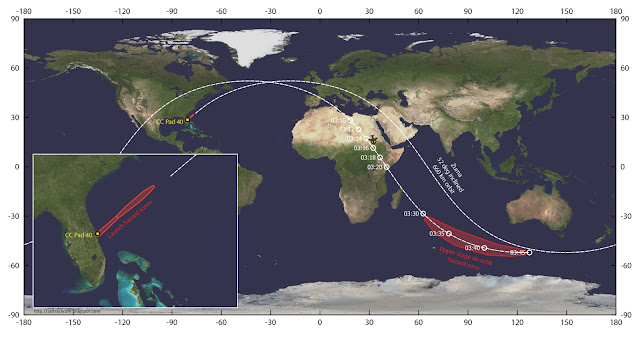
click map to enlarge

Ackowledgement: I thank Peter Horstink for his report, for providing additional information on request, and for the permission to feature his images on this blog. I thank Govert Schilling for bringing me into contact with Peter Horstink. The photographs with this post are (c) Peter Horstink.

Thursday, 4 January 2018

A new launch attempt for ZUMA [updated twice]


Probable launch trajectory of ZUMA
(click map to enlarge)

 UPDATE 1 4 Jan 2018 22:00 UT: The launch has again been postponed by one day, to January 7th (January 6 local time)

 UPDATE 2 5 Jan 2018 14:00 UT: The launch has yet again been postponed by one day, to January 8th (January 7 local time) and I have partly rewritten this post to reflect this.

UPDATE 3 11 Jan 20:00 UT: a follow-up post reflecting my changed thinking on what Zuma could be now we know it targetted a ~900-1000 km orbit, is here

****

[text updated/rewritten twice to reflect launch postponements]

If it isn't delayed even further, SpaceX will finally launch the secretive classified ZUMA satellite for the US Government on January 8th (January 7th local time in the USA) from Cape Canaveral pad 40 in Florida. The launch already has slipped three days from the initial January 5 aim.

The satellite was originally to be launched last November (see an earlier post) from Kennedy Space Center pad 39A but was postponed because of  issues with the payload fairing.

The launch hazard zones and the Falcon 9 upper stage de-orbit zone as gleaned from the Maritime Broadcast Warnings are virtually the same as in November, as was to be expected (there is a very small lateral shift in the launch hazard zone, which is probably related to the change in launch pad, but the direction of the area is the same). They are depicted on the map above.

From the launch azimuth (as gleaned from the launch hazard zones) and the location, extent and time window of the Falcon 9 upper stage de-orbit area, ZUMA will be launched into an approximately 50 degree inclined Low Earth Orbit. In the map above, a trajectory has been plotted for launch into a 50 degree inclined, approximately 400 km orbital altitude orbit. The orbital altitude is a bit uncertain and the eventual real orbit might be higher. [update: it probably is twice as high, from post-launch info discussed in a new post here]

The launch window runs from 1:00 UT to 3:30 UT (January 8th). The de-orbit of the Falcon 9 Upper stage happens some 2 hours after launch over the southern Indian Ocean north of Kerguelen, halfway during the 2nd orbital revolution.

As remarked in my earlier post from November, the launch hazard area and the apparent orbit aimed for as decuced from these hazard zones seem to be very similar to that of USA 276, the classified SpaceX launch for the US government from May 2017 which went into a 50 degree inclined, 400 km altitude orbit (see my article in The Space Review of July 2017). Compare the launch hazard zones of these two launches, they are very similar:

Launch hazard area of ZUMA (red) compared to that of USA 276 (blue)
(click map to enlarge)

Back in November there was some speculation that ZUMA might target the ISS orbital plane, just like the odd classified satellite USA 276 appears to have done last year (see my article in The Space Review of July 2017).


[the now following paragraphs have been heavily editted to reflect the situation change brougth on by the repeated launch delays. I retained some of the original text in striken-out grey for reference]

Another option is that it targets the plane of USA 276. For the initial launch date and window in November 2017, the orbital plane of  USA 276  would have passed over the launch site during the launch window, allowing a launch into the same orbital plane. After several days delay of the launch, the launch was postponed to January after the USA 276 orbital plane moved out of the launch window.

The new launch window for January 8th is the same as it was in November: 1:00 UT to 3:30 UT.

This excludes a launch (exactly) into either the ISS or USA 276 orbital planes, as the latter only pass over the Florida launch site after the launch window has ended.

This means launch into the orbital plane of USA 276 has become viable, as the latter's orbital plane passes over the launch site near 3:38 UT on January the 8th, only minutes after the end of the launch window. Note that for the original January 5 launch date, this was not possible.


This would seem to suggest that the coincidence in time of the launch window and orbital plane passages in November was indeed coincidence (but there is a "but": see below...).

[Edit 4 jan 22:00 UT: or maybe not. There are new delays, launch has now shifted to January 7 UT (January 6 local time) and passage through the USA 276 orbital plane is now very close to the end of the launch window. And it will shift into the launch window if more delays occur.]

On January 6th, the orbital plane of USA 276 passes over the launch site around 4:27 UT, an hour after the end of the launch window. The orbital plane of the ISS passes over the launch site around 7:04 UT, some 3.5 hours after the end of the launch window.

The image below shows the spatial separation of the orbital planes for launch on January 8th (January 7 local time).  For ZUMA, two planes are given (in red), one for launch at 1:00 UT and one for launch at 3:30 UT, representing the start and end of the launch window. The orbital planes for a 3:30 UT launch (end of launch window) and USA 276 (blue) almost coincide:

Relative orbital plane positions for ZUMA (red), USA 276 (blue) and the ISS (white)
Image has been updated twice
(click image to enlarge)


The launch already has slipped three days, and a few days more delay would slip the passage of the USA 276 orbital plane increasingly forward into the launch window, as the moment of orbital plane passage shifts about 24 minutes earlier in time each day. And a further delay eventually would do the same for the ISS orbital plane passage after several more days.

The official reason given for the delays of the past few days is "extreme" weather (strong high altitude winds). This might well be true, but there is always a possibility that the delays are a ruse to obfuscate (if that is the case) that the orbital plane of USA 276 is the actual target (there are historic precedents for such a ruse). That however remains speculation (emphasis), and it could well be that the actual launch time, when it happens, will be off from the moment the orbital plane of USA 276 is passed. We will see.

There is therefore very little to say with certainty about the possible function of ZUMA. But ZUMA is likely a technology demonstrator, i.e. an experimental satellite to show that a particular technology is feasible, as we also pressume USA 276 to be. I could (again) speculate that perhaps ZUMA and USA 276 are part of the same experimental program. As these two spacecraft were built by two different companies (Northrop-Grumman and Ball Aerospace), perhaps they are technology demonstrators in competition for a follow-up contract. But this is pure speculation. Many options are open.

Exactly how (if at all) the two satellites are related to each other remains murky. Maybe future orbital behaviour will shed some light on what ZUMA is doing.

For a further discussion of the ZUMA mission, see my earlier post from November 2017. Some TLE estimates for the orbit are here. They are based on the 50 degree orbital inclination gleaned from the launch azimuth, and an assumed ~400 km orbital altitude. [update: post-launch information leads me to think it went into a higher orbit, 900-1000 km, see the link to the new post below]

UPDATE 9 January 2018: a follow up is here, with spectacular images of a fuel vent by the Falcon 9 Upper Stage.

UPDATE  11 Jan: a second follow-up post reflecting my changed thinking on what Zuma could be now we know it targetted a ~900-1000 km orbit, is here.

Friday, 17 November 2017

[UPDATED] Tomorrow's SpaceX Zuma launch

click map to enlarge

If nothing interferes (the launch has been postponed twice already), SpaceX will launch the classified Zuma satellite from Cape Canaveral Pad 39A in the early hours (UT) of  November 18.

Zuma  was originally scheduled for November 16, but was delayed a day to November 17, and then yet another day to November 18.

The published Maritime Area Warnings give a window from 00:55 to 03:37 UT for the launch. From the Area Warnings, the de-orbit of the Falcon 9 Upper stage happens some 2 hours after launch over the southern Indian Ocean, during the 2nd orbital revolution.

The launch and Upper stage de-orbit hazard zones (I plotted them in red on the map above) strongly suggest a launch into a 50-degree inclined, ~400 km orbital altitude Low Earth Orbit.

The map above plots the trajectory for the first ~1.5 revolutions in such an orbit. As can be seen in the map, such an orbit lines up well with the direction of the launch hazard zones, and with the Falcon 9 upper stage de-orbit hazard zone in the Indian Ocean. The fact that the first stage will return to the Cape for a landing argues for a launch into Low Earth Orbit too.

If a ~50-degree inclined, ~400 km altitude orbit sounds familiar to you: that is because this orbit would be very similar to that of the enigmatic classified satellite USA 276 which was launched - also by SpaceX - in May 2017. This is the one that made all those peculiar close approaches to the ISS in June (see some previous posts from June and my Space Review article here). Perhaps, but this is pure speculation based on suspected potential orbital similarities only, Zuma is up for a similar mission.

It is very interesting that Zuma seems to have been contracted via a similar procedure as USA 276, and that like for USA 276, it has not been made public which Agency will operate the Zuma satellite. So there appear to be similarities from that aspect as well.

It will therefore be interesting to see how the orbit of Zuma, once launched, compares to that of USA 276 and the ISS. The orbital plane of the ISS will be overhead for Cape Canaveral near 2:38 UT on the 18th, so a launch exactly into the ISS orbital plane is possible - and will stay possible for several days to come in case the launch is postponed again (the moment of the ISS orbital plane passing over the Zuma launch site happens ~24 minutes earlier each day).

On the 18th, the orbital plane of USA 276 will be overhead for Cape Canaveral some 10 minutes before the launch window opens. With the newest delay, a launch exactly into the orbital plane of USA 276 is therefore no longer feasible.

But by launching directly at the opening of the launch window on the 18th, the orbits of Zuma and USA 276 would nevertheless still be quite close (launch at 1:00 UT would result in a difference in RAAN of 3 degrees), and differential rates of precession of the RAAN might still slowly drift the two orbits towards each other over the next weeks and months, depending on what the actual orbital altitude and inclination Zuma ends up in would be.

Therefore a launch exactly into the orbital plane of either USA 276 or the ISS, strictly speaking is not necessary to engineer close approaches (indeed, USA 276 itself was not launched exactly into the ISS orbital plane in May).

So it might be worth monitoring Zuma and its behaviour in relation to both USA 276 and the ISS in the weeks after launch. Still, it is also very well possible that Zuma has nothing to do with both spacecraft whatsoever.

UPDATE 1  17 Nov 2017, 13:00 UT:

The  maps below show a comparison of the hazard zones (from Maritime Area Warnings) for the launch of USA 276 in May 2017, and for Zuma.

click maps to enlarge

The USA 276 de-orbit area is shifted more West-wards, because the Falcon 9 upper stage de-orbit from that launch was de-orbitted one orbital revolution later than apparently planned for Zuma. The small difference in size might point to slightly different orbital altitudes for the upper stage (e.g.due to  a somewhat different collision avoidance manoeuvre after payload separation)


UPDATE 2  17 Nov 2017, 13:00 UT:

SpaceX has released a statement that, while not taking a launch tonight off the table, might indicate a further prolonged delay.


Appendix:

These are the Area Warnings published for the launch. They are graphically depicted in the map in the top of this post and the two maps above.

NAVAREA IV 1067/17

WESTERN NORTH ATLANTIC. FLORIDA. 
1. HAZARDOUS OPERATIONS, ROCKET LAUNCHING
160055Z TO 160337Z NOV, ALTERNATE 
170055Z TO 170337Z NOV IN AREAS BOUND BY: 
A. 28-38N 080-43W, 29-12N 080-06W, 
30-04N 079-00W, 29-56N 078-52W, 
28-41N 080-10W, 28-26N 080-21W, 
28-22N 080-38W. 
B. 30-04N 079-00W, 30-52N 
078-17W, 31-32N 077-25W, 
31-54N 076-49W, 31-49N 076-45W, 
31-36N 076-57W, 30-44N 077-53W, 
29-56N 078-52W. 
2. CANCEL THIS MSG 170437Z NOV 17.// 

Authority: EASTERN RANGE 072156Z NOV 17. 

Date: 110428Z NOV 17 
Cancel: 17043700 Nov 17 


HYDROPAC 3895/17 

SOUTHERN INDIAN OCEAN. 
DNC 03, DNC 04. 
1. HAZARDOUS OPERATIONS SPACE DEBRIS 
160300Z TO 160637Z NOV, ALTERNATE 
170300Z TO 170637Z NOV IN AREA BOUND BY 
30-27S 064-51E, 30-44S 067-03E, 
38-10S 082-43E, 47-22S 108-39E, 
50-30S 124-39E, 51-55S 126-03E, 
53-32S 125-05E, 54-24S 116-01E, 
53-34S 101-27E, 47-46S 082-05E, 
39-58S 069-31E, 31-56S 063-23E. 
2. CANCEL THIS MSG 170737Z NOV 17.// 

Authority: EASTERN RANGE 072155Z NOV 17. 
Date: 110407Z NOV 17 
Cancel: 17073700 Nov 17