 |
image (c) Peter Horstink, used with permission
click image to enlarge |
The spectacular image above was taken by
Peter Horstink, the Dutch pilot of a Boeing 747-400 freighter aircraft (Martinair Holland flight MPH8371 from Amsterdam to Johannesburg), around
3:15-3:20 UT on January 8. The aircraft was flying at
35000 feet just north of Khartoum, Sudan, at that moment, which can be seen in the foreground (the yellow lights). The image above is the first one out of four images taken by Horstink.
The spectacular green-blue "spiral" on the image is, given time and location and character, almost certainly the
Falcon 9 Upper Stage from the launch of the classified
Zuma satellite that day (see
my earlier post here),
depressurizing and venting fuel at the end of its de-orbit burn. Some 15-25 minutes later, it would re-enter in its designated re-entry zone in the southern Indian Ocean (see map below).
Horstink described his observation as follows (translated from his Dutch e-mail report):
"It
started with a greenish light in the top of my front window. At first I
thought it was a reflection from some lightsource behind me, but it
turned out not to be. At about 218 UTC [this later turned out to be a
mistake and must read 3:18 UTC: the aircraft passed Khartoum near 3:25
UTC - ML] with a very clear sky and with Khartoum in our sight, a point
of light (like a star but somewhat bigger) moved from above us to South
of us. It moved slower than a usual satellite but clearly did move. I
estimate we saw it for 2-3 minutes. The waning moon crescent at that
time was almost right above us. The object was surrounded by a greenish
glow in the shape of spiral arms, like a spiral galaxy. Two of them,
which didn't seem to move much. The total size of the phenomena was
about three times the diameter of the moon."
(note that when measured from the photographs using the star background as a reference, the actual diameter of the spiral cloud is about 11 degrees. The cloud is at ~8 degrees elevation over the horizon, near azimuth 155 degrees. The two bright stars to the right of the cloud are alpha and beta Centauri ).
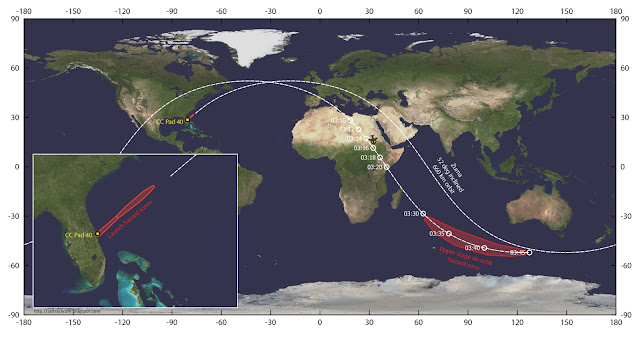
The map below gives my estimated trajectory for the Falcon 9 Upper Stage, with apogee at ~900 km. It fits the area of the sighting, the launch hazard zone direction and the de-orbit zone position (from Maritime Broadcast Warnings) in the Indian Ocean. The Falcon 9 Upper Stage should have re-entered into the atmosphere between 3:30-3:45 UT, about 30 minutes after the window from the Maritime Broadcast Warning opened at 3:00 UT.
 |
| click map to enlarge |
The sighting points to
a somewhat higher orbital altitude for Zuma than I had anticipated before the launch: with hindsight, I had too much of an
idée-fixe that the orbital altitude would be similar to that of USA 276. The Falcon 9 sighting over East Africa suggests an altitude over double as high, in the order of 900-1000 km rather than my original 400 km estimate.
The sighting does confirm the 50-degree orbital inclination of the orbit.
A new estimated elset based on this revision of the orbital altitude is here.
The map below shows the (very) approximate position of the aircraft at the time of Peter Horstink's observation relative to the Falcon 9 trajectory (times in UT, January 8th 2018). The aircraft was flying on a heading of 170 degrees, and Horstink gives his position as "between waypoint Alpox and Khartoum VOR" which corresponds to about 16.38 N, 32.35 E. The Falcon 9 Upper Stage was coming down at an altitude in the range of 200-400 km at that time. Approximate positions for the Falcon 9 Upper Stage are indicated in 2-minute intervals:
 |
| click map to enlarge |
Horstink made the image above and below plus a few more with a handheld camera, from the cockpit of the aircraft.
 |
image (c) Peter Horstink, used with permission
click image to enlarge |
Horstink's observation is not the only observation. Very similar photographs showing a spiral in the sky have been coming from the ground in Sudan, e.g. in this tweet:
 |
| image from the ground, from Sudan (author unknown) |
On rumours that Zuma failed
The sightings from Sudan near 3:15-3:20 UT are significant, as in the late afternoon of the 8th,
rumours appeared on Twitter of a
Zuma launch failure. These rumours then were picked up by some news outlets, e.g.
here and
here.
I have no idea about the veracity of these rumours, and so far SpaceX has said the mission was "nominal" (indicating no problems with the Falcon 9), while Northrop-Grumman and the US military haven't given comments (they never do about classified mission status). They could very well just be rumours, perhaps born out of a misunderstanding of events in the launch seen from the ground by lay observers.
For the moment, unless the US Government comes with some statement, I think it is wise we should treat it as "just rumours", and not necessarily true.
The sighting of the Falcon 9 Upper stage venting
2 hours 15 minutes (1.5 orbit) after launch, bear significantly on the discussion, as it seems to confirm the remarks by SpaceX that the mission was nominal. Of course, for SpaceX the mission ends at orbit insertion.
At any rate, it shows that at least the Upper stage achieved orbit (so it was definitely
not a launch failure where the rocket failed to achieve orbit), and it makes sense that the payload then did as well.
So if something went wrong, if at all (a big "if" - I am skeptical), then there are three options left:
(1) Zuma was inserted into orbit, but it is in the wrong orbit (too high, too low);
(2) Zuma was inserted into orbit, but is "dead", i.e. non-responsive;
(3) Zuma achieved orbit with the Upper Stage, but failed to detach from the Upper Stage, and next de-orbitted with the Upper Stage near 3:30-3:45 UT.
JSpOC ("NORAD") did enter an object from this launch into its master catalogue on January 9th, as object
nr. 43098, COSPAR 2018-001A, name
USA 280. They designated it "PAYLOAD" (and the USA 280 designation would point to this as well). As usual for classified missions, they do not give details on the orbit.
 |
| screenshot showing the JSpOC master catalogue entry for a "PAYLOAD" named USA 280 associated with the launch |
This suggests something achieved orbit long enough (i.e. over more than one orbit) to be detected and added to the catalogue.
While this does not necessarily mean the object is still in orbit (and it could in theory reference the Falcon 9 Upper Stage, with the "PAYLOAD" designation then in error),
it does fuel my skepticism towards the truth of the rumours.
If Zuma is on-orbit but did fail, the situation becomes reminiscent of the
USA 193 saga - an experimental satellite launched in December 2006 that failed after orbit insertion, and a year later was shot out of the sky with an SM3 missile, which has become infamous as "
Operation Burnt Frost".
With regard to the observed fuel dump/depressurization: this is
normal for most launches and does not necessarily indicate something's wrong.
Rocket stages always carry excess fuel, as you don't want the engine to cut out prematurely by running out of fuel. So it always has a sufficient fuel margin. Once its work is done, this excess fuel is often vented, also known as "depressurization".
[
update] An
earlier example of such a spiral resulting from a Falcon 9 venting fuel after launch into LEO, is
this one from a SpaceX Falcon 9 test launch of a DRAGON in 2010. So this event over Sudan is not unusual. [
end of update]
Depressurization and fuel venting avoids the risk of the rocket stage blowing up, for example as a result of static electricity building up in the rocket stage. You do not want your rocket stage to blow up, as it creates an uncontrolable swarm of debris and includes the risk that particles are ejected into orbits where they do not decay quickly, adding to the space debris risk.
The spiral pattern results when the rocket stage is spinning, perhaps as result of the fuel vent.
At the moment, Zuma is not visible from the Northern hemisphere because all passes are in daylight or earth shadow. This will change 1-2 weeks from now, depending on the exact orbital altitude. The sighting from Sudan does confirm the orbital plane the object should be in (that is: unless it did a manoeuvre into another orbital plane after separation from the Falcon - but I doubt that). So we have to wait now untill a new object is observed in this orbital plane.
The hunt is on!
UPDATE: some news sources are now claiming sources within the US military and US Government confirm the failure, saying the second stage of the Falcon 9 "failed" and stage and satellite crashed into sea.
This does not tally with the observations over Sudan, which show the Upper Stage did reach orbit. So my skepticism remains. If there is some truth to it nevertheless, it could point to option (3) above and subsequent misinterpretation in the press.
UPDATE 2: the adapter mating ZUMA to the Falcon 9 Upper Stage was
not made by SpaceX, but by Northrop-Grumman itself (which is somewhat
unusual). So if ZUMA did not separate from the Falcon 9 (and did a dive
into the Indian Ocean with it), the blame is not on SpaceX but on
Northrop-Grumman. In that case, the SpaceX declaration that the Falcon 9
performed "nominal" is correct, even if Zuma did not separate from it.
UPDATE 3 (17 jan 2018): It turns out that a ~52 degree inclined, ~660 km altitude orbit also fits the constraints of the de-orbit area and being over East Africa at the right time. So we are adding that option to the search efforts. I did a partial plane scan of the 50-degree orbital plane two days ago.
 |
| click map to enlarge |
Ackowledgement: I thank Peter Horstink for his report, for providing additional information on request, and for the permission to feature his images on this blog. I thank Govert Schilling for bringing me into contact with Peter Horstink. The photographs with this post are (c) Peter Horstink.


