Showing posts with label Hwasong-12. Show all posts

Thursday, 1 March 2018

On PBS Newshour, about Open Source investigation of the North Korean missile program


In December of 2017, I was interviewed by Miles O'Brien for PBS Newshour, about Open Source investigation into the North Korean missile program.

The item aired on 28 February 2018. It is 9 minutes in duration and alternatingly features Jeffrey Lewis of the Middlebury Institute and me showing what we can learn from analysing DPRK propaganda photographs and video imagery.

(the video above starts at the start of the item).

Monday, 2 October 2017

The North Korean Hwasong-12 test of 14 September: georeferencing Kim Jong Un's map

(This post has been a while in the making. Due to various reasons, including the 21 Sept fireball, I did not come to write it up on this blog until now. The same analysis however was earlier presented as a Twitter-thread, on 23 September)

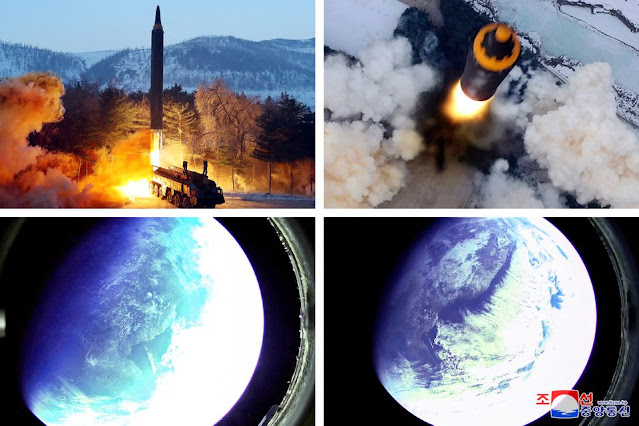
"I love the smell of UDMH in the morning..." (photo: KCNA)

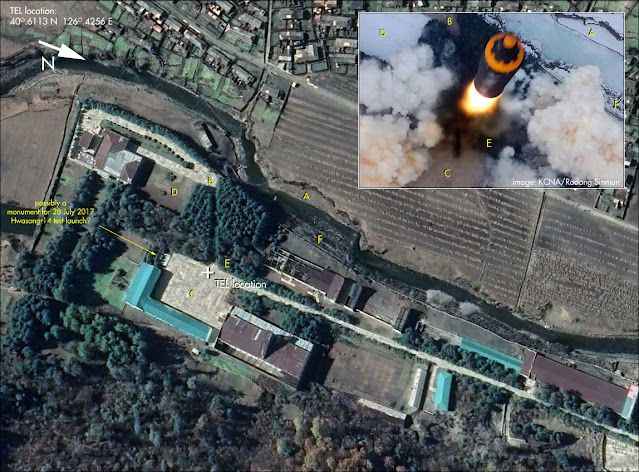
Over the past months, I have spent a number of posts on North Korea's recent increasingly bold missile tests. The latest of these tests happened on September 14 (local September 15 in North Korea). At 21:57 UT that day, North Korea launched a Hwasong-12 IRBM from Pyongyang Sunan airfield towards the east-northeast. It crossed over Japan (causing air-raid alarms to go off) with, according to western military sources, a range of ~3700 km and apogee at 770 km, before impacting in the Pacific Ocean. The test was the second one to launch the Hwasong in a 'regular' rather than 'lofted' trajectory, over Japan.

I was abroad at the time of the test,  meaning it was several days before I could look at this test and start an analysis. Some results were earlier presented on 23 September as a Twitter-thread.

photo: KCNA

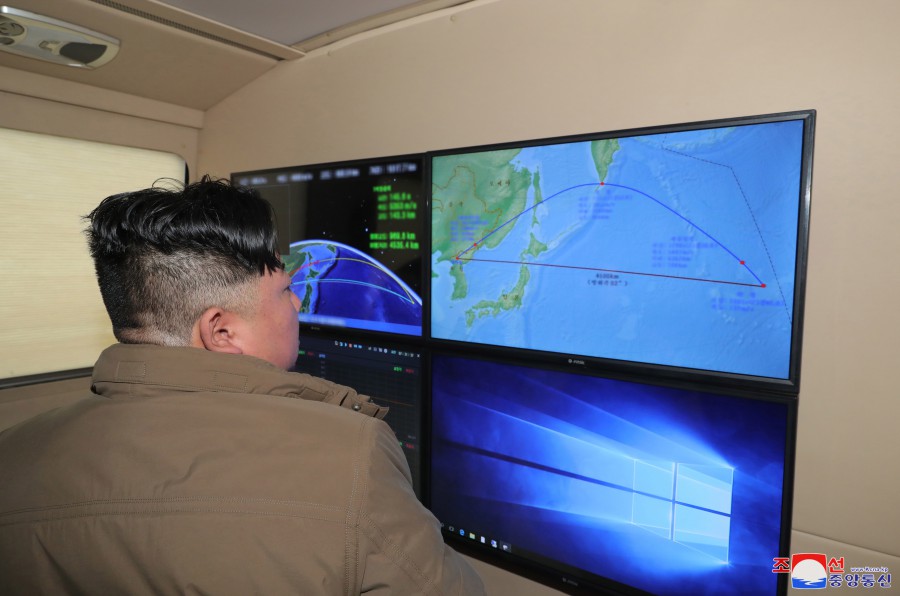
As part of the propaganda photographs published by KCNA following the test, there was (just like after the test of 29 August) a picture of Kim Jong Un sitting behind a desk, with a map in front of him. As was the case for August 29, the map shows a missile trajectory, presumably the trajectory aimed for in this test:

photo: KCNA

I obtained a high resolution version of this photograph for analysis with the much appreciated help of Ankit Panda. First, I roughly squared this image using the skew-tools in Photoshop:


Next, I georeferenced this image against an actual map using QGIS. The resulting map is the one below (the map projection I have used is a Lambert azimuthal equal area projection centered on Sunan. The grid is WGS84). :


click map to enlarge

The result of this georefencing is that the drawn trajectory starting at Sunan ends at approximately 39.60 N, 168.05 E. The range from Sunan to this impact location is 3615 km.

Note that I have added, in yellow, country outlines to the map to show the validity of the georeferencing. I also added a few annotations. I have added an STK-modelled ballistic trajectory to the map as a dashed red line: it is highly similar to the original trajectory line drawn on the map, as you can see, with apogee position corresponding to what appears to be a text in red on the map: what was depicted on Kim Jong Un's map hence appears to be a real ballistic trajectory.

The resulting range of 3615 km is close enough to the range reported by Western military sources (about 3700 km) to conclude that the 14 September test went much as intended.

This is a difference with the 29 August test. In that case, the map showed a ~3300 km range while western military sources said the actual range flown was ~2700 km: it also flew more north than the trajectory that was depicted on the 29 August map. See my earlier blog post here. The match for the 14 September test might indicate that the 29 August test perhaps did not go as intended.

The map below shows both trajectories: that of 29 August as depicted on Kim Jong Un's map (i.e. not the actually flown trajectory!), and that of 14 September as depicted on Kim Jong Un's map:

click map to enlarge (map by author)

It is interesting to look at the range distances for both tests. The range distances of 3316 km and 3615 km ring a bell. The distance from Pyongyang Sunan (the launch location) to Henderson AFB on Guam is ~3415 km. The August 29 map trajectory falls almost exactly 100 km short of that range, while the September 14 trajectory almost exactly 200 km overshoots this range.

I am going back-and-forth on whether this is significant or not. I tend to think that all these kind of map images released are intentional propaganda meant to convey a message: the map is meant to be analysed and "read" by the West.

As an illustration of how it potentially could be read: would we change the launch directions so that they would be towards Guam, then this (the two black crosses) would be the result in terms of the pattern of impact locations relative to Guam:

Remember that North Korea has "threathened" to conduct a quadruple demonstration with four missiles impacting in international waters in an 'envelope' around Guam, if the Trump administration does not stop B1 bomber demonstration flights from Guam. Do we see some kind of test mock enactment for this here? Is the message: "We are already practising for this, imperialist barking dottard dog!".

It would become very interesting if North Korea were to launche two other missiles the coming month, and the pattern where they (were implied to) land relative to the earlier two tests might be very interesting.

photo: KCNA
(I thank Ankit Panda for his help with obtaining a high resolution version of the photograph with Kim Jong Un and the map)

Friday, 1 September 2017

The other subliminal message in Kim Jong Un's missile test map

image: KCNA
The image above (from North Korea's KCNA) shows the North Korean leader Kim Jong Un and a map. It was likely taken on the day of the 29 August missile test that shot a Hwasong-12 MRBM over Japan, into the Pacific Ocean. I analyzed this map and what it shows in detail in my previous post, showing that the trajectory which seems to be sketched on the map deviates from the real missile flight path.

But there is more to this map, it turns out after further analysis. There are not one, but two subliminal messages contained in this map.

The first subliminal message, already discussed at the end of my previous post, is that it depicts a 3300 km trajectory (the real flight trajectory appears to have been shorter, 2700 km). This is the approximate distance to Guam.

But there is a second subliminal message. The map also contains a veiled threath to Hawaii.


click to enlarge

As can be seen in the annotated georeferenced version of the map image above (see also my previous post), the trajectory skeched on the map (white) is very close in direction to what a trajectory towards Hawaii would be.

In the map above, there are two lines representing such a trajectory targetting Hawaii:

- The green dashed line shows what a real, 7400 km range trajectory towards Pearl Harbour would be (this takes earth curvature and earth rotation into account);

- The yellow dashed line shows what the trajectory is if launched into the same azimuth as for  targetting Pearl Harbour, but with a shorter 3300 km range, as on the map in front of Kim Jong Un.

The latter yellow line obviously is very close to what is sketched on Kim Jong Un's map. In fact, I think that within the error margins of my georeferencing effort, they might well be the same.

The white line, my best effort to represent the trajectory sketched on the map, would be a missile launched into azimuth ~77.25 degrees. The dashed yellow and green lines, are both for missiles fired into azimuth ~76.9 degrees. 76.9 and 77.25 degrees are very close, a difference of only ~0.35 degrees.

To clarify further what the map depicts: the reason that, even though the launch azimuth is the same, the green and yellow lines do not overlap is because of earth rotation and earth curvature. Firing a missile into the same azimuth (~76.9 degrees) from Pyongyang Sunan, yields a slightly more southern trajectory if the range of the missile is ~3300 km (as on Kim Jong Un's map) instead of ~7400 km (the distance to Pearl Harbour). This is because a flight to Pearl Harbour takes longer in time, and the earth surface is meanwhile rotating under the flight path.

So the trajectory sketched on the map contains two subliminal messages: the length (~3300 km) is roughly the distance to Guam. The launch direction is the launch direction towards Pearl Harbour. Two veiled threaths in one. No wonder Kim Jong Un smiles so exuberantly: "Riddle this, you Imperialist agressor Puppets!".

I firmly believe that the North Korean propaganda machine deliberately includes these images into what it makes public. When they show a map or monitor with a trajectory, however oblique and vague, it is not unintentional but (I firmly believe) intentional.

(this post is a follow-on to my earlier analysis here)

Thursday, 31 August 2017

North Korea's 29 August Hwasong-12 test with Japan fly-over: did it go as planned?

image: KCNA
It are hectic times for those (like this author) interested in the North Korean rocketry program. The past months have seen a steady series of increasingly bold missile tests (along with a threath of test-firing missiles towards Guam), that have been the subject of three earlier posts on this blog the past months.

And now a new one has occurred, and it is perhaps the boldest of these test flights so far. Last Thursday, 29 August 2017, at 20:57 UT, North Korea launched a Hwasong-12 MRBM on a trajectory over Japan: a politically bold move that caused air-raid sirens to go off in Northern Japan.

images: KCNA

Western military sources say that the missile was fired from Pyongyang Sunan airfield. It reportedly travelled 2700 km, crossing over Hokkaido, coming down in the Pacific Ocean about 1180 km from Cape Erimo in southeast Hokkaido, Japan. Apogee of the trajectory is quoted as 550 km.

This allows us to produce the trajectory reconstruction below (with some leeway as the quoted ranges are probably balpark figures). It shows that the missile crossed Japan over the southern tip of Hokkaido, a trajectory that seems designed to minimize Japanese landmass overflown, mitigating risk levels. The two red circles on the second map are depicting a 2700 km range around Pyongyang Sunan and 1180 km range around Cape Erimo. Where they are closest, is the resulting impact point (near 41.92 N, 157.56 E). Using STK I get a flight-time of ~14 minutes.

click to enlarge

click to enlarge
That odd-looking second of the two maps above is based on an interesting photograph published by the North Korean State News Agency KCNA. It shows an exuberant Kim Jong Un sitting on a desk with a map in front of him:
image: KCNA

We have recently seen more of this kind of shots from KCNA published after previous tests, and they often yield interesting information. In this case, the interesting detail is that a trajectory appears to be depicted on the map, as a thin line (the arc above it ending at the same point likely is a 3D representation):


If the sketched line indeed is the intended trajectory, then the interesting point of it is that it does not match the observed trajectory according to Western military sources.

I used my GIS skills to georeference the map on the image (with QGIS). Like in the case of the 'Guam map', the low resolution of the image and very oblique angle of te map on it make this a challenge, and the georeferencing obviously is not perfect - but good enough for some conclusions. This is the result (look for the vague line that possibly represents a trajectory on the image):

click to enlarge
Here is the same map but with annotations added, and with the trajectory sketched on the map (white line) and the actual observed trajectory (black dashed line):

click to enlarge

It is immediately obvious that the two trajectories do not match well. The trajectory (if it is one) sketched on the Kim Jong Un map is located more to the south, and indicates a larger range, about 3300 km (interestingly, it does conform to a real ballistic trajectory with earth rotation and curvature taken into account, unlike the straight line drawn on the infamous "Guam map").

(the second map shows exactly the same map area, but with a DEM and country shapefile as background. It shows you how the topography matches that on the georectified map from the photograph)

The difference between the two trajectories amounts to a range difference of 600 km and a 45 km difference in apogee. It represents a difference in launch azimuth of 6 degrees and of 3.7 degrees in launch elevation. It points to an underperformance of around 0.4 km/s in the missile's burnout speed.

click to enlarge
It is interesting to note that while North Korea for some previous tests (and their proposed Guam shot) published very accurate figures for range, flight time and apogee, they did not do that this time. It is also interesting to note that some Western military sources report that the missile "broke into three pieces".

So there are multiple indications that the test did perhaps not go entirely as planned, with an underperformance of the rocket engine and an error in launch direction, and perhaps structural failure. This would imply that the targetting of the Hwasong-12 is not quite fail-safe yet, which has implications for Kim Jong Un's proposed Guam enveloping missile demonstration.

This was the first test of the Hwasong-12 on a "normal" trajectory and it shows why it is important for North Korea to test its missiles on such a normal operational, rather than a 'lofted' trajectory: it is a different regime of stress on the missile and has the engines perform under more realistic conditions than on a 'lofted' trajectory. Errors in targetting and missile performance become more apparent.

For North Korea to do such tests on a "normal" trajectory for its MRBM's and ICBM's, they have to fly it over Japan. We are going to see more of this kind of tests the coming months is my prediction.


Update 31 Aug 2017:

(1) The 38 North blog has an interesting post suggesting the possible failure of a post-boost vehicle.
(2) South Korean and US military analysts appear to come to the same analytical conclusions as I did, according to this Korean news bulletin
(3) As Ankit Panda rightfully remarked, the situation drawn on Kim Jong Un's map need not comply to reality. It could be merely meant as a propaganda message (3300 km is roughly the distance from the launch site to Guam).

Update 1 Sep 2017:

A further follow-on post is here, discussing how the map contains two veiled threaths, to Guam and to Pearl Harbour.

Sunday, 13 August 2017

[UPDATED] My take on North Korea's hypothetical threath to Guam

click to enlarge

The sabre rattling between North Korea and the United States is continuing, with increasingly colourful and volatile language and threaths from both sides.

In response to Trumps statements on August 8 that North Korea better stop its threaths or else "they will be met with fire and fury like the world has never seen", the North Korean General Kim Rak Gyom, commander of the Strategic Force of the Korean People's Army, released a  statement through KCNA on August 10 that included a surprisingly detailed threath about firing four Hwasong-12 missiles towards the US island (and important Pacific Naval and Air Base) of Guam.

Two relevant parts of the statement read (emphasis added):

As already clarified, the Strategic Force of the KPA is seriously examining the plan for an enveloping strike at Guam through simultaneous fire of four Hwasong-12 intermediate-range strategic ballistic rockets in order to interdict the enemy forces on major military bases on Guam and to signal a crucial warning to the U.S.
 [...]
The Hwasong-12 rockets to be launched by the KPA will cross the sky above Shimane, Hiroshima and Kochi Prefectures of Japan. They will fly 3 356.7 km for 1 065 seconds and hit the waters 30 to 40 km away from Guam.

The details listed, allow to reconstruct the intended launch site for this scenario. It points to launch of the missiles in the vicinity of Sinpo, an important North Korean Naval Base that is home to its experimental SLBM force and according to satellite imagery analysts has recently seen "high levels of activity" (although that is not necessarily related to the issue under discussion).

The distance from the Sinpo submarine SSBA dockyard to Anderson AFB on Guam is ~3357.5 km, in agreement with the distance mentioned in the KCNA statement. Taking into account Earth rotation, the flight trajectories of the missiles when launched from Sinpo would indeed cross over the three Japanese prefectures mentioned, as can be well seen in the diagram in the top of this post. Together with the listed flight time, it would point to a flight apogee at ~865 km altitude and a launch elevation of ~31.4 degrees, i.e. a "normal" flight trajectory for an IRBM (as opposed to the "lofted", reduced range trajectories of previous tests).

click to enlarge

The map in the top of this post displays the flight trajectories based on this scenario, with the four missiles straddling Guam at ~40 km distance of its shores, uprange, downrange and lateral to both sides of the main flight direction needed to reach Guam.

While the language of the KCNA release is threathening, it is important to realize it is not threathening an actual "attack" on Guam. They talk about a strike that will "envelope" the island with the missiles, each of them impacting at a distance of 30-40 km of the Guam shore.

With the listed 30-40 km offshore impact distances, the missiles would land outside of Guam's territorial waters: but in its Exclusive Economical Zone (EEZ). While sensitive, this is something else than actually hitting Guam or the territorial waters directly surrounding it. The latter would be a real attack on US territory.

Targetting the EEZ has earlier precedents, as recent North Korean missile tests have landed in the Japanese EEZ. What makes it different this time is that it is the EEZ of the US itself, not of an ally, and involves a fly-over of Japan.

Rather than an attack, the scenario painted by the KCNA announcement would be best described as a missile test and demonstration. A test, because it would be the first flight of the Hwasong-12 on a "normal" battle trajectory rather than a "lofted" trajectory. A test, as it would for the first time have the Reentry Vehicle (RV) face the atmospheric reentry conditions it would face if used in an actual conflict. A demonstration, as it would demonstrate that the Hwasong-12 can indeed reach targets at the distance of Guam. A demonstration, as straddling Guam with missile impacts obviously sends a very clear message to the US and its allies.

It would also potentially test the Hwasong-12's performance against US missile defense measures. And it would be a (risky) political test to see how the US and its allies would react to such a demonstration of military power.

How likely is it that it will happen? On the face of it, not that likely. It most likely is hollow rethoric. Firing missiles towards a US military base and US territory is very risky as it could provoke a disastrous counter-attack. A full scale US counter strike would mean the end of the North Korean regime.

However, the oddly detailed August 10 KCNA announcement (which as some analysts on Twitter mentioned almost reads like a NOTAM) could also be seen as a way to mitigate this risk. It clearly signals the intention to not hit Guam itself, just fire near it in a demonstration of power. It is in essence a (tough worded) notice of an upcoming missile demonstration, not an actual war threath.

We should also realize that a US counter-attack would be disastrous for both North Korea and the US and its allies. If the US counter-attacks, North Korea will respond by shelling Seoul into oblivion and, if it can, firing missiles towards targets in South Korea, and possibly towards Japan and US bases in the Pacific. The carnage will be incredible. Hence, a military strike on North Korea as a gut-reaction to North Korean missiles landing near Guam is not as likely as it might at first glance seem. A sane US response would be to restrain from such a counter-attack unless there are strong reasons to do so, like missiles actually hitting targets on Guam. North Korea might have made a similar assessment. But it is a risky one (also taking potential missile malfunctions into account).

North Korea however has taken bold calculated risks before. They recently fired missiles into the EEZ of Japan, a key US ally. They took a risk in sinking the Cheonan in 2010, and shelling Yeonpyeong island that same year.

It is important to note the recent impact of North Korean missiles into the EEZ of Japan, given that the August 10 KCNA announcement points to targetting the EEZ of Guam. This firing into the EEZ of Japan did not lead to military retaliation by the US and allies (and in a sense perhaps might be seen as "testing the waters"). This might embolden North Korea to fire into the EEZ of Guam, expecting (rightfully or not) a similar non-response.

What could the US realistically do in response? As mentioned, a counter-attack in response to the missile firings would lead to dramatic results for the US and its allies. Seoul and Tokyo and who knows Honolulu burning seems a steep price to pay for "acting tough" when the missiles provoking the response harmlessly landed in the Pacific Ocean outside of Guam territorial waters. I fail to see how the US can justify such a result to its citizens and allies when the target of the missiles is in the Guam EEZ and not Guam itself.

Alternatively, the US or allies could perhaps attempt to intercept the missiles. That sounds like a good middle ground but isn't, as it has its own risks. Intercepting missiles on a trajectory that would not reach Guam territorial waters would provide political fuel to North Korea, who can claim their missile test was attacked. Moreover, there is a serious risk that an intercept attempt partly or wholy fails. That would seriously damage the credibility of the US and its capacity to defend itself and its allies, and with that seriously undermine the faith of US allies in the region (apart from the general loss of face). An attempted missile intercept would therefore be unwise in my opinion, as it would be a win-win situation for North Korea no matter the outcome.

So to me, it seems that North Korea is playing a high level (if dangerous) game of chess here, and has managed to checkmate the US. There seems very little the US realistically can do about it, apart from denouncing it. And the tougher the talk from Washington, the more face they will lose if it happens. "Hold my beer", you can hear Kim say in response, knowing he got them cornered.

In case North Korea does go forward with the announced missile demonstration, I expect Trump to do what he has done before: back-peddle on his earlier tough talk and grand-standing. And obscure this by making some unrelated outrageous policy decision or statement in order to deflect attention away from this political defeat, just as he has done with earlier political defeats.

Maybe the North Korean announcement is just a hollow threath. Maybe it is not. More likely than not it will not happen. But I would not exclude it entirely from happening, if North Korea made a similar assessment as outlined above. We will see.


UPDATE  15 aug 13:25:

The North Korean KCNA published a  bulletin on August 15, also carries by Rodong Sinmun. Apart from some interesting statements that might suggest North Korea has put a test fire towards Guam on hold for a while, the Rodong Sinmun newspaper contains some interesting photo's (pdf here via KNCA Watch):

images: KCNA/Rodong Sinmun

Two items on these photographs are of interest: the image on the wall at right, which depicts Anderson AFB on Guam. The other one is the map in front of Kim Jong Un (I put it upside-down here to have north up in the map):


image: KCNA/Rodong Sinmun
This map clearly depicts a missile trajectory towards Guam, that is very close to the trajectory I presented earlier in this blog post. The point of origin of the trajectory indeed seems to be Sinpo on the southeast coast.

UPDATE 2 & 3, 16 Aug 2017 00:30 & 2:45 UT:

Some claims appeared on Twitter that according to South Korean analysis, the map points to launch from Musudan-ri rather than Sinpo:


I do not agree. I used my GIS skills to georeference and reproject the map in front of Kim Jong Un. Below is the preliminary final result:

click to enlarge

What can be seen is that the drawn trajectory points clearly and unequivocally to Sinpo, not Musudan-ri.

What also can be seen is that the line drawn on Kim Jong Un's map is a simple straight drawn line rather than a real missile trajectory. The blue line I have drawn in the map is a true trajectory, including earth curvature and earth rotation and taking the map projection into account. The dashed red line I have drawn is merely a straight line (ignoring map projection).

The country outlines have been added in by me to show how the georeferenced image matches a true map.

Saturday, 27 May 2017

The range of North Korea's Hwasong-12

Hwasong-12 launch. Source: Rodong Sinmun

On 13 May 2017 at 20:58 UT (May 14 in local time, just after local sunrise), North Korea launched a new type of IRBM, the Hwasong-12. It is probably one of the surprise mobile launcher missiles seen during the April 15 parade. A North-Korean Rodong Sinmun communique on the launch is here.

Hwasong-12 on mobile launcher. Source: Rodong Sinmun
In this blogpost, I try to find the maximum range of this missile, going from released information about the missile's trajectory by Western and North Korean sources. I should ad that my analysis is not original: it is inspired by earlier similar analysis by David Wright on the All Things Nuclear blog and a later analysis by Ralph Savelsberg on the 38 North blog.

Hwasong-12 being erected. Source: Rodong Sinmun

My analysis was sparked by three things. One was that I wanted to see whether I could reproduce David Wright's results. The second was that I wanted to visualize the situation (I am a visually oriented guy).

The third was a recent exchange on Twitter between me and Dutch science journalist Martijn van Calmthout of the Volkskrant. He had written a newspaper piece on North Korea's recent missile and atomic activities that seemed to underplay the significance of the May 13 test, choosing wording to suggest North Korea could not reach Japan with this missile. I then pointed him to David Wrigth's analysis.

Van Calmthout is a good journalist, so as a result of our Twitter conversation he actually followed up with a new Volkskrant piece where he corrected himself later:


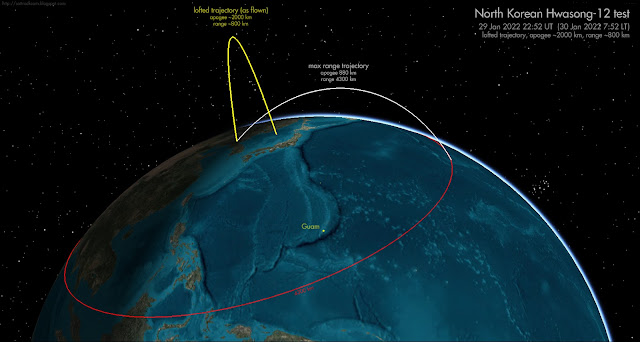
As pointed out by David Wright, the May 13 test missile was not launched on a standard trajectory but on a so-called 'lofted' trajectory: North Korea released info that the missile travelled a ground distance of 787 km and reached an apogee altitude of 2111.5 km. Western military sources quote similar figures, so I see no reason to doubt them.

Such a lofted trajectory brings the missile very high and shortens the ground track. Fired on a more normal trajectory, the same missile with the same impulse would fly a much larger ground distance. A more normal apogee altitude for a missile like this is 600 to 1300 km.

The reason that North Korea choose this 'lofted' trajectory, is in order to avoid that the missile overflies neighbouring countries, which could be mistaken for an attack and might evoke countermeasures. South Korea, Japan (for obvious reasons) don't like it when North Korea fires a missile over their territory.

The 13 May test missile was launched from Kusong in the western part of North Korea, into an E-NE direction overflying North Korea and then onwards over sea. As part of the photographs released by North Korea after the test, an image was released showing Kim Jong Un with a map of the missile's trajectory. Based on that map, I estimate the impact point of the missile to be near 41.64N, 134.27 E, which indeed is ~787 km from Kusong (I have taken the airport near Kusong as the launch location). This is a bit further away from Vladivostok than earlier reports suggested: about 250 km. Of course these could perhaps be the intended test results rather than  the true test results.

Kim Jong Un with map (click to enlarge). Source: Rodong Sinmun
blow-up of part of previous picture

I used these parameters (estimated impact point, 2111.5 km apogee altitude) as input in STK in order to model the trajectory. It suggests that the missile delivers an impulse of 5.59 km/s. The launch was towards azimuth 72.5 degrees under an angle of 81 degrees, almost vertically. The resulting time of flight would be 28 minutes, very close to the ~30 minutes reported by western sources.The resulting trajectory is (as it should be) very similar to that on the photographs above.

Next, I used the same parameters (in terms of impulse), but with the launch angle adjusted from 81 degrees to 45 degrees, consistent with a more normal trajectory optimized for maximum range. This is the visualized result:


click to enlarge
click to enlarge
The red line shows the 'lofted' trajectory from the May 13 test. The blue line shows the trajectory the same missile with the same impulse would travel using a 'normal' launch angle.

The resulting maximum range I get is about 4200 km (with an apogee altitude at ~1300 km) - close to Wright's original figure of 4500 km, somewhat less than his later revised figure of ~4800 km, and slightly larger than Savelsberg's 3700 km. Given the uncertainties, all results mentioned are in the same ballpark figure.

A distance of 4200 km brings this area into range of the Hwasong-12:


click to enlarge
This range circle reconstructed for the Hwasong-12 includes Japan, almost the whole of China, east Russia and the Phillipines. The US bases in Guam would also be in reach, i.e. this means that in theory (and if North-Korea has developed a working re-entry vehicle to match the missile - interestingly, their Rodong Sinmun communique mentions that the test also verified "the homing feature of the warhead under the worst re-entry situation") North-Korea would have the power to strike US bases outside of South Korea with this missile.

click to enlarge

Outside of Hwasong-12 reach would remain Hawaii and the US mainland: the 4200 km range falls just short of reaching Alaska.

click to enlarge

Edit:  The actual range of a missile depends on several parameters. One of these is what you put on it, i.e. the warhead used.

The STK analysis is also slightly simplified as it treats it as purely ballistic and ignores atmospheric drag during initial launch phase and reentry.