Showing posts with label UNHA-3. Show all posts

Sunday, 6 March 2016

The tumble period of the UNHA-3 upper stage from the recent North Korean launch is slowly changing

click image to enlarge

The image above, taken in the evening of 5 March 2016,  is a 10-second exposure showing several flashes of the tumbling UNHA-3/Kwangmyŏngsŏng rb 2016-009B, the upper stage from North Korea's recent Kwangmyŏngsŏng-4 launch. It was taken during a very favourable 67-degree elevation pass, using my Canon EOS 60D and a SamYang 1.4/85mm lens (set at F2.0). The sky had cleared just in time for this pass (a last wisp of clouds is still visible in the image).

The flashes had a brightness of about mag. +3.5 and were visible by the naked eye. The resulting brightness variation curve is this one:

click diagram to enlarge

I have briefly mentioned the tumbling behaviour of this rocket stage in an earlier post. Over the past week I have been following this rocket when weather allowed, obtaining observations in the evenings of Feb 28, Feb 29, March  3 and March 5. This now allows a first look at how the tumble rate is (very) slowly changing.

The theory behind tumbling rocket stages and why their tumble rate changes over time, is briefly discussed here on the satobs.org site. After the payload and the upper stage separate, usually by means of exploding bolts, the upper stage gets a momentum from this separation.

Over time, the resulting tumble is influenced by interaction of the rocket stage body with the earth's magnetic field. Spent upper stages are basically hollow metal tubes, and the Earth's magnetic field causes induction in it, leading to the tube getting an electric charge. Basically, the rocket stage becomes a dynamo. The Earth's magnetic field then further interacts with this electrically charged rocket stage, by means of the Lorentz force exerting a magnetic torque on the rocket stage's spinning motion. It is the latter effect which by "tugging" on the tumbling stage, changes its momentum, with a changing tumble period as a result. The resulting change is one towards a slower tumble rate, and eventually the stage might stop tumbling altogether.

I earlier established a peak-to-peak period of 2.39 seconds for 2009-009B from observations on Feb 28 and 29. Analysis of the new data obtained on March 3 and 5 show that the period is changing: I get 2.43 seconds for March 3 and 2.45 seconds for March 5.

I re-analyzed the Feb 28 and 29 data as well, this time using a fit to a running 5-point average on the raw data, which leads to somewhat better refined peaks. I also found that the initial autofit made by PAST is actually not the best fit, based on the r-square values of the fit. re-analysis leads to a 0.01 second revision to 2.38 seconds of the Feb 28 period, while the Feb 29 period stays at 2.39 seconds as initially established.

So the sequence is:

peak-to-peak periods
-----------------------------------
Date        TLE date    Period(sec)
-----------------------------------
Feb 28.81   16059.81    2.38 ± 0.01
Feb 29.79   16060.79    2.39 ± 0.01
Mar 03.79   16063.79    2.43 ± 0.01
Mar 05.82   16065.82    2.45 ± 0.01
-----------------------------------

(NB: the listed uncertainty is an estimate)

Even though the differences are very small, there appears to be an increasing trend to the periodicity, at the rate of about 0.01 second per day. As the difference is systematic, it is probably real and not just scatter due to measuring uncertainty (time will tell if this indeed holds).

[edit 7 March 2016 19:55]
One caveat: the synodic effect. As the viewing angle changes over the pass, this has some influence on the determined period. For fast tumblers this effect is small, but as we are talking about differences in the order of a few 0.01 seconds, the synodic effect comes into play.
The observations of Feb 28, 29 and March 3 were all made some 30 degrees beyond culmination, so the synodic effect should be about the same. The March 5 observation was done at culmination (I actually have a second image post-culmination as well but have not analysed it yet)
[end of edit]

Below are the brightness curves on which these values are based (click diagrams to enlarge):

click diagrams to enlarge


Appendix: on the construction of these brightness curves

I got a number of questions on how, and with what software, I produce these brightness curves. I will briefly explain below.

(a) calibrate exposure duration
What is first necessary, is that the real duration of the exposure is carefully calibrated. A "10-second" exposure set on your camera is not exactly 10.000 seconds: with my Canon EOS 60D for example, it is 10.05 seconds in reality (this deviation seems to increase exponentially with exposure time: a "15-second" exposure for example is in reality closer to 16 seconds!).

(b) measure pixel values with IRIS
The pixel brightness over the trail on the photograph is measured using the free astrophoto software IRIS.  Load the image, and chose "slice" from the menu option "view". Put the cursor at the start of the trail, and draw a line over the trail to the end of the trail. A window pops up with a diagram. You can save the data behind this diagram as a .txt table.
NB: be aware that Iris always measures from left to right (no matter how you draw the line), so if the satellite moved from right to left, you will later have to invert the obtained data series.

(c) Excel manipulation
The resulting .txt data file is read into excel. There, if necessary I first invert the series (see remark above). The result is a table with a column with pixel brightness values,  to which I ad an increasing pixel count. I then ad another column, representing the time for each pixel measurement. The value of the first cell is the start time of the image in seconds (I usually take the number of seconds after a whole minute, e.g. if the image started at 19:43:32.25 UT the value in this cell is "32.25". If I have a total number of pixels of say 430 (with 430 corresponding pixel brightness values), and an exposure time of 10.05 seconds, then I type this in the cell below it: "=[cell above it]+(exposure/number of pixels - 1)". In our example: "[cell above it] +(10.05/429)".
Then drag this down to the end of the column: the last value now should correspond to the end time of the exposure (in our example, it should be "42.30", i.e. 32.25 + 10.05).

If the raw data graph shows a lot of scatter, it can be useful to apply a running average to the data.

(Note: this approach assumes that the angular motion of the tumbling satellite or rocket stage was fixed over the exposure time in question. In reality, this is not the case. But for short time spans of a few seconds, this can usually be ignored, certainly if the image was taken near culmination of the object. It does introduce some deviation in the result though. Compensating for this makes the exercise a hell of a lot more complicated).

(d) read into PAST and analyse
I then copy the columns with the times and pixel brightness values, and paste them into PAST v.3 (very neat and free statistical software developed by paleontologists. I like it because it is versatile and able to create publication quality vector-format diagrams - the latter ability is something often lacking in such packages).
Press "shift" and select the two columns. Next, under "model" chose "sum-of-sinusoids". Next, a pop-up screen with a diagram appears.
Select "points" under "graph style". I leave "Phase" on "free". You then check the checkbox "fit periods" and click the "compute" button. It will fit a period.
However, I have noted that for some odd reason, the fitted period is not always the best fitting period! Check this by unchecking the "fit period" box, and in the box with the period result, varying the value from the initial fit slightly, after which you press the button "compute" again (leave the "fit period" box unchecked). Look at the R^2 values, and by trial and error find the best R^2 value. This is your actual period.
If your graph shows clearly skewed rather than sinusoidal peaks, than there is a second period interacting with the main period (for example, complex spin motion over two axis, or weaker secondary peaks present). You can try to model this by chosing "2" under "partials".

If you want a nice publishable diagram, press "graph settings" after you are done and adjust the diagram to your liking. Save it as .svg if you want to edit it further in for example Illustrator (as I do), otherwise use one of the other image formats available.

Monday, 29 February 2016

Imaging North Korea's new Kwangmyŏngsŏng-4 satellite, and the flash period of its UNHA-3 rb


Kwangmyŏngsŏng-4 on 28 Feb 2016
(click image to enlarge)

North Korea's recently launched new satellite (see a  previous post), Kwangmyŏngsŏng-4 (KMS-4: 2016-009A), is finally starting to make visible evening passes here at Leiden.

Yesterday evening, 28 Feb 2016 near 19:45 UT (20:45 local time), I shot the image above, one of two images showing the satellite passing near the Celestial pole. It is a short exposure of 2 seconds with the 2.8/180 mm Zeiss Sonnar lens on my Canon EOS 60D.

Below is the same image, but in black-and-white negative, showing the trail a bit better:

Kwangmyŏngsŏng-4 on 28 Feb 2016
(click image to enlarge)

The object is very faint (probably near mag +7). It needs a rather big lens (the Zeiss 2.8/180 mm has a lens diameter of 6.4 cm), which unfortunately also means a small FOV. Over the two images, a total imaging arc of ~6 seconds, it however appeared to be stable in brightness with no sign of a periodicity due to tumble. So either it is not tumbling, or if it is tumbling at all it must be a very slow tumble.

Some 16 minutes earlier, near 19:28 UT, I also imaged the upper stage of the Kwangmyŏngsŏng/UNHA-3 rocket (2016-009B) that was used to launch the satellite. This object is brighter and shows a nice tumble resulting in periodic flashes. Below are crops from three images spanning 19:28:32 - 19:28:44 UT. The brightness variation is well visible (the bright star it passes in the first image is beta Umi):

brightness variation of UNHA-3 r/b 2016-009B on 28 Feb 2016
(click image to enlarge)

A fit to the measured brightness variation over these three images shows several specular peaks at regular intervals, with a slightly asymetric profile:

click diagram to enlarge

The fit shown in red is the result of two combined sinusoids: a major period of 2.39 seconds with a minor period of 1.195 seconds superimposed (resulting in the slight asymmetry). Pixel brightness over the trails was measured with IRIS. The data were fitted using PAST.


UPDATE 1 March 2016:

I imaged both the UNHA-3 r/b and Kwangmyŏngsŏng-4 again in the evening of 29 Feb 2016. The sky conditions wer less good, and the pass was much lower in the sky. I used the 1.4/85 mm SamYang lens this time, to get a larger FOV in order to try to capture a larger arc.

KMS-4 was captured on four images (2 second exposures) between 19:19:17 - 19:19:34 UT. It was barely visible on the images, but again the brightness appeared to be stable over this 17 second time span.

The UNHA-3 r/b was also captured, and 3 images (5 second exposures) between 18:58:42 - 18:59:07 UT again showed a very nice flash pattern, fitting (like the observations of Feb 28) a flash period of 2.39 seconds:

click diagram to enlarge


The image below is a stack of these three images. The rocket stage moves from upper right to lower left in the image.

Thursday, 4 February 2016

[UPDATED] North Korea's upcoming satellite launch

North Korea's previous satellite, Kwangmyŏngsŏng 3-2, imaged in 2015
(click image to enlarge)

On February 8th, 2016, it will be the 70th anniversary of the formation of the Provisional People's Committee for North Korea by Kim Il-Sung, effectively marking the birth of the nation. And 16 February 2016 will be the 74th (actually 75th) birthday of the late Kim Jong-Il, while in addition February 14th is a day that commemorates Kim Jong-Il assuming the role of "Grand General of the DPRK". Such dates often see some significant national posturing of North Korea.

Following a nuclear test on January 6th (claimed to be a small H-bomb by the North Koreans, although western observers doubt this), North Korea has announced the launch of a satellite, with issued Broadcast Warnings pointing to a launch between February 8 and 25. The launch period starts at the date of the 70th anniversary of the Provisional People's Committee.  

Satellite image analysts at the 38 North website had already been documenting preparations for a launch at the launch site in Sohae in January. Over the past 3 year, North Korea had been making several improvements to its launch installations, building various new structures on the site.

Meanwhile, the upcoming launch has western nations and neighbouring states concerned. Especially Japan has expressed very strong concerns about the launch. Like they did in 2012, they have threathened to shoot the rocket down if it seems to be headed for Japan. That is unlikely to happen though.

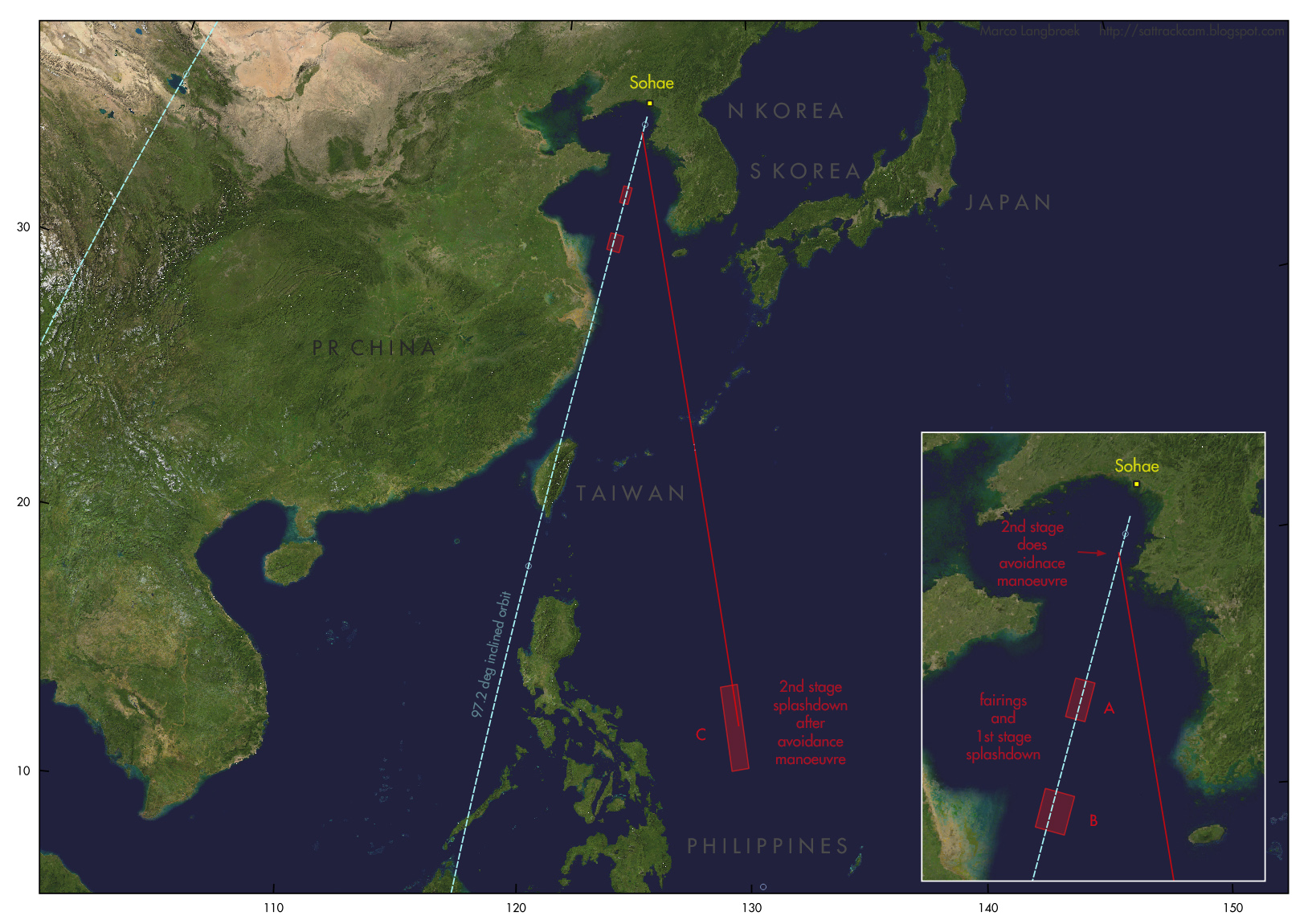
The Broadcast Navigational Warnings issued delineate three splash-down areas of rocket debris:

HYDROPAC 294/16
WESTERN NORTH PACIFIC.
YELLOW SEA.
EAST CHINA SEA.
PHILIPPINE SEA.
ROCKETS.
DNC 23.
1. HAZARDOUS OPERATIONS 2230Z TO 0330Z COMMENCING
   DAILY 07 THRU 24 FEB IN AREAS:
   A. BETWEEN 35-19N 36-04N AND 124-30E 124-54E.
   B. BOUND BY
      33-16N 124-11E, 32-22N 124-11E,
      32-21N 125-08E, 33-16N 125-09E.
   C. BOUND BY
      19-44N 123-53E, 17-01N 123-52E,
      17-00N 124-48E, 19-43N 124-51E.
2. CANCEL THIS MSG 250430Z FEB 16
.

[added note: the original letter of North Korea to the Int. Maritime Organization on which this navigational warning is based, is here].

Area A is the splash-down area for the first stage, area B for the fairings, and area C for the second stage (the third stage will remain on-orbit after launch). Plotting these on a map (red boxes in map below) reveals them to be on a north-south line with azimuth ~180 degrees (yellow line), avoiding the main islands of Japan:

(click map to enlarge)

The ~180 degree launch azimuth points to a satellite launch into Polar orbit, very similar to the launch direction of North Korea's previous satellite, Kwangmyŏngsŏng (KMS) 3-2 (2012-072A) three years ago (a nice background piece on that launch by Brian Weeden discussing "satellite launch or missile test?" can be found here). Compare my map above to the map constructed from the NOTAM's for the KMS 3-2 launch in 2012 on Bob Christy's website, [edit: and see also the comparison of 2012 to 2016 in this blogpost by Melissa Hanham on the Arms Control Wonk blog].

As was the case with their previous KMS 3-2 launch, the intended satellite orbit is, given the launch direction, likely a sun-synchronous orbit with an orbital inclination of 97 degrees. The launch direction due south rather than directly into a ~97 degree inclined orbit has been chosen to avoid overflying (and debris landing on) the territories of China and Taiwan during the ascend phase. In order to reach a true sun-synchronous orbit with inclination ~97 degrees, it necessitates a dog-leg manoeuvre of the third stage with payload during the final phase of the ascend to orbit (blue line in map above, approximate only). Orbit insertion of the payload will be about ten minutes after launch, just before reaching the Phillipines.

Assuming the resulting orbit of the satellite will be similar to that of KMS 3-2 in 2012 (perigee ~495 km, apogee ~588 km, inclination 97.4 degrees), the trajectory of its first revolution around earth will look something like this (yellow dot shows satellite position one hour after orbit insertion):


(click map to enlarge)

The launch window is 17 days long, and runs daily from 22:30 to 03:30 UT, according to the Broadcast Warning. The daily 22:30-03:30 UT window is similar to that of the KMS 3-2 launch in 2012. It runs from local daybreak to just short of local noon, indicating a desire for an orbital plane resulting in morning passes.

[edit: the paragraph below was slightly editted on 5 Feb 2016, expanding the discussion of possible launch times]

In 2012, KMS 3-2 was launched at 00:49:49 UT, almost exactly two hours after Pyongyang sunrise (22:50 UT). This suggests (if a similar orbital plane with overfly times at ~9h am local time is aimed for) that the current launch might happen somewhere between 00:24-00:41 UT, depending on whether the aim is for launch at a similar solar elevation (then it will be close to 00:24 UT) or merely two hours after Pyongyang sunrise (then it will be close to 00:41 UT). However (see the next paragraph), the timing of the 2012 launch also seems to have been (at least partially) dictated by a suitable window lacking overflights by western reconnaissance satellites. As for the date, I hesitate to prophecy on this, but I wouldn't be surprised if they go - weather permitting- for February 8, the first day in the 17-day window.

It appears that the North Koreans carefully chose their launch moment in 2012. US military sources already had claimed shortly after the launch that North Korea had played a ruse on them and evidently knew when western optical imaging satellites had (and had not had) view of the launch installations. This seems to be confirmed by my independent analysis of that launch from December 2012, which showed that the North Koreans used the very end of a longer-than-usual one-hour gap in IMINT coverage of the launch site to launch. And as I wrote in that blog post, a North Korean IP address had been looking for orbital elements of  US optical and radar satellites on this very blog just days before the launch.

The ruse was apparently designed to keep the USA, Japan and South Korea in the dark about the launch moment until the actual moment of launch itself (which would be registered by SBIRS and DSP satellites), as a counter-measure to give potential intercepts of the rocket as little advance preparation time as possible.

It would be difficult for North Korea to repeat such a ruse these days, as the number of western optical and radar reconnaissance satellites has grown ubiquitously in the past three years. Assuming launch near 00:40 UT (two hours after sunrise), the most promising dates (from the perspective of relative lack of western IMINT coverage) are three dates in the first week of the launch window:  February 8, 10 and 14. But maybe North Korea is confident enough this time, following the experience with KMS 3-2, to not bother with western IMINT coverage at all.

Monday, 24 December 2012

The flashing behaviour of North Korea's tumbling Kwangmyongsong 3-2 satellite

North Korea's first satellite Kwangmyongsong 3-2 (KMS 3-2) cannot be seen from the northern hemisphere at the moment (and hence cannot be observed by me currently). On the southern hemisphere, Greg Roberts (CoSatTrak) in South Africa is however successfully tracking the satellite.

He had a particular good pass on December 20th and obtained a very nice video record, tracking on the satellite with a motorized mount (note: movie has a period of black screen between opening title and start of the video record):

Greg Robert's video from S-Africa
(posted with permission)


The satellite is the object near the center of the screen, flashing about each 8.5 seconds with periods of invisibility inbetween. The moving streaks are stars (the mount is tracking the satellite as it moved along the sky): the other stationary dots in the image are hot pixels on the sensor of the video camera.

The video allows for an analysis of the flashing behaviour of the satellite. I used LiMovie to measure the satellites' brightness on the frames, resulting in the following lightcurve:

click diagram to enlarge

Visible is a clear ~8.45s periodicity with flashes of a specular character (suggesting a flat reflective surface). I have marked this with red triangles 8.45 seconds apart. In between the main flashes, a pattern of smaller secondary flashes can be discerned in a semi 8.45 second peridicity too (green triangles). They are not exactly positioned halfway between major flashes.

Assuming that each major flash is a flash caused by one of the sides of the KMS 3-2 cube-shaped body, then it completes a tumble once every ~33.8 seconds. Assuming that the less clear secondary flashes are due to a side of the cube as well, the tumbling periodicity would be half of that, i.e. 16.9 seconds.

Greg recorded the UNHA-3 r/b from the launch too. That one too is tumbling:

Greg Robert's video from S-Africa
(posted with permission)


Again, I used LiMovie to extract brightness information from each video frame. That was less successful with this video, because Greg's mount had difficulty keeping up with the fast-moving r/b for much of the record. A considerable part of the video could not be used for analysis, and I had to chop up the analysis in little non-continuous chunks:

click diagram to enlarge


What can be seen, is a flashing behaviour that starts slow and gentle and is increasing in rapidity near the end of the analysis, this being an effect of changing viewing angle.

Contrary to what some alarmist (sometimes almost hysterical) media reports have suggested, the tumbling of KMS 3-2 is by no means dangerous. David Wright over at All Things Nuclear has a very good debunking story about this all, pointing out the many misconceptions rampant in the reporting.