Showing posts with label Kosmos 2558. Show all posts

Sunday, 29 June 2025

Kosmos 2558 released an object on orbit on June 26 [UPDATED]

Object C (click image to enlarge)


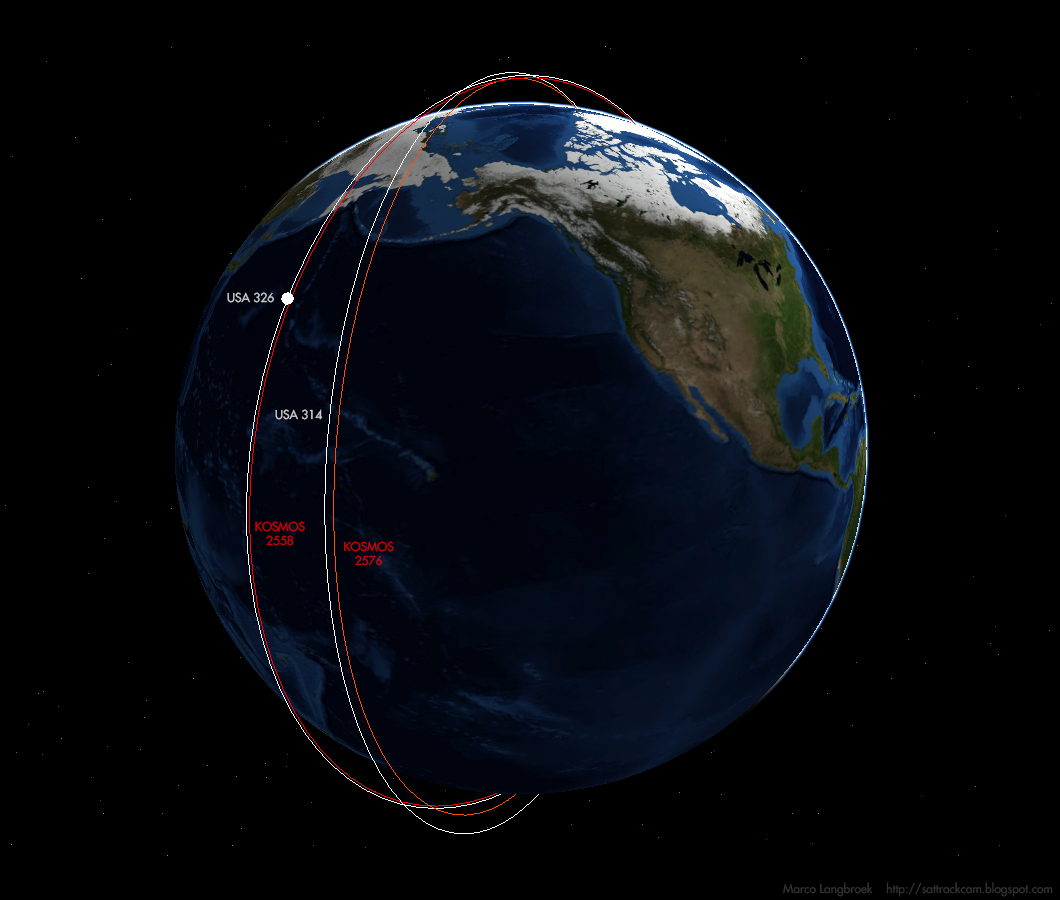
Kosmos 2558 (2022-089A, cat nr. 53323) is a Russian military satellite that was launched from Plesetsk three years ago, on 1 August 2022. It was launched into the orbital plane of an American ADVANCED CRYSTAL spy satellite, USA 326. It is therefore believed to be a 'Nivelir' type 'inspection satellite' (see also this earlier discussion of several of such missions, and Bart Hendrickx' Space Review article on the Nivelir program  here).

As I recently wrote, there have now been four of these missions in a five-year timespan. Apart from Kosmos 2558 discussed here, these are: Kosmos 2542/2543 launched in the orbital plane of USA 245 in 2020;  Kosmos 2576 placed in the orbital plane of USA 314 in 2024 (see this earlier blogpost); and very recently, Kosmos 2588 placed in the orbital plane of USA 338 (see this earlier blogpost). 

With the exception of Kosmos 2542/2543, which have been deorbitted, all three remaining missions are still dedicatedly shadowing their American targets, keeping their orbital altitude and inclination difference such that the rate of RAAN (node) precession matches that of their target. This ensures that the orbital planes do not drift apart.

While mostly seen as 'inspection missions', I have repeatedly voiced a concern that these missions might be the positioning of 'dormant' on-orbit Anti-Satellite (ASAT) weapons. To me, the long, ongoing shadowing of what are some of the most prized US military space assets, their KH-11 Advanced Enhanced Crystal high-resolution optical IMINT satellites, is odd for 'just' an inspection mission. What is there still left to inspect after 3+ years? The satellites make only periodic close approaches (every few days) so monitoring of attitude (pointing) or radio signals is not an explanation.

Understandibly, the 'stalking' behaviour of these Kosmos satellites on their satellites makes the US military nervous. And now they have yet another reason to get even more nervous: on 26 June 2025 near 12:03 UTC (according to my analysis), Kosmos 2558 released  a second object, currently designated as 'Object C' (2022-089C, cat nr. 64627). 

The release is actually visible in the orbital elements for kosmos 2558, as a sudden slight lowering of the orbit:
 

Click diagram to enlarge
 

This is the third time we see this kind of 'Matrushka Doll' behaviour from Russian military satellites in five years time. 

Shortly after reaching orbit in 2020, Kosmos 2542 released a sub-satellite too, Kosmos 2543, which next in turn fired what is interpreted as a projectile, 'object E' (the latter was widely seen as an ASAT technology test at the time). 

In addition, more recently, Kosmos 2583 released an object, 'Object F' (2025-026F), on 18 March this year, as part of a complex series of RPO's (Rendezvous- and Proximity Operations) between Kosmos 2581, Kosmos 2582, Kosmos 2583 and said 'Object F'. I will publish a separate blogpost on these later [edit: separate post now available here].

In 2020 and more recently with Kosmos 2583 and 'Object F', this spawning of other objects happened within weeks after the launch of the parent satellite. But this time with Kosmos 2558 and 'Object C', the release of a second object happened almost three years after launch.

I observed Kosmos 2558 and the newly released 'Object C' last night. 'Object C' reached magnitude +8. The images below are 1-second frame stacks from video observations I made from Leiden, the Netherlands, on the night of 28-29 June 2025, two-and-a-half days after 'Object C' was released. At the time of observation, 'Object C' was some 143 km distant from Kosmos 2558, passing the camera FOV some 16-seconds after it. The first framestack shows 'Object C'; the second shows Kosmos 2558.


Object C (click image to enlarge)


Kosmos 2558 (click image to enlarge)

Below is the video footage of the pass in question. The first to pass through the FOV is Kosmos 2558 as a bright object: then, some 16 seconds later, 'Object C' passes through the FOV as a fainter object. The footage was shot from Leiden, the Netherlands, with a WATEC 902H2 Supreme camera and Samyang 1.2/85 mm lens.


It will be interesting to see whether any manoeuvering between the two objects is happening over the coming weeks.


UPDATE 4 July 2025:

Since release, Object C has been manouevering with respect to Kosmos 2558. While initially manouevering back to Kosmos 2558, it lowered its orbit significantly (by 15 km) on July 3 near 18:42 UTC. See diagram below.

Click diagram to enlarge

Monday, 20 May 2024

The Russian KOSMOS 2576 launch of May 16, and USA 314: another 'inspector satellite'? [UPDATED]

click to enlarge


 (this blogpost reflects discussions with and information provided by Bart Hendrickx, Bob Christy and Jonathan McDowell)

In a previous blogpost I wrote about a Russian launch into SSO from Plesetsk on May 16. According to Roscosmos, the launch was at 21:21:29 UTC.

Based on the Sun-Synchronous orbit indicated by the launch azimuth I initially suspected this to be a new IMINT mission, but now I am not so sure. 

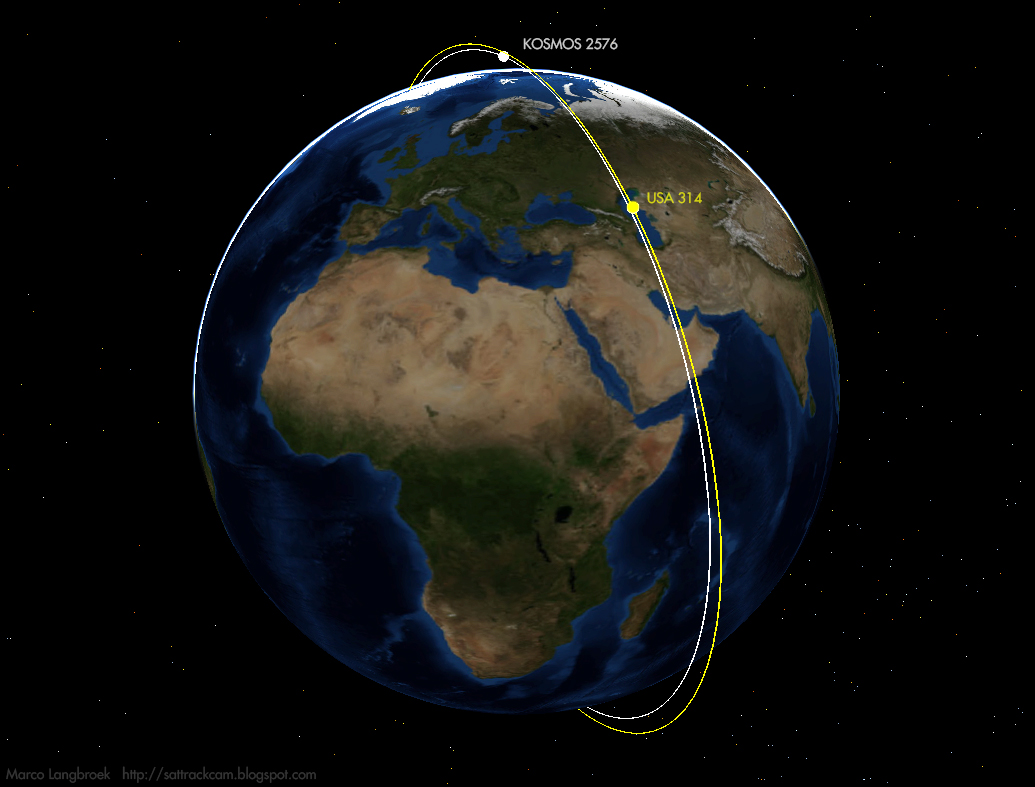
IMINT is part of it, but not all, and the primary payload, KOSMOS 2576, might actually be another inspector satellite, this time targetting the American KH-11 ADVANCED CRYSTAL spy satellite USA 314 (2021-032A), as suggested by Bob Christy.

The launch inserted at least 9 objects into space (2024-092A to J), and possibly more: all in basically the same orbital plane (with small subgroups), but at different orbital altitudes. Based on the nine objects catalogued so far (status 20 May 2024), four groups can be discerned, based on orbital period and inclination:

GROUP     ORBIT (km)  INC     PERIOD   OBJECT(S) possible ID
I         451 x 435   97.25   93.45    A         KOSMOS 2576
II        796 x 780   98.59   100.62   G,H,J     Rassvet
IIIa      552 x 532   97.59   95.52    D,E,F,K   SITRO-AIS
IIIb      548 x 531   97.59   95.45    B,C       Zorkiy 2M

As expected, Roscosmos has announced the primary military payload to be designated KOSMOS 2576. It is likely object A (see below) that stands out as a lone object in orbital altitude and inclination. 

Also part of this launch, according to sources, are three civilian Rassvet satellites that provide high speed internet connectivity; and (as announced by Sputnix) two civil Zorkiy 2M earth observation satellites, and four civil SITRO-AIS satellites (the latter six all cubesats). This means that at least one satellite has not been catalogued yet, if these numbers are correct. [edit: this fourth satellite has now also been catalogued, as object K]

To make it even more complex, some analysts believed the launch to have included three military Razbeg Optical reconnaissance satellites as well. But this now seems less likely.

The orbital plane that the primary payload, Kosmos 2576 was launched into, might not be random. As was first pointed out by Bob Christy, the orbital plane closely matches that of the American KH-11 ADVANCED CRYSTAL spy satellite USA 314 (2021-032A).

In the past, we have seen this happen before. In August 2022, Kosmos 2558 was inserted into the orbital plane of the American KH-11 spy satellite  USA 326 (see this earlier blogpost), making close approaches each 5 days. Earlier, in 2020, Kosmos 2542 and its spawn Kosmos 2543 were inserted into the orbital plane of the American KH-11 spy satellite USA 245, also making close approaches.

Object A, the primary candidate for Kosmos 2576, differs in RAAN with USA 314 by only 0.02 degrees, and in inclination by only 0.8 degrees. Its current orbital altitude (451 x 436 km) is lower than that of USA 314 (769 x 548 km), but both orbital altitude and inclination are the same as that of a previous 'inspector satellite', Kosmos 2558 (see earlier blogpost). Object A might raise its orbit in the future or, like Kosmos 2542 did in 2020, spawn a second satellite that moves upwards in orbit. It will be interesting to see what object A will or will not do in the near future.


click to enlarge

The reason to see the lone group I object, object A as the primary payload (Kosmos 2576) is the following: 

First, as already mentioned, its orbital plane closely matched that of USA 314, and as Bob Christy noted,  its orbit in terms of altitude and inclination closely matches that of a previous 'inspector satellite' that targetted a US KH-11 satellite, Kosmos 2558. 

Second: when propagated backwards to the time of launch, the object is placed close to Plesetsk; and its orbital plane passes right over the stage deorbit area from Navigational Warning NAVAREA XII 330/24 in the Pacific Ocean (see map below, and see also previous post for maps and discussion), related to the initial launch phase. This indicates that object A is the primary payload and the first of the objects to be released into orbit. 

click m ap to enlarge
 

By contrast, the three group II objects (G, H, J) at ~780 km do not match the deorbit area in the Pacific well at all (as can be seen in the map above), and back-propagated to the launch time they do not come out near Plesetsk. This indicates manoeuvers before their orbit insertion.

The orbital insertion sequence of the various objects from this launch was probably as follows:

(1) launch into 97.24 inclined, 435 x 451 km orbit, insertion of object A (primary payload);
(2) manoeuver up into 98.59 inclined, 780 x 796 km orbit, insertion of objects G,H,J (secondary payloads);
(3) manoever down into 97.59 inclined, 535 x 552 km orbit, insertion of objects D,E,F,K;
(4) slightly lower apogee, no inclination change, 531 x 548 km orbit, insertion of objects B,C;
(5) Fregat stage deorbit reentry ~10h 20m after launch.

The reasoning behind this sequence is the following:

In addition to the Navigational Warnings which I discussed above and in a previous post, Bob Christy found a NOTAM in the Indian Ocean which is likely for the Fregat stage deorbit, with a time window starting some 10 hours after launch (suggesting a prolonged coast phase and/or multiple manoeuvers):

F1791/24 NOTAMN
Q) YMMM/QWMLW/IV/BO/W/000/999/2815S07736E500
A) YMMM
B) 2405170700 C) 2405220900
D) DAILY 0700-0900
E) ROCKET LAUNCH FROM RUSSIA WILL TAKE PLACE
FLW RECEIVED FROM GOVERNMENT OF RUSSIA:
THE MINISTRY OF DEFENSE OF RUSSIA PLANS TO LAUNCH MISSILE IN THE
SPACE AND TO SINK ITS FRAGMENTS IN THE WATERS OF THE OCEAN.
CHARACTERISTICS OF IMPACT AREA:
3521S07521E
2100S07900E
2109S07936E
3530S07603E
3521S07521E
F) SFC G) UNL
CREATED: 14 May 2024 12:33:00
SOURCE: YBBBZEZX


The orbital plane of the group III objects (see table earlier in this post) B, C, D, E,  F and K passes over this area, 10h 20m after launch (i.e. near 7:40 UTC, May 17).This could indicate that these objects were the last to be released, before deorbit of the Fregat stage. The orbital planes of group I and II do not match this deorbit area that well, passing somewhat east and west of it. 

click map to enlarge
 

This leaves group II objects G, H J, the ones in the highest orbit (~780 km), whose orbital plane matches neither the Pacific Ocean nor Indian Ocean deorbit areas particularly well. This indicates manoeuvers both before and after their release, suggesting their orbital insertion was between that of group I and group III.

As to the possible identities of the objects from group II, IIIa and IIIb:

The orbital inclination and period (95.45 minutes and 97.6 degrees) of the two group IIIb objects (B, C) match those of two objects (2024-092B and C) from a previous launch that included Zorkiy 2M satellites. So objects B and C of the current launch are probably the two Zorkiy 2M payloads.

The orbital inclination and period  (95.52 minutes and 97.6 degrees) of the three group IIIa objects (D, E, F, K) match those of both earlier Rassvet and SITRO-AIS launches, but their number matches the number of SITRO-AIS payloads announced in this launch.

The three group II objects (G, H, J) in the higher ~780 km orbit match neither previous Rassvet, SITRO-AIS or Zorkiy 2M launches. But by a process of ellimination they must be the three Rassvet payloads announced - if there are no other objects catalogued in the future.

The picture presented here might be revised if more objects are catalogued. For now, this is my best interpretation. It will be particularly interesting to see what object A will do.


UPDATE 22 May 2024:

US United Nations ambassadeur Robert Wood has, in a May 20 UN Security Council debate, accused Russia of launching a 'counterspace weapon' into Low earth Orbit on May 16. The claim was later repeated, including a mention of it being in "the same orbit" as a US Government satellite, by Pentagon spokesman Brig. General Pat Ryder.

This clearly refers to Kosmos 2576 (object A) - the US military evidently also thinks the co-orbital character of Kosmos 2576 with USA 314 is no coincidence. 

Russia flatly dismisses the suggestion, calling it "fake news".

Currently, there are two Russian satellites in LEO that are suspiciously co-planar with an American KH-11 ADVANCED CRYSTAL electro-optical reconnaissance satellite: Kosmos 2558 (2022-089A) co-planar with USA 326 (2022-009A); and now Kosmos 2576 (2024-092A) co-planar with USA 314 (2021-032A). Kosmos 2558 currently makes approaches to ~50 km to USA 326 each 7 days.

click image to enlarge

For those who want to compare, here are two recent orbits for USA 314 and USA 326 based on amateur tracking data:

USA 314
1 48247U 21032A   24141.96990730 0.00002000  00000-0  27073-3 0    05
2 48247  98.0438 254.1015 0157205 111.3087 248.6912 14.70745533    09
USA 326
1 51445U 22009A   24141.98253796 0.00017500  00000-0  79138-3 0    00
2 51445  97.4250 239.7279 0011614 145.1315 214.8683 15.20909891    06

Wednesday, 7 September 2022

Kosmos 2558 keeping its orbit close to USA 326 [UPDATED]

 [updated 9 Sept 2022 20:00 UTC]


In a series of previous blogposts (here, here and here) I wrote about a cat-and-mouse game going on in space, where the recently launched Russian satellite Kosmos 2558 (2022-089A) is stalking the US spy satellite USA 326 (2022-009A).

That game of cat-and-mouse is still ongoing. Over the past week, Kosmos 2558 has been making adjustments to its orbital inclination (see the diagram above). 

At first glance, you would say that it is apparently moving its orbit away from USA 326, as it is increasing the difference in orbital inclination.

But that is deceptive. The difference in orbital inclination between the two objects is actually very small (currently 0.2 degrees), and so is the difference in RAAN (currently 0.26 degrees). The two objects basically share the same orbital plane.

So why the adjustments in orbital inclination? If you look at the diagram below, which depicts the effects of the orbital inclination adjustments on the precession of the RAAN (i.e. the drift of the node of the orbit), you will note that the effect is that the RAAN precession starts to more closely match that of USA 326.

In other words:  the adjustment is actually in order to get the precession of the two orbital planes synchronised, i.e. to make sure the orbital planes do not drift too far apart. This ensures that the two objects will continue to share virtually the same orbital plane.


Click diagrams to enlarge 


Because Kosmos 2558, while sharing the same orbital plane as USA 326, is orbiting at a slightly lower orbital altitude than USA 326 (on average some 60 km lower), its orbital inclination needs to be slightly different from that of USA 326 in order to maintain a similar RAAN precession: the rate of RAAN precession depends on both the inclination and orbital altitude.

The fact that it is making adjustments to synchronize its rate of RAAN precession with that of USA 326, again makes clear that the launch of Kosmos 2558 into the orbital plane of USA 326 is no coincidence.

The image below shows how closely the orbital planes match: the main difference is a relatively small difference in altitude. This results in slightly different orbital periods for both satellites, and as a result Kosmos 2558 is 'taking over' USA 326 every 5 days, resulting in flyby's at distances of 60 to 80 km each 5 days.


click image to enlarge


UPDATE 9 Sept 2022 20:00 UTC:

Kosmos 2558 made an orbit raising manoeuvre on 8 September 2022 around 11:10 UTC, raising apogee by 5.5 km and perigee by 1 km. It also adjusted its orbital inclination again, to get the RAAN precession closer to that of USA 329:


click diagram to enlarge

click diagram to enlarge

Saturday, 6 August 2022

The flyby of USA 326 by Kosmos 2558 on August 4: a post-analysis

click image to enlarge

In a previous post I discussed the launch of Kosmos 2558 (2022-089A), a Russian military satellite which was launched from Plesetsk on August 1, 2022. 

As I pointed out, it was inserted into the same orbital plane as the American classified military satellite USA 326 (2022-009A, an electro-optical reconnaissance satellite launched in February 2022), at an orbital altitude only a few tens of kilometers below it. 

And that was probably no coincidence: Kosmos 25578 is likely an 'inspector' satellite meant to surreptitiously check out USA 326.


click image to enlarge


The two satellites had a relatively close flyby on August 4. I did a post-encounter analysis based on orbits from before and after the flyby, to assess the time and the distance of the flyby.

I find that the close flyby happened near 14:16:27 UTC (August 4, 2022), give or take a few seconds, at a nominal distance of ~67 km. Most of that distance (about 64 km) is in altitude. 

The flyby happened in daylight near 42.3 N, 25.9 W, over the mid-Atlantic, while both objects were southbound. USA 326 was at an altitude of about 518 km at that time, and Kosdmos 2558 at an altitude of about 453km.

Below is an animation of the flyby, as seen from two viewpoints (first lateral, than oblique):


~67 km is a clear safe distance and therefore no cause for worry (although it worried some generals in the Pentagon perhaps), but nevertheless close enough to make it interesting. I strongly suspect that Kosmos 2558 was imaging USA 326 at the time, in an attempt to gather information on the character of the satellite.

The diagram below gives the distance with time between Kosmos 2558 and USA 326 around the time of the approach.

click diagram to enlarge

It will be interesting to follow the two objects and see whether a new flyby happens at some point. In a previous similar case in early 2020, another Kosmos satellite, Kosmos 2542, was sent to check out the US military satellite USA 245, and released a second satellite, kosmos 2543, that chased the US satellite for a while.


Added comment:


Fred Jansen made a pertinent remark: from launch to operational in a mere 3 days would be awfully fast.
Another issue, brought up by Allan Thomson, is that the Sun-Kosmos 2558-USA 326 angle was quite low during this encounter, which is  not ideal.

However, as the two objecst share the same orbital plane, these encounters repeat at intervals: so even if it was not ready and fully operational yet during this approach, there will be other opportunities in the future. It will be interesting to see whether Kosmos 2558 will raise its orbit at some point, or will do other manoeuvres to keep the precession of its RAAN in line with that of USA 326.


(Note: the orbital elements for USA 326 used in this analysis are based on optical tracking data by an international group of  Independent Space Observers, including myself, Cees Bassa and Russel Eberst)

Wednesday, 3 August 2022

A stalker and its prey (Kosmos 2558 and USA 326)


In my previous post I discussed the newly launched Russian military satellite Kosmos 2558 (2022-089A), that was launched on August 1 into the orbital plane of the US military IMINT satellite USA 326 (2022-009A). There are indications that it is an 'inspector' satellite that is going to take a detailed look at USA 326.

Last night I observed them both, passing about half an hour after each other. Over the enxt 24 hrs Kosmos 2558 will approach USA 326, to a distance of ~75 km on August 4 ~14:47 UTC, if they do not manouvre in the mean time.

Above are framestacks from the captures (in the image with USA 326, a flaring Starlink, Starlink-1349, is also visible, in the lower left corner).

Below is the video footage. It was taken with a WATEC 902H2 Supreme with a Pentax 1.2/50 mm lens at 25 fps.

It will be interesting to follow this Cold war cat-and-mouse game above our heads over the coming days and weeks....


Tuesday, 2 August 2022

Kosmos 2558, a Russian inspector satellite targetting the US IMINT satellite USA 326?


click image to enlarge

On August 1, 2022, at 20:25 UTC, Russia launched a Soyuz 2.1v carrying a military satellite from Plesetsk into a Polar orbit. It has since been catalogued under nr 53323 (COSPAR ID is 2022-089A). It will probably receive the designation Kosmos 2558. 

Directly after launch it was in a 435 x 452 km, 97.25 degree inclined orbit. The Volga upper stage was catalogued in a 284 x 425 km orbit.

Before the launch, there was a rumour that this was another 'inspector' satellite - a snooping satellite meant to covertly inspect another satellite. After some speculation about the potential target arose, I pointed out that the middle of the launch window as indicated by NOTAM's for the launch, 20:30 UTC, was close to the moment that the orbital plane of the classified US electro-optical IMINT satellite USA 326 (2022-009A) passed over Plesetsk, at 20:25 UTC. 

And sure enough, it did indeed launch at 20:25 UTC, into the orbital plane of USA 326. And as it turned out, into an orbital altitude that is close as well.

The apparent target, USA 326, was launched in February and is widely believed to be a new generation electro-optical IMINT satellite. It moves in a 97.4 degree inclined, 489 x 518 km sun-synchronous polar orbit. 

The RAAN of the newly launched Kosmos 2558 matches the RAAN of USA 326 closely, with a difference of only 0.04 degree (changing by about 0.01 degree/day). The close correspondance of the two orbital planes can be seen in the diagram above. The orbital altitude of Kosmos 2558 is about 60 km lower than that of USA 326, but that might change if any post-launch manoeuvres are done the coming days and weeks.

With the current orbit, Kosmos 2558 will make a relatively close approach to USA 236 at August 4 near 14:47 UTC. The approach distance is ~75 km, almost all of that (73 km) is in altitude.

 [EDIT: a post-encounter analysis on 6 Aug 2022 based on orbits closer to the approach moment gives 4 August ~14:16:27 UTC for the approach, and a nominal distance of 67 km, most of this in altitude]

In early 2020, Russia did something similar with Kosmos 2542/2543, directing it towards the KH-11 electro-optical reconnaissance satellite USA 245.

It will be interesting to follow both satellites the coming weeks, to see what happens.