Showing posts with label Cygnus. Show all posts

Tuesday, 26 May 2020

Imaging some splendid passes of HTV-9 (Kounotori-9) and Cygnus NG-13


It are very busy times at the International Space Station. Spaceships come and go.

First, on May 11, the US cargoship Cygnus NG-13 was released from the ISS, three months after berthing to it. This cargoship had been launched on 15 February 2020 and berthed on 18 February. After its release from the ISS two weeks ago, it is currently free-flying to do experiments. It will perform a controlled reentry over the southern Pacific on 29 May.

On 20 May at 17:31 UT, the Japanese cargoship HTV-9 (Kounotori-9) was launched. It berthed to the ISS on 25 May. This provided the opportunity to see two ISS cargoships, one departing and one arriving, in the sky last week.

And it continues: we are in anticipation of the Crew Dragon Demo-2 launch, on May 27 if weather cooperates (see my previous blogpost), bringing to astronauts to the ISS.

Both Cygnus NG-13 and HTV-9 made some splendid evening passes last week. Weather was clear on most days, allowing me to observe and photograph several passes, often two on one evening. Through Twitter, I managed to get a lot of people to go out and watch the passes. HTV's are very bright and distinctly orange objects, easily visible with the naked eye even in deep twilight and from an urban environment. So they are ideal objects to get people out and watch.

HTV-9 was a spectacular sight on every pass. It reached magnitude 0 to -1, with a very distinct orange colour that is due to the orange thermal foil it is wrapped in. It was also prone to producing brief bright flares to magnitude -2 to -3. It did this on almost every pass, sometimes multiple times. here is an example, from May 21:


Click to enlarge

click to enlarge

Below are a number of photographic stacks I made during these HTV-9 passes (gaps in the trails are the brief periods between successive photographs in the stack). The first image showing another flare: the second bright satellite crossing the path of HTV-9 in the third image is Resurs P1. Note the orange colour, especially apparent in the second image. Visually, the orange colour was even more profound than in these images (where they have washed out a bit due to the brightness of the trail).


Click to enlarge
Click to enlarge
Click to enlarge


Cygnus NG-13 was much fainter than HTV-9. During a  good pass it would reach magntude +3, but often was below naked eye visibility. Here is imagery from one of the brighter passes, on May 19 when it reached magnitude +3:


click to enlarge
Click to enlarge
Click to enlarge

Click to enlarge


Thursday, 24 May 2018

Orbital ATK's Cygnus AO-9 cargoship chasing the ISS

click to enlarge
click to enlarge


The two images above show Orbital ATK's Cygnus AO-9 cargoshi  chasing the International Space Station (ISS), a few hours prior to berthing. The Cygnus OA-9 cargoship, launched on May 21 from Wallops Island, brings supplies (food, equipment etc.) to the Space Station.

I could observe three passes of the two objects during the night of May 23-24: in all three cases the two objects could be seenr at the same time in the sky, with the Cygnus (the fainter trail in the images above) somewhat behind ISS.

The images above are from the first pass (21:48 UT, 23:48 local time), a high pass,  and the third pass (01:00 UT, 03:00m local time), low over the southwest horizon. The Cygnus spacecraft was about 22 seconds behind the ISS on the third pass. The sky over Leiden was somewhat hazy.

The very short third trail near the ISS on the first image is Kosmos 2392.

As usual, the Cygnus spacecraft was quite faint (mag +4.5), so not an easy naked eye target. The brightness of these Cygnus spacecraft is strongly phase-angle dependent. The Dragon spacecraft of their competitor SpaceX are much brighter and easier to see.

The video footage below is from the third pass:

Monday, 5 June 2017

Cygnus OA-7 and Dragon CRS-11 chasing the ISS in a twilight sky

ISS and Cygnus OA-7. Click to enlarge

June 3, the launch date of SpaceX's Dragon CRS-11 cargo spacecraft to the International Space Station (ISS), was clouded out in Leiden, much to my frustration.

But yesterday evening was (sort of) clear, albeit with cirrus in the sky and a moon that was quite a nuisance. It allowed me to observe the ISS, the Dragon CRS-11, and Orbital ATK's Cygnus OA-7, which had de-coupled from the ISS a few hours earlier, making a low elevation pass (less than 35 degrees elevation) in the southern sky.

The image above shows the ISS (the bright object near the tree) and, as a faint trail, the Cygnus OA-7 (upper right corner, in the cirrus), descending towards the SE horizon.

Below is a better picture of Cygnus OA-7, shot 25 seconds later (ISS is already behind the tree here):

Cygnus OA-7. Click image to enlarge

Cygnus OA-7 passed ~25 seconds after the ISS. One minute later, ~1m 25s behind the ISS and on a slightly lower elevation track came another object: Dragon CRS-11:

Dragon CRS-11. Click image to enlarge

I did not expect the Dragon to be behind the ISS: I expected it somewhat in front of it. So initially I was miffed that I missed it (see below, this evening did not go quite well): to be surprised by it appearing behind the ISS!

This evening did initially not go well, but in a weird way eventually turned out fine.

A number of objects would pass in a short timespan of a few minutes: USA 276, the Dragon solar panel covers, Dragon, ISS, and somewhere nearby the ISS also Cygnus OA-7.

There were no post-ISS-release elements for the Cygnus yet, so its position would be a guess, although I reckoned it probably still was close to the ISS. Cygnus are usually faint (this time too) and only naked eye objects under favourable circumstances (usually, as this time, close to shadow ingress).

For Dragon, only a day old elements were available. These placed Dragon a few minutes in front of the ISS. As it no doubt would have manoeuvered during that day, I expected it to be closer to the ISS in reality, but that it was behind the ISS, that was a bit unanticipated.

The passes occurred in twilight (sun about 10 deg below the horizon). As obtaining new astrometric data on USA 276 (see story here for as to why) was important, I had set up the WATEC video camera to capture it, from the loft window (the only spot in my house where I can view that low south). That took  me longer than expected, as I initially had some trouble finding the target area in the video view (it was still deep twilight).

When I finally had found the target starfield through which USA 276 should pass, I discovered to my dismay that the pass was already imminent within minutes. As I could not visually observe through the same loft window, nor photograph, I had to be outside for that, at the city moat near my house which offers a view low south. So I grabbed my photo gear and ran outside. Arrived at the observing spot, I found that I already missed the opportunity to visually see and photograph USA 276 (luckily, the video camera in the loft window did film it). I also feared I had missed Dragon CRS-11, as I already could see the ISS approaching in the southwest. So I said a few strong words...

As ISS had passed the moon (which was a bloody nuisance, smack in the middle of the trajectory line) and was descending into the trees low in the south-southeast, I spotted a second, not too bright object chasing it (see first two images above). As I was photographing it and it descended into the trees, I re-aimed my camera hoping to catch it in a gap on the other (left) side of the tree.

Then I saw yet another object descend into the right side of the tree, and realised this was either Dragon or Cygnus. I initially thought, to my dismay, that it would be just outside my camera FOV. Luckily, back home later it turned out it still was in the FOV (I used a 35 mm lens).

The first, faint object on the same trajectory as the ISS some 25 seconds behind it I for this moment identify as Cygnus OA-7. The second, brighter one, on a trajectory just south of that of the ISS some 1m 25s behind it, I for the moment identify as the Dragon CRS-11.

Sunday, 12 January 2014

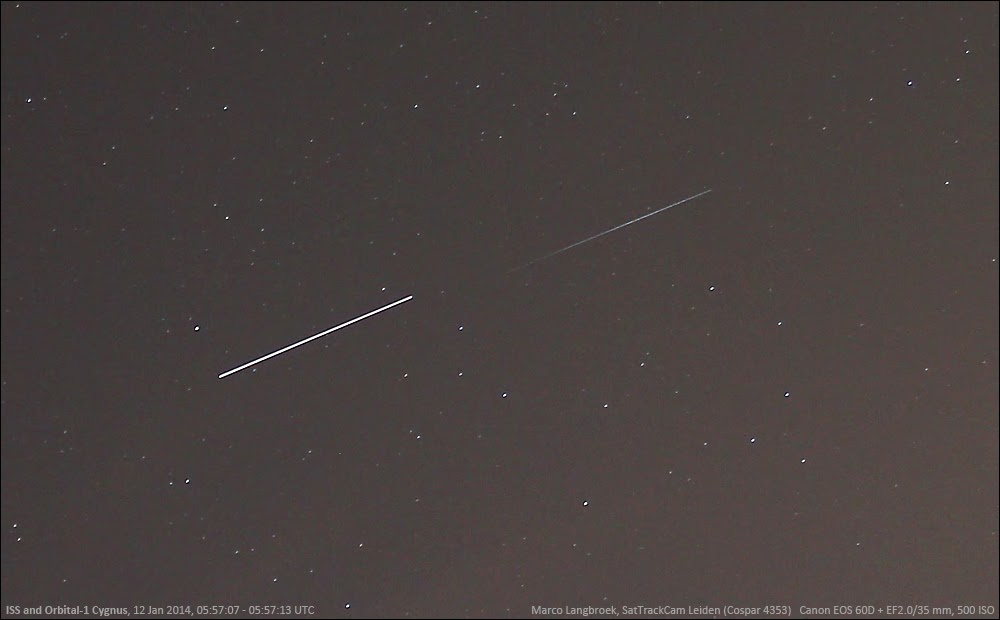
ISS and Orbital-1 Cygnus, 5 hours before docking

click image to enlarge

This morning near 6:56 local time (5:56 UT) I had a visible pass of the International Space Station ISS and the Orbital-1 Cygnus commercial cargoship bringing supplies to the ISS, five hours before the latter would dock to the first. The pass had a maximum elevation of 28 degrees, in the S-SE.

The Cygnus was faint: for most of the pass it was not visible by the naked eye (nor visible in my imagery, taken with an EF 2.0/35mm lens at F2.2 and 500 ISO).

Near 5:57:05 UT however, it briefly flared to mag. +2 and the duo ISS-Cygnus then became  well visible as a result, low in the sky at about 23 degrees elevation. They were quite close, with a pass-time difference in the order of 8 seconds. As always, seeing two spacecraft this close was an impressive (if brief) sight!

click image to enlarge

Sunday, 29 September 2013

ISS and Cygnus

On September 18, Orbital Science Corporation launched an Antares rocket from Wallops, with the Cygnus COTS demo as payload. Just like SpaceX-es Dragon, the Cygnus is a commercial cargoship built to bring cargo to the ISS as part of  the Commercial Orbital Transportation Services (COTS) initiative. The September 28 launch is the inaugural demonstration flight of the Cygnus.

Initially Cygnus was to dock with the ISS on September 22nd, but a communication problem between the ISS and the Cygnus board computer caused a delay. Next the launch and docking of Soyuz TMA-10M bringing a new astronaut crew to the ISS on September 25 intervened, with the result that the Cygnus docking was rescheduled for September 29th.

click image to enlarge

In the early morning of September 29th, around 4:01 UT (6:01 am local time), ISS and the Cygnus COTS demo cargoship made a 40-degree pass in the southern sky as seen from Leiden. I had no idea how close the pair would be before actually observing the pass. It turned out to be close, the two spacecraft passing some 15 seconds after each other. The ISS was leading, Cygnus following.

Shortly after emerging from eclipse, the Cygnus was reasonably bright (mag. +3) and visible by the naked eye. But it quickly lost brightness, and by the time the pair entered the FOV of my camera, which I had aimed at Orion, Cygnus was no longer visible to the naked eye.

As a result, the image above (taken with an EF 2.0/35mm lens) is not the best: I had to pull a full suite of post-edit tricks to make the very faint trail of the Cygnus stand out a bit better. The image shows the pair traversing the area of Orion's belt and the Orion nebula.