 |
| click map to enlarge |
On 19 June 2022 at 4:27 UT, SpaceX launched a Falcon 9 from Cape Canaveral pad 40 ostensibly carrying a Globalstar block II communications satellite, Globalstar-2 FM15.
However, something was odd about this launch, and rumour has it that it covertly launched a second unacknowledged payload for the US Government. [UPDATE: now confirmed. And it are actually 4 payloads!]
This payload, if it exists, was seemingly released into a lower orbit than the Globalstar payload eventually was, possibly (as suggested by Cosmic Penguin on Twitter) at ~535 km (the Globalstar satellite was subsequently released at a much higher ~1125 km altitude). It likely is in the same 52-degree inclined orbital plane as the Globalstar satellite.
At ~535 km and with ~52 degree orbital inclination, this means the covert payload is hiding near the forest of Starlink satellites, which orbit at around ~550 km in 53-degree inclined orbits, only slightly higher in orbital altitude and 1 degree higher in orbital inclination.
The oddities with the launch that gave rise to the rumour are listed in this Spaceflight.com article. Given the mass of a Globalstar satellite and capacity of a Falcon 9, there was no need to have the first stage land on a droneship downrange in the Atlantic Ocean, rather than have it return to land at Cape Canaveral. This suggests it might have carried a heavier payload (e.g., because a second covert payload was on board), which lead to the rumours.
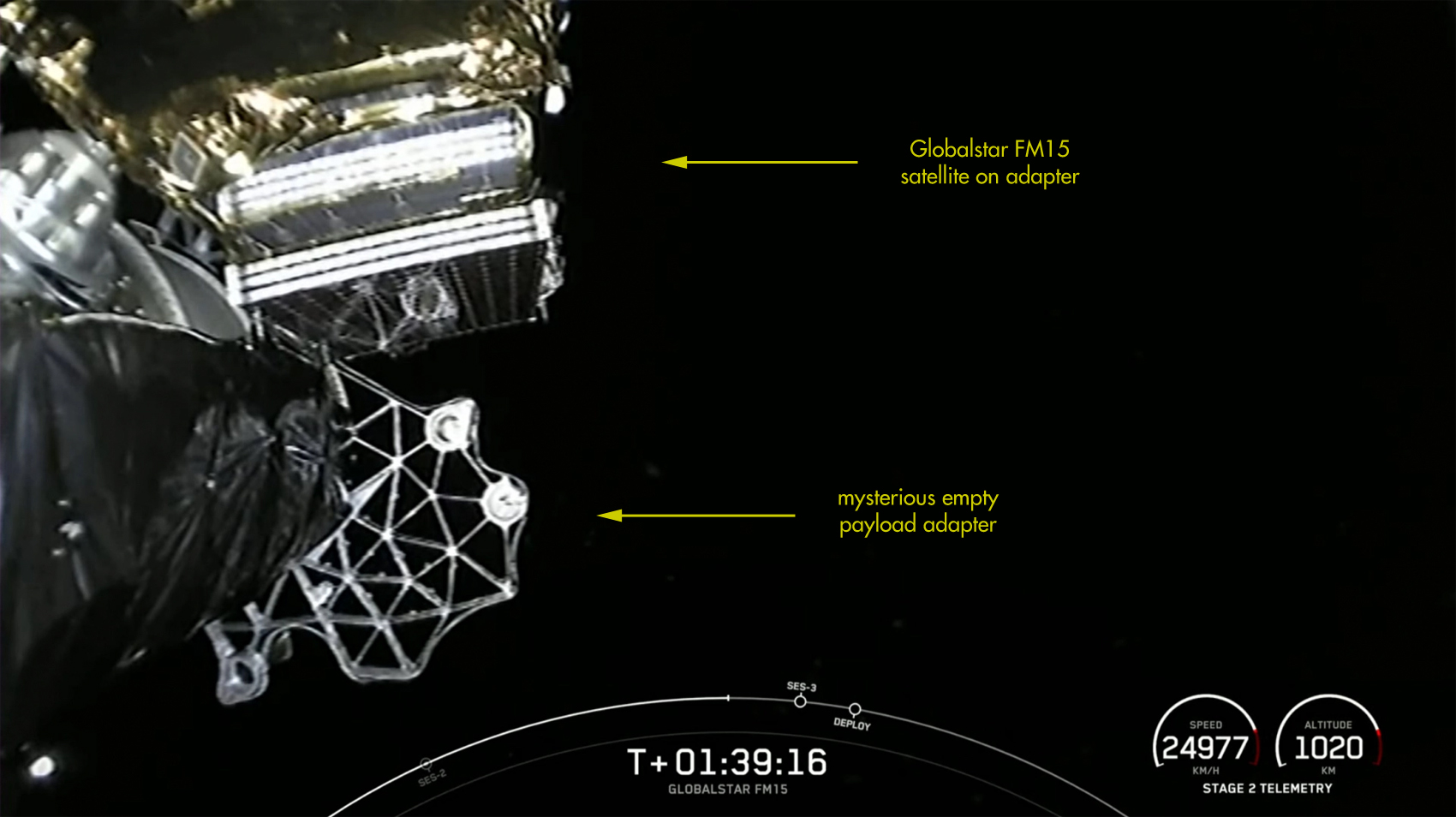
And then, just before the Globalstar deployment, live in-flight footage was shown (screenshot below) that showed something odd: the Globalstar satellite (still attached to the payload adapter on top of the rocket stage) and what looks like a second, empty payload adapter.
 |
| click image to enlarge |
So this gives credence to the suspicion of a covert deployment of a second satellite in a lower orbit, before deployment of the Globalstar payload into a higher orbit.
The live webcast made no mention of such a second payload: after initial orbit insertion of the Falcon 9 some 10.5 minutes after launch, merely a long 'coasting phase' was suggested (with no live footage during this coasting period), before an orbit raising burn 1 hour 5 minutes after launch (~5:33 UT) , followed by a circulation burn 1 hour 47 minutes after launch (~6:14 UT) and deployment of the Globalstar satellite at 1h 53 minutes after launch (6:20 UT).
At the moment the live feed cut out after reaching orbit, the Falcon 9 seemed to be in a coasting orbit at ~535 km altitude. If there was a covert second payload, it was likely released at this altitude, either just after orbit insertion of the Falcon 9 upper stage slightly over 10 minutes after launch, or just before the orbit raising burn at about an hour after launch. The latter burn, at about ~5:33 UT, was to raise the Falcon 9 plus payload to the orbital altitude of the Globalstar satellite. It was followed some 40 minutes later by a brief orbit circularization burn, at ~6.14 UT.
|
| click map to enlarge |
The orbit circularization burn at ~6:14 UT and deorbit burn after 6:20 UT happened over the central and eastern United States and caused a spectacle in the sky, with a 'smoke ring' (probably from the circularization burn) followed by a bright fuzzy cloud (probably the start of the deorbit burn).
This footage of the sky events related to the circularization burn and deorbit burn was made by Dan Bush in Albany, Missouri:
More images can be seen on the Spaceweather.com site here. Some very nice images which can be seen here were taken by Lick Observatory telescope operator Keith Wandry.
Spectacular views were also seen an hour later over New Zealand, where the Falcon 9 upper stage tank depressurization (fuel vent) in anticipation of the deorbit over the Pacific Ocean near Hawaii caused the by now familiar, spectacular bright 'spiral' cloud in the sky typical for Falcon 9 upper stage fuel vents (e.g. see an earlier similar event here, connected to the ill-fated Zuma launch in 2018). Imagery of the spiral cloud can be seen here.
In terms of the potential orbit of the covert payload, if it exists: a lot is uncertain, but I offer this very rough search orbit: [EDIT: updated orbits based on observations here]
UNKNOWN launched with Globalstar FM15
1 70001U 22999A 22170.18541667 .00000000 00000-0 00000-0 0 02
2 70001 052.0000 230.1696 0001447 047.8547 325.7015 15.10393460 00
UPDATE 1 (20 June 20:45 UT):
The CSpOC catalogue list 4 (four) additional objects for this launch (all with orbital elements witheld):
USA 328, USA 329, USA 330 and USA 331 (catalogue nrs 52889 to 52892).
UPDATE 2 (23 June 10:00 UT):
We are tracking the objects from the launch, see this follow up post. One of the four payloads seems to be tumbling.


