Thursday, 2 November 2023

An upcoming French SLBM test in the Atlantic, ARRW, and a failed Minuteman test in the Pacific

click map to enlarge


click image to enlarge

While strong Autumn storms and rainshowers (the image above is an APT image my radio received from NOAA 19 this morning, showing storm Ciarán over the Channel) are making satellite observations impossible, various missile test activities the past and upcoming weeks keep me occupied.

In a previous post I wrote about a Missile Defense test, FTM-48 north of Hawaii on October 25, and indications for another LRHW test from Cape Canaveral (it is unknown whether the latter test happened: FTM-48 reportedly was a success).

In this post, I will write about three other missile tests


French M51 SLBM test

First, an upcoming French M51 SLBM test to be launched from DGA Essais de missiles near Biscarrosse on the southwest coast of France. Its trajectory is over the Gulf of Biscaye and northern Atlantic towards a target area some 830 km south of Saint-Pierre et Miquelon (two French islands in front of the Newfoundland coast). 

Two Navigational Warnings (HYDROLANT 2484/23 and NAVAREA IV 1273/23 ) have appeared that indicate the test, with a window running from November 6 to December 1. Below is a map with the hazard zones for this test and the text of the Navigational Warnings:

click map to enlarge

311957Z OCT 23
HYDROLANT 2484/23(36,37,38).
BAY OF BISCAY.
NORTH ATLANTIC.
FRANCE.
DNC 08.
1. MISSILE OPERATIONS 0200Z TO 1200Z
   DAILY 06 NOV THRU 01 DEC
   IN AREAS BOUND BY:
   A. 44-26.33N 001-15.67W, 44-28.00N 001-20.00W,
      44-35.00N 001-27.75W, 44-44.75N 002-17.25W,
      44-23.50N 002-25.00W, 44-14.75N 001-35.75W,
      44-17.25N 001-26.75W, 44-18.00N 001-17.00W.
   B. 45-14.20N 005-17.58W, 45-22.57N 006-11.45W,
      45-05.33N 006-16.65W, 44-57.02N 005-23.05W.
   C. 45-14.20N 005-17.58W, 44-57.02N 005-23.05W,
      44-23.50N 002-24.98W, 44-44.75N 002-17.25W.
   D. 47-08.05N 014-18.15W, 47-20.18N 017-10.22W,
      45-33.87N 017-23.13W, 45-22.12N 014-36.47W.
   E. 47-05.02N 029-54.25W, 46-58.67N 031-53.87W,
      46-11.73N 031-47.78W, 46-17.98N 029-49.87W.
2. CANCEL THIS MSG 011300Z DEC 23.


020945Z NOV 23
NAVAREA IV 1273/23(14).
WESTERN NORTH ATLANTIC.
1. HAZARDOUS OPERATIONS 0200Z TO 1200Z DAILY
   06 NOV THRU 01 DEC IN AREA WITHIN
   80 MILES OF 39-21.36N 057-43.60W.
2. CANCEL THIS MSG 011300Z DEC 23.//

The indicated range for this test is about 5100 km, which is somewhat less than the test on 28 April 2021, as can be seen in this map comparing the two tests:

click map to enlarge

The test involves a manoeuvre changing the heading of the missile somewhere after jettison of the third stage. The shorter range, and closer range to the splashdown zones of the stages, could indicate either a more loftet test or (more likely) a heavier payload.

UPDATE:

The Navigational Warnings have been re-issued for Nov 16 - Dec 1 and adding an additional time window (18:00-23:59 UTC):

161904Z NOV 23
HYDROLANT 2631/23(36,37,38).
BAY OF BISCAY.
NORTH ATLANTIC.
FRANCE.
DNC 08.
1. MISSILE OPERATIONS 0001Z TO 1200Z AND
   1800Z TO 2359Z DAILY 16 NOV THRU 01 DEC
   IN AREAS BOUND BY:
A. 44-18.00N 001-17.00W, 44-17.25N 001-26.75W,
   44-14.75N 001-35.75W, 44-23.50N 002-25.00W,
   44-44.75N 002-17.25W, 44-35.00N 001-27.75W,
   44-28.00N 001-20.00W, 44-26.33N 001-15.67W.
B. 45-22.57N 006-11.45W, 45-05.33N 006-16.65W,
   44-57.02N 005-23.05W, 45-14.20N 005-17.58W.
C. 44-57.02N 005-23.05W, 45-14.20N 005-17.58W,
   44-44.75N 002-17.25W, 44-23.50N 002-24.98W.
D. 47-20.18N 017-10.22W, 45-33.87N 017-23.13W,
   45-22.12N 014-36.47W, 47-08.05N 014-18.15W.
E. 46-58.67N 031-53.87W, 46-11.73N 031-47.78W,
   46-17.98N 029-49.87W, 47-05.02N 029-54.25W.
2. CANCEL HYDROLANT 2628/23.
3. CANCEL THIS MSG 020100Z DEC 23.

UPDATE 18 Nov 2023:

The SLBM test happened this evening, 18 Nov 2023, around 18:20 UTC. Several spectacular images and video footage of illuminated exhaust cloluds were obtained from France, Spain and Italy.


US AGM-183 ARRW hypersonic test

On the other side of the World, in the Northwest Pacific between California and Hawaii, another AGM-183 ARRW hypersonic missile test appears to be on the calendar for November 4th, with an alternative window between Nov 7 and 13, as indicated by this Navigational Warning:

300930Z OCT 23
NAVAREA XII 760/23(18,19).
EASTERN NORTH PACIFIC.
CALIFORNIA.
1. HAZARDOUS OPERATIONS 041200Z TO 042030Z NOV,
   ALTERNATE 1300Z TO 2130Z DAILY 07 AND 13 NOV
   IN AREAS BOUND BY:
   A. 31-55.63N 127-43.18W, 33-12.37N 122-41.36W,
      33-06.52N 119-53.89W, 32-55.31N 119-51.90W,
      32-03.13N 122-28.33W, 31-40.94N 127-39.48W.
   B. 28-34.12N 135-59.93W, 30-09.63N 136-34.60W,
      30-52.95N 133-51.97W, 29-16.77N 133-19.65W.
   C. 26-17.92N 141-50.77W, 27-26.72N 142-21.67W,
      28-20.65N 139-47.33W, 27-11.27N 139-17.77W.
2. CANCEL THIS MSG 132230Z NOV 23.//
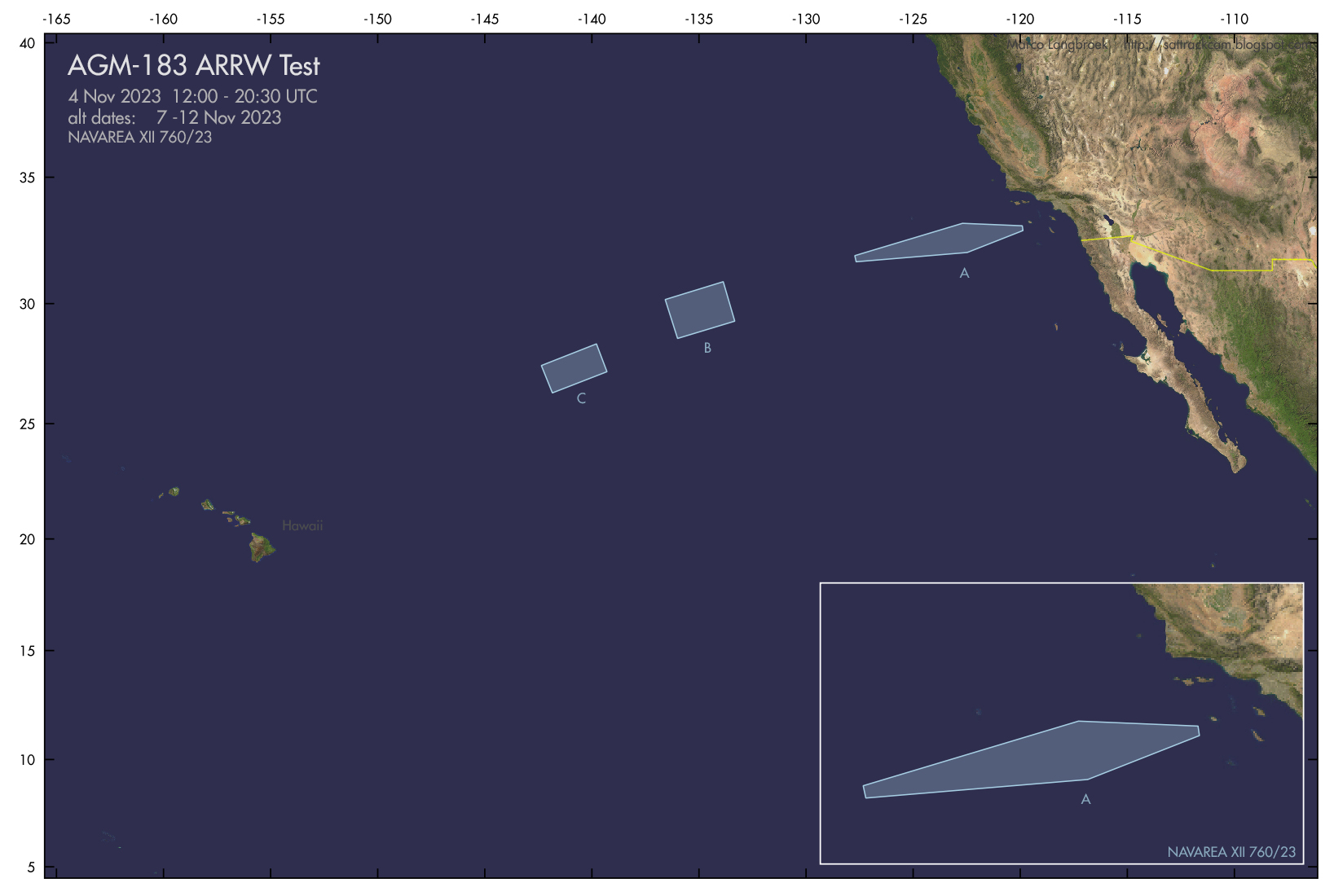
click map to enlarge

 The areas are similar to earlier known or suspected ARRW tests:

click map to enlarge

This missile must be one of the last of the (scrapped) AGM-183 program left.


Failed Minuteman-III ICBM test

Meanwhile, November 1 saw what should have been a rather routine Minuteman-III ICBM test from Vandenberg to Illegini Island, Kwajalein, going awry.

According to the Air Force Global Strike Command, an anomaly occurred and the missile was terminated in flight. A nice photograph of the launch is here.

Below is the map with the trajectory the missile should have flown, and the relevant Navigational Warnings:

click map to enlarge

260936Z OCT 23
NAVAREA XII 749/23(18,19,81).
EASTERN NORTH PACIFIC.
CALIFORNIA.
1. HAZARDOUS OPERATIONS 01 AND 02 NOV:
   A. 0631Z TO 1335Z IN AREA BOUND BY
      34-40.00N 121-25.00W, 34-40.00N 120-54.00W,
      34-46.00N 120-37.00W, 34-57.00N 120-37.00W,
      34-58.00N 120-58.00W, 34-58.00N 121-24.00W.
   B. 0631Z TO 1340Z IN AREA BOUND BY
      34-19.00N 124-36.00W, 34-40.00N 124-39.00W,
      34-56.00N 121-59.00W, 34-36.00N 121-56.00W.
   C. 0631Z TO 1347Z IN AREA BOUND BY
      32-30.00N 137-13.00W, 32-48.00N 137-18.00W,
      33-04.00N 136-01.00W, 32-45.00N 135-56.00W.
   D. 0631Z TO 1431Z IN AREA BOUND BY
      14-36.00N 175-34.00E, 14-54.00N 175-13.00E,
      14-35.00N 174-55.00E, 14-23.00N 174-49.00E,
      14-17.00N 174-54.00E, 14-17.00N 175-15.00E.
2. CANCEL THIS MSG 021531Z NOV 23.//


270329Z OCT 23
HYDROPAC 3397/23(81).
NORTH PACIFIC.
MARSHALL ISLANDS.
DNC 12.
1. HAZARDOUS OPERATIONS 010700Z TO 011411Z NOV,
   ALTERNATE 020700Z TO 021411Z NOV
   IN AREAS BOUND BY
   A. 09-53.00N 168-50.00E, 09-55.00N 168-47.00E,
      09-32.00N 168-09.00E, 09-24.00N 167-35.00E,
      09-09.00N 167-08.00E, 08-45.00N 167-23.00E,
      09-01.00N 167-49.00E, 08-51.00N 168-22.00E,
      08-54.00N 168-32.00E, 09-18.00N 169-10.00E,
      09-20.00N 169-11.00E.
   B. 11-08.00N 172-02.00E, 12-18.00N 171-37.00E
      13-20.00N 170-42.00E, 13-28.00N 170-33.00E
      13-20.00N 170-07.00E, 13-14.00N 170-00.00E,
      13-07.00N 169-54.00E, 12-01.00N 170-24.00E,
      11-54.00N 170-31.00E, 10-59.00N 171-14.00E,
      10-52.00N 171-22.00E, 10-57.00N 171-47.00E,
      10-59.00N 171-54.00E.
2. CANCEL THIS MSG 021511Z NOV 23.//

Wednesday, 25 October 2023

A Goodbye to Delfi-C3

Delfi-C3 tracklet on a stack of 16 video frames, 24 Oct 2023

 (note: new reentry forecasts are now published in a separate dedicated blogpost)

Earlier this year, my TU Delft colleague Stefano Speretta asked me if I could try to I imaged a pass of the TU Delft-built 3U cubesat Delfi-C3 (2008-021G). 

It next took a long time due to initially unfavourable observing geometries and - when the observing geometries got better - the Dutch weather, but I finally managed to successfuly image it in late evening twilight of 24 October 2023. 

Above is a stack of 16 video frames showing the tracklet created by the cubesat; below is the actual video footage, shot with a WATEC 902H2 Supreme camera and Samyang 2.0/135 mm lens at 25 fps (the object is very faint in the footage, due to it being very small in size):


Delfi-C3 (2008-021G) is a 3U cubesat and was the first cubesat built in the Netherlands. It was launched on 28 April 2008 from Satish Dawan in India on a PSLV rocket, as part of a rideshare mission.

It was built by students of Delft Technical University (my current employer) as the first in what was to become a line of Dutch-designed-and-built cube- and pocketsats. It carried at that time experimental technology (autonomous star sensors and thin-film solar panels) and an amateur radio responder. More information on the cubesat, its mission and the technology onboard can be found at the TU Delft website.

Although no longer operational, there is occasionally still radio telemetry received from the cubesat by our TU Delft Rooftab Radio lab.


Delfi-C3 in stowed condition (image: TU Delft)


Delfi-C3in deployed condition (image: TU Delft)

Fifteen years after launch, it is time to say Goodbye this very successful cubesat. It has less than half a month to live.


[post NO LONGER UPDATED below. Instead refer to this new dedicated post here for new reentry forecast updates]


Initially launched into a 615 x 635 km, 98.0 inclined orbit, the orbit has now decayed to 321 x 324 km (status as of 3 Nov 2023), and the cubesat is coming down increasingly fast, as can be seen in the diagrams below (currently, the orbit is dropping by 4 km/day (status 3 Nov 2023)):


click diagrams to enlarge

click diagram to enlarge


Delfi-C3 will probably reenter into the atmosphere and burn up somewhere mid-November 2023 (depending on how solar activity develops over November).

Here is the evolution of my GMAT reentry forecast so far (ignore the error bars and quoted  reentry date uncertainty for now, as this far before reentry they still have little meaning, due to the uncertainty in future solar activity):

click diagram to enlarge

The initial shift of the forecast over time towards a progressively later date is slowing down. My best guess at this moment (3 Nov2023) is reentry mid-November, around 12-14 November 2023, plus-minus a few days.

I will update this figure over the coming days and weeks, as the reentry forecast develops

New reentry forecasts are now published in a separate dedicated blogpost.

I do not expect a TIP to be issued for this object. Recent experience shows that TLE updates will probably cease some 2-3 days before the actual reentry, after which CSpOC issues an 'administrative decay'.

Delfi-C3 is very small and the reentry will be completely harmless, with the cubesat burning up completely.


Sunday, 22 October 2023

[UPDATED] A possible Missile Defense Test from Hawaii on October 25-29 (FTM-32?) and another LRHW test from Cape Canaveral


click map to enlarge

 [this post was updated 25 Oct 2023 to include an upcoming LRHW test from Cape Canaveral]


A Navigational Warning (NAVAREA XII 735/23) has appeared  that suggests a Missile Defense test will take place north of Hawaii with a target launched from the Pacific Missile Range Facility at Kauai, Hawaii, in the last week of October. The window runs from October 25 to 29.

200855Z OCT 23
NAVAREA XII 735/23(19).
NORTH PACIFIC.
HAWAII.
1. HAZARDOUS OPERATIONS 251930Z TO 260100Z OCT,
   ALTERNATE 261930Z TO 270100Z,
   271930Z TO 280100Z, 281930Z TO 290100Z OCT
   IN AREA BOUND BY
   22-02.00N 159-47.00W, 22-04.00N 159-52.00W,
   23-52.00N 161-49.00W, 22-37.00N 163-18.00W,
   23-00.00N 164-29.00W, 24-54.00N 164-53.00W,
   27-30.00N 167-44.00W, 29-23.00N 167-44.00W,
   35-17.00N 161-05.00W, 35-46.00N 156-36.00W,
   30-43.00N 152-22.00W, 28-18.00N 152-15.00W,
   27-35.00N 152-48.00W, 26-04.00N 155-40.00W,
   24-19.00N 160-57.00W, 22-09.00N 159-45.00W,
   22-03.00N 159-46.00W.
2. CANCEL THIS MSG 290200Z OCT 23.//

In the map above I have plotted the hazard area from the Navigational Warning. The target launch track from PMRF on Kauai can be seen, as well as a large intercept area.

Although not the same, it is riminiscent for that of test FTM-31 E1a of 30 March this year (see a March blogpost) which was a salvo firing of two SM-6 missiles from the US Navy ship USS Daniel Inouyeto that intercepted a MRBM target fired from PMRF Kauai.

The upcoming test might be FTM-32  (see page 5 of this Congressional document) which reportedly also will be a salvo firing of two SM-6 missiles against an MRBM target [edit: it was actually FTM-48]. The missiles will be fired from a US Navy Guided Missile Cruiser positioned north of Kauai, perhaps USS Carl M. Levin or USS Kidd, who both were seen sailing out of Pearl Harbor recently.

UPDATE 26 Oct 2023:

The test happened on 25 October and involved the interception of multiple targets. The interception was done by the USS Carl M. Levine (DDG120). Two HALO observing aircraft (HALO2 and HALO51) where in the air during the test, along with a US Navy P3, a USAF aircraft and fifth small aircraft. MDA news item on it here and a Naval News story here. It was test FTM-48 codenamed Vigilant Wyvern. The targets consisted of two SRBM's and two cruise missiles, the first intercepted with two SM-3 missiles, the second with two SM-2 missiles.

The MDA released this image of the test, showing one of two SRBM targets being fired from the PMRF Kauai (and the smoke trail of another one):


image: Missile Defence Agency

 They also published this video:

 [end of update]


LRHW Test from Cape Canaveral

Meanwhile, another Navigational Warning, NAVAREA IV 1235/23, is pointing to yet another test of the Long Range Hypersonic Weapon (LRHW) from Cape Canaveral on October 26-28:


241619Z OCT 23
NAVAREA IV 1235/23(GEN).
NORTH ATLANTIC.
FLORIDA.
1. HAZARDOUS OPERATIONS 261500Z TO
   281840Z OCT.
   IN AREAS BOUND BY:
A. 28-32.93N 080-33.90W, 28-28.00N 080-02.00W,
   28-18.00N 080-02.00W, 28-23.00N 080-31.00W,
   28-25.64N 080-34.47W.
B. 28-02.00N 078-50.00W, 28-11.00N 078-47.00W,
   27-55.00N 077-24.00W, 27-40.00N 077-27.00W.
C. 28-27.00N 080-02.00W, 28-24.00N 079-09.00W,
   28-11.00N 078-47.00W, 28-02.00N 078-50.00W,
   28-00.00N 079-12.00W, 28-18.00N 080-02.00W.
D. 27-00.00N 063-00.00W, 28-00.00N 059-00.00W,
   27-00.00N 059-00.00W, 26-00.00N 063-00.00W.
E. 23-30.00N 063-00.00W, 21-30.00N 058-30.00W,
   20-30.00N 058-30.00W, 22-30.00N 063-00.00W.
F. 28-45.00N 049-00.00W, 30-45.00N 049-00.00W,
   32-00.00N 044-00.00W, 30-00.00N 044-00.00W.
G. 17-00.00N 048-45.00W, 13-30.00N 041-30.00W,
   11-30.00N 041-30.00W, 15-00.00N 048-45.00W.
2. CANCEL THIS MSG 281940Z OCT 23.

click map to enlarge

Two earlier LRHW test attempts, in March (see this blogpost) and in September (see this blogpost) were aborted. Maybe third time is a charm.

UPDATE: this LHRW test was scrubbed as well.

Friday, 13 October 2023

Did Russia position a geostationary satellite over Israel last month? No.

screenshot quote Budanov in interview with Ukranian Pravda
 

Based on this interview with Kyrylo Budanov, the Chief of the Intelligence Directorate of the Ukranian military, in the Ukranian Pravda newspaper, a story is going around claiming that Russia relocated a geostationary satellite over Israel in the last week of September, with the suggestion that this was part of an operation to help Iran and the terror organisation Hamas to commit the latter's atrocious assault on Israel.

I was asked by a journalist and a number of people on social media whether I had any evidence that could confirm Budanov's claim. 

In short: this claim cannot be substantiated and makes little sense.

The date mentioned (24 September) for the purported relocation implies that the satellite in question should be LUCH (OLYMP) 2 (2023-031A).  This is the second in the OLYMP-K series of SIGINT satellites operated by the Russian military, and was launched in March of this year.

Below is a plot of the longitudes of all operational Russian geostationary assets (civilian and military) in a wide swat of longitude spanning Africa to west Asia. Only LUCH (OLYMP) 2, indicated by the larger red dots, changes position starting near the mentioned date of September 25/26 (the relocation was completed by October 4), moving from 9.0 E to 3.2 E.

(the other satellite slowly drifting from 7 E to 15E, is the commercial satellite EXPRESS AM-33 which has been drifting for over a year, since august 2022).


click diagram to enlarge


Given the date quoted, Budanov's remarks clearly seem to indicate LUCH (OLYMP) 2 as the satellite in question. But it makes no sense, because:

(1) moving from longitude 9 E to 3.2 E, it is not located near Israel, the difference in longitude being almost 30 degrees;

(2) it is moving westwards, away rather than towards the longitude of Israel.

So Budanov's claim is quite a stretch (and I wonder if someone in his staff perhaps simply misinterpreted "3.2 E" as "32 E" and jumped the gun).

Moreover, the repositioning of the satellite has to be seen in the light that this is an OLYMP-K class satellite

These SIGINT satellites serve a similar role as the US satellite PAN (see my 2016 article in The Space Review for more on PAN): they rove from commercial telecom satellite to commercial telecom satellite, to eavesdrop on communications and map which sources are utilizing the satellite. Hence, their targets of interest are other satellites.

This behaviour can be well seen in this plot of longitude over time for LUCH (OLYMP) 2's predecessor, LUCH (OLYMP) 1  (2014-058A, aka 'OLYMP-K'). At least 24 relocations over the past 9 years can be seen (and each time, it was put next to another commercial telecom satellite:

LUCH (OLYMP) 1 behaviour. Click to enlarge


The newer sistership,  LUCH (OLYMP) 2 has only recently been launched, on 12 March 2023. In the 8 months since, it has been relocated 3 times (including the relocation now under discussion):

LUCH (OLYMP) 2 behaviour. Click image to enlarge


It is clearly following in the footsteps of its predecessor LUCH (OLYMP) 1, as it too is put close to commercial telecom satellites during these relocations

For example, here it is on September 20 (a few days before its last relocation) imaged by me from Leiden in the Netherlands. At that time the satellite was positioned very close to Eutelsat (KA Sat) 9A - the true distance between the two satellites was about 22 km at the moment of imaging:


click to enlarge


 And here it is on October 14, after relocation to 3.2 E, close to Eutelsat 3B:


click to enlarge

The targets of  LUCH/OLYMP satellites are other geostationary satellites, on which they eavesdrop. That they frequently relocate, is a normal, well-established pattern.

Combined with the fact that LUCH (OLYMP) 2 is actually not located over Israel at all but almost 30 degrees more West in longitude, there is no credible evidence that the late September relocation had anything to do with the events in Israel on October 7.

Thursday, 5 October 2023

Paper in Nature on the high optical Brightness of the BlueWalker 3 satellite


Last Monday 2 October 2023,  a consortium paper initiated by the IAU-CPS was published in the high-impact Journal Nature. It is titled "The high optical brightness of the BlueWalker 3 satellite", and I am one of the co-authors of this paper. An Open Acces version of the paper is here.

The BlueWalker 3 satellite (2022-111AL), launched in September 2022 into a 500 km altitude Low Earth Orbit, is a prototype satellite from AST Space Mobile. It is meant to demonstrate the feasibility of making direct contact with normal cell phones through a satellite

Eventually, AST Space Mobile wants to create a constellation with large numbers of these satellites (it filed with the FCC for 243 of such satellites, although lower operational numbers are also floating about on the internet. AST Space Mobile has said that they need at least 110 operational satellites to provide world coverage). Launch of operational versions might start in 2024.


 BlueWalker 3 filmed on 3 April 2023

The paper provides the results of our monitoring of the brightness of the satellite, before and after deployment of its large 64 m2 Phased Array antenna. We show that the satellite is very bright, brighter than satellites generally are, shining as bright as some of the brightest stars in the sky. It reaches magnitude +0.5 to zero on well illuminated passes. 

We discuss what this means for the outlook of the night sky, it's impact on Astronomy, and point to the mitigation efforts astronomical Observatories might need to take if large numbers of such satellites will be launched. At the end of the paper, we make a call that the impact of such satellite constellations should be made an explicit part of launch permit assessments.

While BlueWalker 3 and the proposed constellation of similar satellites are the inspiration for our paper, the implications stemming from our paper are explicitly relevant to a wider issue of the rise of large satellite constellations, and the impact these will have on the night sky and users of the night sky (which, by the way, are not just astronomers).

More backgrounds on the topic and my involvement with the study are provided in this interview with me on the website of Delft Technical University.

Saturday, 16 September 2023

PAN is on the move again

click image to enlarge


In a recent post I mentioned that I recovered the enigmatic SIGINT satellite PAN/NEMESIS-1 (2009-047A) - we had lost sight of it for about a year - and that it appeared to be stationkeeping at 39.9 E, not far from Express AM-7, when I recovered it mid-August.

It was definitely in a stable position near Express AM-7 in August: but my most recent observations show that PAN has started to drift again, westward. This drift probably was initiated somewhere between September 7 and September 10, 2023, with a drift rate of about 0.16 degrees/day.

Above are four images, from August 22, August 27, September 10 and September 15, 2023 (they are 10 second exposures made by me from Leiden, the Netherlands with a ZWO ASI 6200MM Pro and Samyang 1.2/85 mm lens). If you look at the position of PAN relative to the neighbouring satellites, it is clear that it was stationary between August 22 and August 27, but started to drift after that.

PAN/NEMESIS-1 is a SIGINT satellite with an unusual history of frequent moves in position, and each time it moved it was being positioned very close to a commercial telecommunication satellite

From it's launch in 2009 until mid 2013, it was repositioned each few months (see my 2016 article in The Space Review). 

After mid 2013 it stopped moving and was steady at 47.7 E for many years: untill it started to move again in early 2021. 

Our coverage of it has been a bit spotty since that time (with an almost a year long coverage gap between 20 October 2022 and 22 August 2023, when I recovered it again). below is an updated diagram of it's relocations since it's launch in 2009:


click diagram to enlarge


The frequent moves between 2009 and 2013 had to do with the unique role of PAN/NEMESIS-1 in the drone war at that time: see this in-depth 2016 article about satellites and the drone war in The Intercept, and my 2016 article in The Space Review for the details.


PAN launch patch (collection author)

Friday, 15 September 2023

The upcoming (?) reentry of Kwangmyŏngsŏng 3-2 (KMS 3-2), North Korea's last remaining satellite

KMS 3-2 (image: KCNA)


Somewhere this week, North Korea's last remaining - albeit probably not functional - satellite on orbit, Kwangmyŏngsŏng 3-2 (KMS 3-2, 2012-072A), will reenter (or has it already? See later...).

Kwangmyŏngsŏng 3-2 was launched on 12 December 2012 and was North Korea's first succesful satellite launch. Following in the footsteps of a later launch, KMS 4 from 2016 which reentered earlier this year on 30 June 2023, it is now set to have an uncontrolled reentry. 

With this, North Korea will lose the last satellite they have on orbit (the UNHA-3 upper stage of this launch is still on orbit).

It is not clear whether KMS 3-2, said to be a remote sensing satellite to monitor crops and weather, was ever functional. To my knowledge, no independent reception of signals from the payload has ever been reported.

Unfortunately, orbital updates for KMS 3-2 stopped to appear in the CSpOC catalogue after September 12. The last available orbit has epoch 12 Sept 2023 15:20:30 UTC. My reentry forecast based on that orbit was 16 Sept 2023 18:00 UTC ± 20 hrs.


click diagram to enlarge


A TIP was not issued (it wasn't for KMS-4 either at the time), but a reentry notice was suddenly added to the KMS 3-2 entry in the CSpOC SATCAT on Sept 15, stating 13 September 2023 as the reentry date.

I think that date is not correct, and merely an 'administrative decay'  - meaning they either don't really know, or are not willing to share, when it really reentered. 

The last known orbit from September 12 is a 226 x 235 km orbit and even using extremely high values for solar activity (higher than they in reality were) I can't get it to reenter earlier than Sept 15-16 in my GMAT model, nor in SatEvo. I simply don't see it coming down from that altitude within a day, unless something drastic happened (e.g. a structural disintegration of the satellite before the actual reentry). For reference, it took KMS 4 some four-and-a-half days to come down from that altitude and reenter in June.


click diagram to enlarge


So it looks like either CSpOC lost the object and doesn't really know, or they do not want to to share the last whereabouts of KMS 3-2 (e.g. from a notion that this would help the North Koreans in some way).

Meanwhile, after two failed launch attempts the past months using a new carrier rocket, North Korea said it will attempt to loft a new satellite into orbit in October.

I recently talked to the website North Korea News about the upcoming KMS 3-2 reentry, which you can read here.

Firefly Alpha 'Victus Nox' Rapid Response launch [UPDATED]


click to enlarge

On September 15 at 2:28 UTC, Firefly Aerospace succesfully launched a Firefly Alpha rocket from SLC-2 at Vandenberg Space Force Base in California. It carried 'Victus Nox', a small satellite, as a Rapid Response launch exercise. 

The latter is a program where a payload is launched with a very short notice (60 hours) during which the carrier rocket and payload have to be readied and launched.

Navigational Warnings for the launch appeared on September 14. They point to launch into a ~97.8 degree inclined Sun-synchronous orbit (see map above).

140310Z SEP 23
NAVAREA XII 631/23(17,18,19).
EASTERN NORTH PACIFIC.
1. HAZARDOUS OPERATIONS:
   A. 150157Z TO 150319Z SEP, ALTERNATE
      160157Z TO 160319Z SEP IN AREA BOUND BY
      25-50.00N 126-00.00W, 26-00.00N 126-35.00W,
      25-28.00N 126-51.00W, 24-59.00N 125-50.00W,
      25-31.00N 125-33.00W.
   B. 150406Z TO 150413Z SEP, ALTERNATE
      160406Z TO 160413Z SEP IN AREA BOUND BY
      46-21.00N 143-08.00W, 28-18.00N 147-24.00W,
      27-54.00N 146-22.00W, 46-06.00N 141-21.00W.
2. CANCEL THIS MSG 160513Z SEP 23.//

Firefly Aerospace announced on September 15 that the launch was successful. Some imagery of te launch is here.


UPDATE:

An object has now been catalogued by CSpOC as nr 57861 (2023-142A) in a 97.32 deg inclined, 476 x 531 km sun-synchronous orbit:


click image to enlarge

It has a slightly lower orbital altitude than I estimated and 0.5 degree lower orbital inclination:


click image to enlarge

Sunday, 10 September 2023

Recovering USA 310, PAN and Trumpet 2


click image to enlarge

Our coverage of classified objects in high altitude orbits has been waning over the past few years. In February, I made a first attempt to recover some. In the past two weeks, I again recovered a number of these objects, as a by product of testing a ZWO ASI6200MM camera (that ultimately is going to be installed on the roof of the Delft Technical University Aerospace faculty).

One of the objects I recovered, is a very unusual one: USA 310 (2020-083A). This object is in an odd 58.5 degree inclined, 11097 x 11074 km MEO orbit. It was launched on 13 November 2020 as NROL-101 (see this 2020 blogpost). We tracked it and it's Centaur upper stage for a couple of weeks, but lost it after February 2021. In other words: it had not been seen for the last 2.5 years!

That is, untill I serendipitously picked it up last August 22, while imaging geostationary satellites. In the imagery, a streak was encountered (see image above). It is a fit with USA 310. I managed to track it again during several nights the past two weeks. Frankly, I am not 100% sure whether it is USA 310 or the Centaur upper stage from that launch, but it does not seem to have the periodic brightness variation the Centaur upper stage showed in 2020/2021. And it is (relatively) bright only in the eastern part of the sky, just like USA 310 back in 2020/2021.

More objects were recovered. Several geosynchronous objects that hadn't been observed for a while, were imaged. One of them, the enigmatic PAN (2009-047A), had moved (just as it used to frequently do in the past, see my in-depth article on PAN in The Space Review from October 2016). I recovered it at longitude 39.7 degrees East, in the vicinity of Express AM-7. Observations over the past two week show it is stationkeeping, so it appears to be still operational (see also this post from 2021, when after several years of being stable at 47.7 E, it started to drift). Below is the recovery image:


click image to enlarge


Coverage of high altitude objects in HEO has likewise become spotty. I observed a number of them late February (see this blogpost), and again did so the past two weeks (a.o. TRUMPET 1 and USA 278). I recovered the SIGINT satellite TRUMPET-2 (1995-034A) on September 5, which had not been seen for almost 2 years:


One reason why I only sporadically track objects in GEO and HEO is that identifying and measuring them is much more labour-intensive than video-tracking objects in Low Earth Orbit, as identifying and measuring is still done manually for these objects by me. One day, I should get myself some software to make this a more easy task...

Wednesday, 6 September 2023

A new test attempt of the LRHW hypersonic missile from Cape Canaveral

click map to enlarge


A few days ago, Navigational Warnings (NAVAREA IV 1030/23) were published that point to a new test launch attempt of the Long Range Hypersonic Weapon (LRHW) from Cape Canaveral in the period 6 - 8 September 2023.

The Navigational Warning delineates seven hazard zones which, just like for the scrubbed test in March, delineate a signature "forked" trajectory (see map above):

041402Z SEP 23
NAVAREA IV 1030/23(GEN).
NORTH ATLANTIC.
FLORIDA.
1. HAZARDOUS OPERATIONS 061400Z TO 081841Z SEP
   IN AREAS BOUND BY:
   A. 28-30.57N 080-33.08W, 28-30.00N 080-27.00W,
      28-27.00N 080-02.00W, 28-20.00N 080-02.00W,
      28-22.00N 080-21.00W, 28-25.18N 080-34.79W.
   B. 28-04.00N 078-49.00W, 28-11.00N 078-47.00W,
      27-43.00N 076-32.00W, 27-31.00N 076-31.00W.
   C. 28-27.00N 080-02.00W, 28-22.00N 079-09.00W,
      28-11.00N 078-47.00W, 28-04.00N 078-49.00W,
      28-03.00N 079-12.00W, 28-20.00N 080-02.00W.
   D. 23-00.00N 060-00.00W, 20-30.00N 060-00.00W,
      22-00.00N 063-00.00W, 24-00.00N 063-00.00W.
   E. 28-30.00N 060-00.00W, 26-00.00N 060-00.00W,
      25-00.00N 063-00.00W, 27-00.00N 063-00.00W.
   F. 28-00.00N 056-00.00W, 30-00.00N 042-30.00W,
      32-00.00N 042-30.00W, 30-00.00N 056-00.00W.
   G. 19-00.00N 057-00.00W, 11-30.00N 041-00.00W,
      13-30.00N 041-00.00W, 21-00.00N 057-00.00W.
2. CANCEL THIS MSG 081941Z SEP 23.

Launch is likely from a TEL on Cape Canaveral pad 46.

The hazard areas are very similar to, but not exactly the same  as, those for the scrubbed March test (areas fro that scrubbed test marked in red in the comparison map below):


click map to enlarge

Meanwhile, at the other side of the United States, a routine test launch of an unarmed  Minuteman-III ICBM from Vandenberg in California to the Reagan Test Range on Kwajalein in the Marshall Islands is also planned for 6-7 September 2023 UTC, according to both a Vandenberg Space Force Base news bulletin and Navigational Warnings published:

click image to enlarge


The hazard zones in the map above come from these two Navigational Warnings:

292100Z AUG 23
NAVAREA XII 597/23.
1. HAZARDOUS OPERATIONS 06 THRU 07 SEP DAILY:    
   A. 0631Z TO 1337Z IN AREA BOUND BY
      34-38.00 N 121-23.00 W, 34-38.00 N 120-52.00 W,
      34-44.00 N 120-35.00 W, 34-55.00 N 120-35.00 W,
      34-56.00 N 120-57.00 W, 34-56.00 N 121-22.00 W.
   B. 0631Z TO 1326Z IN AREA BOUND BY
      34-20.00 N 124-33.00 W, 34-35.00 N 124-35.00 W,
      34-52.00 N 122-01.00 W, 34-37.00 N 121-59.00 W.
   C. 0631Z TO 1326Z IN AREA BOUND BY
      32-36.00 N 136-04.00 W, 32-49.00 N 136-08.00 W,
      33-01.00 N 135-05.00 W, 32-48.00 N 135-02.00 W.
   D. 0631Z TO 1431Z IN AREA BOUND BY
      13-17.00 N 173-49.00 E, 13-36.00 N 174-20.00 E,
      13-16.00 N 174-33.00 E, 12-57.00 N 174-01.00 E.
2. CANCEL THIS MSG 081531Z SEP 23.


282325Z AUG 23
HYDROPAC 2811/23(81).
NORTH PACIFIC.
MARSHALL ISLANDS.
DNC 12.
1. HAZARDOUS OPERATIONS 060700Z TO 061411Z SEP,
    ALTERNATE 070700Z TO 071411Z SEP
    IN AREAS:
   A. 09-16.00N 167-22.00E, 09-23.00N 167-33.00E,
      09-34.00N 167-26.00E, 09-43.00N 167-33.00E,
      10-09.00N 168-13.00E, 09-31.00N 168-38.00E,
      09-05.00N 167-58.00E, 09-02.00N 167-47.00E,
      08-58.00N 167-33.00E.
   B. 11-51.00N 171-59.00E, 12-37.00N 171-21.00E,
      12-24.00N 170-59.00E, 11-39.00N 171-22.00E,
      10-53.00N 171-58.00E, 11-05.00N 172-20.00E.
2. CANCEL THIS MSG 071511Z SEP 23.


UPDATE: 

The Minuteman-III test from Vandenberg to Kwajalein has happened, at 6 sept 2023 8:26 UTC, per a Vandenberg SFB news bulletin. According to the Air Force Global Strike Command, the test involved three reentry vehicles.

UPDATE II:

The test of the LRHW out of Cape Canaveral was aborted, just like earlier in March

Tuesday, 22 August 2023

A new North Korean satellite launch attempt upcoming [UPDATED]

Click map to enlarge

UPDATE (24 Aug 2023)

The launch took place around 18:50 UTC (so at nighttime this time) on August 23. The payload failed to reach orbit.

According to the North Korean State News Agency KCNA, the first and second stages worked nominally (the second stage failed during the May launch), but there was an "error in the emergency blasting system during the third-stage flight".

This sounds like the self-destruct mechanism was triggered by mistake.

KCNA reports that a third launch attempt will be conducted in October. Apparently, they have a lot of spare satellites and rockets in store...

[end of update]


North Korea has issued a Navigational Warning for a new satellite launch attempt from Sohae. The launch window runs from 23 August 15:00 UTC to 30 August 15:00 UTC.

The three hazard areas from HYDROPAC 2699/23 (blue in the map above)  are similar to those for the failed June launch attempt. They are different from the 2016 KMS-4 launch (shown in red in the map above, for comparison)

(more on the failed June attempt in a previous post here, which also discusses the two possible launch trajectories I have depicted in the map).

The text of Navigational Warning HYDROPAC 2699/23:

211953Z AUG 23
HYDROPAC 2699/23(91,92,94).
PHILIPPINE SEA.
YELLOW SEA.
CHINA.
DNC 11, DNC 23.
1. HAZARDOUS OPERATIONS, ROCKET LAUNCHING
   231500Z TO 301500Z AUG IN AREAS BOUND BY:
   A. 36-06.94N 123-33.11E, 35-24.52N 123-22.78E,
      35-20.02N 123-48.62E, 36-02.44N 123-59.18E.
   B. 34-05.90N 123-01.99E, 33-23.47N 122-51.88E,
      33-16.54N 123-29.66E, 33-58.97N 123-40.07E.
   C. 14-54.17N 128-40.10E, 11-19.30N 129-10.84E,
      11-26.81N 129-54.13E, 15-01.70N 129-24.05E.
2. CANCEL THIS MSG 301600Z AUG 23.

Tuesday, 8 August 2023

The reentry of a Soyuz rocket stage over southern Australia on August 7

click map to enlarge


On 7 August 2023 at 13:20 UTC, Russia launched the first of it's improved GLONASS-K2 navigation satellites from Plesetsk Cosmodrome. The launch employed a Soyuz 2.1b rocket with a Fregat upper stage. The payload and the Fregat upper stage were subsequently catalogued in 19156 x 19135 km resp 19182 x 19005 km, 64.8 degree inclined Medium Earth Orbits (MEO), as catalogue numbers 57517 and 57518.

Some 40 minutes after the launch, people from southern Australia and Tasmania were treated to a spectacular sight of a bright slow-moving, fragmenting fireball that crossed the sky. Many eyewitness video's were posted on social media and poicked up by the News media: for a few fine examples see here, here, here and  here. Immediate suspicions were raised that this was space debris.

Indeed, the fireball was the Soyuz 3rd stage reentering the atmosphere. A Navigational Warning for space debris connected to this launch had been published earlier (HYDROPAC 2502/23), for an area south of Australia and Tasmania:

021113Z AUG 23
HYDROPAC 2502/23(75,76).
TASMAN SEA.
WESTERN SOUTH PACIFIC.
TASMANIA.
DNC 05, DNC 06.
1. HAZARDOUS OPERATIONS, SPACE DEBRIS
   071300Z TO 071600Z AUG, ALTERNATE
   1300Z TO 1600Z DAILY 08 AND 09 AUG
   IN AREA WITHIN 35 MILES OF TRACKLINE JOINING
   43-10.00S 148-55.00E, 53-30.00S 163-20.00E.
2. CANCEL THIS MSG 091700Z AUG 23.


The time window matches well with the Australian reentry sighting. The area defined by the Navigational Warning matches a launch into a ~63 degree inclined parking orbit from Plesetsk:

click map to enlarge


The Soyuz 2.1b rocket consists of four side boosters ('stage 1'), a core stage ('stage 2') and a third stage. On top of that is (for this launch) the Fregat upper stage. The Soyuz rocket brings the Fregat upper stage and GLONASS payload in a low parking orbit. From there, a series of firings of the Fregat stage bring the payload to 19150 km Medium Earth Orbit (MEO). The Fregat upper stage is left on orbit, but the Soyuz stages deorbit downrange from the launch site: the last of these stages, is the stage that reentered over southern Australia about half a revolution after the launch.

GLONASS is the Russian equivalent of GPS.


Monday, 26 June 2023

[UPDATED] North Korea's KMS 4 has only a few days left on orbit


[post update nr 8, 4 July 2023  09:40 UTC]

Recently, on May 30, North Korea tried to launch a new satellite. The satellite however did not reach orbit, because the second stage of the launch vehicle failed (see my earlier post here).

There are currently two older North Korean satellites on orbit: KMS 3-2 (launched on 12 December 2012) and KMS 4 (launched on 7 February 2016). One of these, KMS 4, is now very close to reentry.

Kwangmyŏngsŏng 4 (KMS 4, 2016-009A) was launched on 7 February 2016, into a 501 x 465 km, 97.5 degree inclined sun-synchronous orbit. It is said to be an optical reconnaissance satellite, as also implied by its sun-synchronous orbit: but it was never clear whether it ever actually functioned after launch. 

A lot of noise was made in some parts of the US Media back in 2016 about it "tumbling out of control" through space, but optical observations did and do not show clear signs of tumbling.

Over the past 8.5 years, natural orbital decay has lowered the orbit of the satellite, to the point where it at the last available orbit  (orbit epoch 29 June 2023, 21:14 UTC) was down to a 149 x 168 km orbit. The video above was filmed by me on June 14, 2023, and shows the current fast angular movement due to the low orbital altitude.

The diagram below shows the orbital evolution since 1 January this year: it is was coming down fast. At the moment you are reading this, it likely only has a few hours on orbit left it has reentered already.


click diagram to enlarge


[Updated and editted 3 July 2023] My current "aftercast", based on a late published orbit with epoch 29 June 21:14 UTC, is reentry in the early hours of June 30, 2023. The nominal modelled reentry time is 30 June, 03:54 UTC ± 1.4 hr (note the large uncertainty interval, about one full orbit!).

The diagram below shows how the reentry forecasts for KMS 4 were developing with each orbit update.

click diagram to enlarge


With the current still widely uncertain "aftercast", with an uncertrainty of one full orbital revolution, the blue line on the map below is where it could have come down: 


click map to enlarge

Note that this reentry is NOT something to worry about. The reentry will have been harmless: KMS 4 is small, it is a box of about 1 x 0.65 meter with solar panels, weighing maybe 200 kg. It will likely have burned up completely upon atmospheric reentry. Yet because it is a North Korean satellite, the reentry might garner some interest.

[UPDATED] Curiously, CSpOC (18th SPSS) never published a TIP for KMS 4. Early on July 3, 2023, the catalogue listed it as if still on orbit, albeit with days old elements. Late on July 3, a reentry date (but no reentry time) of 30 June 2023 was entered into the catalogue.

Apparently 18 SPSS told Jonathan McDowell (see this tweet) that no TIP was issued because the satellite was "too small" to warrant one. Which is not very believable, as the same week they did issue a TIP for Skysat C18 (2020-057BR), which is of similar size as KMS 4, and TIP's have been issued for even smaller objects in the past....

We are not talking about a cubesat here, KMS 4 was about one meter in size, not counting deployed solar panels.

Perhaps - but this is my speculation only- they wanted to keep the reentry quiet because anything North Korean is accompanied by unbridled panic and paranoia around 'nefarious intentions' in the US. Some US media pundits, fueled in this idea by a US Government Task Force and a Congressional Hearing, have tried to push the narrative that the KMS satellites are EMP devices. Something which others have characterized as "grossly overstated" (see this debunk on 38North and further comments by others here in this Newsweek article) as North Korea does not seem to have nuclear weapons that are powerfull enough to cause serious EMP effects.

It will be interesting to see whether TIP's will appear for the other North Korean satellite, KMS 3-2, which I currently forecast to reenter somewhere in September-October 2023.

[The text of this post has been repeatedly updated. Post last updated: 4 July 2023, 09:40 UTC]